



Content Curator
Magnetic effects of electric current is observed when an electric current flows through a wire and produces a magnetic field around it. It is also known as the name of Electromagnetic effects. When a compass is brought near a conductor carrying current, the needle of the compass will get deflected due to the flow of electricity. This is a classic example to understand the property of electricity having a magnetic effect.
The basic principle behind this is that the wire acts like a magnet and interacts with the permanent magnet placed next to it. This effect is reversible if the direction of flow of electric current is altered. Thus the direction of the magnetic field is dependent on the direction in which the current is flowing. This direction of the magnetic field can be obtained by following the Right-Hand Thumb Rule.
Read More: Magnetic Effects of Electric Current
| Table of Contents |
Key Terms: Magnetic Effects, Electric Current, Magnetic Field, Biot-Savart law, Ampere’s law, Electricity, Circular Loop, Electric Charge, Solenoid, Magnet
Magnetic Effects of Electric Current Formula
[Click Here for Sample Questions]
The magnetic effects of electric current are dependent on the following factors:
- Magnetic Field Lines
- Direction of Magnetic Field Lines
- Strength of Magnetic Field Lines
This can be easily understood from the following illustration which depicts the Right-Hand Thumb rule to determine the direction of magnetic field when an electric current flows through a conductor.
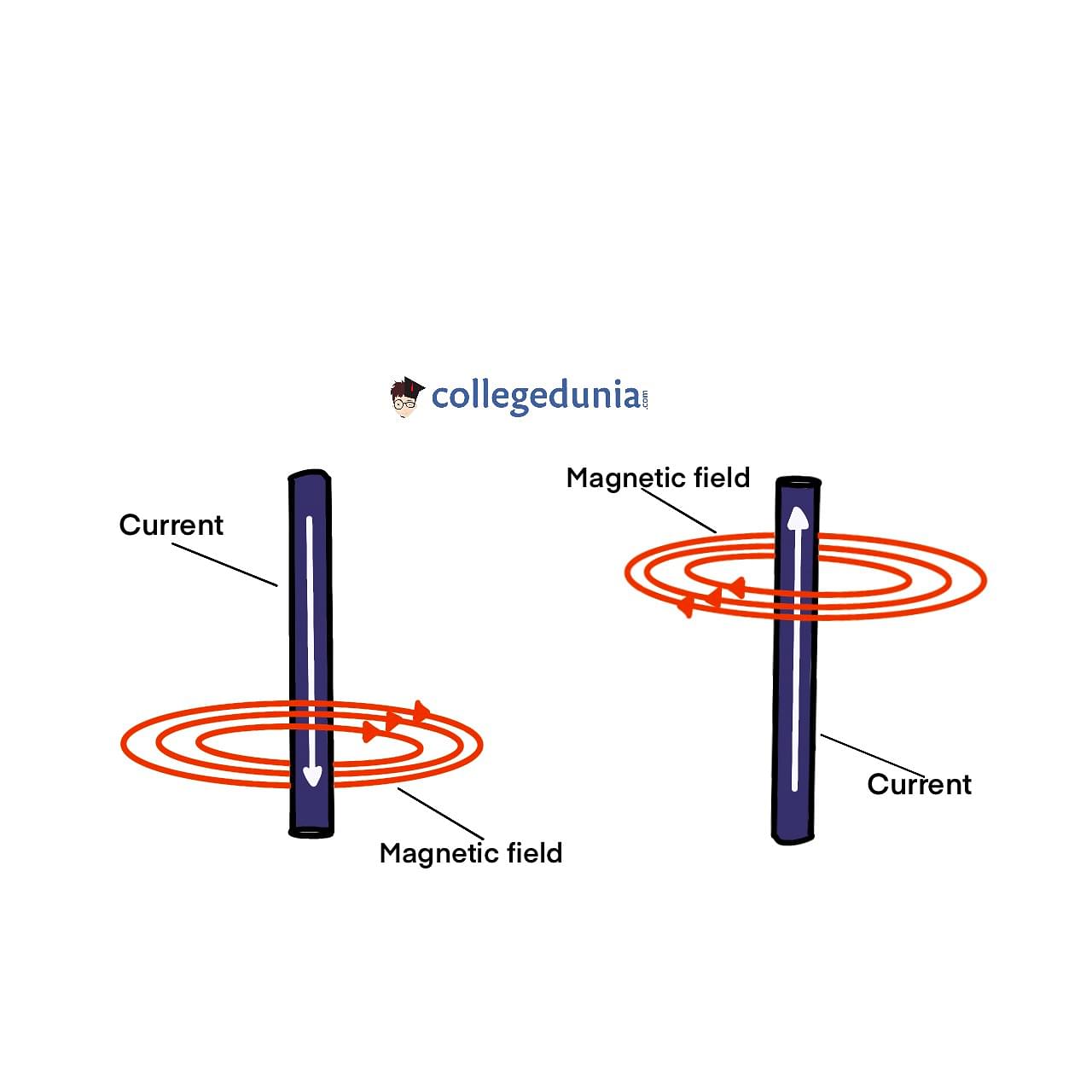
Right-Hand Thumb Rule
Some of the important Formulae for calculating the magnetic effect of electric current are summarised below:
Magnetic field due to a moving point charge
The permeability of the free space is: μ₀ = 4Π * 10 N-7.s2/C2
Biot - Savart Law
Biot-Savart law is an equation which states the relation between the magnetic field and the electric current. A constant electric current helps in the generation of the magnetic field.
Biot - Savart Law Formula: dB ∝ (I . dl . sinθ)/r

Bio-Savart Law Illustration
Magnetic Field due to a Straight Line
B = (μ₀/4Π).(I/r).(sinθ₁ + sinθ₂)

Magnetic Field due to Straight Line
Magnetic Field due to an Infinite Straight Line
B = (μ₀/2Π).(I/r)

Magnetic Field due to Infinite Straight Line
Magnetic Field due to a Circular Loop
- At the center: B = μ₀NI/2Π
- At the axis: B = (μ₀/2)[NIR2/(R2 + x2)3/2]

Magnetic Field due to a Circular Loop
Magnetic Field on the Axis of a Solenoid
B = (μ₀NI/2)(cosθ₁ - cosθ₂)
Ampere’s Law: ∮B.dl = μ₀I

Magnetic Field on Axis of Solenoid
Read More: Solenoid
Magnetic Field due to a Long Cylinder
- B = 0, r < R
- B = μ₀I/2Πr, r ≥ R

Magnetic Field due to Long Cylinder
Magnetic Force working on a Moving Point Charge
F = q(v*B)

Magnetic Force on a Moving Charge
Some other important formulae for the magnetic effects of electric current are:
- Magnetic Force working on a Current Carrying Wire- F = l(l*B)
- Magnetic Moment of a Current Carrying Loop- M = NIA
- Working of a Torque on a Loop - Torque = M*B
- Magnetic Field due to a Single pole- (μ₀/2Π)m/r²
- Magnetic Field on the Axis of the Magnets- (μ₀/4Π)2M/r³
- Magnetic Field on the Equitorial Axis of the Magent -(μ₀/4Π)M/r³
- Magnetic Field at the Point charge P of a Magnet- B = μ₀/4Π M/r³ √(1 + 3cos²θ)
Do Check Out:
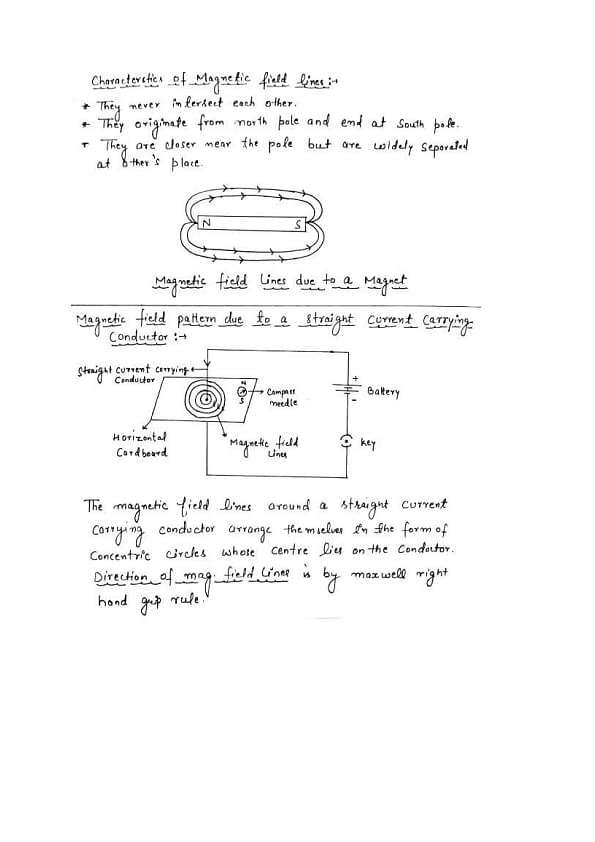
Handwritten Notes on Magnetic Effects of Electric Current
Provided below are handwritten notes on some of the important concepts and formulae from magnetic effects of electric current for quick reference.




Read More:
Things to Remember
[Click Here for Sample Questions]
- Magnetic field lines represent the force of a magnet and the direction of the force.
- On the outside, the magnetic lines of force are directed from the north to south pole but on the inside, it is from the south to north pole.
- The magnetic field of a straight current-carrying conductor is in the shape of a concentric circle.
- The direction of the flow of the magnetic field in a current-carrying conductor is the same as that of the direction of the flow of the current.
- Right-hand thumb rule helps in explaining the magnetic effect of electric current through a straight conductor.
Also Read:
Sample Questions
Ques. Describe Solenoid. How does current behave in a solenoid? (3 marks)
Ans. The solenoid is defined as a coil having circular turns of insulated copper wire bound on any cylindrical body. It is bound in such a way that its length is generally greater than its diameter.
The pattern of the magnetic lines resembles those of a bar magnet which highlights fixed polarity, i.e. The North and South poles are situated at its end. Also, the direction of the electric current and attractive properties of the solenoid is similar to a bar magnet. The magnitude of the magnetic field stands directly proportional to the electric current and the number of turns present in a solenoid.
Ques. How are the magnetic field lines produced when current is passed through a circular coil? (2 marks)
Ans. The concentric circles which are present at every point of the circular loop represent its magnetic field. The magnetic field lines are generally close to the axis of the loop and are straight. They stand perpendicular to the plane of the coil. Magnetic field lines keep on diverging in different directions when moved away from the center of the loop.
Ques. What are Magnetic Field Lines and why do they form closed curves? (2 marks)
Ans. Magnetic field lines are the imaginary lines or path along which the North Pole moves in a magnetic field. Magnetic field lines generally form closed continuous curves. It is because they diverge from the north pole of a bar magnet and converge into the south pole.
Ques. How does the strength of the magnetic field in a straight conductor varies with the strength of the electric current flowing in the conductor? (2 marks)
Ans. The strength of the magnetic field varies directly in a current-carrying a straight conductor. As the flow of electric current is increased, similarly, the strength of the magnetic field is also increased and vice versa.
Ques. A current of 30 A is flowing in a straight wire. If the horizontal component of the earth’s magnetic field is 2×10⁻⁵Tesla, then what will be the position of the null point? (2 marks)
Ans. We know that,
B= µ0 I2πr
At, null point the value of the magnetic field must be equal to the horizontal component of the earth’s magnetic field but its direction is opposite.
Therefore, 2×10-5= 4π×10-7×302×π×r
r = 0.3 m
Ques. A length L of wire which is carrying current I is bent into a circle having one turn. The field at the centre of the coil is found to be B1. A similar wire of the same length and carrying the same current is bent into a square of one turn at the centre B2. Then, the magnetic field of which is stronger, B1 or B2? (2 marks)
Ans. For the circular coil, the magnetic field will be, B1= µ0 I2πr
Circumference of the coil= 2πr= L.
Thus, B1= 3.14 µ0 I/L
For square loop, B2 = 22µ0 I/L = 3.60µ0 I/L
Thus, the magnitude of the magnetic field of B2 will be greater than B1.
Ques. How is the strength of the magnetic field near a straight current-conductor? (3 marks)
(i) related to the strength of the current in the conductor?
(ii) is it affected when the direction of current flow in the conductor is changed?
Ans. i)The strength of the magnetic field around a straight current conductor increase with the increase in the current strength of the conductor and vice versa.
(ii)If the direction of current through a straight current-carrying conductor is reversed, the magnetic field direction around that conductor is reversed.
Do Check Out:



Comments