



Education Journalist | Study Abroad Lead
Dihybrid cross describes a mating experiment between two organisms that are identically hybrid for two traits. A heterozygous organism possesses two distinct alleles at a certain genetic location or locus, resulting in a hybrid organism. In 1865, Gregor Mendel performed dihybrid crosses on pea plants and found the Property of Independent Assortment, a key law of genetics.
Read Also: Difference Between Monohybrid and Dihybrid
| Table of Content |
Key Takeaways: Dihybrid Cross, Mendel’s Experiment, Mendel’s law, Independent Assortment, Hybridization, Heterozygous genotypes, Homozygous genotypes, Locus, Genotypes, Genes
What is Dihybrid Cross?
[Click Here for Sample Questions]
Dihybrid cross is a genetic cross between two individuals who have homozygous or heterozygous genotypes for two features or traits. The traits of these individuals are identified by genes. The parents in a dihybrid cross experiment carry different alleles for each trait where one would be a homozygous dominant allele and the other would be a homozygous recessive allele.
Also Read:
| Related Articles | ||
|---|---|---|
| Pleiotropy | Genetic Disorders | Phenotype |
| What is Genetics? | Principles of Inheritance and Variation | Mendelian Inheritance |
Mendel’s Experiment
[Click Here for Sample Questions]
Mendel could only examine the inheritance of one gene in the plant using monohybrid crosses. He only looked at one character on pairs of pea plants with one contrasting attribute (plant height). Using the same dihybrid cross-approach, Mendel later investigated the inheritance of the two genes in plants.

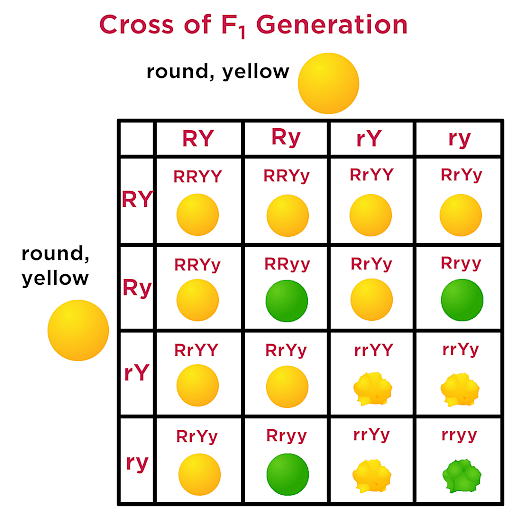
A dihybrid cross is a cross between a homozygous pea plant with round yellow seeds and wrinkled green seeds. RRYY alleles are found in round yellow seeds, while wrinkled green seeds have RRyy alleles. RY and ry are the gametes that result from these alleles. F1 hybrids containing the RrYy allele are created when the two parents are crossed. Round yellow seeds (RrYy) with the dominant R allele for roundness and the dominant Y allele for yellow color are found in hybrids.
The four alleles can be combined in four different ways: RY, Ry, rY, and ry. Four different types of gametes are created by mixing the four alleles at random. During fertilization, the gametes unite at random to produce sixteen different types of individuals in the F2 generation. The proportions of the hybrids are 9 round yellow, 3 round green, 3 wrinkled yellow, and 1 wrinkled green. Mendel obtained a 9:3:3:1 ratio.
Genotype ratio: 1:2:1:2:4:2:1:2:1
Phenotype ratio: 9:3:3:1
This irregularity in the ratio of F2 offspring was explained by Mendel stating that “when the parents differ from each other in two or more pairs of contrasting characters or factors then the inheritance of one pair of factors is independent to that of another pair of factors”. This is Mendel’s Law of Independent Assortment.
P1: YYRR (pure yellow-round) X yyrr (pure green wrinkled)
↓
F1: YyRr (hybrid yellow-round)
↓
F2:
| Gametes of F1 | YR | Yr | yR | yr |
|---|---|---|---|---|
| YR | YYRR (yellow round) | YYRr (yellow round) | YyRR (yellow round) | YyRr (yellow round) |
| Yr | YYRr (yellow round) | YYrr (yellow wrinkled) | YyRr (yellow round) | Yyrr (yellow wrinkled) |
| yR | YyRR (yellow round) | YyRr (yellow round) | yyRR (green round) | yyRr (green round) |
| yr | YyRr (yellow round) | Yyrr (yellow wrinkled) | yyRr (green round) | Yyrr (green wrinkled) |
- A monohybrid cross concentrates on a single feature, whereas a dihybrid cross focuses on distinctions in two attributes.
- The monohybrid cross is used to study the dominance of genes, while the dihybrid cross is used to study the offspring assortment.
Checkout Important Question on: Ratio of Dihybrid Cross
Things to Remember
- Crossing between genes that differ in two comparative properties is known as dihybrid crossing.
- Gregor Mendel is recognized as being the first to discover the basic principles of heredity. He became renowned as the "Father of Modern Genetics" after that.
- The phenotypic ratio of F2 offspring in the dihybrid cross is 9:3:3:1.
- The genotypic ratio F2 generation is 1:2:1:2:4:2:1:2:1.
- From the dihybrid cross, Mendel got the second law of genetics: Independent Assortment.
- The pea plant was chosen for the experiment by Mendel because it is self-pollinating and has physical traits that are easy to distinguish and study.
Also Read:
Sample Questions
Ques: What is a dihybrid cross? (2 marks)
Ans: A dihybrid cross is a cross in which two traits are taken into account during the testing process. A dihybrid cross is a cross between a yellow smooth seeded pea plant and a green wrinkled seeded pea plant.
The Law of Independent Assortment can be deduced from the dihybrid cross that each gene is assorted independently of the other throughout its passage from one generation to the next.
Ques: Mention the advantages of selecting a pea plant for the experiment by Mendel. (5 marks)
Ans: Advantages of selecting pea plant as experimental material: Mendel selected the pea plant (Pisum sativum) because:
- There were numerous varieties with observable alternate versions for a trait or characteristic.
- Peas self-pollinate because their corolla completely encloses the reproductive organs until pollination is complete.
- It was simple to obtain.
- It has pure lines for testing purposes, which means that they always breed true.
- It has contrasting personalities. Seed color, pod color, pod shape, flower shape, flower location, seed shape, and plant height were the traits studied.
- It had a brief life cycle and a big number of offspring.
- Except for pollination, the plant is simple to cultivate and requires no special attention.
Ques: Explain the law of independent assortment with a dihybrid cross. (CBSE 2013, 2014)(5 marks)
Ans: Law of independent assortment: The components of distinct pairs of opposing characters, according to this law, have no influence on one another. During gamete formation, they are independent of one another in their arrangement to form a new combination. Cross between two hybrids. A dihybrid cross is a cross in which two traits are taken into account during the testing process.
It's thought to be a cross between a yellow smooth pea plant and a green wrinkled pea plant.
Explanation: When a pea plant with yellow smooth seeds (YYSS) crosses with a pea plant with green wrinkled seeds, the result is a pea plant with green wrinkled seeds (yyss). Yellow smooth (YYSS) produces gametes with genes (YS) during cross-pollination, while green-wrinkled produces gametes with genes (YS) (ys). At random, gametes combine. Because yellow and smooth features predominate over green and wrinkled, the seeds collected will grow into plants and generate seeds that are yellow-smooth (YySs). Plants of the F1 When plants of the F1 generation are allowed to self-pollinate gametes formed YS, Ys, yS, and ys by meiosis, they unite at random forming seeds. The plants thus obtained are called F2 generation plants. They are yellow-smooth (YYSS, YySS, YySs, YYSs); yellow-wrinkled (YYss, Yyss), green smooth (yySS, yySs), and green-wrinkled (yyss) in the ratio of 9: 3: 3: 1. The result of a dihybrid cross can be shown in Fig. on the chequerboard.

It can be concluded from the preceding dihybrid cross that each gene is assorted separately of the others during its passage from generation to generation, or that the law of independent assortment is justified.
Ques: What is Test Cross? Give an example. (2 marks)
Ans: A test cross is a genetic cross between a homozygous recessive individual and a suspected heterozygote to determine the latter's genotype.
The origin experiment Mendel conducted himself to determine the genotype of a yellow pea is a classic example of the test cross. The alleles Y and y are utilized for the yellow and green variants of the allele, respectively, as shown in the image below. The Y allele, which is yellow, is dominant over the y allele. As a result, only the yellow allele is seen in the phenotypic of an organism with the genotype Yy. Mendel had a yellow pea and was trying to figure out if it was YY or Yy.

Ques: How to find the Genotype of a Dihybrid cross? (3 marks)
Ans:
- Establishing a parental cross would be the first step (P).
- Then, for the traits to be crossed, build a 4x4 (or 16 square) Punnett Square.
- Determine the genotypes of the parents and assign letters to the alleles, using lowercase letters for recessive traits and uppercase letters for dominant traits.
- Arrange the qualities on the square — recessive traits only occur if both parents have recessive traits, according to logic. For instance, if both parents carry the recessive trait "f," the emerging trait will be ("ff"). If one of the parents possesses the letter "F," the ensuing feature will be "Ff," not "fF."
Ques: In a dihybrid cross, white-eyed, yellow-bodied female Drosophila was crossed with red-eyed, brown-bodied male Drosophila. The cross produced 1.3 percent recombinants and 98.7 progeny with parental type combinations in the F2 generation. Analyze the above observation and compare it with the Mendelian dihybrid cross. (CBSE Sample Paper 2018-19)(3 marks)
Ans: Morgan noticed that the two genes did not segregate independently and that the F2 ratio was significantly different from the 9:3:3:1 ratio.
He attributed this to the physical relationship or linkage of two genes, coining the terms linkage and recombination to describe non-parental gene pairings.
Morgan and his colleagues discovered that even when genes were grouped on the same chromosome, some were firmly coupled (with little recombination) and others were loosely linked (showing higher recombination). The phenotypes round, yellow; wrinkled, yellow; round, green; and wrinkled, green occurred in the Mendelian dihybrid cross in the ratio 9:3:3:1.
Wrinkled, yellow, round, green is possible because the distance between the two genes is greater. Therefore, recombination of the parental type is possible.

Ques: What is the genetic basis of the wrinkled phenotype of pea seed? (2 marks)
Ans: A single gene determines the shape of the seed. The (R) is for the round shape, which is dominant over (r) for the wrinkled seed. If homozygous alleles control the seed shape, it will depict the phenotype of the same alleles, for eg., RR (round), rr (wrinkled). If the alleles are heterozygous, the phenotype of the dominant allele will be expressed, for eg., Rr (round).
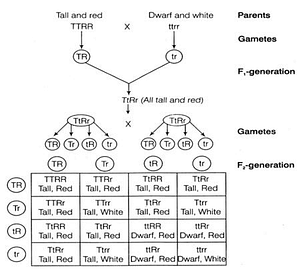
Ques: A tall plant with red flowers (dominant) is crossed with a dwarf plant with white flowers (recessive). Work out a dihybrid cross and state the dihybrid ratio. What will be the effect on the dihybrid ratio if the two genes are interacting with each other? (2 marks)
Ans: The standard dihybrid ratio observed is 9:3:3:1. If the two genes interact the values will deviate. This is because when genes are linked, they do not exhibit independent assortment and remain together in the gametes and the offspring. The dihybrid ratio thus obtained is 3:1.
Ques: Define autosome, hemizygous, homozygous, and heterozygous. (2 marks)
Ans: Autosome- All chromosomes apart from the sex chromosomes are called the Autosomes. The number of autosomes differs from one organism to another. Humans have 44 numbers or 22 pairs of autosomes.
Hemizygous- It is a condition in which an organism has only one copy of a gene or DNA sequence present in diploid cells.
Homozygous- It is a condition in which an organism has two similar alleles of a given gene (XX).
Heterozygous- It is a condition in which an organism has two different alleles of a given gene (XY).
Ques: A dihybrid heterozygous round, yellow seeded garden pea (Pisum sativum) was crossed with a double recessive plant. (3 marks)
(i) What type of cross is this?
(ii) Work out the genotype and phenotype of the progeny.
(iii) What principle of Mendel is illustrated through the result of this cross?
Ans:
- It is a dihybrid test cross.

- It illustrates the principle of independent assortment.
Ques: In dogs, barking trait is dominant over silent trait & erect ears are dominant over drooping ears. What is the expected phenotypic ratio of offspring when dogs heterozygous for both the traits are crossed? (2 marks)
Ans:

Ration: Barking & erect = 9
Barking & drooping = 3
Silent & erect = 3
Silent & Drooping = 1
Phenotypic ratio = 9:3:3:1
For Latest Updates on Upcoming Board Exams, Click Here: https://t.me/class_10_12_board_updates
Check-Out:



Comments