



Content Writer
Dimethyl sulfoxide is an organosulfur compound with two methyl groups, one oxygen atom and one sulfur atom. The chemical formula for dimethyl sulfoxide is (CH3)2SO. It is a colourless liquid that can dissolve both polar and nonpolar compounds. Dimethyl sulfoxide is abbreviated as DMSO. It was first synthesized in Kazan, Russia by Russian scientist Alexander Saytzeff. Due to its high dielectric constant, it has excellent solvent properties for both organic and inorganic chemicals.
| Table of Content |
Definition: Dimethyl Sulfoxide
[Click Here for Sample Questions]
Dimethyl sulfoxide or DMSO is a colourless highly polar organic liquid discovered in 1866 and has a chemical formula C2H6OS.
The other names of Dimethyl sulfoxide are – methylsulfonylmethane, methylthiomethane.
| Density | 1.1 g/cm3 |
|---|---|
| Molecular Weight/ Molar Mass | 78.13 g/mol |
| Boiling Point | 189°C |
| Melting Point | 19 °C |
| Related Links | ||
|---|---|---|
| Metals and Non-Metals Formula and Equations | Haloalkanes and haloarenes | Hydrogen chloride |
| Micelle | Isomerism in coordination compounds | Metals and Non-Metals Formula and Equations |
Structure of Dimethyl Sulfoxide
[Click Here for Sample Questions]
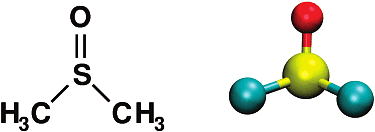
Dimethyl sulfoxide or DMSO is a polar aprotic compound that has idealized Cs symmetry. Its molecular geometry is trigonal pyramidal. In dimethyl sulfoxide S=C bond length is 186.2 pm, S=O bond length is 167.8 pm, O-S-C bond angle is 105.1° and C-S-C bond angle is 98°.
Physical Properties of Dimethyl sulfoxide – C2H6OS
[Click Here for Sample Questions]
| Odour | Cabbage-like |
|---|---|
| Appearance | Colourless liquid |
| Complexity | 29 |
| Melting Point | 19 °C |
| Specific Gravity | 1.101 at 20oC |
| Hydrogen Bond Acceptor | 2 |
Chemical Properties of Dimethyl Sulfoxide – C2H6OS
[Click Here for Sample Questions]
- Dimethyl sulfoxide or DMSO easily reacts with hydrogen peroxide to form thioglycolic acid and water. The chemical reaction is given below.
C2H6OS + 2H2O2 → C2H4O2S + 3H2O
- Reaction with electrophile – DMSO behaves like a nucleophile and reacts with electrophiles. Its sulfur center functions as a nucleophile for weak electrophiles while its oxygen center functions as a nucleophile for strong electrophiles. For instance, it reacts with methyl iodide to form trimethylsulfoxonium iodide. The chemical reaction is given below:
(CH3)2SO + CH3I → [(CH3)3SO]I
Sulfur ylide can be produced using this reaction. Sulfur ylide is formed when trimethylsulfoxonium iodide salt reacts with sodium hydride. The chemical reaction is given below:
[(CH3)3SO]I + NaH → (CH3)2S(CH2)O + NaI + H2
Uses of Dimethyl sulfoxide – C2H6OS
[Click Here for Sample Questions]
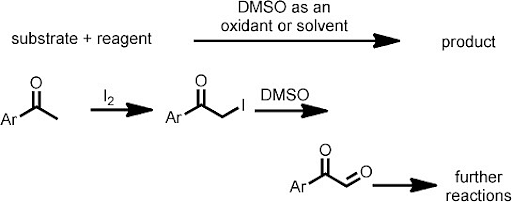
- It is used as a non-medicinal industrial solvent for dyes, resins, fungicides and pigments.
- DMSO is used as a paint remover, reactant for chemical synthesis, medicinal anti-inflammatory agent.
- It gets through the skin and reduces pain and heals tissue.
- DMSO is ideal for both polar and nonpolar organic and in-organic compounds. As a result, it is used in the synthesis of a wide range of compounds.
- It is a plentiful and relatively inexpensive byproduct of the wood pulp industry that is primarily used as an industrial solvent.
- Dimethyl sulfoxide is commonly used as an extractant in biochemistry and cell biology.
- It is a weak acid therefore it can withstand strong bases and is used in the study of carbanions.
- Acid dissociation constant for various organic compounds can be determined by using a DMSO solution.
- The DMSO solution is also used in NMR - spectroscopy.
- Dimethyl is used for manufacturing microelectronic devices.
- Also used in LCD displays, advanced packaging applications and stem cell baking.
- It is a safer alternative to use as a paint stripper than dichloromethane and nitromethane.
- DMSO is a good solvent and can dissolve in various compounds therefore it is used in sample management and drug design.
- The biological usage of Dimethyl Sulfoxide is its usage as an inhibitor for DNA primers in PCR or polymerase chain reaction.
- It can also be used to protect tissues from freezing damage. It is added to the cell media so that there is no ice formation and cells will not die because of over freezing.
- Dimethyl Sulfoxide is used in a variety of biological adsorption processes. For instance: C.elegans nematode uses DMSO for the absorption of flavonol glycoside.
- It has been used in pharmaceuticals since 1963. It can enter the cell without causing any damage to the cell membrane. It is used in anti-inflammatory, analgesics and antioxidant drugs.
- It is one of the components of antifungal medicines and is used in transdermal drug delivery systems.
- DMSO is used as a drug vehicle in both vivo and vitro experiments.
- It is used as an alternative medicine to treat a variety of diseases. It is also used for treating cancer.
- DMSO is used in medicines for treating skin-related problems in horses.
Things to Remember
- Dimethyl sulfoxide is an organosulfur compound with two methyl groups, one oxygen atom and one sulfur atom.
- Dimethyl sulfoxide is known by the chemical formula: (CH3)2SO
- It was first synthesized in Kazan, Russia by Russian scientist Alexander Saytzeff.
- The other names of Dimethyl sulfoxide are – methylsulfonylmethane, methylthiomethane
- Dimethyl sulfoxide or DMSO is a polar aprotic compound that has idealized Cs symmetry. Its molecular geometry is trigonal pyramidal.
- DMSO has multiple uses ranging from a paint remover, reactant for chemical synthesis, medicinal anti-inflammatory agent to a drug vehicle and as an inhibitor for DNA primers.
Sample Questions
Ques: What is the use of dimethyl sulfoxide? (2 marks)
Ans: It is topically used for relieving discomfort and for healing wounds, burns, and muscle and skeletal injuries. DMSO is also used topically to treat painful conditions like swelling, headache, swelling, rheumatoid arthritis, osteoarthritis and tic douloureux (extreme facial pain).
Ques: Is Dimethyl Sulfoxide toxic or poisonous? (2 marks)
Ans: It is a non-toxic solvent with a median lethal dose higher than ethanol. Early clinical trials with DMSO were stopped due to its health concerns, particularly it's potential to harm the eyes.
Ques: What causes DMSO to be toxic to cells? (2 marks)
Ans: DMSO is considered as a low-toxicity solvent. However, some DMSO concentrations may affect cell activation in culture. Cell cultures obtained from rats treated with DMSO increase lysosomal enzyme activity by 25%.
Ques: What is used to prepare DMSO? (2 marks)
Ans: Dimethyl Sulfoxide or DMSO, is a by-product of paper-making. It is extracted from a substance found in wood. Since the mid-1800s, DMSO has been used as an industrial solvent. The FDA has approved DMSO as a prescription drug to treat the symptoms of painful bladder syndrome.
Ques: Is DMSO denser than water? (2 marks)
Ans: These types of compounds are denser than water, and therefore they appear later when combined with water in the centre. Not only this, a few organic compounds such as dimethyl sulfoxide (DMSO) and dimethylformamide (DMF) are so polar that they are miscible with water (which is also very polar), and do not form layers.
Learning Outcome
- From this part of the chapter, the students will learn about Dimethyl Sulfoxide and its usage.
- The students will be aware of the physical and chemical properties of Dimethyl Sulfoxide.
- The chapter also draws attention to the structure of Dimethyl Sulfoxide.
For Latest Updates on Upcoming Board Exams, Click Here: https://t.me/class_10_12_board_updates
Check-Out:



Comments