



Exams Prep Master
An electrostatic precipitator is a sort of filter (dry scrubber) that removes soot and ash from exhaust fumes before they exit the smokestacks by using static electricity. This is a common device for reducing air pollution. The majority of power plants produce electricity by burning fossil fuels such as coal or oil. These fuels produce smoke when they are burned. Small soot particles float in heated, rising air, forming smoke. The unburned carbon particles are drawn out of the smoke by the static charge in the precipitators, allowing clean, hot air to escape the smokestacks. Here in this article, we will be learning more ab electrostatic precipitator and discuss some important questions.
| Table of Content |
Key Takeaways: Electrostatic precipitator, Filter, electric charge, the efficiency of electrostatic precipitator, working principles of the electrostatic precipitator.
What is an Electrostatic Precipitator?
[Click Here for Sample Questions]
A device that uses an electric charge to remove specific impurities—either solid particles or liquid droplets—from the air or other gases in smokestacks and other flues is known as an electrostatic precipitator. The precipitator works by directing energy exclusively at the particulate matter being collected, obstructing the passage of gases only slightly. Electrostatic precipitators, which were originally meant to recover valuable industrial-process materials, are now utilized for air pollution control, particularly for eliminating dangerous particulate matter from waste gases at industrial sites and power plants.

Electrostatic Precipitator
Working Principles of an Electrostatic Precipitator?
[Click Here for Sample Questions]
The corona discharge effect provides the basis for an ESP. Across the two plates or electrodes, a strong DC voltage is applied. The dust particles are drawn to the negatively charged plate, which is then drawn to the positively charged electrode by the ionization process. The image below depicts a corona discharge. Corona discharge Electrostatic attraction Dust particle collection and removal of accumulated dust particles are the two processes.
For an ESP to work, it must go through four essential steps.
- Components
- Control system and high-voltage supply source
- Gas Distribution Mesh System
- Hopper
- Discharge from the collecting plate
- The electrodes are supplied with a high voltage DC source in order for the corona discharge to occur.
Mesh is used to gather dust particles as both a pre-filter and a post-filter. Before transferring flue gases to the ionization process, a pre-filter catches dust. If any dust particles are found after the ionization process, a post-filter is utilized to filter them out.
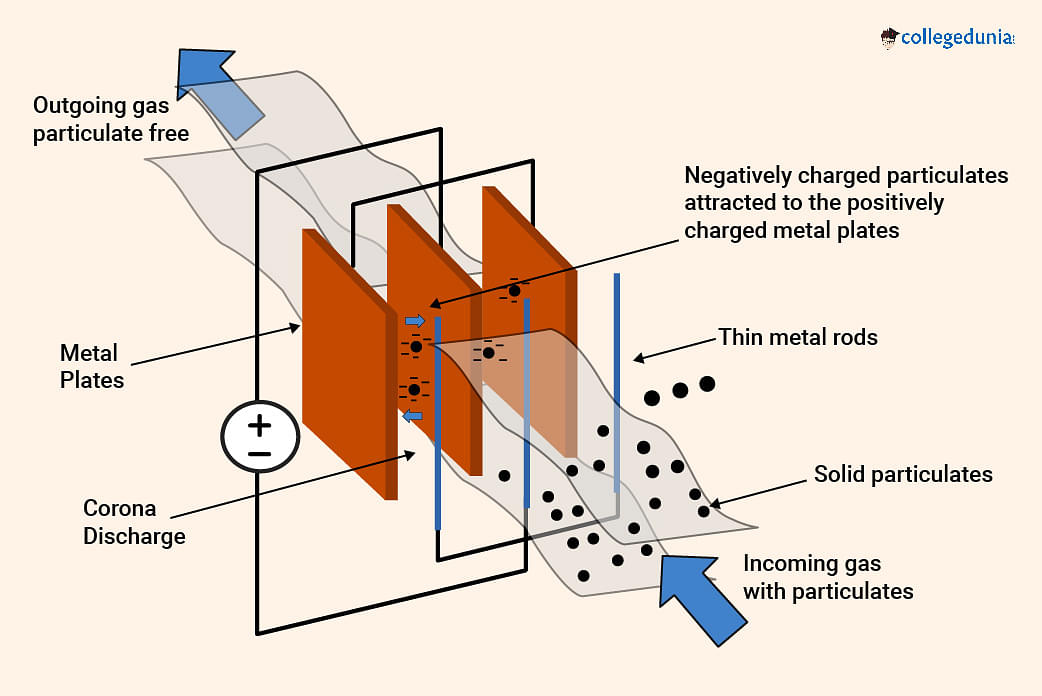
Working Principles of an Electrostatic Precipitator
Also Read:
| Related Articles | ||
|---|---|---|
| Semiconductor Diode | Semiconductor Electronics | Electric Current |
Efficiency of Electrostatic Precipitator
[Click Here for Sample Questions]
The ability of an electrostatic precipitator to gather dust from flue gases determines its efficiency. The electrical resistance of dust affects its collection effectiveness. Electrostatic precipitators can easily catch particles having a resistance in the usual zone. When particles in the low resistivity zone reach the collecting plates, they lose their charge and re-enter the dust collection region, reducing dust collection efficiency. Re-training is the term for this phenomenon. Increasing electrical resistivity affects efficiency even for particles with a high resistivity. As a result, the particle's electrical resistivity has a significant impact on the electrostatic precipitator's efficiency.
The particle size of the aerosol (dust, mist) to be collected determines how effective the electrostatic precipitator is. For larger heavy particles, the collecting efficiency is high, while for small particles, it is poor. The efficiency formula is a formula that is used to determine the efficiency of a system.
The efficiency of an electrostatic precipitator is calculated using the Deutsch-Anderson equation, which is as follows:
Õ²=1-e(-WA/Q)
where,
ð¼ is the fractional collection efficiency
W is the terminal drift velocity in ms-1
A is the total collection area in m2
Q is the volumetric airflow rate in m3s-1
Types of Electrostatic Precipitator
[Click Here for Sample Questions]
Plate and wire (dry), flat plate (dry), wet, and two-stage ESPs are the four fundamental varieties. ESPs have a huge air volume, work well in a variety of temperatures, and are low-maintenance. Their physical size, operating costs, and uneven collecting efficiency are all drawbacks.
Plate precipitator: This is the most basic type of precipitator, consisting of a stack of vertically stacked massive flat metal plates spaced 1cm to 18cm apart with rows of thin vertical wires. Before passing through the large stack of plates, the air is driven horizontally via the vertical plates. To ionize the particles, a negative voltage is applied between the wire and the plate. The ionized particles are then directed towards the grounded plates via electrostatic force. As the particles aggregate on the collection plate, they are removed from the air stream.
Dry precipitator: The dry electrostatic precipitator is used to capture pollutants such as ash or cement in a dry form. It consists of electrodes that allow ionized particles to flow through and a hopper that collects the particles. By hammering the electrodes, dust particles are gathered from a stream of air.
Wet electrostatic precipitator: This precipitator is used to remove wet materials such as resin, oil, tar, and paint. It is made up of collectors that are constantly sprayed with water in order to gather ionized particles from the sludge. They outperform dry ESPs in terms of efficiency.
Tubular precipitator: This is a single-stage unit that consists of tubes with high voltage electrodes that are positioned parallel to each other and rotate on their axes. The tubes could be arranged in a circular, square, or hexagonal honeycomb pattern, with gas flowing upwards or downwards. The gas is forced through all of the tubes. They look for applications that require the removal of sticky particles.
Advantages and Disadvantages
[Click Here for Sample Questions]
Advantages of Electrostatic Precipitator
The High Removal Efficiency of Particles/Pollutants
The efficiency of an electrostatic precipitator is determined by a variety of elements, including particle resistivity, corona power ratio, and so on. Under typical conditions, their efficiency for particle removal is exceptionally good, with up to 99 percent dust particle removal. Over a wide range of particle sizes (0.05-5 m), electrostatic precipitators have reasonably high collection efficiency (99-100%).
- Pollutants, both dry and wet, are collected.
Wet and dry electrostatic precipitators are the two types of electrostatic precipitators. Dry ESPs are used to gather dry pollutants such as ash and cement dust. Wet ESPs are used to remove wet particles such as resin, oil, paint, tar, acid, and other substances that aren't dry in the traditional sense.
- Operating Costs are Low
Electrostatic precipitators have low operating costs and are economically viable in the long run.
Disadvantages of Electrostatic Precipitator
- Exorbitant startup costs
Electrostatic precipitators have a large initial capital cost, making them prohibitively expensive for small businesses. They are both costly to buy and install.
- Requires a lot of room
They are not only expensive, but they also require a lot of space to set up. Small-scale industries' value proposition is decreased once again because they are costly and require a lot of room to set up.
- Not adaptable Electrostatic precipitators do not provide operational flexibility once installed. It's impossible to increase the ESP's capacity or relocate it once it's been installed. As a result, careful planning is required for the capacity, kind, and location of the ESP installation.
- They are not suitable for collecting gaseous contaminants.
Only dry and wet pollutants, not gaseous pollutants, can be collected with an electrostatic precipitator. This is a significant drawback of ESPs.
Also Read:
Application of Electrostatic Precipitator
[Click Here for Sample Questions]
In steam plants, electrostatic precipitators are used to remove dust from flue gases. Oil mists and acid mists are removed using electrostatic precipitators in machine shops and chemical facilities. In the medical field, ESPs are used to eliminate bacteria and fungi.
Things to Remember
[Click Here for Sample Questions]
- A device that uses an electric charge to remove specific impurities—either solid particles or liquid droplets—from air or other gases in smokestacks and other flues is known as an electrostatic precipitator
- The ability of an electrostatic precipitator to gather dust from flue gases determines its efficiency.
- The precipitator works by directing energy exclusively at the particulate matter being collected, obstructing the passage of gases only slightly.
- When particles in the low resistivity zone reach at the collecting plates, they lose their charge and re-enter the dust collection region, reducing dust collection efficiency.
Sample Questions
Ques: What is the function of an electrostatic precipitator? (1 mark)
Ans: An electrostatic precipitator (ESP) removes particles from a gas stream by charging them positively or negatively with electrical energy.
Ques: What does an electrostatic precipitator measure? (1 mark)
Ans: An electrostatic precipitator (ESP) removes particles from a gas stream by charging them positively or negatively with electrical energy.
Ques: Is an electrostatic precipitator used in vehicles? (2 marks)
Ans: The electrostatic precipitation principle can be used to remove solid particulates from the exhaust gas of automotive engines. . Electrostatic precipitators should be scaled down into a retrofit device that can be put on an automobile's exhaust pipe for this use.
Ques: What do electrostatic precipitators clean? (2 marks)
Ans: An electrostatic precipitator is a sort of filter (dry scrubber) that removes soot and ash from exhaust fumes before they exit the smokestacks by using static electricity. Most power plants generate electricity by burning fossil fuels like coal or oil.
Ques: What type of pollutants do electrostatic precipitators remove? (2 marks)
Ans: Electrostatic precipitators can aid in the reduction of air pollution. Fine particle materials like as ash, dust, and soot are removed from exhaust emissions. This is especially beneficial for power plants that generate electricity using fossil fuels such as coal or oil.
Ques: What are the main processes in the electrostatic precipitator process? (2 marks)
Ans: Electrostatic precipitation is a four-step technique for trapping particle matter: (1) negative high-voltage discharge, ionisation of flue gas, formation of negative ions; (2) fly ash is charged by electric field and negative ions; (3) charged fly ash is collected on the anode plate; (4) following rapping.
Ques: What are the benefits of using an electrostatic precipitator to reduce pollution? (2 marks)
Ans: Using an electrostatic charge, the electrostatic precipitator removes particles and smoke from a gas stream. Dust particles pass through wires with a high direct current (DC) voltage, ionizing the surrounding atmosphere.
Ques: Who was the first to invent the electrostatic precipitator? (2 marks)
Ans: The "electrostatic precipitator," created by Frederick Cottrell, eliminates contaminants from smoke. Cottrell was born in Oakland, California, on January 10, 1877, to Henry and Cynthia Cottrell. His inventiveness and interest in applied sciences were evident from the start.
For Latest Updates on Upcoming Board Exams, Click Here: https://t.me/class_10_12_board_updates
Check-Out:



Comments