



Education Journalist | Study Abroad Lead
Line Voltage and Phase voltage are directly proportional to each other. Line Voltage in a three-phase system is the potential difference between any two lines or phases present in the system. It can be denoted by VLine or VL-L. Whereas, Phase Voltage is the potential difference between any one of the phases (R, Y or B) and the neutral junction point. Phase Voltage is denoted by Vphase = VR (voltage in red phase) = VB (voltage in blue phase) = VY (voltage in yellow phase).
| Table of Content |
Key Takeaways: Line Voltage, Phase Voltage, Voltage, Conductors, Delta Connection, Star Connection, Coil
Line Voltage
[Click Here for Sample Questions]
Phases present in the Line Voltages are conductors or windings of a coil. Line Voltage in a three-phase system is the potential difference between any two lines or phases present in the system, it can be denoted by VLine or VL-L. If R, Y and B are the three phases (red phase, yellow phase, blue phase) then the voltage difference between the R & Y, Y & B, B & R forms a line voltage. As the line voltage of an AC system changes constantly, there will always be two converter valves under conducting state at any moment.
Line Voltage
In a type of three balanced system, the potential difference across the phase concerning another phase which is always equal to the magnitude of the voltage, the phase angle and vector sum of the three phases will always be equal to zero. Line Voltage in simple words is defined as the voltage that a power line delivers to the destination, or we can say that the point where it is being used. If the Line Voltage increases unexpectedly, it is going to result in a condition called ‘power surge’.
Also Read:
| Related Articles | ||
|---|---|---|
| Alternating Current | LC Oscillations | Transformers |
| Difference Between Voltage and Current | Electric current | Ohm’s Law |
Phase Voltage
[Click Here for Previous Year Questions]
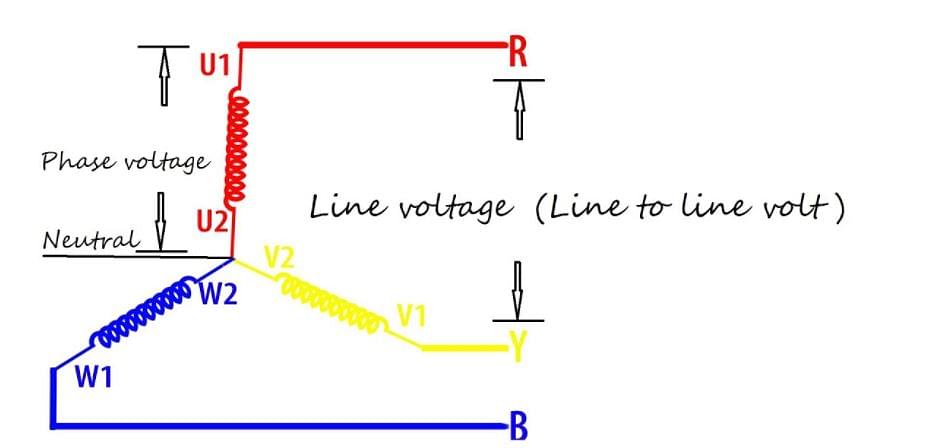
Phase Voltage is the potential difference between any one of the phases (R, Y or B) and the neutral junction point. Phase Voltage is denoted by Vphase = VR (voltage in red phase) = VB (voltage in blue phase) = VY (voltage in yellow phase). Phase Voltage depicts the voltage which is measured from any one component in a balanced three-phase source or load. When we measure voltage difference between one phase and another phase, it is known as phase-to-phase voltage.

Phase Voltage
The distribution side of the transformer is connected in a star configuration. Line to line voltage for a three-phase network is √3 x phase voltage. Generally, phase to phase voltage and line to line voltage are the same. Line voltage or phase voltage above 440 volts can be measured with the help of a potential transformer. The potential meter reduces the voltage from a higher position to a lower position representing 110 volts to 63.5 volts.
Relation Between Line Voltage And Phase Voltage
[Click Here for Sample Questions]
Phase voltage and line voltage are directly proportional to each other.
- When the line voltage increases, phase voltage also tends to increase.
- When the phase voltage decreases, line voltage also tends to decrease.

Relation between phase and line voltage
The relation between Line and Phase Voltage can be established by forming circuits in star and delta connection.
Line and Phase Voltage In Star Connection
[Click Here for Previous Year Questions]
Star connection system is also called a three-phase four wire system and this type of connection is a much preferred system for AC power distribution. In the star connection, starting points or ending points of the three coils are joined together to form a neutral point.

Line and Phase Voltage in a Star Connection
Suppose three coils of wire or winding of a transformer are attached by a common connection point. The three wires going away from each coil to the load are known as line wires, and conductors are the phases. This system is considered a three-phase three-wire star connection system. If a neutral wire is attached to the shared middle point, then it is considered a three-phase four-wire star connection system.
The relation between phase and line voltage is as follows,
VRY = VR - Vy (vector difference)
To calculate the vector of VRY, we should increase the vector of Vy in the reverse direction.
Line And Phase Voltage In Delta Connection
[Click Here for Sample Questions]
Delta connection is also called mesh connection. The last terminal of one winding is connected to the start terminal of the other phase and so on. Thus, it will form a closed circuit. The three-line conductors run from three junctions of mesh which are known as line conductors. In a delta connection, all the three ends of the phases are connected to each other to form a closed triangular loop, and it has no neutral connection. In the delta connection, line voltage and phase voltage are related as follows:
Vline = Vphase
In the case of a delta connection, the line voltage will be equal to the phase voltage.

Line and Phase Voltage in Delta Connection
Difference Between Line Voltage and Phase Voltage
[Click Here for Previous Year Questions]
The key differences between Line Voltage and Phase Voltage are as follows.
| Line Voltage | Phase Voltage |
|---|---|
| In a star connection, the Phase Voltage is greater than the line voltage. | In a delta connection, the Phase Voltage is lesser than the Line Voltage. |
| In a polyphase system, Line Voltage is a voltage that is given between two phases. | Phase Voltage is a voltage given between the phase and the neutral. (Note that neutral is only available in star connection and not in delta connection.) |
| Line Voltage is a phasor potential of a phase wire in connection with another phase wire. | Phase Voltage is a phasor potential of a phase wire in connection with a neutral wire. |
Things to Remember
- Line Voltage in a three-phase system is the potential difference between any two lines or phases present in the system.
- Phase Voltage is the potential difference between any one of the phases.
- Domestic three-phase power supply or the 440 volts is called the line voltage.
- Single-phase 230 volts alternating current supply is the potential difference between one of the phases and the neutral junction or either of the phase voltage.
- The system where all the line voltages and line currents are considered is a three-phase balanced system. But, in the case of unsymmetrical loads, the system is known to be unbalanced.
Also Read:
Previous Year Questions
- A coil has resistance 30 ohm and inductive reactance 20 ohm at 50Hz frequency….[NEET 2011]
- A coil is self-inductance L is connected in series with a bulb B and an AC source. Brightness of the bulb decreases when … [NEET 2013]
- The current through the inductor when the potential difference across the condenser…. [NEET 2010]
- A series LCR circuit is connected to an ac voltage source. When L is removed from the circuit, the phase difference between current...[NEET 2020]
- A transformer having efficiency of 90% is working on… [ NEET 2014]
- An ac voltage is applied to a resistance R and an inductor L...[NEET 2011]
Sample Questions
Ques. Calculate the phase voltage if the line voltage is 460 volts, given that the system is a three-phase balanced star connection system. (2 Marks)
Ans. As we already know that,
\(Phase Voltage = \frac{Line Voltage}{\sqrt3}\)
\(V_{phase} = \frac{V_{Line}}{\sqrt3}\)
\(V_{phase} = \frac{460}{\sqrt3}\)
Vphase = 265.59 Volts
Ques. What is line current? (2 Marks)
Ans. The measurement of the current in one phase before the star or delta arrangement of the component is called the line current (mainly input current in motor or output current in alternator). In a type of three balanced system, it may be R phase current or Y phase current or B phase current. The line current is typically denoted by IL ampere.
Ques. What is phase current? (2 Marks)
Ans. Phase current is the measure of the current which is present inside the star connection or delta connection of the three-phase system. It is denoted by Iph. This current is also defined as the current flowing between two phases.
Ques. What is the relationship between the phase current and the line current with respect to the star connection and the delta connection? (3 Marks)
Ans. In the case of phase current,
In star connection:
IL = Iph
Where,
line current = phase current
In delta connection:
IL = √3 x Iph
Where,
line current = phase current
Thus,
In star connection:
Iph = IL
In delta connection:
\(lph = \frac{IL}{1.732} Amps\)
Ques. What are phasor diagrams? (2 Marks)
Ans. Phasor diagrams are used to depict the phase differences between the sinusoidal signals. When we use phasor diagrams, we find that it is easy to analyze the signals with the same frequencies. Also, phasor diagrams are used to show the phase relationships between two or more sine waves having the same frequencies.
Ques. Why 60° angle is considered as the angle between the two phases in star connection? (2 Marks)
Ans. The phase difference between the two phases in a star connection is 120° but the angle 60° is considered for calculation because the resultant connection was drawn between any one of the negative axes and the real axes.
Ques. State Kirchhoff's current law. (2 Marks)
Ans. Kirchoff’s current law is one of the fundamental laws used for circuit analysis. It states that “For a parallel path, the total current entered in the circuit junction will be exactly equal to the total current leaving the same current junction”. Also, we can say that the algebraic sum of the currents entering and leaving from the circuit will be equal to zero. This law is also known as Kirchhoff's first law.

Kirchoff’s Current Law
Ques. State Kirchoff's voltage law. (2 Marks)
Ans. Kirchoff’s voltage law is one of the fundamental laws used for circuit analysis. It states that “The potential difference around a loop equals to the sum of every voltage drop in the same loop for any closed network will be equal to zero”. Also, we can say that the algebraic sum of every voltage in the loop should be equal to zero, and this type of property of Kirchoff's law is called the conservation of energy. This law is also known as Kirchhoff's second law.

Kirchoff’s Voltage Law
Ques. What are the properties of Electric Charge? (3 Marks)
Ans.
- Unlike charges attract each other and like charges repel each other.
- The force between two charges varies directly as the product of two charges and inversely as the square of the distance (r) between both charges (q1 and q2).
- \(F \alpha \frac{q_1 \times q_2}{r_2}\) → \(F = K \frac{q_1 \times q_2}{r_2}\) (Where K is a Constant)
- S.I. unit of charge is coulomb (C).
- 1 coulomb = 1 ampere × 1 second (1C = 1A × 1s)
- Thus, the quantity of charge which flows through a circuit when one ampere of current flows through it in one second is known as a 1-coulomb charge.
Ques. Define Potential Difference. (2 Marks)
Ans. The difference in the amount of electric potential energy between two points in an electric circuit is called the electric potential difference. Electric potential difference is known as voltage, which is equal to the amount of work done to move the unit charge between two points against a static electric field.
Therefore,
\(Voltage = \frac{Work done}{Charge}\)
For Latest Updates on Upcoming Board Exams, Click Here: https://t.me/class_10_12_board_updates
Check-Out:



Comments