



Education Journalist | Study Abroad Lead
Epimers in Chemistry play a vital role in determining the properties of elements. Epimers are a particular type of diastereomers possessing only one chiral centre with a different configuration. In addition to this, epimers possess different physical and chemical properties from each other. Two isomers present in the molecules differ at the stereogenic centre, while the rest remains identical. A molecule may have a number of stereocenters leading to several stereocenters.
| Table of Contents |
Key Terms: Epimers, Diastereomers, Stereoisomers, Molecules, Anomers, Chiral Carbon, Configuration, Chiral Centre
Definition of Epimers
[Click Here for Sample Questions]
A type of stereoisomers of carbohydrates which differ in their placement of the -OH group in only one of the places are known as Epimers in Chemistry. In stereochemistry, Epimers are known to be one of a pair of stereoisomers. Stereoisomers are two molecules which have the same connectivity and formula but they differ in their 3-D structure. Therefore, epimers are not identical or mirror images of each other. Furthermore, they differ not only in physical but also the chemical properties from one another.
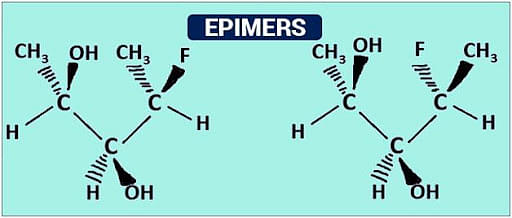
Epimers
To understand better, let us take the real-life example of twins. Suppose there are two identical twin brothers say, Ajay and Rahul. Ajay has a mole on the left side of his face while Rahul has it on the right side. So, despite being twins their mirror images can not be the same due to the mole on the different sides.
Likewise, D-glucose and D-galactose are the most suitable examples of Epimers.
Read More:
Main Characteristics of Epimers
[Click Here for Sample Questions]
The main characteristics of epimers are as follows:
- Epimers differ from each other in one chiral carbon in the configuration but can contain more than one chiral carbon.
- They are different from each other in a few chiral carbons, but not all chiral carbons.
- They do not have mirror images of each other.
- Their physical, as well as chemical properties, are different from each other.
How Do Epimers and Anomers Differ?
[Click Here for Sample Questions]
A particular type of Epimers is found in carbohydrate (sugar) molecules which are known as Anomer. They differ in 3-D structure from each other only at one site, that is, the hemiacetal/ hemiketal carbon, which is also called the anomeric carbon. The anomeric carbon refers to the carbon atom in the cyclical carbon chain, reduced to form a ketone. Anomers also have names to differentiate their forms- the alpha designation is given to the form where the OH group points down on the anomeric carbon, and the beta designation is given to the form where the OH group points up on the anomeric carbon. We can understand this term with an example:
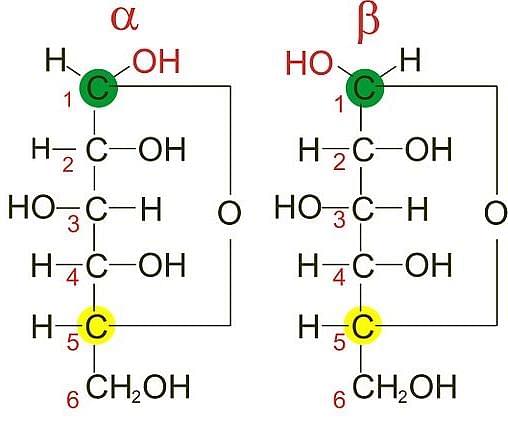
Examples of Anomers
In the above figure, for the alpha anomer of glucose, the -OH group points down, which is attached to the anomeric carbon (C1), and for the beta anomer of glucose, the -OH points up, which is attached to the anomeric carbon. The configuration at one chiral centre is different in both the anomers. For alpha, the -OH is on the right but for beta, the -OH is on the left.
Things to Remember
- All epimers are diastereomers but all diastereomers are not necessarily epimers. Epimers are not mirrored images of each other. Furthermore, they differ in their physical and chemical properties.
- Some examples of Epimers are anomeric forms of sugars and other sugars except not anomers (such as D-glucose and D-galactose).
- The -OH group plays a wide role in the formation of epimers and anomers too.
- There is also a chemical process, Epimerization, to convert one epimer into the other. It can be a spontaneous one, which is a slow process, or can be catalyzed by the enzymes.
Read More:
| Chapter Related Concepts | ||
|---|---|---|
| Carbohydrate Metabolism | RNA and DNA | |
| Cellulose | Fats and Oils | Sucrose |
Sample Questions
Ques. What is meant by the term ‘Epimers’? (3 Marks)
Ans. Epimers are a kind of stereoisomers which differ in the position of the -OH group in only one of the positions. They are not identical or mirror images of each other. Moreover, they differ in their physical and chemical properties from one another, which results in different 3-D structures of epimers.
Ques. What are some examples of epimers? (3 Marks)
Ans. Glucose, mannose, and galactose are some important examples of epimers that should be memorized thoroughly. Glucose and mannose differ at the C-2 carbon while glucose and galactose differ at the C-4 carbon. Other examples are ð-D-mannopyranose and ð-D-glucopyranose. The two epimers which are used as drugs are Doxorubicin and epirubicin.
Ques. What is the main difference between epimers and anomers? (3 Marks)
Ans. The epimer is a type of stereoisomer that differs in the configuration of a single stereogenic centre whereas the anomer is a type of stereoisomer that differs in the configuration at the hemiacetal/acetal carbon (called also anomeric carbon). The epimers can be acyclic or cyclic molecules but anomers are always the cyclic ones.
Ques. What are the similarities between epimers and anomers? (3 Marks)
Ans. Epimors and anomers both are structural isomers. They both differ in a single carbon atom in their structure. Another similarity is that they both can be found in sugar molecules. They both are formed due to the same reason, that is, differences in the location of only one -OH group.
Ques. What is meant by Epimerization? (3 Marks)
Ans. In stereochemistry, Epimerization is a process that includes transferring an epimer into its counterparts. It is a slow process and can be catalyzed by enzymes. For example, converting N-acetylglucosamine into N-acetylmannosamine is epimerization which takes with the presence of enzymes.
Ques. What is the difference between epimers and enantiomers? (2 Marks)
Ans. Epimers are a kind of stereoisomers which differ in the position of the -OH group in only one of the positions. They are not identical or mirror images of each other. Enantiomers are the optical isomers that are mirror images of each other which are non-superimposable.
Ques. What are the similarities between epimers and enantiomers? (2 Marks)
Ans. Epimers and enantiomers both are stereoisomers and both are the types of optical isomers. Both of them namely, enantiomers and epimers, in their structure show chirality. D-glucose and D-mannose are the epimers of each other, these two are examples of epimers.
Ques. How will you represent the structure of the epimer? (2 Marks)
Ans. The structure of the epimer can be represented as

Ques. Draw the structure of D-glucose and D-galactose. (3 Marks)
Ans. The structure is represented below as

Check-Out:



Comments