



Education Journalist | Study Abroad Lead
Epoxide Reactions plays a critical role in various organic transformations, owing to the distinctive strained three-membered ring structure they possess. Of particular significance within this realm are the ring-opening reactions of epoxides.
- Among these reactions, the ring-opening of epoxides holds significant importance due to their potential to generate structurally intricate and valuable molecules.
- This process involves the cleavage of the epoxide ring and subsequent bond formation, guided by factors such as nucleophile choice, reaction conditions, and regioselectivity.
- By dissecting the distinct mechanisms behind each reaction, the intricate interplay between nucleophilic attack, leaving group displacement, and stereochemical outcomes becomes clear.
Key Terms: Epoxides, Epoxide Reactions, Alcoholysis, Hydrolysis, Nucleophiles, Methanol
Epoxide Ring-Opening Mechanism via Alcoholysis: SN2 and SN1 Processes
[Click Here for Sample Questions]
Epoxides, depending on their type and reaction conditions, can undergo ring-opening reactions through SN2 or SN1 processes. The resulting product structure varies based on the dominance of these processes, especially when dealing with asymmetric epoxides.
SN2 Ring-Opening Process in Basic Methanol
Asymmetric epoxides treated with basic methanol follow an SN2 process during alcoholysis. In this mechanism, the less substituted carbon within the epoxide ring becomes the target of nucleophilic attack. The resulting product, referred to as product B, is obtained through this regioselective reaction.

SN2 Ring-Opening Process in Basic Methanol
SN1-Like Solvolysis in Acidic Methanol
In contrast, acidic methanol prompts a solvolysis process with strong SN1 characteristics. The attack site shifts to the highly substituted carbon within the epoxide ring in this process.
- The dominant product, known as product A, is formed as a result of this regioselective reaction.
- Both of these reactions serve as excellent examples of regioselective reactions, where the choice of reaction conditions and type of epoxide determine the specific pathway and resulting product structure.

SN1-Like Solvolysis in Acidic Methanol
Epoxide Ring-Opening through Hydrolysis: Formation of Trans-1,2-Diols
[Click Here for Previous Year Questions]
Trans-1,2-diols, also known as vicinal diols or vicinal glycols, are the products obtained from the hydrolysis of epoxides. This transformation can occur in both acidic and basic environments, each proceeding through distinct mechanisms.
Acid-Catalyzed Hydrolysis
In the presence of an aqueous acidic medium, the epoxide oxygen is protonated. A nucleophilic attack by water ensues, leading to the formation of a 1,2-diol product. Afterward, deprotonation occurs to regenerate the acid catalyst.
- If the epoxide is asymmetric, the entering water nucleophile prefers to attack the more substituted epoxide carbon.
- The SN2-like process of epoxide ring opening results in the trans configuration of the two -OH groups in the product.

Acid-Catalyzed Hydrolysis
Basic Hydrolysis
Under aqueous basic conditions, an SN2 reaction takes place. A hydroxide nucleophile initiates the epoxide ring opening. The epoxide oxygen interacts with water to create an alkoxide intermediate.
- Protonation of the alkoxide generates the 1,2-diol product.
- For an asymmetric epoxide, the hydroxide nucleophile targets the less substituted carbon during the attack.
- The reaction proceeds via an SN2 mechanism, yielding trans-oriented -OH groups in the final product.

Basic Hydrolysis
Both acidic and basic hydrolysis of epoxides leads to the formation of trans-1,2-diols, with the specific mechanisms and regioselectivity determined by the reaction conditions and the structure of the epoxide molecule.
Epoxide Ring-Opening via HX: Formation of Trans-Halohydrins
[Click Here for Sample Questions]
Anhydrous acids (HX) can effectively trigger the opening of epoxides, leading to the formation of trans-halohydrins. This reaction pathway offers distinct outcomes based on the nature of the epoxide carbons involved, primarily focusing on their substitution patterns and the resulting regioselectivity.
Attack on Primary or Secondary Epoxide Carbons
When both epoxide carbons are primary or secondary in nature, the reaction proceeds in a manner reminiscent of an SN2 mechanism.
- The halogen anion from the anhydrous acid (HX) acts as the nucleophile, targeting the less substituted carbon within the epoxide.
- This nucleophilic attack generates a trans-halohydrin product, characterized by the presence of both a halogen and a hydroxyl (-OH) group.
Influence of Tertiary Epoxide Carbon
In scenarios where at least one of the epoxide carbons is tertiary, the reaction pathway takes on characteristics resembling an SN1 process.

Influence of Tertiary Epoxide Carbon
- The halogen anion exhibits a preference for attacking the tertiary carbon within the epoxide molecule.
- This selective attack on the tertiary carbon initiates the formation of a trans halohydrin, showcasing the distinctive reactivity of tertiary centers in these reactions.
Epoxide Ring-Opening by Diverse Nucleophiles: A Multifaceted Approach
[Click Here for Previous Year Questions]
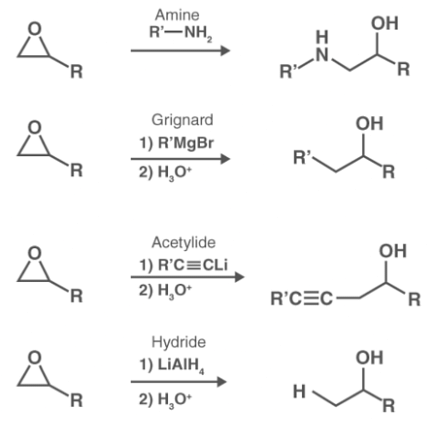
The ring-opening of epoxides is facilitated by a wide array of basic nucleophiles, each contributing to the formation of distinct products and reaction outcomes. These nucleophiles, including amines, hydrides, Grignard reagents, acetylide anions, and hydrides, play a vital role in breaking the strained epoxide ring to yield various functional groups.
Key Nucleophiles for Epoxide Ring Opening
Key Nucleophiles for Epoxide Ring opening include:
- Amines: Amines, which can be primary, secondary, or tertiary, are effective nucleophiles in epoxide ring-opening reactions.
- Hydrides: Hydride ions (H-) serve as strong nucleophiles, participating in the cleavage of epoxide rings to produce diverse products.
- Grignard Reagents: Organomagnesium compounds, known as Grignard reagents, react with epoxides to initiate ring opening and forge new carbon-carbon bonds.
- Acetylide Anions: Acetylide anions, derived from terminal alkynes, exhibit nucleophilic characteristics, making them valuable agents in epoxide ring-opening transformations.
- Hydrides (Revisited): Beyond their application as reducing agents, hydrides also engage in nucleophilic attacks on epoxides to unravel their cyclic structures.
Utilization of SN2 Mechanism
The mechanism predominantly employed for epoxide ring opening involving these basic nucleophiles is the SN2 (substitution nucleophilic bimolecular) mechanism.
- The SN2 process involves simultaneous nucleophilic attack and displacement of the leaving group, resulting in the opening of the epoxide ring.
- This mechanism ensures regioselectivity and often leads to the formation of trans products, particularly in asymmetric epoxides.
Utilization of SN2 Mechanism
Check-Out:
Additional Ring-Opening Stereochemical Considerations
[Click Here for Sample Questions]
Additional Ring-Opening Stereochemical Considerations play a pivotal role in determining the spatial arrangement of atoms in the resulting products, adding an extra layer of complexity to this transformative process.
Regiochemical Control in Asymmetric Epoxide Ring-Opening
In the context of asymmetrical epoxides, the process of ring opening is often strategically guided to yield a single stereoisomer. This controlled regiochemistry ensures the formation of a specific stereoisomeric product, enhancing the predictability and precision of the reaction outcome.
Regiochemical Regulation
Asymmetrical epoxides exhibit distinct nucleophilic reactivity at their carbon atoms due to their differing substitution patterns.
- Regiochemical control, achieved through careful reaction conditions and nucleophile choice, directs the nucleophilic attack to a specific carbon within the epoxide ring.
- This deliberate control promotes the generation of a sole stereoisomer as the predominant product.
Symmetrical Epoxide Ring-Opening
In contrast, when dealing with symmetrical epoxides, a unique scenario emerges where both epoxide carbons possess nearly identical nucleophilic susceptibilities.
- The symmetry within the epoxide molecule results in an approximately equal likelihood of nucleophile attack occurring at either carbon center.
- Consequently, the resulting product derived from a symmetrical epoxide often comprises a mixture of enantiomers.
Enantiomeric Mixture Formation
Due to the balanced nucleophilic tendencies at each carbon atom of the symmetrical epoxide, the nucleophilic attack may take place on either side with comparable frequency. This absence of preferential regioselectivity leads to the generation of enantiomeric pairs in the product mixture.

Enantiomeric Mixture Formation
Read More: Structure of Amines: Alkyl and Aromatic Amines
Things to Remember
- Epoxide Reactions transform molecules, yielding valuable structures with distinct properties.
- Epoxides undergo diverse ring-opening reactions with different nucleophiles, leading to various functional group formations.
- Reaction mechanisms can involve SN2 or SN1 processes, resulting in regioselective or stereochemical outcomes, respectively.
- Asymmetric epoxides show regioselective reactions, while symmetrical epoxides often yield enantiomeric mixtures.
- Nucleophiles like amines, hydrides, Grignard reagents, and acetylide anions influence the product structure and stereochemistry.
- Hydrolysis forms trans-1,2-diols, showcasing acidic and basic influence.
- Anhydrous acids create trans halohydrins, driven by substitution patterns.
- Regiochemical control dictates stereoisomer formation, providing strategic control over the desired product.
- The choice of reaction conditions, such as acidic/basic environments, influences the mechanism and product outcome.
Previous Year Questions
- Extraction of metal from the ore cassiterite involves...[JEE Advanced 2011]
- Commonly used vectors for human genome sequencing are...[NEET UG 2014]
- Interfascicular cambium and cork cambium are formed due to..
- Pneumotaxic centre is present in...[UP CPMT 2007]
- Reaction of HBr with propene in the presence of peroxide gives….[NEET UG 2004]
- Assuming the expression for the pressure exerted by the gas on the walls of the container, it can be shown that pressure is...[MHT CET 2016]
- Which among the following is the strongest acid?...[TS EAMCET 2017]
- Isopropyl alcohol on oxidation forms..
- A vector is not changed if..
- Which of the following arrangements does not represent the correct order of the property stated against it?...[JEE Main 2013]
- The major product of the following reaction is...[JEE Main 2019]
- Major product of the following reaction is..[JEE Main 2023]
- The percentage of nitrogen in urea is about..
- The electric field at a point is
- Which of the following statements is true?..[JKCET 2006]
Sample Questions
Ques: What is meant by an epoxide ring-opening reaction? (2 Marks)
Ans: An epoxide ring-opening reaction involves breaking the cyclic structure of an epoxide compound to form new chemical bonds. In an SN2 reaction under aqueous basic conditions, a hydroxide nucleophile attacks the epoxide, leading to the opening of the ring. The epoxide oxygen reacts with water, producing an alkoxide intermediate that is subsequently protonated to yield a 1,2-diol product.
Ques: How can epoxides be synthesized? (2 Marks)
Ans: Epoxides can be synthesized through various methods. One approach involves the enantioselective catalytic reduction of an achiral chloromethyl ketone using a chiral oxazaborolidine catalyst and borane as a stoichiometric reductant. This reaction plays a crucial role in the production of chiral phenyloxirane.
Ques: What is the concept of regioselective reactions? (2 Marks)
Ans: Regioselective reactions refer to chemical reactions where one specific chemical bond is formed or broken preferentially over other potential bonds in a molecule. This selectivity results in the preferential formation of one product over another. An example is a regioselective reaction that produces one constitutional isomer rather than an alternative isomer.
Ques: Are epoxide reactions enantiomerically balanced? (2 Marks)
Ans: Epoxide reactions can lead to racemic mixtures of enantiomers under certain conditions. When an achiral epoxide is employed as the starting material, both carbons in the epoxide ring are equivalent and attacked by nucleophiles at the same rate. As a result, the reaction can generate a mixture containing equal amounts of both enantiomers.
Ques: Which reagent is involved in epoxide formation? (2 Marks)
Ans: Epoxide formation can be achieved directly by treating an alkene with a "peroxy acid," which is a carboxylic acid containing additional oxygen. One commonly used peroxy acid for this purpose is m-chloroperoxybenzoic acid (m-CPBA). Various other peroxy acids with the general structure RCO3H are also employed in epoxide synthesis.
Ques: How does an epoxide ring-opening reaction occur under basic conditions? (2 Marks)
Ans: In an epoxide ring-opening reaction under basic conditions, such as aqueous basic circumstances, a hydroxide nucleophile initiates the process. The hydroxide attacks the epoxide, leading to ring cleavage. The epoxide oxygen reacts with water to generate an alkoxide intermediate, which is subsequently protonated. This sequence ultimately yields a 1,2-diol product.
Ques: What is a common method for the asymmetric synthesis of epoxides? (1 Mark)
Ans: The asymmetric synthesis of epoxides often involves using chiral catalysts. For instance, employing chiral epoxides and oxaziridines as reagents with various substrates can lead to the creation of enantiomerically enriched epoxide products.
Ques: How does regioselectivity impact reaction outcomes? (1 Mark)
Ans: Regioselectivity influences which specific bonds are formed or broken in a chemical reaction. By controlling the reaction conditions and reagents, chemists can guide a reaction to preferentially yield one regioisomer over others, resulting in a specific product.
Ques: Can epoxide reactions result in diastereomers? (1 Mark)
Ans: Yes, under certain circumstances, epoxide reactions can lead to the formation of diastereomers. This can occur when the attacking nucleophile is differentially oriented relative to the epoxide carbon centers, leading to distinct stereoisomeric products.
Ques: What is the importance of epoxide ring-opening reactions in synthesis? (1 Mark)
Ans: Epoxide ring-opening reactions are essential tools in organic synthesis, enabling the creation of a wide range of functionalized molecules. They offer diverse pathways for introducing new functional groups and building complex molecular architectures.
For Latest Updates on Upcoming Board Exams, Click Here: https://t.me/class_10_12_board_updates
Check-Out:



Comments