



Content Curator
Formaldehyde is the simplest aldehyde composed of hydrogen, carbon, and oxygen with the formula CH2O.
- Formaldehyde is one of a large family of chemicals called volatile organic compounds which evaporate and become gaseous at room temperature.
- Formaldehyde is a reactive molecule and the first in the series of aliphatic aldehydes.
- Formaldehyde is a colorless, strong-smelling, flammable chemical produced industrially.
- It is also referred to as methanal, methylene oxide, oxymethyline, methylaldehyde, and oxomethane.
- Formaldehyde is naturally produced in small amounts in our bodies.
- It is used in construction materials including particleboard, plywood, and other pressed-wood products.
| Table of Content |
Key Terms: Formaldehyde, Chemical formula, Organic compound, Hydrogen, Carbon, Oxygen, Aldehyde, Ammonia, Sodium Hydroxide, Density
What is Formaldehyde?
[Click Here for Sample Questions]
Formaldehyde is referred to as the simplest aldehyde made of hydrogen, carbon, and oxygen.
- The chemical formula of Formaldehyde is CH2O.
- It is a smelly, colorless gas that spontaneously polymerizes into paraformaldehyde.
- It is kept in aqueous solutions (formalin), mostly composed of the hydrate CH2(OH)2.
- It is the simplest of the aldehydes (R-CHO).
- Formaldehyde is a precursor to many other materials and chemical compounds.
- Its global production was estimated to be 12 million tons per year in 2006.
- It is mainly used in the manufacturing of industrial resins, such as particle board and coatings.
| Formaldehyde | |
|---|---|
| Chemical Formula | CH2O |
| Molecular Weight/ Molar Mass | 30.031 g/mol |
| Density | 815 kg/m3 |
| Boiling Point | -19 °C |
| Melting Point | -92.0 oC |
Also Read:
| Related Articles | ||
|---|---|---|
| Diethyl Ether | Cellulose(C6H10O5)n- | Organic Solvent |
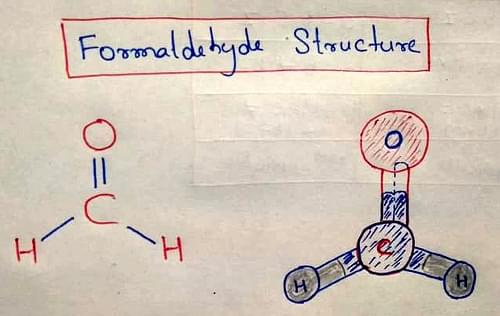
Formaldehyde Structure
[Click Here for Sample Questions]
The structure of formaldehyde is shown below
Physical Properties of Formaldehyde
[Click Here for Sample Questions]
The following are the physical properties of Formaldehyde
| Physical Properties | |
|---|---|
| Odor | Suffocating odor |
| Appearance | Colorless gas |
| Covalently-Bonded Unit | 1 |
| Hydrogen Bond Acceptor | 1 |
| Complexity | 2 |
| Solubility | Soluble in water and acetone. |
Chemical Properties of Formaldehyde
[Click Here for Sample Questions]
The following are the chemical properties of Formaldehyde
Reaction with Sodium Hydroxide
Formaldehyde reacts with a base like sodium hydroxide forming sodium formate and methanol. The chemical equation is given below.
2HCHO + NaOH → HCOONa + CH3OH
Reaction with Ammonia
Formaldehyde reacts with ammonia to form formamidine and water. The chemical equation is given below.
6HCHO + 4NH3 → (CH2)6N4 + 6H2O
It is stable at around 150°C, but once condensed into a liquid it polymerizes.
Uses of Formaldehyde
[Click Here for Sample Questions]
The following are the applications of Formaldehyde
Building and Construction
Formaldehyde-based resins are used to make composite and engineered wood products widely used in furniture, countertops, moldings, furniture, shelving, stair systems, siding flooring, wall coverings, support beams, and trusses, and many other furniture and structures for the home.
- Adhesives that use formaldehyde as a constituent element are exceptional binders, which offer high quality and economical performance.
- The wood products industry uses formaldehyde-based resins in a wide range of panels and panels, allowing sustainable use of forest resources and minimizing waste.
Medical Applications
Formaldehyde has long been used safely in the manufacture of vaccines, anti-infective drugs, and capsules.
Personal Care and Consumer Products
Formaldehyde chemistry is essential in the production of many personal care and consumer products.
Cars
Formaldehyde technology helps make vehicles lighter and more energy-efficient. Formaldehyde-based resins are used to make internal molded components and under-hood components that must withstand high temperatures.
Things to Remember
- Formaldehyde is the simplest aldehyde composed of hydrogen, carbon, and oxygen.
- The chemical formula of Formaldehyde is CH2O.
- It is mainly used in the manufacturing of industrial resins, such as particle board and coatings.
- Its melting point is -19 °C.
- It is a smelly, colorless gas that spontaneously polymerizes into paraformaldehyde.
- It is soluble in water and acetone.
- It reacts with ammonia to form formamidine and water.
Also Read:
Sample Questions
Ques. Why is formaldehyde a good preservative? (1 Mark)
Ans. Formaldehyde is composed of hydrogen, oxygen, and carbon. Because of its antibacterial characteristics, it is widely used as a preservative.
Ques. How is formic acid converted to formaldehyde? (2 Marks)
Ans. With the addition of hydrogen, formic acid is transformed to formaldehyde. As a result, atmospheric oxygen can more quickly convert formaldehyde to formic acid. Formic acid and water are miscible, as are most polar organic solvents.
Ques. Why is formaldehyde used in vaccines? (2 Marks)
Ans. Formaldehyde has been used safely for many years in the production of bacterial and viral vaccinations. This is used to inactivate viruses to prevent sickness, such as the poliovirus used in polio vaccinations, as well as to detoxify bacterial toxins, such as the toxin used in diphtheria immunizations.
Ques. Write a test to differentiate between Acetone and Formaldehyde. (4 Marks)
Ans. Structures of formaldehyde and acetaldehyde are

When formaldehyde and acetaldehyde are treated with iodine in NaOH. Acetaldehyde gives yellow precipitation. On the other hand, formaldehyde does not react with it. From this reaction occurs a change in the physical characteristics which can be visualized to understand the difference between formaldehyde and acetaldehyde.
The overall reaction is illustrated below.

The mechanism is shown below,

This reaction is commonly referred to as the iodoform reaction. The iodoform reaction is used to demonstrate the presence of R-CO-CH3, R-CO-CH3 a carbonyl group, and R-CH (OH) -CH3 R-CH (OH) -CH3 alcohol. in the oxidation of the carbonyl group and the alcoholic group. On oxidation, they form a carboxylic acid. And beyond that, yellow precipitation of iodoform occurs in this reaction. This yellow precipitation is an indication that the reaction has taken place.
Ques. Write the structure of 3-oxopentanal. (2 Marks)
Ans.

Ques. Write the structural formula of 1-phenylpentan- 1-one. (2 Marks)
Ans.

1-Phenylpentan-1-one
Ques. What is Tollen’s reagent? Write one use of this reagent. (3 Marks)
Ans. The ammonical silver nitrate solution is called Tollen’s reagent.
Uses: It is used to test aldehydes. Both aliphatic and aromatic aldehydes reduce Tollen’s reagent to a shining silver mirror. It is also used to distinguish aldehydes from ketones.

Ques. Draw the structure of 3-methylbutanal. (2 Marks)
Ans.

Ques. Arrange the following compounds in increasing order of their reactivity in nucleophilic addition reactions: ethanal, propanal, propanone, and butanone. (1 Mark)
Ans. Butanone < Propanone < Propanal < Ethanal
Ques. Write the IUPAC name of the following: (2 Marks)
Ans.

IUPAC name : Pent-2-enal
For Latest Updates on Upcoming Board Exams, Click Here: https://t.me/class_10_12_board_updates
Check-Out:



Comments