



Education Journalist | Study Abroad Lead
Hint: A zygote is a eukaryotic cell formed by the fertilization event between two gametes. The zygote's genome is the combination of the DNA from each gamete and contains all the genetic information needed to form a new individual. A zygote is the earliest stage of development in multicellular organisms.
In humans and most other heterozygous organisms, a zygote is formed when an egg is fertilized by a sperm.
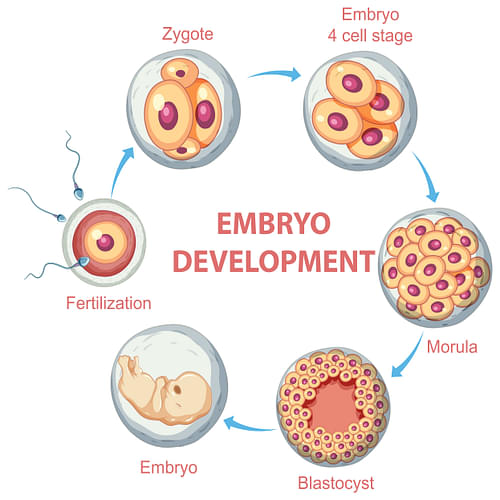
Formation of Zygote During Embryo Development
Answer: The fusion of male and female gametes takes place through a process called fertilization. Sperm is released by the male reproductive organ called the penis. Semen enters a woman's body through one of her reproductive organs called the vagina. The sperm then passes through the fallopian tubes and meets the egg produced by the female organs. Fertilization takes place in the fallopian tube.
When male and female gametes fuse, the first cell formed is called a zygote. The whole process takes place inside the female body, that's why it is called internal fertilization. In this way, the zygote is formed inside. Embryonic development, also known as embryogenesis, is the development of animal or plant embryos. Embryonic development begins with the fertilization of an egg (egg) by a sperm (sperm). Once fertilized, the egg becomes a diploid cell called a zygote.
The zygote undergoes meiosis without significant growth (a process called cleavage) and cell differentiation, resulting in the development of a multicellular embryo after passing through an organizational checkpoint during mid-embryogenesis.
Note: The formation of a totipotent zygote with the potential to generate an entire organism depends on epigenetic reprogramming. Demethylation of the paternal genomic DNA in the zygote appears to be an important part of epigenetic reprogramming.
In the paternal rat genome, DNA demethylation, especially at methylated cytosine sites, is probably an important process in establishing the ability to thrive. Demethylation is involved in basic repair processes and may be based on other DNA repair mechanisms.



Comments