



Content Writer
Human Reproduction is a form of sexual reproduction that is used to produce offspring by the process of fertilization.
- It is a form of sexual intercourse between human males and females.
- The process of human reproduction involves the formation of gametes.
- Insemination is the process of transfer of sperm to the female tract.
- The fusion between male and female gametes results in the formation of a zygote.
- Zygotes formed from a parent's cell have 23 chromosomes for each of both parents.
- Human embryogenesis is the process of development of the zygote.
- The liberation of eggs is an essential feature of human reproduction system.
- For the process to be carried out smoothly, specific organs are required in both males and females.
| Table of Content |
Key Terms: Human Reproduction, Male Reproductive System, Female Reproductive System, Gametogenesis, Menstruation Cycle, Fertilization, Pregnancy, Foetus
Male Reproductive System
[Click Here for Sample Questions]
The male reproductive system is situated in the pelvis region of the human body. It is divided into two areas, namely testicles and the penis.
- Testicles are where male sperm are produced.
- Penis is responsible for discharging sperm in the form of semen.
- Accessory ducts, glands and external genitalia are parts of the male reproductive system.
Some important part of male reproductive system are as follows:
Scrotum
The scrotum is a pouch-like structure that is situated below the abdominal cavity. It is used to maintain the testes' low temperature, which is between 2-2.5 degrees Celsius. It is used to lower than the normal internal body temperature which is necessary for spermatogenesis.
Testicular Lobules
Testicular lobules are situated in the testes, which comprise 250 compartments. It is a form of dense covering that covers the testes. Each testicular lobule tends to consist of 1-3 coiled seminiferous tubules. The seminiferous tubules are the place where sperm is produced.
Sertoli Cells
Sertoli Cells are types of cells that are found at the lining of the tubules.
Interstitial Cells
Interstitial cells are also known as leydig cells. It is used to synthesize and secrete testicular hormones called androgens. The cells are located at the seminiferous tubules.
Accessory Ducts
The accessory ducts include vasa efferentia, rete testis, vas deferens, and epididymis. It is responsible for storing and transporting sperm through urethra.
Urethra Meatus
Urethra Meatus is a form of external opening that originates from the urethra of the urinary bladder and is extended to the penis.

Male Reproductive System
Read More:
| Chapter Related Concepts | ||
|---|---|---|
| Pollination by Insects | Double Fertilization in Angiosperms | Pollination |
| Asexual reproduction | Binary fission | Reproduction in animals |
Female Reproductive System
[Click Here for Previous Year Questions]
The female reproductive system is made up of ovaries which also includes a pair of oviducts, vagina, uterus, external genitalia and cervix. The parts of the female reproductive system are situated in the pelvic region.
- The process of reproduction of females includes ovulation, fertilization, pregnancy, childbirth and child care.
- The glands of the female reproductive system are supported structurally and functionally.
Some important parts of the female reproductive system are as follows:
Ovaries
Ovaries are the main sex organ of the female reproductive system. It is used in the production of gamete and many steroid hormones, which are also called ovarian hormones.
- It is situated at the lower abdomen of the human body.
- The size of the ovaries is about 2 to 4 cm in length.
Accessory Ducts
The accessory ducts of the female consist of the fallopian tube, vagina and uterus. It consists of a funnel-shaped infundibulum that is located close to the ovary.
Fimbriae
Fimbriae are finger-like projections that are terminated at the infundibulum. It is used for the ovum that is placed by fallopian tubes.
Isthmus
Isthmus is the last part of the oviduct, a form of narrow lumen. The isthmus is connected to the uterus, which is also known as the womb.
Uterus
The uterus is a single passage that opens into the vagina through the cervix. It is an inverted pear that is supported by ligaments attached to the pelvic wall. The uterus is also known as the womb.
Hymen
Hymen is a type of membrane that is used to cover the vagina partially. It is most probably torn at the time of first coitus. Hymen is an indicator of virginity or sexual experience.

Female Reproductive System
Process of Human Reproduction
[Click Here for Sample Questions]
The process of human reproduction is divided into three categories which are as follows:
Pre-Fertilisation
Pre-fertilisation is the first stage of the human reproductive system. In this stage, gametes are formed and transferred to the female reproductive system.
Fertilization
Fertilization is the second stage of human reproduction, which includes fusion of sperm. The process is initiated when semen is released in the vagina of a female by the male reproductive system.
Post-Fertilization
Post-Fertilization is the process where the mitotic division of the zygote takes place. It leads to the formation of embryos. The process of formation of an embryo is also called embryogenesis.
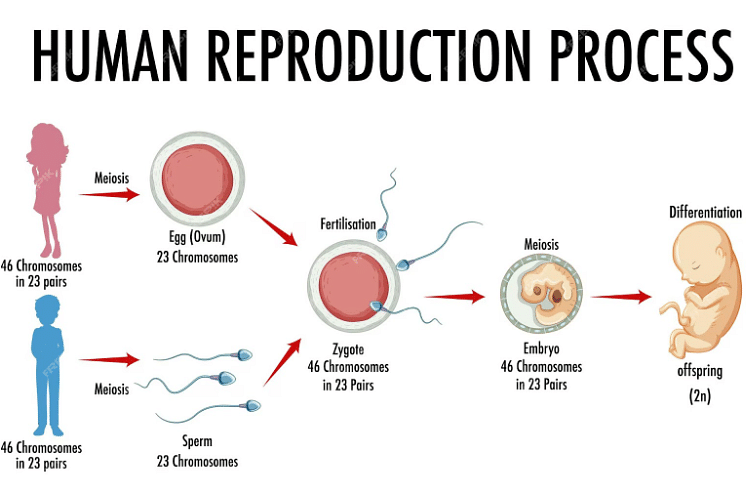
Human Reproduction
Gametogenesis
[Click Here for Previous Year Questions]
Gametogenesis is a process where the primary sex organs of the male and female reproductive system form gametes.
- It has diploid cells that undergo cell division to form mature gametes.
- The process takes place either through mitosis or the meiotic division of diploid gametocytes.
- Spermatogonia is responsible for the creation of sperms in the testes at the time of puberty.
- It consists of a total of 46 chromosomes.
- The process of waiting for a female gamete to become mature is called oogenesis.
Menstruation Cycle
[Click Here for Sample Questions]
Menstruation cycle is a type of cycle that is initiated when you start shedding your uterus lining. It will prepare your body for pregnancy.
- A usual menstruation cycle lasts for around 24 to 38 days.
- It is also known as menses, menstrual period, menstrual cycle or period.
- Menstrual Phase, Follicular Phase , Ovulatory Phase and Luteal phase are four phases of the menstrual cycle.
- During the menstruation period, the female body produces an ovum.
- It usually lasts for three to five days.
Pregnancy and Embryonic Development
[Click Here for Previous Year Questions]
Pregnancy is a biological process where a woman's womb may create one or more offspring. It usually starts on the first day of your last menstrual cycle.
- The process of pregnancy usually lasts for almost 266 days or 38 weeks.
- A female body undergoes three stages of the trimester.
- The first three months indicate the first trimester, which involves pre-embryonic and embryonic development.
- The second stage of the trimester results in the development of the fetus.
- The third trimester, which usually lasts for three months, is when the baby grows and matures.
Things to Remember
- Human reproduction consists of the male and female reproductive system.
- Perimetrium, Myometrium and Endometrium are three different types of uterus walls.
- The process is responsible for the fusion of male and female gametes in the reproductive system.
- The male and female reproductive systems differ in terms of structure and function.
- Artificial insemination is the process of creating an ovum in the female uterus.
Read More:
Previous Year Questions
- Extraction of metal from the ore cassiterite involves...[JEE Advanced 2011]
- Commonly used vectors for human genome sequencing are...[NEET UG 2014]
- Interfascicular cambium and cork cambium are formed due to..
- Pneumotaxic centre is present in...[UP CPMT 2007]
- Reaction of HBr with propene in the presence of peroxide gives….[NEET UG 2004]
- Assuming the expression for the pressure exerted by the gas on the walls of the container, it can be shown that pressure is...[MHT CET 2016]
- Which among the following is the strongest acid?...[TS EAMCET 2017]
- Isopropyl alcohol on oxidation forms..
- A vector is not changed if..
- Which of the following arrangements does not represent the correct order of the property stated against it?...[JEE Main 2013]
- The major product of the following reaction is...[JEE Main 2019]
- Major product of the following reaction is..[JEE Main 2023]
- The percentage of nitrogen in urea is about..
- The electric field at a point is
- Which of the following statements is true?..[JKCET 2006]
Sample Questions
Ques. Explain the term reproduction? (3 marks)
Ans. Reproduction is defined as the process of giving birth to offspring or young ones that are identical to the parent cells.
- It is divided into two categories: sexual and asexual reproduction.
- The process involves the fusion of sperm and egg in the male and female reproductive system.
- It leads to the process of fertilization that results in the development of the fetus.
Ques. What is the difference between asexual and sexual reproduction? (3 marks)
Ans. The difference between sexual and asexual reproduction are as follows:
| Sexual Reproduction | Asexual Reproduction |
|---|---|
| Sexual reproduction requires fusion of male and female cells. | Asexual reproduction does not require fusion of male and female cells. |
| It requires energy. | It requires less energy. |
| The process takes a longer time. | The process does not take a longer time. |
Ques. Explain the stage of parturition? (4 marks)
Ans. The process of parturition involves development of placenta and foetus. In this contraction of the uterus takes place.
- The process takes place in the maternal pituitary gland.
- It instigates the release of a chemical called oxytocin.
- The compound reacts with the muscles of the uterine.
- It results in the formation of contractions.
- A stronger contraction will be created by the pique reflex between uterine contraction and oxytocin.
- The baby is released from the uterus.
Ques. Explain the process of spermatogenesis? (3 marks)
Ans. Spermatogenesis is a process used to develop cells that take place inside the male reproductive system.
- During this process, the male sperm cells undergo meiosis.
- The process will result in the formation of spermatocyte cells.
- It is usually initiated at the time of puberty of the seminiferous tubules of the male reproductive system.
- The process depends upon the sexual reproduction inside the body.
Ques. What is the difference between external fertilization and internal fertilization? (3 marks)
Ans. The difference between external fertilization and internal fertilization are as follows:
| External Fertilization | Internal Fertilization |
|---|---|
| External fertilization takes place in the external environment. | Internal fertilization takes place by the fusion of gametes inside the female body. |
| In this multiple gametes are formed. | In this lesser number of gametes are formed. |
| The process takes place outside the body. | The process takes place inside the body. |
Ques. Explain the process of reproduction? (3 marks)
Ans. The process of reproduction is as follows:
- Pre-Fertilisation: This is the first stage where gametes are formed and transferred to the female reproductive system.
- Fertilization: This is the second stage of human reproduction where semen is released in the vagina of a female by the male reproductive system.
- Post-Fertilization: This is the third stage which leads to the formation of embryos. The process of formation of an embryo is also called embryogenesis.
Ques. What are the different stages of sexual reproduction? (3 marks)
Ans. The different stages of sexual reproduction are as follows:
- Juvenile Phase: Juvenile Phase is the first phase of sexual reproduction where an individual organism grows after its birth. The process continues until it reaches its reproductive maturity.
- Reproductive Phase: Reproductive Phase is the second stage where an individual organism reproduces sexually.
- Senescent Phase: Senescent Phase is the third stage where an organism will grow old and cannot reproduce.
Ques. What are the stages of pregnancy? (3 marks)
Ans. The different stages of pregnancy are as follows:
- First Trimester: This is the first stage of pregnancy, where embryonic development of the zygote takes place. It usually starts from week one to twelve.
- Second Trimester: This is the second stage where the development of foetal take place. In this stage, most of the body parts are developed.
- Third Trimester: This is the last stage of pregnancy, which results in the formation of the blood cells, bones turn hard, sense organs developed and the fingernails are also visible by this stage.
Ques. Explain the process of oogenesis? (3 marks)
Ans. The process of oogenesis is divided into three stages, which are as follows:
- Pre-natal Stage: This is the first stage of oogenesis, where cells inside the human body are enlarged to form oocytes.
- Antral Stage: This is the second stage of oogenesis, where the antrum is formed by the combination of a fluid-filled area between the granulosa cells.
- Pre-Ovulatory Stage: During this stage, a follicle is formed, and this results in the formation of two unequal cells.
Ques. What is the difference between male and female reproductive systems? (3 marks)
Ans. The difference between male and female reproductive systems are as follows:
| Male Reproductive System | Female Reproductive System |
|---|---|
| Male reproductive system consists of two main divisions namely testicles and sperm. | Female Reproductive System consists of two main divisions namely external genitalia and the internal genitalia. |
| Accessory ducts, glands and external genitalia are parts of the male reproductive system. | Pair of oviducts, vagina, uterus, external genitalia and cervix are parts of the female reproductive system. |
| It depends upon the functioning of testes. | It depends upon the functioning of ovaries. |
Ques. What are the strategies undertaken by a doctor to understand embryology? (3 marks)
Ans. The strategies undertaken by a doctor to understand embryology are as follows:
- Therapeutic procedures that are used in case of infertility
- Diagnosis for prenatal conditions
- Using surgical procedures for pregnancy
- Taking measures to prevent the cases of birth defects
For Latest Updates on Upcoming Board Exams, Click Here: https://t.me/class_10_12_board_updates
Check-Out:



Comments