



Education Journalist | Study Abroad Lead
Every organism undergoes a series of variations and growth during its lifecycle. Gametogenesis refers to the process of formation gametes in the primary sex organs. Gametogenesis in humans includes spermatogenesis in males and oogenesis in females. In simple terms, spermatogenesis refers to the process of formation of sperms, and oogenesis refers to the process of formation of the ovum. The article focuses on defining the process of gametogenesis in humans in detail.
| Table of Content |
Key Takeaways: Gametogenesis, Spermatogenesis, Oogenesis, Sperm, Egg/ovum, Ovulation, Meiosis, Mitosis, Gamete, Diploid Cell, Haploid cell, Gametophyte
Gametogenesis
[Click Here for Sample Questions]
Gametogenesis can be defined as the process of division of diploid cells to form new haploid cells via cell differentiation and meiotic division. Gametogenesis is a vital process necessary for sustaining life. It is the process of formation of male and female gametes in the primary sex organs.
- In humans, there are two different types of gametes. Sperm is the male gamete, and ova or ovum is the female gamete.
- In plants, haploid spores are formed when diploid cells undergo meiosis. These haploid spores give rise to a haploid generation called gametophyte.
- Animals consist of a tissue called germline that is dedicated to the formation of gametes. The germline consists of germ cells, which undergo meiosis and give rise to gamete cells, which eventually develops into gametes.
Gametogenesis includes two important processes: Spermatogenesis and Oogenesis. Spermatogenesis is a process in which formation of sperms occurs in males. Oogenesis refers to the formation of the ovum in females.
Also Read:
| Related Articles | ||
|---|---|---|
| Difference between sperm and ovum | Female reproductive system | Difference between spermatogenesis and oogenesis |
Spermatogenesis
[Click Here for Sample Questions]
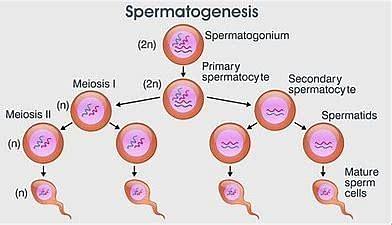
Spermatogenesis refers to the process of formation of sperms (male gamete). In males, during puberty, the immature germ cells or spermatogonia in the testes are converted into sperms via the process of spermatogenesis.
Stages of Spermatogenesis
The process of spermatogenesis has got three phases:
Multiplication phase
In the multiplication phase, the spermatogonia or the male germ cells, which are diploid cells, undergo mitotic divisions and form a large number of spermatogonia.
Growth phase
During the growth phase, the spermatogonia accumulate nutrition in the cytoplasm and become large in size. They are ready for meiotic division and are called primary spermatocytes. Primary spermatocytes consist of 46 chromosomes.
Maturation phase
In the maturation phase, the primary spermatocytes undergo the first meiotic division and produce two equal haploid cells called the secondary spermatocytes. They only have 23 chromosomes each. These secondary spermatocytes undergo a second meiotic division to generate four equal haploid spermatids or immature sperms. These immature sperms or spermatids undergo the process of spermiogenesis to transform into sperms, also called spermatozoa.
Hormones involved in Spermatogenesis
Gonadotropin releasing hormones (GnRH), follicle stimulating hormone (FSH), luteinizing hormone (LH), and androgens are the hormones involved in stimulating the process of spermatogenesis.
Hormones involved in Spermatogenesis
Oogenesis
[Click Here for Sample Questions]
Oogenesis refers to the process of formation of the ovum or the matured female gamete. The process of oogenesis has got three phases- pre-antral stage, antral stage and pre-ovulatory stage.
Stages of Oogenesis
Pre-antral Stage
Pre-antral stage is a slow stage requiring about 300 days at least to complete various processes. This is a gonadotropin independent stage of oogenesis. The germ cells in the ovary undergo mitotic division and produce many gamete mother cells called oogonia. These mother cells or oogonia undergo mitosis and lead to the formation of primary oocytes. Meiosis I get arrested, while the primary oocyte grows. On the outer layer of the primary oocytes, primary follicles are present. Slowly the primary oocyte grows and acquires a stratified cuboidal epithelium. These cells are referred to as granulosa.
Antral Stage
This is a gonadotropin dependent stage of oogenesis. During this phase, the fluid-filled spaces between granulosa cells merge together to form the antrum which is a central fluid-filled cavity or space. When more granulosa cells and a theca start to surround the primary follicles, it forms secondary follicles. Under the influence of luteinizing hormone (LH) and follicle-stimulating hormone (FSH) these secondary follicles develop during every monthly cycle. Gradually, the secondary follicle develops into a tertiary follicle. The theca layer gets organized into an outer theca externa and inner theca interna.
Pre-Ovulatory Stage
This stage is induced by a surge in the luteinizing hormone (LH) and here meiosis-I gets completed. The primary oocytes present in the tertiary follicles grow and undergo first meiotic division during female puberty. The division is unequal and results in the formation of a large secondary oocyte (haploid) and a tiny polar body. Following this, the tertiary follicle undergoes certain functional and structural variations and matures into the Graafian follicle. A new membrane structure called zona pellucida forms around the secondary oocyte. (The secondary oocyte is called the other daughter cell). The secondary oocyte undergoes a second meiotic division and results in ovum formation. Later the Graafian follicle ruptures and the ovum gets released from the ovary via the process of ovulation.
Hormones involved in Oogenesis
Hormones involved in the formation of female gamete or ovum are GnRH, Luteinizing Hormone (LH), Follicle Stimulating Hormone (FSH), progesterone and estrogen.

Hormones involved in Oogenesis
Also Read: Reproductive system in humans
Things to Remember
Following are some important points:
- Gametogenesis refers to the process of formation of male and female gametes in the sex organs.
- Sperm is known as the male gamete, whereas ovum is known as the female gamete.
- The male gamete is formed via the process of spermatogenesis.
- Oogenesis is the process of the formation of ova or ovum in the ovary.
- GnRH, Luteinizing Hormone (LH) and Follicle Stimulating Hormone (FSH) are the major hormones involved in gametogenesis.
- Gametogenesis involves a series of meiotic and mitotic divisions, resulting in the creation of gametes.
Also Read:
Sample Questions
Ques: Differentiate between spermatogenesis and oogenesis? (5 Marks)
Ans: Following are the differences:
| Spermatogenesis | Oogenesis |
|---|---|
| Process of formation of male gametes. | Process of formation of female gametes. |
| In spermatogenesis, sperms are produced from spermatogonia. | In oogenesis, eggs or ovum are produced from oogonia. |
| Spermatogenesis occurs in the testes. | Oogenesis occurs inside the ovary. |
| In this process, all stages are completed in testes. | A major part of the process occurs inside the ovary. The final few stages occur in the oviduct. |
| Spermatogenesis is a continuous process. | Oogenesis is a discontinuous process. The initial stages take place in the foetus and the rest in later stages of life. |
| Sperms are motile gametes. | Ovum or egg are non-motile gametes. |
| Equal division happens resulting in the production of four sperms. | Unequal division occurs ultimately producing one large ovum and tiny polar bodies. |
Sperm and ovum fuses together to form a zygote, which further develops into an embryo. Fusion of male and female gametes is known as fertilization.
Ques: Explain the structure of a sperm? (4 Marks)
Ans: Sperm is the male gamete. It is a microscopic, motile structure. Sperm includes a head, neck, middle piece and tail. The tail helps the sperms to move and reach the ovum and is called a flagellum. The plasma membrane covers the whole body of the sperm. The head of the sperm consists of an elongated haploid nucleus and is surrounded anteriorly by a thin cap-like structure called the acrosome. The acrosome consists of enzymes that aid the sperm in penetrating the ovum. The middle portion consists of numerous mitochondria, which provides the sperm with sufficient energy to move and fuse with the egg. The seminal plasma, along with the sperm, constitutes the semen.

Structure of a sperm
Ques: What is spermiogenesis? (2 Marks)
Ans: Spermiogenesis is the final stage of spermatogenesis, where spermatids get matured into spermatozoa or sperms. The spermatid is a circular cell consisting of a nucleus, centriole, Golgi apparatus and mitochondria. All these components play a vital role in the formation of sperms. Post spermiogenesis, the head of the sperms gets embedded in the Sertoli cells, and they are released into the lumen of seminiferous tubules. This process of release of spermatozoa is called spermiation.
Ques: What is ovulation? (2 Marks)
Ans: Ovulation refers to the process of release of the ovum or matured egg from the ovary. In other words, it is the process where the Graafian follicle ruptures and releases the secondary oocyte from the ovary. Ovulation happens once a month. The released egg through the fallopian tube reaches the uterus and waits for the sperm to enter. The uterine lining becomes thick for welcoming the fertilised egg. If fertilization does not happen, the uterine wall will be along with blood. This process is called menstruation.
Ques: Explain the structure of the ovum? (3 Marks)
Ans: Ovum or egg is the matured female gamete. It is formed via the process of oogenesis. Release of the egg from the ovary is known as ovulation. Ovum is haploid in nature and is generated via meiosis. These female gametes are larger than sperms and are the largest found cell in humans. Ovum has a spherical structure and is immobile in nature (since they lack a tail like the sperms). It consists of a central nucleus, cytoplasm and cell membrane. The ovum has got a thin double layer. The inner layer is called the vitelline membrane, and the outer layer is called zona pellucida. The space or gap between these two layers is called the pre-vitelline membrane.

Structure of a ovum
Ques: Which are the major hormones involved in gametogenesis? (3 Marks)
Ans: Gonadotropin Releasing Hormone (GnRH), Luteinizing Hormone (LH) and Follicle Stimulating Hormone (FSH) are the hormones that commonly participate in both spermatogenesis and oogenesis. GnRH is a peptide hormone that regulates the release of FSH and LH from the hypothalamus. FSH controls or regulates the process of gametogenesis by acting on the gamete producing cells. LH acts on the endocrine system and stimulates the release of steroid sex hormones. Additionally, androgens play a vital role in spermatogenesis, and hormones like estrogen and progesterone stimulate oogenesis.
Ques: Explain the menstrual cycle? (5 Marks)
Ans: Menstrual cycle refers to the rhythmic variation in the reproductive organs of the female body. The average length of a menstrual cycle is 28 to 29 days (but this can vary from one person to another). The first menstruation (or periods) starts at puberty and is called menarche. The cyclic events beginning from one menstruation till the next one is what is called the menstrual cycle.
There are four phases in the menstrual cycle. They are:
- Menstruation
- The follicular phase
- Ovulation
- Luteal phase
Many different glands and hormones are involved and control the menstrual cycle. During menstruation, the endometrial lining of the uterus along with blood vessels and unfertilized ovum comes out of the vagina. The process only happens if the egg is not fertilised. Lack of menstruation generally indicates pregnancy, but in some case, it can be a result of stress, or any health issues. Menopause is the time that marks the end of a person’s menstrual cycles. It is a natural biological process like menarche. Menopause is usually seen in women who are in their 40s or 50s.
For Latest Updates on Upcoming Board Exams, Click Here:https://t.me/class_10_12_board_updates
Do Check Out:



Comments