




The IIT JAM Economics Syllabus 2027 has been released along with the official Information Brochure by the conducting IIT. The IIT JAM Economics syllabus is expected to remain unchanged from 2026 and covers Microeconomics, Macroeconomics, Statistics for Economics, Indian Economy, and Mathematics for Economics at the undergraduate level.
| IIT JAM Economics Syllabus 2027 PDF (Expected Soon) |
- Topics such as Consumer Theory, General Equilibrium, Game Theory, IS-LM, Mundell-Fleming, Probability, OLS Regression, and Mathematical Optimisation are among the key high-priority areas based on previous-year trends.
- The IIT JAM Economics syllabus is expected to follow the 2026 syllabus structure, with no major revisions announced so far.
- The IIT JAM Economics paper consists of 60 questions carrying 100 marks and is conducted for 3 hours across MCQ, MSQ, and NAT sections.
Related Links:
- IIT JAM Syllabus 2027: Subject Wise Topics, Topic Wise Weightage and PDF Download
- IIT JAM 2027: Notification Expected September 2026, Syllabus, Eligibility and Cutoff
- IIT JAM Chapter Wise Weightage: Check Subject Wise High Weightage Topics
Key Summary
- IIT JAM Economics Syllabus 2027 is expected to be released in September 2026, with the syllabus likely to remain unchanged from 2026.
- The syllabus covers Microeconomics, Macroeconomics, Statistics, Indian Economy, and Mathematics for Economics.
- Microeconomics and Macroeconomics carry the highest combined weightage, making them key areas for preparation.
- Candidates should focus on PYQs, high-weightage topics, numerical practice, standard books, and regular mock tests.
IIT JAM Economics Syllabus: What’s New in 2027?
No official Economics syllabus revision has been announced for IIT JAM 2027 as of August 2026. The 2027 syllabus is expected to follow the structure established in the 2026 Information Brochure.
- The official curriculum remains completely identical and stable following previous revisions.
- The test structure remains a 3-hour Computer-Based Test (CBT) consisting of 60 questions totaling 100 marks:
Check out the below video for more detailed information
Ques. What are the subjects included in the IIT JAM Economics syllabus 2027?
Ans. The 5 subjects included in the IIT JAM Economics syllabus are:
- Microeconomics
- Macroeconomics
- Statistics & Econometrics
- Mathematics for Economics
- Indian Economy
Also Check:
How to Download IIT JAM Economics Syllabus 2027 PDF?
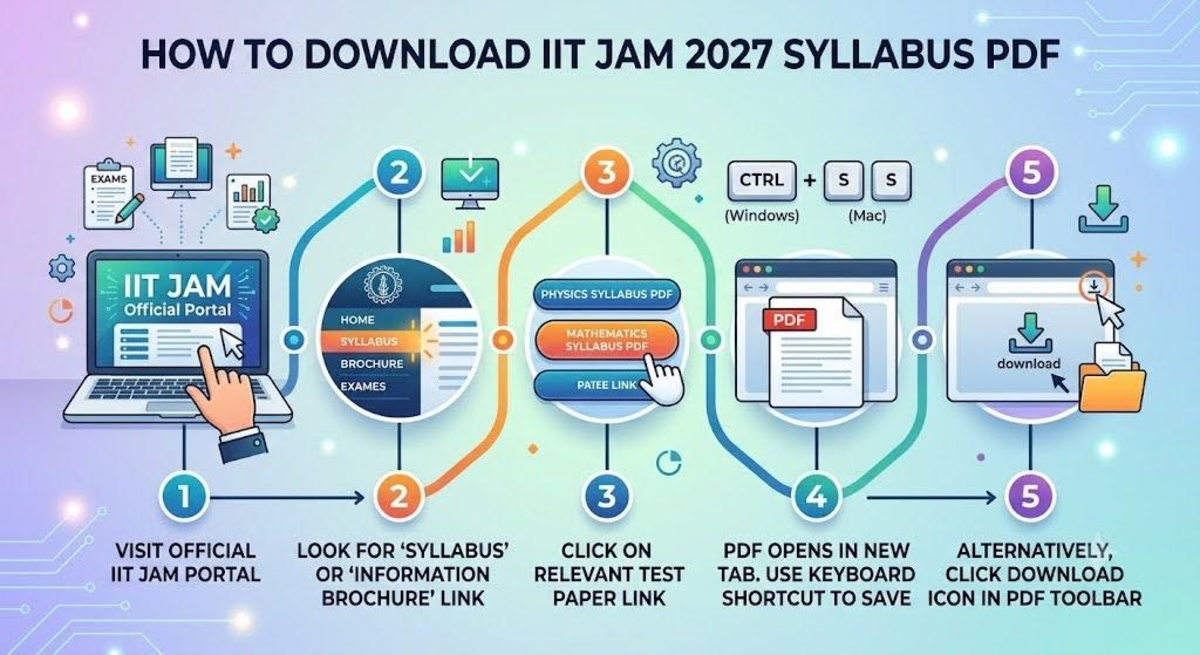
The official IIT JAM Economics syllabus 2027 PDF will be part of the Information Brochure expected to be published by IIT Roorkee. Follow these steps once the portal goes live in September 2026:
- Visit the official IIT JAM portal.
- Look for the "Syllabus" or "Information Brochure / Bulletin" link in the homepage navigation menu.
- Click on the Economics test paper link.
- The PDF opens in a new browser tab. Press Ctrl + S (Windows) or Cmd + S (Mac) to save it to your device.
- Alternatively, click the download icon in your browser’s PDF toolbar to save the file directly.
Ques. What is the IIT JAM Economics exam pattern for 2027?
Ans. The IIT JAM Economics exam is a 3-hour Computer-Based Test (CBT) worth 100 total marks. It consists of 60 questions split into three distinct sections:
- Section A (MCQ): 30 Multiple Choice Questions (Negative marking applies).
- Section B (MSQ): 10 Multiple Select Questions with more than one correct option (No negative marking).
- Section C (NAT): 20 Numerical Answer Type questions requiring a calculated decimal input (No negative marking).
Also Check:
IIT JAM 2027 Syllabus for Economics (EN)
Below is the detailed IIT JAM Economics syllabus, based on the official syllabus PDF 2026:
- The IIT JAM Economics syllabus 2027 covers five areas: Microeconomics, Macroeconomics, Statistics, Indian Economy, and Mathematics for Economics.
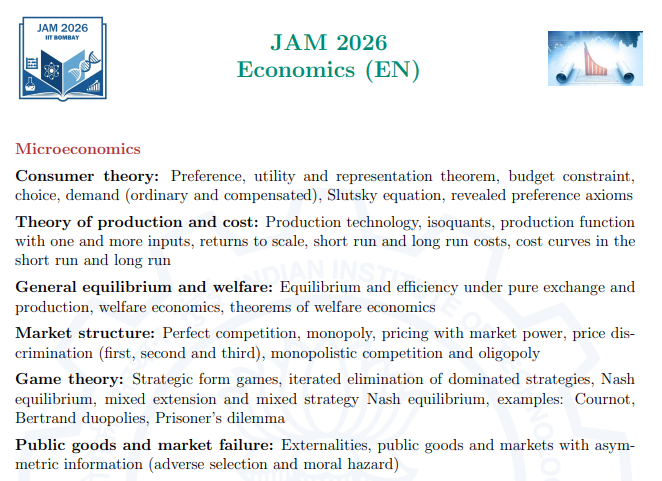
Source: IIT JAM Official Economics Syllabus 2026
| Unit | Chapter | Key Sub-topics |
|---|---|---|
| 1 | Microeconomics | Consumer Theory: preference relations and utility; budget constraints; utility maximisation and demand; expenditure minimisation; Slutsky equation; income and substitution effects; demand elasticity (price, income, cross); revealed preference theory. Producer Theory: production functions (Cobb-Douglas, CES, Leontief); isoquants; cost minimisation and cost curves; profit maximisation; factor demands. Market Structures: perfect competition; monopoly (price discrimination); monopolistic competition; oligopoly (Cournot, Stackelberg, and Bertrand models). General Equilibrium: exchange economy; Walrasian equilibrium; Edgeworth box; Pareto optimality; First and Second Welfare Theorems. Market Failure: externalities and Pigouvian tax; public goods; information asymmetry (adverse selection, moral hazard, signalling). Game Theory: strategic form games; dominant strategies; Nash equilibrium; mixed strategy equilibrium; extensive form games; backward induction; subgame perfect Nash equilibrium. |
| 2 | Macroeconomics | National Income Accounting: GDP, GNP, NNP; measurement methods (expenditure, income, value added); nominal vs real GDP; GDP deflator. IS-LM Framework: consumption function; investment function; IS curve derivation; money demand and supply; LM curve derivation; simultaneous equilibrium; fiscal and monetary policy multipliers; crowding-out effect. AD-AS Model: aggregate demand; short-run and long-run aggregate supply; price level and output determination; stagflation. Inflation and Unemployment: types of unemployment; natural rate of unemployment; Phillips curve (short-run and long-run); adaptive and rational expectations. Open Economy: balance of payments (current and capital account); exchange rate systems; purchasing power parity; Mundell-Fleming model. Economic Growth: Harrod-Domar model; Solow growth model (steady-state, golden rule of capital accumulation, convergence); endogenous growth basics (AK model). |
| 3 | Statistics for Economics | Descriptive statistics (central tendency, dispersion, skewness, kurtosis); probability theory (sample space, events, Bayes’ theorem); probability distributions (binomial, Poisson, normal); sampling methods and sampling distributions; point and interval estimation; hypothesis testing (z-test, t-test, chi-square test, F-test); simple and multiple linear regression (OLS assumptions, R-squared, F-test, multicollinearity basics); index numbers (Laspeyres, Paasche, Fisher); time series basics (trend, seasonality). |
| 4 | Indian Economy | Economic planning in India (Five-Year Plans, NITI Aayog); poverty (measurement, trends, anti-poverty programmes); inequality (Gini coefficient, Lorenz curve); agriculture sector (land reforms, Green Revolution, agricultural marketing, food security); industrial sector (industrial policy, public sector, 1991 liberalisation); foreign trade and balance of payments; monetary policy and RBI functions; fiscal policy (Union Budget, FRBM Act); banking sector reform; inflation trends; unemployment types; human development indicators (HDI, education, health). |
| 5 | Mathematics for Economics | Linear Algebra: matrix operations (addition, multiplication, transpose); determinants; rank; inverse; system of linear equations (Cramer’s rule, Gauss elimination); eigenvalues and eigenvectors. Calculus: univariate and multivariate functions; derivatives (chain rule, product rule); partial derivatives; total differential; implicit differentiation; Euler’s theorem for homogeneous functions. Optimisation: unconstrained optimisation (first and second order conditions, Hessian matrix); constrained optimisation (Lagrange multipliers, bordered Hessian; Kuhn-Tucker conditions); Envelope theorem. Differential Equations: first-order linear differential equations; stability analysis of equilibria. |
Ques. What are the most important Microeconomics topics for IIT JAM Economics?
Ans. Most important Microeconomics topics for IIT JAM Economics include:
- Consumer Theory: Utility maximisation, Slutsky equation, and non-standard preferences (min/max functions).
- Market Structures: Cournot, Bertrand, Stackelberg oligopoly models, and price discrimination.
- Game Theory: Nash equilibrium and dominant strategies.
IIT JAM Economics Question Paper with Solutions
| Subject | Question Paper PDF | Solution PDF |
|---|---|---|
| IIT JAM Economics 2026 | Download PDF | View Solution |
| IIT JAM Economics 2025 | Download PDF | Check Solutions |
| IIT JAM Economics 2024 | Download PDF | Check Solutions |
| IIT JAM Economics 2023 | Download PDF and Check Solutions | |
| IIT JAM Economics 2022 | Download PDF and Check Solutions | |
IIT JAM Economics Syllabus: Paper-wise Weightage 2027
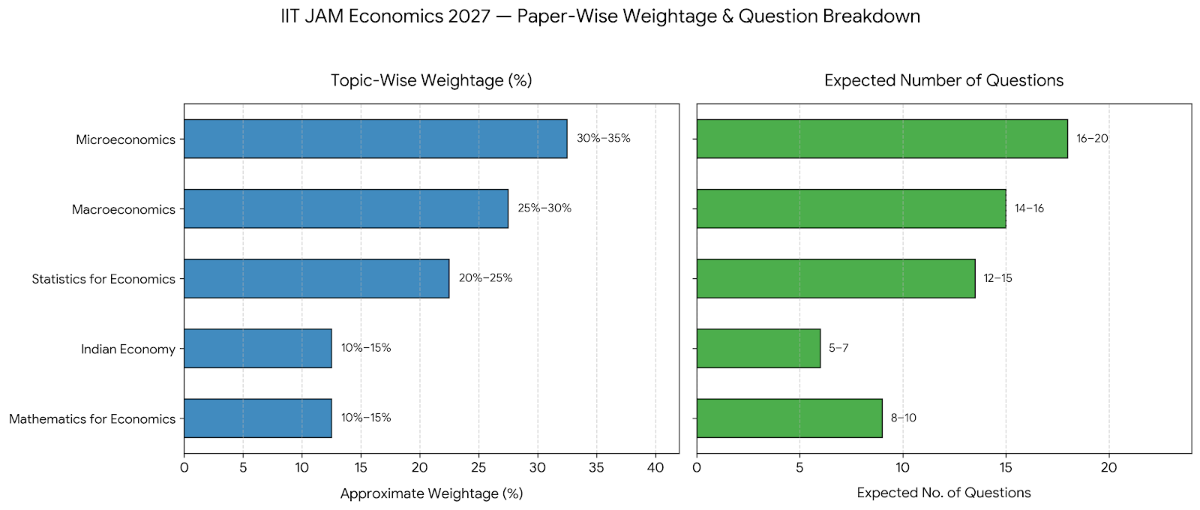
The tables below show approximate topic-wise weightage derived from analysis of previous IIT JAM question papers:
- Prioritise Microeconomics and Macroeconomics, as together, they account for around 55–65% of the paper, making consumer theory, market structures, IS-LM, Solow and Mundell-Fleming key preparation areas.
- Focus on OLS regression, hypothesis testing, Lagrangian optimisation, eigenvalues and differential equations, while also covering RBI frameworks and recent Indian economy trends.
| Section | Approximate Weightage | Expected No. of Questions | Key Topics to Prioritise |
|---|---|---|---|
| Microeconomics | 30–35% | 16–20 | Consumer theory, Nash equilibrium, market structures (Cournot, Bertrand) |
| Macroeconomics | 25–30% | 14–16 | IS-LM model, Solow growth model, Mundell-Fleming |
| Statistics for Economics | 20–25% | 12–15 | OLS regression, hypothesis testing, normal distribution |
| Indian Economy | 10–15% | 5–7 | RBI frameworks, inflation targeting, recent fiscal balance trends |
| Mathematics for Economics | 10–15% | 8–10 | Lagrangian optimisation, eigenvalues, first-order differential equations |
| Total | 100% | 60 Questions | — |
Ques. What are the most important Macroeconomics topics for IIT JAM Economics?
Ans. Most important Macroeconomics topics for IIT JAM Economics include:
- Behavioral Frameworks: IS-LM dynamics and AD-AS policy multipliers.
- Growth Models: Solow-Swan steady-state and Golden Rule capital calculations.
- Open Economy: Mundell-Fleming framework and Balance of Payments.
Also Check: IIT JAM Paper Analysis 2027: Expected February 2027, Session-Wise Difficulty and Good Attempts
IIT JAM Economics Syllabus 2027: High-Weightage Topics & Important Questions
As per the YouTube video, below are the most important questions to prepare in the IIT JAM Economics syllabus:
- Focus first on Consumer Theory, General Equilibrium, Market Structures, Game Theory, IS-LM, Mundell-Fleming, Probability, MLE, and Multivariable Calculus.
| Section | High-Weightage Topic | Most Important Questions to Practise |
|---|---|---|
| Microeconomics | Consumer Theory | Solve utility maximisation with complex min/max utility functions; find substitution, income and total effects; revealed preference questions; calculate risk premium and insurance premium |
| General Equilibrium & Welfare | Find competitive equilibrium; analyse First & Second Welfare Theorems; identify conditions under which welfare theorems fail | |
| Producer Theory & Market Structure | Multiplier-related problems; Lerner Index; monopoly equilibrium; perfect competition vs monopoly; consumer/producer surplus and deadweight loss | |
| Price Discrimination | Solve 1st, 2nd and 3rd-degree price discrimination problems; bundling and optimal pricing | |
| Game Theory | Strategic & Dynamic Games | Find equilibrium in 2-player/3-strategy and 3-player/2-strategy games; sequential games; identify Nash equilibrium |
| Oligopoly | Cournot, Bertrand & Stackelberg | Solve 2-, 3- and n-firm models; derive equilibrium quantity/price; compare (P=a-bQ) and (P=a-Q); differentiated products; Bertrand paradox |
| Macroeconomics | IS-LM | Calculate equilibrium income and interest rate; analyse monetary/fiscal policy changes; solve numerical IS-LM problems |
| Multiplier & Money Multiplier | Calculate investment/expenditure multiplier and money multiplier under different conditions | |
| Mundell-Fleming | Solve the major Mundell-Fleming cases under fixed/flexible exchange rates and different monetary/fiscal policies | |
| Statistics | Probability | Solve Bayes' theorem, conditional probability, independent/mutually exclusive events and exhaustive-event problems |
| Probability Distributions | Solve questions on Binomial, Exponential, Geometric, Negative Binomial and Normal distributions; calculate mean/variance/probabilities | |
| Joint Distribution | Find marginal distributions, (E(X)), (E(Y)), covariance and related expectations from joint distributions | |
| Maximum Likelihood Estimation | Derive and calculate MLE for standard distributions and solve numerical estimation problems | |
| Hypothesis Testing | Identify Type I/II errors, calculate/interpret power of a test, and solve testing problems | |
| Mathematics | Multivariable Calculus | Test continuity, partial differentiability and differentiability of piecewise two-variable functions |
| Linear Programming | Identify feasible/non-feasible solutions, solve optimisation problems and practise duality; solve NAT-based linear programming questions | |
| Macroeconomics | Consumption Theories | Solve numerical questions on Life-Cycle Hypothesis, Permanent Income Hypothesis and Fisher's consumption model |
| Investment Theory | Solve Tobin's Q/investment function numerical problems | |
| Phillips Curve | Compare original and expectations-augmented Phillips curves; identify correct statements | |
| Inflation | Differentiate demand-pull, cost-push and creeping inflation; solve conceptual/statement-based questions | |
| Growth Models | Solve Harrod-Domar and Solow model numericals | |
| Statistics | Correlation & Covariance | Practise covariance/correlation properties and numerical questions |
| Regression | Solve OLS/regression problems and practise formula-based questions from previous papers | |
| Mathematics | Vector Algebra | Find norms, angles between vectors, scalar multiplication and solve vector-based problems |
| Linear Algebra | Determine linear independence/dependence; solve determinant-based conditions and systems of equations | |
| Convexity | Identify convex sets, quasi-convex and quasi-concave functions | |
| Differential/Difference Equations | Solve differential/difference equations and understand phase diagrams and equilibrium conditions | |
| Microeconomics | Monopolistic Competition | Solve equilibrium and conceptual MCQs on monopolistic competition |
| Monopoly Applications | Solve questions on advertising ratio and optimal product quality | |
| Information Economics | Asymmetric Information | Conceptual MCQs on moral hazard and numerical problems on adverse selection |
| Public Economics | Social Choice | Voting paradox and conditions under which voting/social welfare mechanisms fail |
| Indian Economy | Economic History & Policy | Five-Year Plans, LPG reforms, Drain of Wealth, national income and major policy changes |
| Inequality & Fiscal Policy | Gini coefficient, Union Budget and Economic Survey-based questions |
Ques. How important is Statistics for IIT JAM Economics preparation?
Ans. Statistics questions are mostly asked within the scoring Numerical Answer Type (NAT) questions of the IIT JAM Economics exam. It focuses heavily on Simple/Multiple OLS Regression, Hypothesis Testing (t, F, Chi-square), and Maximum Likelihood Estimation (MLE).
Ques. Which Mathematics topics should I prioritise for IIT JAM Economics?
Ans. Mathematics topics to prioritise for IIT JAM Economics:
- Optimisation: Constrained optimisation using the Lagrangian method and the Envelope theorem.
- Linear Algebra: Matrix determinants, eigenvalues, and systems of equations.
- Calculus: First and second-order differential and difference equations.
Also Check: IIT JAM Eligibility Criteria 2027, Check Required Qualification and Marks
Best Books to cover the IIT JAM Economics Syllabus 2027
As per the YouTube video, below are some recommended books to prepare for the IIT JAM Economics syllabus:
- Prioritise Varian/Nicholson for Microeconomics, Hammond & Chiang for Mathematical Economics, and Michael Hoy for college-level Maths/Statistics, while using advanced books only for specific weak areas.
- Treat previous-year papers as a source of concepts and problem types, rather than memorising solutions, and use them to identify and strengthen weak areas.
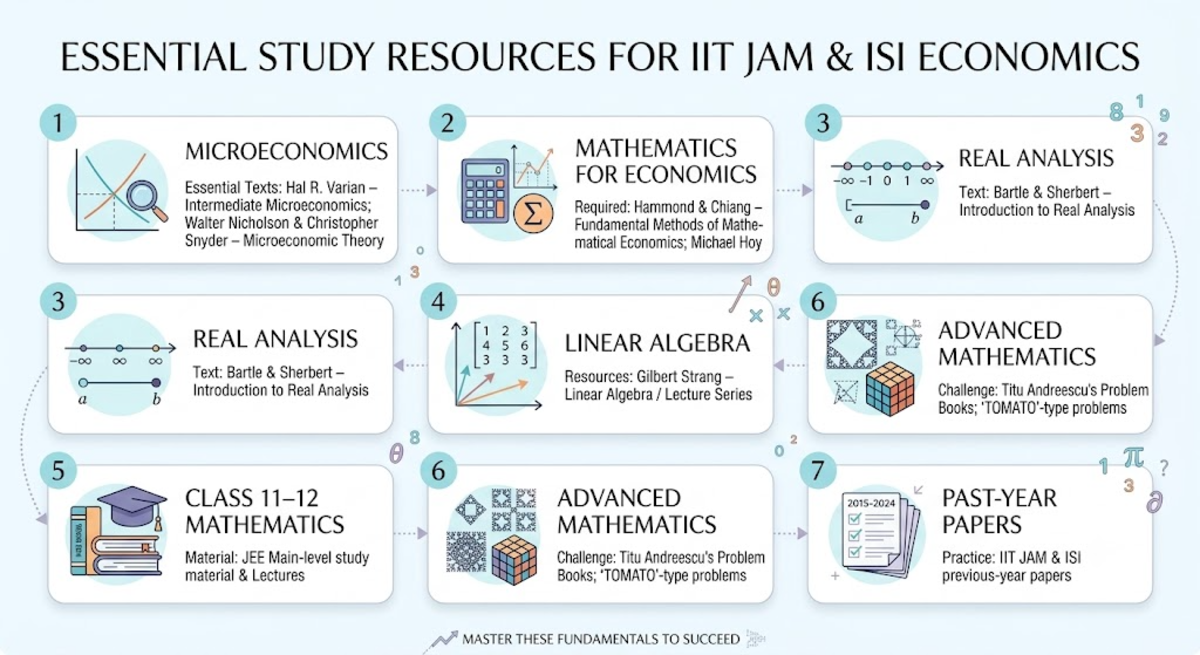
| Area | Recommended Book | How to Use It |
|---|---|---|
| Microeconomics | Hal R. Varian – Intermediate Microeconomics | Build concepts and practise application-based microeconomic problems |
| Microeconomics | Walter Nicholson & Christopher Snyder – Microeconomic Theory | Strengthen advanced micro concepts and problem-solving |
| Mathematics for Economics | Hammond & Chiang – Fundamental Methods of Mathematical Economics | Practise mathematical economics and optimisation concepts |
| Mathematics | Michael Hoy | Useful for college-level mathematics and statistics concepts |
| Real Analysis | Bartle & Sherbert – Introduction to Real Analysis | Reference for real analysis concepts; use selectively |
| Linear Algebra | Gilbert Strang – Linear Algebra / Lecture Series | Strengthen linear algebra fundamentals and problem-solving |
| Class 11–12 Mathematics | JEE Main-level study material/lectures | Useful for strengthening weak fundamentals in school-level mathematics |
| Advanced Mathematics | Titu Andreescu's/Tomato-type problem books | The topper considered this largely overkill; not essential for JAM preparation |
| Past-Year Papers | IIT JAM & ISI previous-year papers | Use as a concept-discovery and application resource rather than memorising solutions |
Ques. How should I prepare for IIT JAM Economics using previous-year papers?
Ans. Use Past Year Papers (PYPs) from 2021 onwards to map out recurring mathematical variants—specifically targeting how calculus is integrated into Micro and Stats questions. Solve Sections B and C without options under a strict timer to build speed and accuracy for zero-error numerical entry.
Also Check:
IIT JAM Economics (EN) 2027 Preparation Tips
Below are some tips for IIT JAM Economics preparation:
- Microeconomics and Macroeconomics together account for over 55% of the EN paper, so prioritise both sections from the start.
- Game Theory (Nash equilibrium, dominant strategies, subgame perfect equilibrium) is a consistently high-scoring topic in IIT JAM EN. Master all equilibrium concepts and their derivations.
- The Statistics section overlaps with Mathematical Statistics topics; if you are familiar with OLS regression and hypothesis testing, you can score here quickly.
- For Indian Economy, use a standard Indian economy textbook and the latest Economic Survey for data-driven questions.
- Constrained optimisation (Lagrangian method) and eigenvalue problems appear as NAT questions, so practise these numerically.
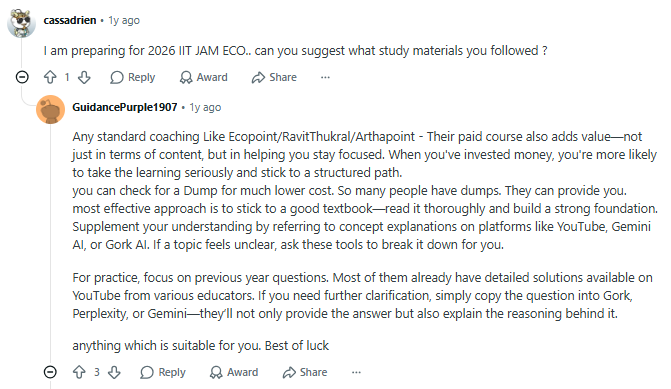
Based on a Reddit thread, below are some important tips for IIT JAM Economics preparation:
- While paid coaching (like Ecopoint or Arthapoint) can provide discipline and structure, the real value lies in consistent self-study with strong textbooks.
- Supplement textbooks with concept explanations from platforms like YouTube or AI assistants (Gemini, Groke, Perplexity).
- For practice, prioritize previous year papers; solutions are widely available online, and AI tools can break down reasoning step by step when doubts arise.
Source: Reddit
FAQs
Ques. How many questions are asked in IIT JAM Economics?
Ans. A total of 60 questions are asked in the IIT JAM Economics exam, split across 3 sections.
Ques. Which topics have the highest weightage in IIT JAM Economics?
Ans. The topics with the highest weightage in the IIT JAM Economics exam:
- Microeconomics: 30–35% weightage for ~16–20 questions
- Macroeconomics: 25–30% weightage for ~14–16 questions
- Statistics & Econometrics: 20–25% weightage for ~12–15 questions.
Ques. What are the best books for IIT JAM Economics preparation?
Ans. Best books for IIT JAM Economics preparation include:
- Microeconomics: Intermediate Microeconomics by Hal Varian.
- Macroeconomics: Macroeconomics by Richard Froyen or N. Gregory Mankiw.
- Mathematical Economics: Fundamental Methods of Mathematical Economics by Alpha Chiang and Kevin Wainwright.
- Statistics & Econometrics: Mathematical Statistics by S.C. Gupta & V.K. Kapoor; Basic Econometrics by Damodar Gujarati.
- Indian Economy: Indian Economy by Ramesh Singh, supplemented by the latest Union Budget and Economic Survey summaries.



Comments