IIT JAM Syllabus 2027 has been released by the Indian Institute of Technology (IIT) Kharagpur, the organizing institute for IIT JAM 2027, as part of the official Information Brochure published on August 22, 2026, at jam.iitkgp.ac.in. The Joint Admission Test for MSc (IIT JAM) covers seven test papers: Physics (PH), Chemistry (CY), Mathematics (MA), Mathematical Statistics (MS), Biotechnology (BT), Economics (EN), and Geology (GG). Students aiming for MSc and other post-bachelor programs at IITs and IISc must download the official IIT JAM 2027 syllabus PDF from jam.iitkgp.ac.in and build their preparation around the prescribed topic list.

  • IIT JAM 2027 is organized by IIT Kharagpur and will be held on February 14, 2027.
  • The exam covers seven papers: Physics (PH), Chemistry (CY), Mathematics (MA), Mathematical Statistics (MS), Biotechnology (BT), Economics (EN), and Geology (GG).
  • Each paper carries 100 marks across three sections — MCQ (Section A, 50 marks), MSQ (Section B, 20 marks), and NAT (Section C, 30 marks).
  • The IIT JAM 2027 syllabus is broadly stable compared to 2026 — no major topic additions or removals have been reported across any of the seven papers.
  • Electricity & Magnetism and Modern Physics together carry approximately 33–40% of the Physics paper.
  • Physical Chemistry is the highest-weightage division in the Chemistry paper — roughly 40–45%.
  • You can download the official IIT JAM 2027 syllabus PDF from jam.iitkgp.ac.in/syllabus.html.

You should download the official IIT JAM 2027 syllabus PDF from IIT Kharagpur’s website and plan your preparation around the official topic list — the Information Brochure is the single authoritative reference for all seven papers.

IIT JAM Syllabus 2027: Subject-wise PDF Download

IIT JAM Syllabus 2027: Download Subject-wise PDFs

IIT Kharagpur has published the IIT JAM 2027 syllabus for all seven papers in the Information Brochure released on August 22, 2026. You can access subject-wise syllabus details from the official JAM 2027 portal.

IIT JAM Syllabus 2027: Overview

IIT JAM Syllabus 2027: Overview

IIT Kharagpur conducts IIT JAM 2027 on behalf of the Ministry of Education, Government of India. The exam grants admission to MSc, Joint MSc-PhD, MSc-PhD Dual Degree, and other post-bachelor programs at IITs and IISc Bangalore.

ParticularsDetails
Exam Full NameJoint Admission Test for MSc (IIT JAM)
Organizing Institute (2027)Indian Institute of Technology (IIT) Kharagpur
Official Websitejam.iitkgp.ac.in
Conducting BodyMinistry of Education, Government of India (via IITs)
Number of Test Papers7 (BT, CY, EN, GG, MA, MS, PH)
Mode of ExamComputer-Based Test (CBT)
Total Marks per Paper100
Duration per Paper3 Hours
Exam DateFebruary 14, 2027
Syllabus BasisBSc-level topics in respective disciplines
Maximum Papers per StudentTwo (in different sessions on exam day)
Admissions Offered AtIIT Bombay, IIT Delhi, IIT Kharagpur, IIT Madras, IIT Roorkee, IIT Kanpur, IIT Guwahati, IIT Hyderabad, IISc Bangalore, and others
IIT JAM 2027: Important Dates

IIT JAM 2027: Important Dates

The IIT JAM 2027 Information Brochure was released by IIT Kharagpur on August 22, 2026. Registration opens September 5, 2026. Missing the registration deadline means waiting an entire academic year — note all upcoming dates immediately after downloading the brochure.

EventDateStatus
Information Brochure ReleasedAugust 22, 2026Released
Online Registration OpensSeptember 5, 2026Upcoming
Registration Closes (Regular Fee)October 12, 2026Upcoming
Application Form Correction WindowOctober 2026 (Tentative)Upcoming
Admit Card DownloadJanuary 2027 (Expected)Upcoming
IIT JAM 2027 ExamFebruary 14, 2027Upcoming
Answer Key ReleaseFebruary–March 2027 (Expected)Upcoming
Result DeclarationMarch 2027 (Expected)Upcoming
Score Card DownloadApril 2027 (Expected)Upcoming
Admission Process (JOAPS Portal Opens)April–May 2027 (Expected)Upcoming

Source: jam.iitkgp.ac.in

IIT JAM 2027 Exam Pattern

IIT JAM 2027 Exam Pattern

Each IIT JAM 2027 paper is a three-hour Computer-Based Test with 60 questions across three sections. Section A carries negative marking — attempt a question only when you are confident, to avoid losing marks through wrong answers.

SectionQuestion TypeNumber of QuestionsMarksTotal MarksNegative Marking
Section AMultiple Choice Questions (MCQ) — one correct option30 (10 of 1 mark + 20 of 2 marks)1 or 2501/3 mark for 1-mark wrong; 2/3 mark for 2-mark wrong
Section BMultiple Select Questions (MSQ) — one or more correct options10 (all 2 marks)220None
Section CNumerical Answer Type (NAT) — type the answer; no options given20 (10 of 1 mark + 10 of 2 marks)1 or 230None
Total60100Section A only

MSQ questions in Section B award full marks only when all correct options are selected and no incorrect options are chosen — partial selection earns zero marks. NAT questions require entering the exact numerical value on the on-screen virtual keypad; no options are provided.

IIT JAM Syllabus 2027 for Physics (PH)

IIT JAM Syllabus 2027 for Physics (PH)

The IIT JAM Physics (PH) paper covers seven major units at the BSc level. Electricity & Magnetism and Modern Physics together carry roughly 33–40% of the paper — prioritise these two units first in your preparation schedule.

UnitTopic AreaKey Sub-topics
1Mathematical Methods

Sub-topics of Unit 1 — Click Here

Calculus of single and multiple variables; partial derivatives; Jacobian; Taylor expansion; Fourier series; Vector algebra and vector calculus; Multiple integrals; Divergence theorem; Green’s theorem; Stokes’ theorem; First order ODEs; Linear second order ODEs with constant coefficients; Matrices and determinants; Algebra of complex numbers

2Mechanics and General Properties of Matter

Sub-topics of Unit 2 — Click Here

Newton’s laws; Velocity and acceleration in Cartesian, polar, and cylindrical coordinates; Uniformly rotating frame; Centrifugal and Coriolis forces; Central force motion; Kepler’s laws; Gravitational law and field; Conservative and non-conservative forces; Centre of mass; Conservation of linear and angular momentum; Variable mass systems; Elastic and inelastic collisions; Rigid body motion; Moments and products of inertia; Principal moments and axes; Bernoulli’s theorem; Equation of continuity

3Oscillations, Waves and Optics

Sub-topics of Unit 3 — Click Here

SHM equations and solutions; Damped and forced oscillations; Resonance; Travelling and standing waves; Energy density and energy transmission; Group velocity and phase velocity; Sound waves; Doppler effect; Fermat’s principle; Image formation; Thin lens, thick lens, lens combinations; Interference of light; Optical path retardation; Fraunhofer diffraction; Rayleigh criterion; Diffraction gratings; Linear, circular, elliptic polarization; Double refraction; Optical rotation

4Electricity and Magnetism

Sub-topics of Unit 4 — Click Here

Coulomb’s law; Gauss’s law; Electric field and potential; Electrostatic boundary conditions; Solution of Laplace’s equation; Conductors, capacitors, dielectrics; Dielectric polarization; Volume and surface charges; Biot-Savart law; Ampere’s law; Faraday’s law of EM induction; Self and mutual inductance; DC and AC circuits with R, L, C; Displacement current; Maxwell’s equations; Plane EM waves; Poynting’s theorem; Reflection and refraction at dielectric interface; Lorentz force; Motion of charged particles in E and B fields

5Kinetic Theory and Thermodynamics

Sub-topics of Unit 5 — Click Here

Kinetic theory of gases; Maxwell velocity distribution; Equipartition of energy; Specific heats of mono-, di-, and tri-atomic gases; Ideal gas; Van der Waals equation; Mean free path; Laws of thermodynamics; Zeroth law; First law; Isothermal and adiabatic processes; Reversible and irreversible processes; Second law and entropy; Carnot cycle; Maxwell’s thermodynamic relations; Thermodynamic potentials; Phase transitions; Clausius-Clapeyron equation; Maxwell-Boltzmann, Fermi-Dirac, Bose-Einstein distributions

6Modern Physics

Sub-topics of Unit 6 — Click Here

Inertial frames; Postulates of special relativity; Lorentz transformations; Length contraction; Time dilation; Relativistic velocity addition; Mass-energy equivalence; Blackbody radiation; Photoelectric effect; Compton effect; Bohr’s atomic model; X-rays; Wave-particle duality; Uncertainty principle; Superposition principle; Schrodinger equation; Solutions for 1D, 2D, 3D boxes; 1D harmonic oscillator; Reflection and transmission at step potential; Pauli exclusion principle; Nuclear structure; Mass and binding energy; Radioactivity and decay laws

7Solid State Physics, Devices and Electronics

Sub-topics of Unit 7 — Click Here

Crystallography; Diffraction methods; Bonding in solids; Elastic properties; Crystal defects; Lattice vibrations; Thermal properties; Free electron theory; Band theory — metals, insulators, semiconductors; p-n junctions; Diodes and transistors; LCR circuits; Rectifiers; Amplifiers; Active filters and oscillators; LASER basics and applications; Superconductivity

IIT JAM Physics Chapter-wise Weightage

Topic AreaApprox. WeightageHigh-Priority Chapters
Electricity & Magnetism18–22%Maxwell’s equations, electromagnetic induction, Gauss’s law, AC circuits
Modern Physics15–18%Schrodinger equation, special relativity, photoelectric effect, radioactivity
Kinetic Theory & Thermodynamics12–15%Maxwell distribution, Carnot cycle, thermodynamic potentials, statistical distributions
Mechanics12–15%Central force motion, rigid body dynamics, Bernoulli’s theorem, Coriolis force
Solid State Physics & Electronics10–12%Band theory, semiconductors, p-n junctions, transistors
Oscillations, Waves & Optics10–12%Fraunhofer diffraction, polarization, SHM, interference
Mathematical Methods8–10%Vector calculus, Fourier series, differential equations, complex algebra
IIT JAM Syllabus 2027 for Chemistry (CY)

IIT JAM Syllabus 2027 for Chemistry (CY)

The IIT JAM Chemistry (CY) paper is divided into Physical Chemistry, Organic Chemistry, and Inorganic Chemistry. Physical Chemistry carries the highest weightage at roughly 40–45% — leaving this division weak will cost you significantly in the final score.

DivisionUnit / TopicKey Sub-topics
Physical ChemistryBasic Mathematical ConceptsFunctions, limits, differential equations, vectors, determinants, matrices
Atomic and Molecular Structure

Sub-topics — Click Here

Fundamental particles; Bohr’s theory; de Broglie’s hypothesis; Heisenberg’s uncertainty principle; Wave mechanics — Schrodinger equation; Hydrogen atom quantum numbers; Electronic configurations; Molecular orbital theory; Valence bond theory; Hybridization; VSEPR and shapes of molecules; Dipole moment

Theory of GasesEquations of state; Kinetic theory; Maxwell distribution; Van der Waals equation; Compressibility factor; Transport properties
Solid StateCrystal systems; Miller indices; Close packing; Unit cell calculations; Ionic crystals; X-ray diffraction; Point defects
Chemical Thermodynamics

Sub-topics — Click Here

First law; Internal energy; Enthalpy; Heat capacities; Kirchhoff equation; Second law; Entropy calculations; Gibbs and Helmholtz free energies; Chemical potential; Standard reaction thermodynamics; Equilibrium constant and temperature dependence; Le Chatelier’s principle; Third law of thermodynamics

Chemical and Phase EquilibriaLaw of mass action; Kp, Kc, Kx relationships; Clausius-Clapeyron equation; Phase rule; One-component and two-component phase systems; Colligative properties
ElectrochemistryEMF of cells; Standard electrode potentials; Nernst equation; Electrochemical series; Corrosion; Electrolytic conductance; Kohlrausch’s law; Debye-Huckel limiting law
Chemical KineticsRate laws; Order and molecularity; Rate constants; Arrhenius equation; Temperature dependence; Reaction mechanisms; Chain reactions; Enzyme catalysis (Michaelis-Menten)
AdsorptionPhysical vs. chemical adsorption; Langmuir isotherm; BET equation; Colloids — preparation, properties, coagulation
SpectroscopyRotational; Vibrational; Raman; Electronic spectroscopy; NMR basics; Beer-Lambert law; UV-Vis spectrophotometry
Organic ChemistryBasic Concepts and StereochemistryIUPAC nomenclature; Hybridization; Isomerism; Chirality; R/S and E/Z configurations; Newman projections; Conformational analysis; Ring strain
Reaction Mechanism and Synthetic Applications

Sub-topics — Click Here

Reactive intermediates — carbocations, carbanions, radicals, carbenes; SN1 and SN2 mechanisms; E1 and E2 mechanisms; Electrophilic and nucleophilic addition; Aromatic electrophilic substitution; Named reactions — Aldol, Cannizzaro, Grignard, Claisen, Diels-Alder, Wittig, Wolff-Kishner, Clemmensen, Baeyer-Villiger; Rearrangements — Pinacol, Beckmann; Multi-step synthetic planning

Qualitative Organic AnalysisFunctional group identification tests; Solubility classification; Melting and boiling point analysis
Natural Products ChemistryCarbohydrates; Amino acids; Peptides and proteins; Lipids; Nucleic acids; Alkaloids; Terpenes and steroids
Aromatic and Heterocyclic ChemistryBenzene aromaticity (Huckel’s rule); Electrophilic aromatic substitution and directing effects; Heterocycles — furan, pyrrole, thiophene, pyridine
Inorganic ChemistryPeriodic TablePeriodic trends; Ionization energy; Electronegativity; Electron affinity; Atomic and ionic radii; Oxidation states
Chemical Bonding and ShapesLewis structures; VSEPR theory; Ionic and covalent bonding; MO theory; Hybridization; Bond order correlations
Main Group Elements (s and p blocks)Chemistry of hydrogen, alkali metals, alkaline earth metals, boron group, carbon group, nitrogen group, oxygen group, halogens, noble gases
Transition Metals (d block)

Sub-topics — Click Here

General characteristics of d-block elements; Coordination compounds — nomenclature, isomerism, bonding; Crystal field theory — octahedral, tetrahedral, and square planar splitting; Magnetic properties (spin-only formula); Colour and d-d transitions; Organometallic compounds; Catalysis by metal complexes; Lanthanides and actinides

Bioinorganic ChemistryMetal ions in biological systems; Haemoglobin; Chlorophyll; Carbonic anhydrase; Vitamin B12
Instrumental Methods of AnalysisColorimetry; AAS; Mass spectrometry basics; NMR basics; Flame photometry
Analytical ChemistryErrors in analysis; Gravimetric analysis; Volumetric analysis (acid-base, redox, complexometric, precipitation titrations); Solubility equilibria; Chromatographic separation

IIT JAM Chemistry Chapter-wise Weightage

DivisionApprox. WeightageHigh-Priority Topics
Physical Chemistry40–45%Chemical thermodynamics, chemical kinetics, electrochemistry, atomic structure, spectroscopy
Organic Chemistry30–35%Reaction mechanisms, named reactions, stereochemistry, natural products
Inorganic Chemistry20–25%Coordination chemistry (Crystal Field Theory), transition metals, main group elements
IIT JAM Syllabus 2027 for Mathematics (MA)

IIT JAM Syllabus 2027 for Mathematics (MA)

The IIT JAM Mathematics (MA) paper covers BSc-level pure mathematics across nine topic areas. Real Analysis, Linear Algebra, and Calculus together account for roughly 55–60% of the paper — no other combination of three areas carries this level of combined weight.

UnitTopic AreaKey Sub-topics
1Sequences and Series of Real NumbersConvergence of sequences; Cauchy sequences; Monotonic sequences; Tests of convergence (comparison, ratio, root, integral test); Alternating series; Absolute and conditional convergence; Power series; Taylor and Maclaurin series
2Functions of One Real Variable

Sub-topics of Unit 2 — Click Here

Limits; Continuity and types of discontinuity; Differentiability; Mean value theorems — Rolle’s, Lagrange’s, Cauchy’s; L’Hopital’s rule; Taylor’s theorem with remainder; Maxima and minima; Concavity and inflection points; Riemann integration and its properties; Fundamental theorem of calculus; Improper integrals and convergence tests

3Functions of Two or Three Real VariablesLimits and continuity; Partial derivatives; Differentiability and total derivative; Directional derivatives and gradient; Maxima, minima, saddle points; Lagrange multipliers; Double and triple integrals; Jacobian and change of variables
4Integral CalculusDefinite integrals; Reduction formulae; Area, arc length, volume calculations; Surface and volume integrals; Green’s theorem; Stokes’ theorem; Gauss’s divergence theorem
5Differential Equations

Sub-topics of Unit 5 — Click Here

First order ODEs — separable, exact, linear, Bernoulli; Orthogonal trajectories; Second order linear ODEs with constant coefficients; Method of undetermined coefficients; Variation of parameters; Euler-Cauchy equations; Systems of first order linear ODEs; Power series solutions; Laplace transform and applications

6Vector CalculusGradient, divergence, curl; Line integrals; Path independence and conservative fields; Surface integrals; Green’s theorem; Stokes’ theorem; Gauss’s divergence theorem
7Group TheoryGroups, subgroups, cosets; Lagrange’s theorem; Normal subgroups and quotient groups; Homomorphisms and isomorphisms; Isomorphism theorems; Cyclic groups; Permutation groups; Sylow theorems; Direct products
8Linear Algebra

Sub-topics of Unit 8 — Click Here

Finite-dimensional vector spaces over R and C; Linear independence; Basis and dimension; Linear transformations; Rank-nullity theorem; Matrix representation; Systems of linear equations; Rank; Determinants; Eigenvalues and eigenvectors; Characteristic polynomial; Cayley-Hamilton theorem; Diagonalization; Inner product spaces; Gram-Schmidt orthogonalization; Symmetric and Hermitian matrices; Quadratic forms

9Real AnalysisInterior points, open and closed sets; Limit points; Bolzano-Weierstrass theorem; Heine-Borel theorem; Compactness; Uniform continuity; Sequences of functions; Pointwise and uniform convergence; Weierstrass M-test; Properties of Riemann integrals

IIT JAM Mathematics Chapter-wise Weightage

Topic AreaApprox. WeightageHigh-Priority Chapters
Real Analysis20–25%Sequences and series, continuity, differentiability, Riemann integration, uniform convergence
Linear Algebra18–22%Eigenvalues, diagonalization, linear transformations, inner product spaces
Calculus (One and Multi-variable)15–20%Maxima-minima (Lagrange multipliers), multiple integrals, Taylor’s theorem
Differential Equations12–15%First order ODEs, linear ODEs with constant coefficients, Laplace transform
Group Theory10–12%Sylow theorems, quotient groups, permutation groups, isomorphism theorems
Vector Calculus8–10%Green’s theorem, Stokes’ theorem, Gauss’s divergence theorem
IIT JAM Syllabus 2027 for Mathematical Statistics (MS)

IIT JAM Syllabus 2027 for Mathematical Statistics (MS)

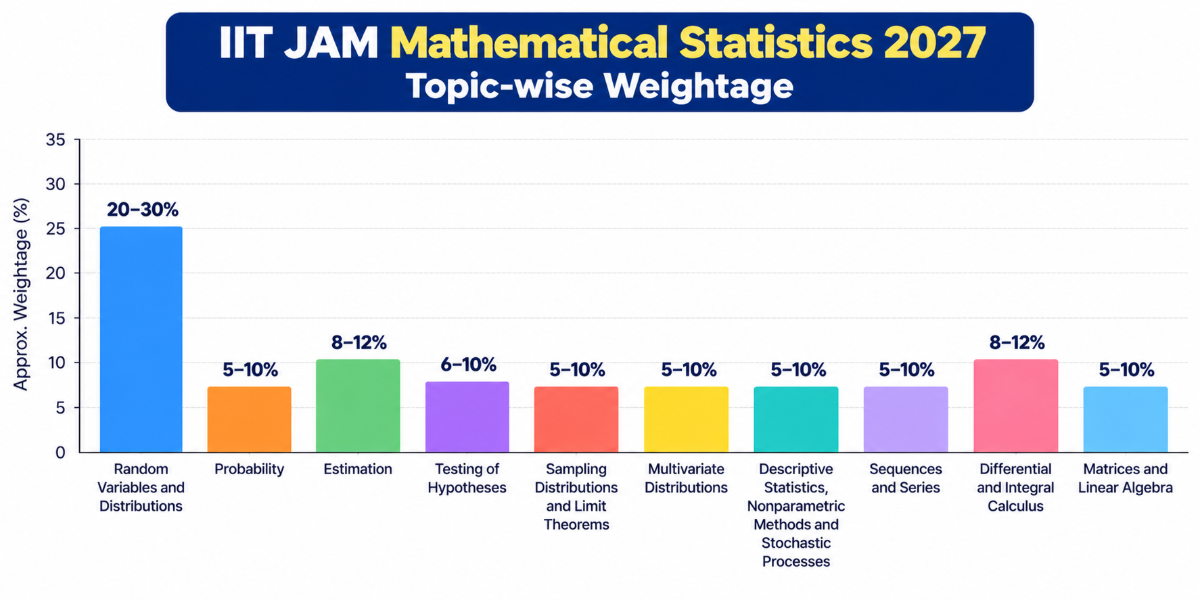
The Mathematical Statistics (MS) paper is split approximately 40% Mathematics and 60% Statistics. You must have solid command over all standard probability distributions — their means, variances, and MGFs appear in multiple question types across all three sections.

SectionTopicKey Sub-topics
Mathematics (40%)Sequences and SeriesConvergence; Cauchy sequences; Power series; Taylor series; Tests of convergence
Differential CalculusLimits; Continuity; Differentiability; Mean value theorems; Maxima and minima; L’Hopital’s rule
Integral CalculusRiemann integration; Definite integrals; Double integrals; Area and volume applications; Improper integrals
MatricesRank; Determinants; Matrix inverse; Eigenvalues and eigenvectors; Positive definite matrices; Quadratic forms; Systems of linear equations
Statistics (60%)ProbabilitySample space and events; Probability axioms; Conditional probability; Bayes’ theorem; Independence of events
Random VariablesDiscrete and continuous RVs; PMF, PDF, CDF; Mathematical expectation; Variance; Moments; Moment generating functions
Standard Distributions

Distribution list — Click Here

Discrete: Bernoulli, Binomial, Poisson, Geometric, Negative Binomial, Hypergeometric, Discrete Uniform
Continuous: Uniform, Exponential, Normal (Gaussian), Gamma, Beta, Cauchy, Lognormal
Key to know: Mean, variance, MGF, and inter-distribution relationships

Joint DistributionsJoint PMF and PDF; Marginal and conditional distributions; Independence; Covariance and correlation; Bivariate Normal distribution; Transformation of random variables
Sampling DistributionsChi-square distribution; t-distribution; F-distribution; Central Limit Theorem; Distribution of sample mean and variance from Normal populations; Order statistics
EstimationUnbiasedness; Consistency; Sufficiency; Completeness; Cramer-Rao lower bound; UMVUE (Rao-Blackwell and Lehmann-Scheffe theorems); MLE; Method of moments; Confidence interval construction
Testing of HypothesesSimple and composite hypotheses; Type I and II errors; Neyman-Pearson lemma; UMP tests; Likelihood ratio tests; p-value; Large sample tests (z, t, chi-square, F); Non-parametric tests (sign, Wilcoxon, Mann-Whitney)
IIT JAM Syllabus 2027 for Biotechnology (BT)

IIT JAM Syllabus 2027 for Biotechnology (BT)

The IIT JAM Biotechnology (BT) paper is uniquely interdisciplinary. Biology forms 44% of the paper — focus heavily on Recombinant DNA Technology, Cell Biology, Genetics, and Microbiology to score well in this largest component.

ComponentApprox. WeightageKey Topics
Biology44%

Biology topics — Click Here

General Biology: Taxonomy of plants and animals; Evolution; Ecology — species interactions, nutrient cycles; Animal physiology; Plant physiology — photosynthesis, respiration, growth regulators.

Biochemistry and Biophysics: Cell membrane structure and transport; Enzyme kinetics — Michaelis-Menten, competitive/non-competitive inhibition; Glycolysis; TCA cycle; Electron transport chain and oxidative phosphorylation; DNA structure and replication; Transcription and translation; Post-translational modifications; Vitamins and coenzymes.

Microbiology: Bacterial cell structure; Growth kinetics (lag, log, stationary, death phases); Sterilization and disinfection; Bacteriophage lifecycle; Viruses; Fungi; Antibiotics and resistance.

Cell Biology: Cell organelles and their functions; Cell cycle regulation; Mitosis and meiosis; Cell signalling — receptor tyrosine kinase, GPCR, second messengers; Apoptosis.

Genetics and Immunology: Mendelian genetics; Linkage and recombination; Chromosomal mutations; Gene regulation in prokaryotes and eukaryotes; Innate and adaptive immunity; Antigen-antibody interactions; Complement system; Vaccine types.

Recombinant DNA Technology: Restriction enzymes and mapping; Cloning vectors — plasmids, lambda phage, cosmids, BAC, YAC; PCR and its variants — RT-PCR, qPCR, site-directed mutagenesis; Gel electrophoresis; Southern, Northern, Western blotting; Gene expression systems; CRISPR-Cas9 basics; DNA sequencing; Bioinformatics basics.

Chemistry20%Classes of organic molecules; Functional groups; Structure and function of biochemical molecules — carbohydrates, lipids, proteins, nucleic acids; Chemical reactions relevant to metabolic pathways; Buffer chemistry; Henderson-Hasselbalch equation
Mathematics18%Sets, functions, relations; Algebra — permutations, combinations, binomial theorem; Trigonometry; Matrices and determinants; Differential and integral calculus; Vectors; Probability and statistics — mean, median, mode, standard deviation, Bayes’ theorem, normal distribution
Physics18%Kinematics; Laws of motion; Work, energy and power; Rotational motion; Gravitation; Fluid mechanics; Thermodynamics; Waves and optics; Electrostatics; Current electricity; Magnetism; Modern physics — dual nature, atomic models, nuclear physics, electronic devices
IIT JAM Syllabus 2027 for Economics (EN)

IIT JAM Syllabus 2027 for Economics (EN)

The IIT JAM Economics (EN) paper tests BSc-level economic theory, statistics, and Indian economic development. Microeconomics and Macroeconomics together carry approximately 50–55% of the paper — mastering these two sections is the highest-leverage investment in your preparation time.

UnitKey Sub-topics
Microeconomics

Sub-topics — Click Here

Consumer theory — preferences, utility maximisation, demand; Income and substitution effects; Slutsky equation; Revealed preference; Theory of the firm — production functions, cost curves; Profit maximisation; Market structures — perfect competition, monopoly, monopolistic competition, oligopoly (Cournot, Bertrand, Stackelberg); Game theory — Nash equilibrium, dominant strategies, mixed strategies; General equilibrium and welfare economics; Public goods and free-rider problem; Externalities; Asymmetric information — moral hazard and adverse selection

Macroeconomics

Sub-topics — Click Here

National income accounting — GDP, GNP, NNP; Keynesian consumption and investment functions; Multiplier; IS-LM model; Aggregate demand and supply; Business cycles; Inflation — demand-pull and cost-push; Unemployment — frictional, structural, cyclical; Phillips curve (short and long run); Money supply and monetary policy tools; Fiscal policy; Open economy macroeconomics; Solow growth model; Harrod-Domar model

Statistics for EconomicsDescriptive statistics; Probability; Discrete and continuous distributions; Sampling theory and CLT; Estimation and hypothesis testing; Correlation; Simple and multiple regression; Time series basics; Index numbers
Indian EconomyIndian economic development since independence; Planning and NITI Aayog; Agriculture — land reform, green revolution; Industrialisation and 1991 reforms; Poverty and inequality; External sector and trade policy; Monetary and fiscal policy; Key economic indicators
Mathematics for EconomicsLinear algebra; Single and multivariable calculus; Unconstrained and constrained optimisation (Lagrangian); Differential equations in economic modelling; Input-output analysis; Dynamic optimisation basics
IIT JAM Syllabus 2027 for Geology (GG)

IIT JAM Syllabus 2027 for Geology (GG)

The IIT JAM Geology (GG) paper covers BSc-level Earth Sciences across nine units. Mineralogy, Petrology, and Structural Geology are the highest-weightage areas — thorough rock and mineral identification knowledge is essential for competitive scoring.

UnitKey Sub-topics
The Planet EarthSolar system origin; Origin of Earth; Interior structure — crust, mantle, core; Evidence from seismic waves; Geophysical methods; Geomagnetic field and reversals; Isostasy; Volcanoes; Plate tectonics — seafloor spreading, subduction, transform faults, continental collision
GeomorphologyTypes of weathering; Soil formation and soil profile; Fluvial processes and landforms; Glacial geomorphology — erosional and depositional landforms; Aeolian processes and desert landforms; Coastal geomorphology; Karst topography; Mass wasting
Structural Geology

Sub-topics — Click Here

Concept of stress and strain; Folds — classification (anticline, syncline, isoclinal, recumbent, plunging), fold geometry and terminology; Faults — classification (normal, reverse, thrust, strike-slip), displacement, recognition; Joints and fractures; Unconformities — angular, disconformity, nonconformity; Foliations (cleavage, schistosity, gneissosity) and lineations; Stereographic projection basics; Plate tectonics and structural implications

PalaeontologyFossilization processes; Classification and morphology of major fossil groups — foraminifera, brachiopods, molluscs, echinoderms, corals, graptolites; Index fossils and stratigraphic value; Evolution of life; Mass extinctions
StratigraphyPrinciples of stratigraphy — superposition, original horizontality, lateral continuity, cross-cutting relationships; Rock-stratigraphic and time-stratigraphic units; Geological time scale; Indian stratigraphy — Gondwana supergroup, Deccan Traps, Himalayan sequences, Precambrian shields
MineralogyCrystal symmetry — elements, crystal systems, crystal classes; Physical properties of minerals — hardness (Mohs scale), cleavage, fracture, lustre, streak, specific gravity; Optical properties in thin section; Classification of minerals — silicates, oxides, sulphides, carbonates; Rock-forming silicate minerals; Ore minerals
Petrology

Sub-topics — Click Here

Igneous Petrology: Bowen’s reaction series; Classification — TAS diagram, QAPF diagram; Textures (phaneritic, aphanitic, porphyritic, glassy, vesicular); Magmatic differentiation; Intrusive and extrusive bodies; Volcanic rocks of India (Deccan Traps).

Sedimentary Petrology: Classification — clastic and non-clastic rocks; Sedimentary structures — bedding, cross-bedding, ripple marks, graded bedding; Depositional environments; Diagenesis.

Metamorphic Petrology: Types of metamorphism — contact, regional, dynamic; Metamorphic grades and index minerals (chlorite, biotite, garnet, staurolite, kyanite, sillimanite); Barrovian zones; Metamorphic facies; Metamorphic reactions; Foliations and lineations; PTt paths.

Economic GeologyProcesses of ore deposit formation — magmatic, hydrothermal, sedimentary, supergene; Classification of ore deposits; Important Indian mineral deposits; Coal geology; Petroleum geology — source, reservoir, cap rock, and traps; Marine mineral resources
Applied GeologyHydrogeology — groundwater, aquifer types, Darcy’s law; Engineering geology — site investigation, rock mass classification (RMR, Q system), geological hazards; Environmental geology; Remote sensing basics — aerial photography, satellite imagery, GIS applications
IIT JAM 2027 Subject-wise Weightage Summary

IIT JAM 2027 Subject-wise Weightage Summary

The table below consolidates high-priority topics across all seven IIT JAM 2027 papers based on previous year question paper trend analysis.

Paper (Code)Top High-Weightage TopicsApprox. Combined WeightagePreparation Insight
Physics (PH)Electricity & Magnetism, Modern Physics (Quantum Mechanics)~33–40%Section C NAT questions frequently target EM and thermodynamics numerical problems
Chemistry (CY)Physical Chemistry — thermodynamics, kinetics, electrochemistry~40–45%Physical Chemistry drives Section C; Organic Chemistry drives MSQ in Section B
Mathematics (MA)Real Analysis, Linear Algebra, Calculus~55–60%Proof-based questions in Real Analysis and Group Theory appear in Sections A and B
Mathematical Statistics (MS)Probability, Standard Distributions, Estimation, Hypothesis Testing~45–50% (Statistics portion)Central Limit Theorem applications and MLE derivations appear almost every year
Biotechnology (BT)Recombinant DNA Technology, Cell Biology, Genetics, Immunology~30–35% (of Biology 44%)Molecular biology questions are highly specific — memorise mechanisms, not just names
Economics (EN)Microeconomics, Macroeconomics~50–55%IS-LM diagrams and game theory matrices appear in all three sections in different formats
Geology (GG)Mineralogy, Petrology, Structural Geology~45–50%Bowen’s reaction series and fault classification questions appear in almost every paper
IIT JAM Syllabus 2027: Changes from 2026

IIT JAM 2027 Syllabus: Changes from 2026

The IIT JAM 2027 syllabus published by IIT Kharagpur in the Information Brochure released on August 22, 2026 is broadly consistent with the 2026 syllabus. No major topic additions or deletions have been announced for any of the seven papers.

PaperNew Topics Added (2027)Topics Removed (2027)Overall Status
Physics (PH)No major changes reportedStable
Chemistry (CY)No major changes reportedStable
Mathematics (MA)No major changes reportedStable
Mathematical Statistics (MS)No major changes reportedStable
Biotechnology (BT)No major changes reportedStable
Economics (EN)No major changes reportedStable
Geology (GG)No major changes reportedStable

You should always cross-check your preparation topic list against the official IIT JAM 2027 Information Brochure at jam.iitkgp.ac.in — the official document is the definitive reference and supersedes all third-party summaries.

Best Books for IIT JAM 2027

Best Books for IIT JAM 2027: Subject-wise Recommendations

Selecting the right books is the first major decision in IIT JAM preparation. The following books are consistently recommended by high scorers across all seven papers.

PaperBook NameAuthor / PublisherWhy This Book
Physics (PH)Introduction to ElectrodynamicsDavid J. GriffithsBest resource for Electricity & Magnetism — explanations are clear and problems match JAM exam style
Concepts of Modern PhysicsArthur BeiserCovers all Modern Physics and Quantum Mechanics topics at the exact JAM depth
Mathematical Methods for PhysicistsArfken, Weber & HarrisComprehensive coverage of all mathematical methods tested across the Physics paper
Chemistry (CY)Atkins’ Physical ChemistryP. Atkins & J. de Paula (Oxford)Standard Physical Chemistry text — thermodynamics, kinetics, and spectroscopy at JAM level
Organic ChemistryClayden, Greeves & WarrenMechanism-first approach directly matches how JAM frames Organic Chemistry questions
Concise Inorganic ChemistryJ. D. LeeCovers d-block, coordination chemistry, and main group elements at the required depth
Mathematics (MA)Principles of Mathematical AnalysisWalter RudinGold standard for Real Analysis — essential for rigorous proof-based questions in Sections A and B
Linear AlgebraKenneth Hoffman & Ray KunzeThorough treatment of all Linear Algebra topics in the JAM MA syllabus
Abstract AlgebraDavid S. Dummit & Richard M. FooteCovers Group Theory at the required depth — focus on groups, subgroups, and Sylow theorems chapters
Mathematical Statistics (MS)Mathematical Statistics with ApplicationsWackerly, Mendenhall & ScheafferClear treatment of estimation, hypothesis testing, and regression — covers Statistics portion directly
Introduction to Probability and Mathematical StatisticsRobert V. Hogg, Joseph W. McKean & Allen T. CraigStandard reference for probability distributions and statistical inference at JAM MS level
Biotechnology (BT)Molecular Biology of the CellAlberts, Johnson, Lewis et al.Comprehensive for Cell Biology, Genetics, and Molecular Biology — the definitive BT preparation book
Molecular Biology of the GeneWatson, Baker, Bell et al.Best for Recombinant DNA Technology, gene expression, and advanced Molecular Biology topics
Economics (EN)Intermediate Microeconomics: A Modern ApproachHal R. VarianStandard text for all Microeconomics topics in the JAM EN syllabus — graphical and mathematical treatment
MacroeconomicsN. Gregory MankiwCovers IS-LM, growth models, and open economy — all high-priority Macroeconomics topics
Geology (GG)Introduction to Mineralogy and PetrologyS. K. Haldar & Josip Tisljar (Elsevier)Practical approach to mineralogy and rock identification — essential for Geology identification questions
Structural GeologyHaakon Fossen (Cambridge University Press)Covers folds, faults, foliations, and plate tectonics with diagrams matching JAM question style
How to Download IIT JAM Syllabus 2027 PDF

How to Download IIT JAM Syllabus 2027 PDF

The IIT JAM 2027 official syllabus is available on the IIT Kharagpur JAM portal. Follow these steps to save it to your device.

  1. Visit the official IIT JAM 2027 website at jam.iitkgp.ac.in.
  2. Click on the "Syllabus" link in the main navigation menu, or look for the "Information Brochure" link on the homepage.
  3. The syllabus page or brochure PDF will open — it contains the complete subject-wise syllabus for all seven papers.
  4. Press Ctrl + S on Windows or Cmd + S on Mac to save the PDF, or click the download icon in your browser’s built-in PDF viewer.
  5. Save the file to a dedicated IIT JAM 2027 preparation folder on your device for quick reference throughout your study schedule.

Note: The Information Brochure released on August 22, 2026 contains the official and complete IIT JAM 2027 syllabus — use this as your primary reference, not third-party summaries which may be incomplete.

IIT JAM 2027 Preparation Tips

IIT JAM 2027 Preparation Tips

You have approximately five and a half months from August 2026 to the IIT JAM 2027 exam on February 14, 2027. Systematic, subject-specific preparation using a phased approach is the most reliable path to a high score.

Physics (PH) Preparation Tips

  • Start with Electricity & Magnetism and Modern Physics — together these carry roughly 33–40% of the paper.
  • Solve the previous five years of IIT JAM Physics papers to understand the depth and style of Section C numerical questions.
  • Do not neglect Mathematical Methods — it underpins questions on EM, Mechanics, and Quantum Mechanics across all three sections of the paper.
  • Use Griffiths for Electricity & Magnetism and Beiser for Modern Physics as your two primary books; supplement with previous year papers for problem-solving practice.
  • Attempt full-length three-hour mock tests regularly — sustained precision under timed conditions is a skill built only through consistent practice.

Chemistry (CY) Preparation Tips

  • Allocate 40–45% of your Chemistry preparation time to Physical Chemistry — it dominates the paper and Section C numerical marks.
  • Master reaction mechanisms in Organic Chemistry before memorising named reactions — understanding the mechanism makes product prediction automatic, not memory-dependent.
  • Focus on Coordination Chemistry (Crystal Field Theory) and transition metal properties first within Inorganic Chemistry.
  • Practise Physical Chemistry numericals from Electrochemistry, Chemical Kinetics, and Thermodynamics daily — these drive Section C marks.
  • Create a one-page Physical Chemistry formula sheet — instant recall of key equations is critical in the three-hour exam.

Mathematics (MA) Preparation Tips

  • Real Analysis demands daily engagement — dedicate at least four study sessions per week to proofs and conceptual exercises throughout the preparation period.
  • Write mathematically rigorous proofs in Group Theory and Real Analysis — vague reasoning loses marks even when the core argument is correct.
  • Build a structured formula sheet for Linear Algebra — eigenvalue properties, Cayley-Hamilton, and inner product identities appear repeatedly across all three sections.
  • Practise Differential Equations problem sets daily — they appear in varying difficulty across Sections A, B, and C.
  • Use the previous five years of IIT JAM MA question papers as your primary benchmark — topic frequency stabilises quickly across years.

Mathematical Statistics (MS) Preparation Tips

  • Memorise all standard distribution properties — means, variances, MGFs, and inter-distribution relationships — as a foundational first step before attempting problems.
  • The Central Limit Theorem and its applications appear in multiple question types — treat it as a must-master topic before attempting any mock test.
  • Practise deriving MLE and UMVUE for standard distribution families — derivation-type questions appear frequently in Section B (MSQ).
  • Do not underestimate the Mathematics portion (40%) — Linear Algebra and Calculus questions here match the rigor of the full MA paper.

Biotechnology (BT) Preparation Tips

  • Recombinant DNA Technology is consistently the highest-value Biology topic — study restriction mapping, PCR variants (RT-PCR, qPCR, site-directed mutagenesis), and blotting techniques in depth.
  • The Physics and Mathematics components (combined 36%) can be covered efficiently using Class 12 NCERT textbooks — do not invest disproportionate time here.
  • Enzyme kinetics (Michaelis-Menten and variants), cell signalling pathways, and metabolic cycles (glycolysis, TCA) reward mechanistic understanding — learn the logic, not just the names.
  • Build a systematic Immunology study plan — antigen-antibody interactions, complement system, and vaccine types appear across all three sections in various formats.

Economics (EN) Preparation Tips

  • Build a strong conceptual foundation in Microeconomics using Varian — game theory and market structure questions require both graphical and mathematical reasoning.
  • IS-LM model, Phillips curve, and Solow growth model are the three most frequently tested Macroeconomics topics — master all three with graphical derivation and algebraic treatment.
  • The Statistics section overlaps with standard probability theory — cover regression, hypothesis testing, and index numbers from an applied economics perspective.
  • Indian Economy topics are largely factual — use Class XI and XII NCERT Economics textbooks for efficient and reliable coverage.

Geology (GG) Preparation Tips

  • Practise mineral identification by physical and optical properties — Mineralogy questions require precision and cannot be guessed from general knowledge.
  • Bowen’s reaction series and igneous rock classification appear in almost every IIT JAM Geology paper in different question formats — these are non-negotiable topics.
  • Use topographic and geological maps for Structural Geology practice — Section C NAT questions frequently involve strike-dip relationships and map-based angle calculations.
  • Create an index fossil chart and geological time scale summary card — Palaeontology and Stratigraphy are factual sections that reward organised, systematic revision.
IIT JAM Syllabus FAQs

IIT JAM Syllabus 2027 FAQs

Ques. Is the IIT JAM 2027 syllabus the same as the 2026 syllabus?

Ans. Yes, the IIT JAM 2027 syllabus released by IIT Kharagpur is broadly the same as the 2026 syllabus. No major topic additions or removals have been announced for any of the seven papers in the Information Brochure published on August 22, 2026. You should always verify against the official brochure at jam.iitkgp.ac.in for the authoritative topic list before finalising your preparation plan.

Ques. Which IIT is organizing IIT JAM 2027?

Ans. IIT Kharagpur is the organizing institute for IIT JAM 2027. The official website is jam.iitkgp.ac.in, where registration, admit card, answer key, and results will be published. The organizing IIT rotates each year among the participating IITs.

Ques. When is the IIT JAM 2027 exam date?

Ans. IIT JAM 2027 will be held on February 14, 2027, in Computer-Based Test (CBT) mode. The exam is conducted across two sessions on the same day, covering all seven test papers. You can appear in a maximum of two papers, provided they are in different sessions.

Ques. Where can I download the official IIT JAM 2027 syllabus PDF?

Ans. You can download the IIT JAM 2027 official syllabus PDF from jam.iitkgp.ac.in/syllabus.html. The Information Brochure released on August 22, 2026 contains the complete subject-wise syllabus for all seven papers — Physics, Chemistry, Mathematics, Mathematical Statistics, Biotechnology, Economics, and Geology.

Ques. Which subject has the highest weightage in IIT JAM Physics?

Ans. Electricity & Magnetism carries the highest single-topic weightage in IIT JAM Physics — approximately 18–22%. Modern Physics (Quantum Mechanics and Special Relativity) is second at roughly 15–18%. Together, these two areas account for nearly 33–40% of the Physics paper, making them the highest-priority topics for preparation.

Ques. Is there negative marking in IIT JAM 2027?

Ans. Negative marking applies only in Section A (MCQ). For 1-mark MCQ questions, 1/3 mark is deducted per wrong answer. For 2-mark MCQ questions, 2/3 mark is deducted. Section B (MSQ) and Section C (NAT) have no negative marking — you should attempt all questions in Sections B and C since wrong answers carry no penalty in those sections.

Ques. How many papers does IIT JAM 2027 have?

Ans. IIT JAM 2027 has seven test papers: Biotechnology (BT), Chemistry (CY), Economics (EN), Geology (GG), Mathematics (MA), Mathematical Statistics (MS), and Physics (PH). Each paper is an independent three-hour, 100-mark Computer-Based Test. You can apply for a maximum of two papers in one cycle.

Ques. Which are the most important chapters for IIT JAM Chemistry?

Ans. In Physical Chemistry: Chemical Thermodynamics, Chemical Kinetics, Electrochemistry, and Spectroscopy are the highest-priority topics. In Organic Chemistry: Reaction Mechanism and Synthetic Applications (Named Reactions, SN1/SN2, E1/E2) and Stereochemistry are most critical. In Inorganic Chemistry: Coordination Compounds (Crystal Field Theory) and transition metal properties carry the highest marks. Physical Chemistry as a whole accounts for 40–45% of the Chemistry paper.

Ques. What books should I use for IIT JAM Mathematics?

Ans. For IIT JAM Mathematics (MA), use Rudin’s Principles of Mathematical Analysis for Real Analysis, Hoffman & Kunze for Linear Algebra, and Dummit & Foote (selected chapters) for Group Theory. For Differential Equations, use Simmons or Tenenbaum & Pollard. Supplement all theory study with the previous five years of IIT JAM MA papers as your primary practice source.

Ques. Is the IIT JAM Biotechnology (BT) paper only Biology-based?

Ans. No. The IIT JAM Biotechnology paper is interdisciplinary. Biology accounts for 44%, Chemistry for 20%, Mathematics for 18%, and Physics for 18%. Students who only prepare Biology typically lose significant marks in the Chemistry and Physics sections — all four components need adequate preparation for a competitive score.

Ques. Can students from any stream apply for IIT JAM 2027?

Ans. Eligibility depends on the paper you choose. For Physics (PH), your qualifying bachelor’s degree must include Physics. For Mathematics (MA), you need Mathematics in your undergraduate program. For Biotechnology (BT), a life sciences or biotechnology background is required. For Economics (EN), you need Economics or Mathematics. Check the official IIT JAM 2027 Information Brochure at jam.iitkgp.ac.in for complete paper-wise eligibility criteria before registering.

Ques. How should I plan to cover the full IIT JAM 2027 syllabus in 5 months?

Ans. Use a three-phase plan. Phase 1 (Weeks 1–8): complete the highest-weightage topics in your chosen paper — for Physics, start with Electricity & Magnetism, Modern Physics, and Thermodynamics; for Mathematics, start with Real Analysis and Linear Algebra. Phase 2 (Weeks 9–16): cover remaining syllabus units and do chapter-wise topic tests after each unit. Phase 3 (Weeks 17–22): full-length mock tests every alternate day, revision of weak areas, and at least five previous IIT JAM papers under timed exam conditions. Maintain 6–8 hours of focused daily study throughout.

Source: IIT JAM 2027 — Official Website, IIT Kharagpur

*The article might have information for the previous academic years, which will be updated soon subject to the notification issued by the University/College.