




IIT JAM Biotechnology Syllabus 2027 covers 4 major subject areas: Biology, Chemistry, Mathematics, and Physics, with a primary focus on biological sciences, including molecular biology, cell biology, biochemistry, genetics, and biotechnology. IIT Kharagpur has updated the syllabus for 2027 on its official website, jam.iitkgp.ac.in. No recent changes have been made to the syllabus.
The Biotechnology syllabus covers General Biology, Microbial Biotechnology, Plant Biotechnology, Animal Biotechnology, and Biotechniques. It also includes Chemistry at the 10+2+3 level and Mathematics and Physics at the 10+2 level. Biology and Biotechnology are the main subjects, but candidates should prepare Chemistry, Mathematics, and Physics as well.
- The Biotechnology (BT) syllabus integrates General Biology, Biochemistry, Microbiology, Molecular Biology, Cell Biology, and Mathematics & Statistics.
- In the Chemistry (CY) paper, focus on Physical Chemistry (approximately 35–40%), Organic Chemistry (25–30%), and Inorganic Chemistry (25–30%).
- The Physics (PH) paper gives the highest weightage to Quantum Mechanics and Electricity & Magnetism together, roughly 40–47% of the paper.
- Any student can appear in a maximum of 2 test papers in a single JAM cycle, subject to timing and eligibility conditions.
- The IIT JAM Biotechnology syllabus is rooted in BSc/BA-level curricula and has remained largely stable across recent cycles.
Related Links:
- IIT JAM Exam Pattern 2027: Subject-wise Pattern, Total Marks, Marking Scheme and Question Types
- IIT JAM Biotechnology Sample Paper: Download PDF
- IIT JAM Previous Year Question Paper PDF Download, Solutions & Paper Analysis
How to Download IIT JAM Biotechnology Syllabus 2027 PDF?
The IIT JAM 2027 Information Brochure, which contains the official syllabus for all 7 papers, has been released on the official website. Follow these steps to download it.
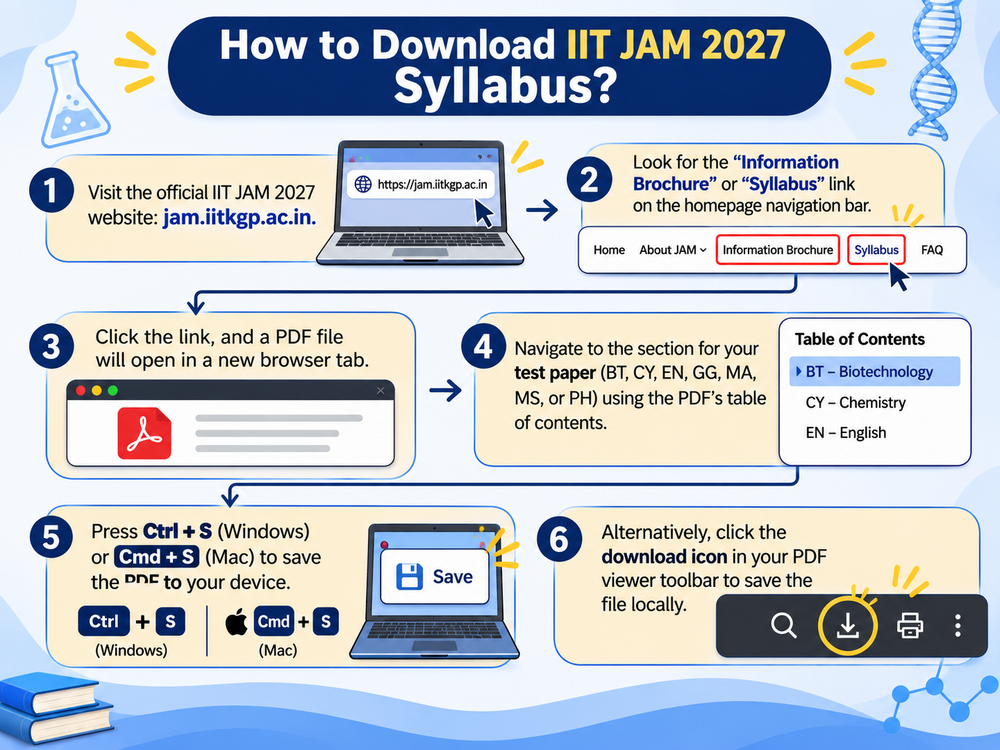
- Visit the official IIT JAM 2027 website: jam.iitkgp.ac.in.
- Look for the "Information Brochure" or "Syllabus" link on the homepage navigation bar.
- Click the link, and a PDF file will open in a new browser tab.
- Navigate to the section for your test paper (BT, CY, EN, GG, MA, MS, or PH) using the PDF’s table of contents.
- Press Ctrl + S (Windows) or Cmd + S (Mac) to save the PDF to your device.
- Alternatively, click the download icon in your PDF viewer toolbar to save the file locally.
IIT JAM Biotechnology Syllabus 2027: Exam Pattern
The IIT JAM examination will be conducted in Computer-Based Test (CBT) mode for 3 hours.
- The question paper will have 60 questions carrying 100 marks, divided into three compulsory sections: A, B, and C.
| Section | Question Type | Number of Questions | Total Marks |
| Section A | Multiple Choice Questions (MCQs) | 30 | 50 |
| Section B | Multiple Select Questions (MSQs) | 10 | 20 |
| Section C | Numerical Answer Type (NAT) | 20 | 30 |
| Total | — | 60 | 100 |
Note: For MSQ questions, you must select ALL correct options to earn marks. Selecting only a partial set of correct options earns zero marks. There is no partial credit in Section B. NAT questions require typing a precise numerical value using an on-screen keypad. No answer choices are shown. Practise NAT problems separately.
IIT JAM Biotechnology Syllabus 2027: High-weightage Topics in Biology
The IIT JAM BT paper is unique.
- It draws from Biology, Biochemistry, Microbiology, and Mathematics at the BSc level.
- Students from BSc Biotechnology, Biochemistry, Microbiology, or Life Sciences are the primary target for this paper.
- Molecular Biology and Cell Biology together carry the highest combined weightage and should be your priority.
| Important Topics | Important Subtopics | Approx. Weightage (%) | No. of Questions Asked (Approx.) |
| Cell Biology | Cell structure, cell organelles, cell cycle, mitosis, meiosis and cell signalling | 15% | 3 – 5 |
| Molecular Biology | DNA replication, transcription, translation, gene regulation and genetic code | 15% | 4 — 6 |
| Genetics | Mendelian genetics, linkage, crossing over, mutations and chromosomal inheritance | 12% | 3 – 5 |
| Biochemistry | Proteins, carbohydrates, lipids, nucleic acids, enzymes and enzyme kinetics | 12% | 3 – 5 |
| Microbiology | Microbial classification, bacterial structure, viruses, microbial growth and reproduction | 12% | 4 – 6 |
| Plant Physiology | Photosynthesis, respiration, plant hormones, mineral nutrition and transport | 10% | 2 – 4 |
| Animal Physiology | Nervous system, circulatory system, endocrine system, digestion and respiration | 10% | 1 – 3 |
IIT JAM Biotechnology Syllabus 2027: High-Weightage Topics in Chemistry
The IIT JAM CY paper covers Physical, Organic, and Inorganic Chemistry at the BSc level.
- Physical Chemistry carries the highest weightage (approx 40–45% of the paper).
- You must maintain equal strength across all three branches to score a competitive rank in IIT JAM CY.
| Important Topics | High-Weightage Subtopics | Approx. Weightage (%) | No. of Questions Asked (Approx) |
| Chemical Bonding | Ionic and covalent bonding, molecular geometry, hybridisation and molecular orbital theory | 20% | 2 – 3 |
| Chemical Equilibrium | Acid-base equilibrium, pH, buffer solutions and equilibrium constants | 15% | 2 – 3 |
| Thermodynamics | Laws of thermodynamics, enthalpy, entropy, Gibbs free energy and spontaneity | 15% | 1 – 2 |
| Organic Chemistry | Functional groups, reaction mechanisms, isomerism and stereochemistry | 15% | 1 – 2 |
| Chemical Kinetics | Rate of reaction, order, molecularity and activation energy | 10% | 1 – 2 |
| Atomic Structure | Quantum numbers, electronic configuration and atomic orbitals | 10% | 1 – 2 |
IIT JAM Biotechnology Syllabus 2027: Chemistry Section-wise Weightage
Physical Chemistry carries the highest estimated weightage of 40–45%, followed by Organic Chemistry at 30–35% and Inorganic Chemistry at 25–30%.
- Candidates should prioritise Thermodynamics, Chemical Kinetics, Reaction Mechanisms, Stereochemistry, and Coordination Chemistry for better preparation.
| Branch | Approx. Weightage (%) | High-Scoring Focus Areas |
|---|---|---|
| Physical Chemistry | 40–45% | Chemical Thermodynamics, Kinetics, Quantum Chemistry (Atomic Structure) |
| Organic Chemistry | 30–35% | Reaction Mechanisms, Stereochemistry, Named Reactions, Functional Groups |
| Inorganic Chemistry | 25–30% | Coordination Chemistry (CFT), Periodic Trends, HSAB principle |
IIT JAM Biotechnology Syllabus 2027: High-Weightage Topics in Mathematics
Calculus carries the highest estimated weightage at 25%, followed by Algebra and Differential Equations at 20% each.
- Candidates should prioritise these topics, along with Probability and Statistics (15%), covering concepts such as matrices, integration, differential equations, probability, and standard deviation.
| Important Topics | High-Weightage Subtopics | Approx. Weightage (%) | No/ of Questions Asked (Approx) |
| Calculus | Limits, continuity, differentiation, integration & applications of derivatives | 25% | 3 – 5 |
| Algebra | Matrices, determinants, linear equations and complex numbers | 20% | 2 – 4 |
| Differential Equations | First-order differential equations, second-order equations and their solutions | 20% | 2 – 3 |
| Probability and Statistics | Probability, permutations, combinations, mean, median, variance & standard deviation | 15% | 2 — 3 |
IIT JAM Biotechnology Syllabus 2027: High-Weightage Topics in Physics
| Important Topics | High-Weightage Subtopics | Approx. Weightage (%) | No. of Questions Asked (Approx.) |
| Mechanics | Laws of motion, work, energy, power, circular motion and gravitation | 20% | 2–3 |
| Electricity and Magnetism | Electric fields, electric potential, current electricity, magnetic fields and electromagnetic induction | 20% | 2–3 |
| Thermodynamics | Laws of thermodynamics, heat transfer, specific heat, entropy and kinetic theory of gases | 15% | 1–2 |
| Optics | Reflection, refraction, lenses, mirrors, interference and diffraction | 15% | 1–2 |
| Modern Physics | Atomic structure, nuclear physics, radioactivity and photoelectric effect | 10% | 1–2 |
| Waves and Oscillations | Simple harmonic motion, wave motion, sound waves and frequency | 10% | 1–2 |
| Properties of Matter | Elasticity, viscosity, surface tension and fluid mechanics | 10% | 1–2 |
Best Books to prepare for the IIT JAM Biotechnology Syllabus 2027
To master the IIT JAM Biotechnology syllabus, standard reference books like Lehninger (Biochemistry), Alberts (Cell Biology), Watson (Molecular Biology), and Primrose/Brown (Biotechniques) build necessary core conceptual depth. Pairing these foundational texts with focused practice on high-yield numericals and biotechniques guarantees top-tier performance across the exam.
 Source: Quora
A student on Quora has asked a question, ”Which books are good for the IIT JAM Biotechnology exam?” to prepare better for the upcoming exam.
| Topic | Recommended Book Title | Author(s) / Publisher | Key Focus / Utility |
|---|---|---|---|
| Biochemistry | Principles of Biochemistry | David L. Nelson & Michael M. Cox (Lehninger) | Enzyme kinetics, bioenergetics, metabolic pathways. |
| Cell Biology | Molecular Biology of the Cell | Bruce Alberts et al. | Cell cycle, organelles, signaling, and cell transport. |
| Molecular Biology | Molecular Biology of the Gene | James D. Watson et al. | Replication, transcription, translation, and gene expression. |
| Genetics | Genetics: A Conceptual Approach | Benjamin A. Pierce | Mendelian genetics, gene mapping, and population genetics. |
| Microbiology | Microbiology | Prescott, Willey, and Sherwood | Microbial growth kinetics, genetics, and diversity. |
| Immunology | Kuby Immunology | Thomas J. Kindt, Richard A. Goldsby, et al. | Immune cells, antigens, antibody structure, and MHC. |
| Biotechniques & rDNA | Principles of Gene Manipulation and Genomics / Gene Cloning | S.B. Primrose & R.M. Twyman / T.A. Brown | PCR, cloning vectors, restriction enzymes, and blot techniques. |
| Plant Biology | Plant Physiology and Development | Lincoln Taiz & Eduardo Zeiger | Photosynthesis, plant hormones, and transport. |
Also Read: How to Select the right book for the IIT JAM Biotechnology syllabus?
How to Prepare for IIT JAM Biotechnology Syllabus 2027?
Preparation strategy for IIT JAM Biotechnology 2027 requires balancing high-weightage graduate-level Biology (~44–50% weightage) with crucial 10+2 level non-bio subjects (Chemistry ~20%, Mathematics ~18%, Physics ~18%).
| Phase & Timeline | Primary Focus & Core Subjects | Key Tasks & Action Plan |
|---|---|---|
| Month 1: Foundation & High-Yield Biology | • Biology: Biochemistry, Cell Biology, Molecular Biology • Non-Bio: Organic Chemistry & NCERT 10+2 Math | • Build concepts in enzyme kinetics, metabolic cycles, central dogma, and operons. • Revise organic mechanisms, reaction kinetics, calculus, and basic probability. • Solve basic 1-mark MCQs at the end of every chapter. |
| Month 2: Applied Biology & Core Physical Sciences | • Biology: Microbiology, Genetics, Biotechniques & rDNA • Non-Bio: Physical/Inorganic Chemistry, Mechanics & Electricity | • Focus on PCR, cloning vectors, spectroscopy, gene mapping, and immunology. • Practice basic formulas in thermodynamics, electrochemistry, SHM, and vectors. • Start practicing Numerical Answer Type (NAT) questions using on-screen virtual calculators. |
| Month 3: Advanced Topics & Previous Years Papers | • Biology: Plant/Animal Biology, Evolution & Ecology • Non-Bio: Optics, Modern Physics, Differential Equations & Matrices | • Complete remaining minor modules across all 4 subjects. • Solve 10 years of IIT JAM BT previous-year question papers (PYQs). • Master Multiple Select Questions (MSQs) requiring complete option-wise analysis. |
| Month 4: Full-Length Mocks & Revision | • All Subjects: Comprehensive Speed & Accuracy Training | • Take 8–10 timed Full-Length Mock Tests (3-hour CBT pattern). • Work on eliminating wrong attempts in Section A (MCQs with negative marking). • Maintain a formula-and-shortcut notebook for quick daily revisions. |
Also Read: IIT JAM Preparation 2027: 6-Month Strategy, Mock Tests, Previous Papers
What Not to Miss While Covering the IIT JAM Biotechnology Syllabus 2027?
While covering the IIT JAM Biotechnology Syllabus 2027, do not skip Molecular Biology, Cell Biology, Genetics, Biochemistry, and Genetic Engineering, as these are important areas for concept-based questions.
- Pay special attention to DNA replication, gene expression, enzyme kinetics, recombinant DNA technology, and microbial growth.
- Also, practise numerical problems from Chemistry, Mathematics, and Physics instead of focusing only on theory.
- Revise important biological processes, chemical reactions, formulas, and scientific techniques regularly.
- Solve IIT JAM previous year papers to identify your weak areas and improve accuracy before the exam.
IIT JAM Biotechnology Syllabus 2027: Sample Paper
Solving the IIT JAM Biotechnology Sample Paper 2027 helps candidates understand the exam pattern, question types, and difficulty level.
- It also improves time management, highlights weak areas, and helps candidates practise Biology, Chemistry, Mathematics, and Physics questions.
- Attempt these 10 full-length sample papers under strict exam conditions – 3-hour timer, no interruptions, no breaks.
- After each mock, categorise every error as conceptual, computational, or time-management. Treat each category differently in your revision.
- Revise high-weightage units (see the Weightage Summary table above) in the two weeks before the exam.
- Do not start any new topics in the last week. Consolidate, practise formula recall, and sleep adequately before February 14.
| Sample Paper | PDF Download |
| IIT JAM Biotechnology Sample Paper 1 | Download PDF |
| IIT JAM Biotechnology Sample Paper 2 | Download PDF |
| IIT JAM Biotechnology Sample Paper 3 | Download PDF |
| IIT JAM Biotechnology Sample Paper 4 | Download PDF |
| IIT JAM Biotechnology Sample Paper 5 | Download PDF |
| IIT JAM Biotechnology Sample Paper 6 | Download PDF |
| IIT JAM Biotechnology Sample Paper 7 | Download PDF |
| IIT JAM Biotechnology Sample Paper 8 | Download PDF |
| IIT JAM Biotechnology Sample Paper 9 | Download PDF |
| IIT JAM Biotechnology Sample Paper 10 | Download PDF |
IIT JAM 2027 Syllabus FAQs
Ques. Is the IIT JAM 2027 syllabus the same as 2026?
Ans. No official changes to the IIT JAM 2027 syllabus have been announced as of August 21, 2026. Based on the trend over recent cycles, no changes are expected. You can safely use the 2026 syllabus as your preparation reference until the 2027 brochure is available at jam.iitkgp.ac.in.
Ques. Which IIT is conducting IIT JAM 2027?
Ans. IIT Kharagpur is the organising institute for IIT JAM 2027. The official website jam.iitkgp.ac.in is already live with confirmed exam dates, registration schedule, and key information.
Ques. What is the exam date for IIT JAM 2027?
Ans. IIT JAM 2027 is scheduled for February 14, 2027 (Sunday). This date is confirmed on the official website jam.iitkgp.ac.in. The exam is conducted in Computer-Based Test (CBT) mode across multiple cities. The admit card, which will be released on January 15, 2027, will specify your exam centre, test paper(s), and reporting time.
Ques. How many test papers can I appear for in IIT JAM 2027?
Ans. You can appear in a maximum of 2 test papers in one JAM session. The 2 papers must be at different time slots on exam day — IIT Kharagpur will publish the full timetable in the Information Brochure on August 22, 2026. Check for slot conflicts before registering for two papers. A separate application fee is payable for each paper.
Ques. What is the most important topic in IIT JAM Physics (PH)?
Ans. Quantum Mechanics and Electricity & Magnetism are the top-priority units in IIT JAM PH — together they account for roughly 40–47% of the paper. Mathematical Methods form the foundation for both — without strong vector calculus and complex analysis, you will struggle in QM and EM. Build Mathematical Methods first, then move to Quantum Mechanics and Electrodynamics using Griffiths’ textbooks.
Ques. Has the IIT JAM Biotechnology (BT) syllabus been revised for 2027?
Ans. No changes to the IIT JAM BT syllabus have been announced for 2027 as of August 21, 2026. The BT syllabus — covering General Biology, Biochemistry, Microbiology, Molecular Biology, Cell Biology, and Mathematics & Statistics — has remained stable over the past several JAM cycles. Confirm the final topic list from the official Information Brochure released on August 22, 2026 at jam.iitkgp.ac.in.
Ques. Is there negative marking in IIT JAM 2027?
Ans. Negative marking in IIT JAM 2027 applies only to Section A (MCQ). For 1-mark MCQs, 1/3 mark is deducted per wrong answer. For 2-mark MCQs, 2/3 mark is deducted. Section B (MSQ) and Section C (NAT) carry no negative marking. For MSQ, however, you earn marks only if you select ALL correct options – a partial selection earns zero even if all your chosen options are correct.
Ques. What books should I follow for IIT JAM Mathematics (MA)?
Ans. For Real Analysis, use Walter Rudin’s "Principles of Mathematical Analysis" (Baby Rudin). For Linear Algebra, use Hoffman & Kunze. For Group Theory, use I.N. Herstein’s "Topics in Algebra." For Differential Equations, use Simmons’ "Differential Equations with Applications and Historical Notes." Supplement all four books with IIT JAM MA previous-year solved papers from 2019 to 2026 for focused problem-solving practice.
Ques. How should I cover the full IIT JAM 2027 syllabus in 6 months?
Ans. Use a three-phase plan. Phase 1 (August–October 2026): cover all theory from standard textbooks, unit by unit. Phase 2 (November–December 2026): solve unit-wise JAM previous year questions and maintain an error log. Phase 3 (January 2027): attempt 8–10 full-length mock tests, analyse each carefully, and revise high-weightage topics from the Weightage Summary table. Do not start new topics in the final week before the exam.
Ques. Which IIT JAM paper is best for BSc Mathematics students?
Ans. BSc Mathematics students most commonly appear for Mathematics (MA) or Mathematical Statistics (MS). MA covers pure mathematics — Real Analysis, Linear Algebra, Group Theory, and Differential Equations. MS combines Mathematics (40%) with Statistics (60%) and is ideal if you have also studied probability and statistics alongside your mathematics coursework. You can appear for both MA and MS in a single JAM cycle if the exam time slots do not conflict.



Comments