




IIT JAM 2027 preparation should be based on the student’s current level, understanding of the syllabus, previous-year questions, and mock-test practice. With 7 test papers and a 100-mark paper to be completed in 3 hours, students should focus on high-weightage topics while gradually improving speed and accuracy.
- Each IIT JAM paper has 60 questions carrying 100 marks, divided into MCQ, MSQ, and NAT sections. A 6-month strategy should progress from concept building and syllabus coverage to PYQs, mock tests, and final revision.
- Use previous-year papers to understand question trends and difficulty, followed by regular timed mocks to improve accuracy, question selection, and time management.
- The last phase should focus on revision, formula/reaction sheets, error-log analysis, and full-length mock tests rather than starting large new topics.
- Focus on core areas like Real Analysis in Mathematics, Thermodynamics in Chemistry, and Electricity & Magnetism in Physics. These consistently carry the highest portion of marks.
- In IIT JAM Chemistry, Physical Chemistry carries around 39%, Organic Chemistry carries 31%, and Inorganic Chemistry carries 30% weightage.
- High-weightage topics for IIT JAM Physics include “Electricity and Magnetism”, and “Solid State Physics, Devices, and Electronics”, with each carrying 10 questions.
- For IIT JAM Mathematics, high-weightage topics include Series of Real Numbers, Limits and Continuity, Sequence of Real Numbers, and Vector Spaces.
Related Links:
- IIT JAM Chapter Wise Weightage: Check Subject Wise High Weightage Topics
- IIT JAM 2027: Notification Expected September 2026, Syllabus, Eligibility and Cutoff
- IIT JAM Application Form 2027: Registration Expected September 2026, How to Apply, Documents and Fee
Key Summary
- Start with the syllabus and basics: Understand the exam pattern, divide the syllabus into manageable topics and strengthen fundamentals before attempting advanced questions.
- Prioritise high-weightage areas: Focus more time on frequently tested topics while maintaining coverage of the complete syllabus.
- Make PYQs and mocks central to preparation: Solve previous-year questions topic-wise, take full-length mocks and maintain an error log to identify recurring mistakes.
- Practise exam strategy: Use multiple-pass attempts, avoid getting stuck on difficult questions, manage time carefully, and practise MSQs/NATs under realistic exam conditions.
How to prepare for IIT JAM 2027 from the Basics?
Below is the 5-step plan to prepare for the IIT JAM exam 2027 from the basics:
Step 1: Plan Before You Start
Before opening your books, spend the first week understanding the exam and syllabus.
- Know the Syllabus: Download the official syllabus for your subject and divide it into topics you already know and topics that need more preparation.
- Understand the Exam Pattern: JAM has three sections: MCQ, MSQ, and NAT. MCQs have negative marking, while MSQs and NATs do not. Understand the rules of each section before you start practicing.
Step 2: Build Your Basics (Months 1–3)
Focus on understanding concepts before solving difficult JAM questions.
- Study Concepts First: Read each topic carefully and make short, one-page notes with important formulas, concepts, exceptions and key points.
- Practice Basic Questions: Solve the problems given at the end of your standard textbooks. For subjects such as Physics, Chemistry, and Economics, make sure your basic mathematical skills are strong.
Step 3: Focus on High-Weightage Topics (Months 4–5)
Once your basics are clear, shift your focus to important and frequently tested topics.
- Follow the 70/30 Rule: Identify the 3 highest-weightage topics in your subject and spend more time mastering them. Use the remaining time to cover other topics.
- Practice the Virtual Calculator: JAM does not allow physical calculators. Practice using the on-screen calculator so that calculations do not slow you down during the exam.
Step 4: Practice Previous Year Questions (Month 6)
Use PYQs to understand the actual level and pattern of the JAM exam.
- Maintain an Error Log: Note every question you get wrong and identify the reason — conceptual mistake, calculation error or unit conversion mistake.
- Review Your Mistakes: Go through your error log regularly, preferably once a week, and revise the topics where you are making repeated mistakes.
Step 5: Take Regular Mock Tests
Use the final weeks to improve your speed, accuracy, and exam-day performance.
- Follow Exam Conditions: Take full-length mocks within the actual 3-hour exam duration and practice in the official exam time slots whenever possible.
- Revise Regularly: Spend around 20% of your daily study time revising old notes and formulas. Avoid leaving a topic untouched for several weeks.
Related Articles:
As per students on Quora, below are some effective tips to apply in your IIT JAM preparation for 2027:
| JAM Prep Tip | What Beginners Should Actually Do |
|---|---|
| Build strong fundamentals |
|
| Make problem-solving a daily habit |
|
| Use PYQs and mocks as learning tools |
|
| Learn from mistakes and seek help |
|
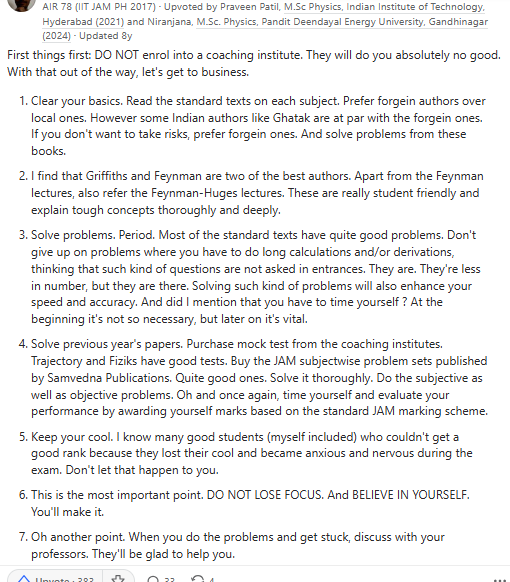
Source: Quora
Ques. How should I analyse IIT JAM mock tests and previous-year papers?
Ans. Do not just look at your score. Categorise every mistake into three buckets: Concept Error (re-read the topic), Calculation Error (re-solve carefully), or Silly Mistake (improve focus). Maintain a "Mistake Notebook" to review before the final test.
Related Articles:
IIT JAM 2026 Mock Tests
| Subject | Mock Test Link |
|---|---|
| Chemistry | Attempt Mock Test Here |
| Economics | Attempt Mock Test Here |
| Physics | Attempt Mock Test Here |
| Mathematics | Attempt Mock Test Here |
| Biotechnology | Attempt Mock Test Here |
| Geology | Attempt Mock Test Here |
| Mathematical Statistics | Attempt Mock Test Here |
How Toppers Attempt the IIT JAM Exam?
Based on the experience shared by IIT JAM Mathematics AIR 12 Aastha Jain, these are the key preparation and exam-attempt strategies:
- Trust your preparation, stick with your teacher and study material, practise consistently, and learn to manage stress. Aastha specifically advises students not to keep switching between teachers or coaching platforms because of FOMO.
- You do not need to attempt every question. The focus should be on identifying questions that are worth attempting for your strengths and moving forward when a question isn't working.
Use the 2-Pass method while attempting Mocks:
- Pass 1 (First 90 Minutes): Scan the paper and solve only the low-hanging fruit—direct formula application, factual questions, and simple definitions. If a question takes more than 3 lines of scratch paper, hit the "Mark for Review" button and move on.
- Pass 2 (Next 60 Minutes): Attack the marked questions. You will face them with the psychological comfort of knowing you have already locked down a baseline qualifying score from Pass 1.
- Final 30 Minutes: Exclusively review your NAT decimal calculations and double-check that you didn't miss a third correct option in the MSQs.
| Strategy | How to Apply It |
|---|---|
| Don't Try Every Question | The goal is not to solve the entire paper. Focus on questions that you can solve accurately and efficiently. |
| Use Multiple Rounds | Attempt the paper in rounds. Solve your strongest and easiest questions first, then return to questions requiring more calculation or time. |
| Play to Your Strengths | Identify the topics/question types where you are strongest and attempt those early to build confidence and secure marks. |
| Don't Get Stuck | If a question is not getting solved, move ahead instead of wasting too much time. Mocks help develop this habit. |
| Be Careful With NATs | Pay close attention to decimal places and the required answer format. Incorrectly entering the numerical value can cost marks even when the calculation is correct. |
| Read MSQ Statements Carefully | Avoid rushing through true/false-type options. Read every statement carefully before selecting your answer. |
| Use Mocks to Build Speed | Regular mocks improve speed and help you understand which questions to attempt first and which to leave for later. |
| Manage Exam Stress | Three hours of focused exam performance requires stress management. Staying calm helps you avoid careless mistakes and use your strategy effectively. |
Ques. How can I prepare for IIT JAM 2027 while studying in college?
Ans. Align your university semester topics with your JAM syllabus checklist. Use your college library hours exclusively for solving physics/math problems or organic chemistry mechanisms, keeping your weekends clear for dedicated mock tests.
The video discusses how AIR 12 Aastha Jain attempted her IIT JAM exam and her preparation strategies.
Check here:
IIT JAM Preparation: Exam Pattern 2027
IIT JAM is an entrance exam to get admission to master's programs at IITs and IISc Bangalore. The exam is 3 hours long and contains a total of 60 questions.
- There are 3 sections in the question paper: MCQs, MSQs, and NATs, which make the total score 100.
- Negative marking is applied to the MCQs section only; the other 2 sections do not apply any negative marking.
| Aspect | Details |
|---|---|
| Mode | Computer-Based Test (CBT) |
| Duration | 3 hours |
| Total Questions | 60 |
| Total Marks | 100 |
| Sections | 3 (all compulsory) |
| Section A | 30 MCQs of 50 marks |
| Section B | 10 MSQs of 20 marks |
| Section C | 20 NATs of 30 marks |
| Negative Marking | Only in Section A (MCQs): –1/3 for 1-mark, –2/3 for 2-mark questions. No negative marking in MSQ or NAT. |
| Medium | English only |
| Papers | 7 subjects (BT, CY, EN, GG, MA, MS, PH) |
| Max papers per candidate | Up to 2 (scheduled in different sessions) |
Ques. How many hours should I study daily for IIT JAM 2027?
Ans. Aim for 4 to 6 hours of consistent, focused study daily. Quality of problem-solving matters much more than arbitrary logged hours.
Also Check: Good Score in IIT JAM 2027: Rank vs Marks, Topper Scores, Admission Chances & Expected Cutoff
IIT JAM Preparation: Download Syllabus 2027 PDF
| Test Paper | Paper Code | IIT JAM Syllabus- Download PDF |
|---|---|---|
| Physics | PH | IIT JAM Physics Syllabus PDF |
| Chemistry | CY | IIT JAM Chemistry Syllabus PDF |
| Mathematics | MA | IIT JAM Mathematics Syllabus PDF |
| Mathematical Statistics | MS | IIT JAM Mathematical Statistics Syllabus PDF |
| Biotechnology | BT | IIT JAM Biotechnology Syllabus PDF |
| Economics | EN | IIT JAM Economics Syllabus PDF |
| Geology | GG | IIT JAM Geology Syllabus PDF |
IIT JAM 2026 Question Paper with Solutions
| Subject | Question Paper PDF | Solution PDF |
|---|---|---|
| Chemistry (CY) | Download PDF | View Solution |
| Geology (GG) | Download PDF | View Solution |
| Mathematics (MA) | Download PDF | View Solution |
| Biotechnology (BT) | Download PDF | View Solution |
| Economics (EN) | Download PDF | View Solution |
| Mathematical Statistics (MS) | Download PDF | View Solution |
| Physics (PH) | Download PDF | View Solution |
How to prepare for IIT JAM while in college?
To effectively prepare for the IIT JAM exam, don't study for college and JAM separately. Use college classes as your first exposure, then upgrade the same topic to JAM level through PYQs and advanced problems.
- Weekends should be application-heavy: Spend less time reading theory and more time on PYQs, NATs, MSQs, and mock tests.
- Use the 80/20 rule: Give maximum time to high-weightage topics and recurring PYQ concepts, rather than trying to master every topic equally from the beginning.
- During semester exams, a temporary slowdown on JAM is fine. Resume your normal schedule immediately after exams.
Prioritize subjects where your college syllabus closely matches JAM. This gives the highest return per hour.
| Strategy | What to Do |
|---|---|
| Syllabus Overlap | When college covers a JAM topic, study the same topic at JAM level instead of studying it twice. |
| Follow a 3+2 Hour Schedule | Weekdays: 1.5 hrs concepts + 1.5 hrs practice/revision. Weekends: 5 hrs for PYQs, mocks and difficult topics. |
| Use Free Time | Revise formula sheets, reactions, definitions or your error log during commutes, breaks and waiting periods. |
| Use Labs for JAM Practice | Connect practical work with JAM concepts. For example, titration calculations, optics, dilutions, PCR and unit conversions. |
| Adjust During Semester Exams | Reduce JAM temporarily 10–14 days before semester exams and prioritize university preparation. |
| Make PYQs the Weekly Anchor | After completing a college/JAM topic, solve its JAM PYQs instead of repeatedly rereading theory. |
| Maintain an Error Log | Record every repeated mistake, confusing concept and formula you forget. Review it weekly. |
| Keep One Integrated Study System | Maintain one set of concise notes containing college concepts + JAM-level additions + PYQ mistakes. |
Ques. When should I start taking IIT JAM mock tests?
Ans. Start taking topic-wise mock tests from month two of your preparation. Transition to full-length 3-hour mock tests roughly 2 to 2.5 months before the final exam.
What are the Best Books for IIT JAM Preparation?
Below are some of the best books as recommended by toppers and IIT JAM Rank holders, and tips on how to use those books effectively:
- In books like Griffiths, Atkins, or Varian, the authors embed critical conceptual leaps and problem-solving shortcuts directly inside the solved examples.
- Thoroughly solve and understand every in-text example before moving to the end-of-chapter problems.
- For Chemistry: Whenever a book highlights an exception (e.g., an organic reaction that fails under specific conditions, a mathematical sequence where a standard convergence test fails, or an enzyme inhibitor exception), write it down in a dedicated notebook.
- For Math/Stats: Draw out integration boundaries and map distribution behaviors visually rather than relying purely on algebraic equations.
| Physics (PH) | ||
|---|---|---|
| Book Name | Author / Publisher | What to prioritise |
| Introduction to Electrodynamics | David J. Griffiths |
|
| Concepts of Modern Physics | Arthur Beiser |
|
| Mathematical Physics | H.K. Das |
|
| Chemistry (CY) | ||
|---|---|---|
| Book Name | Author / Publisher | What to prioritise |
| Physical Chemistry | Peter Atkins / I.N. Levine |
|
| Organic Chemistry | Morrison & Boyd / Paula Y. Bruice |
|
| Concise Inorganic Chemistry | J.D. Lee |
|
| Mathematics (MA) | ||
|---|---|---|
| Book Name | Author / Publisher | What to prioritise |
| Principles of Mathematical Analysis | Walter Rudin |
|
| Calculus, Vol. 1 & 2 | Tom M. Apostol |
|
| Topics in Algebra | I.N. Herstein |
|
| Mathematical Statistics (MS) | ||
|---|---|---|
| Book Name | Author / Publisher | What to prioritise |
| Introduction to Mathematical Statistics | Hogg, McKean & Craig |
|
| Introduction to Probability and Statistics | Rohatgi & Saleh |
|
| Biotechnology (BT) | ||
|---|---|---|
| Book Name | Author / Publisher | What to prioritise |
| Molecular Biology of the Cell | Alberts et al. |
|
| Lehninger Principles of Biochemistry | Nelson & Cox |
|
| Economics (EN) | ||
|---|---|---|
| Book Name | Author / Publisher | What to prioritise |
| Intermediate Microeconomics | Hal R. Varian |
|
| Macroeconomics | N. Gregory Mankiw |
|
| Geology (GG) | ||
|---|---|---|
| Book Name | Author / Publisher | What to prioritise |
| Physical Geology | Longwell, Flint & Sanders |
|
| Optical Mineralogy | Paul F. Kerr |
|
IIT JAM Preparation FAQs
Ques. How many IIT JAM 2027 papers can a candidate appear for?
Ans. A candidate can appear for a maximum of two papers. However, the two papers must be scheduled in different exam sessions (Morning vs. Afternoon).
Ques. Which subjects are available in IIT JAM 2027?
Ans. There are 7 subjects available: Biotechnology (BT), Chemistry (CY), Economics (EN), Geology (GG), Mathematics (MA), Mathematical Statistics (MS), and Physics (PH).
Ques. Is IIT JAM conducted in online or offline mode?
Ans. It is conducted strictly in online mode as a Computer-Based Test (CBT).
Ques. How can I prepare for IIT JAM 2027 in 6 months?
Ans. Divide the time into 3 phases: Months 1–3 for core theory and topic-wise notes; Months 4–5 for intense topic-wise problem-solving and Previous Year Questions (PYQs); and Month 6 exclusively for full-length mock tests and formula revision.
Ques. How can I improve my speed and accuracy for IIT JAM?
Ans. Practice calculation-heavy questions without your phone's calculator; use the virtual on-screen calculator instead. Set strict countdown timers while solving standard daily practice sheets.



Comments