



Content Curator
Immunity can be defined as the body's ability to guard itself against disease-causing organisms. In other words, it is the ability to resist an infection by the action of particular antibodies. Our body has the ability to produce antibodies against pathogens and defend itself from diseases; therefore, we may come in contact with several viruses everyday, but not get ill. This defence mechanism is therefore known as immunity.
| Table of Content |
Keyterms: Immunity, Immune System, organisms, disease, infection, antibodies, pathogens, pathogen, antigen, enzymes
Read More: Difference Between Antigen and Antibody
Types of Immunity
[Click Here for Sample Questions]
The two major types of immunity are:
- Innate Immunity or Non-specific Immunity.
- Acquired Immunity or Adaptive Immunity.
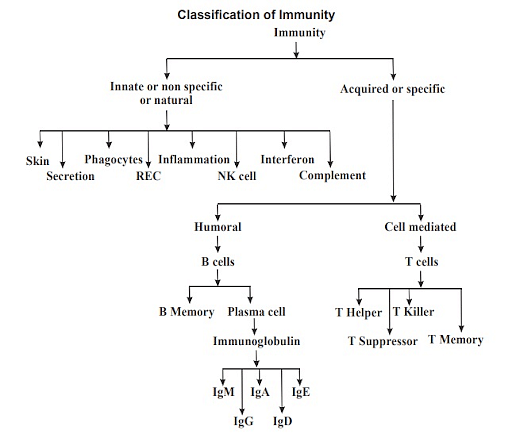
Types of Immunity
Innate Immunity
Innate immunity is present in our body by birth. This immunity includes certain defence mechanisms that do not allow the particles to enter our body.

Innate immunity
Innate immunity is referred to as the body’s defence system and helps us by providing the natural resistance components that include natural killer cells, salivary enzymes, intact skin and neutrophils, etc. This produces an initial response against the viruses at birth preceding the vulnerability to a pathogen or antigen. Innate immunity can be referred to as a long-term immunity, wherein the antibodies are produced on itself.
Read More: Blood Coagulation
Types of Barriers
The four types of barriers include:
Physical Barrier: The physical barriers form the first layer of defence and include the body hair, eyelashes, skin, cilia, the respiratory tract, and the gastrointestinal tract.

Physical Barrier
Moreover, our skin provides a physical barrier to the entry of viruses. The mucus coating present in our ear and nose offers a protective layer that traps the pathogen before it enters the body.
Physiological Barriers: The stomach makes use of hydrochloric acid for breaking down the food particles. Due to such a strong acidic environment, most of the germs that enter our body with the food are destroyed before they could carry on any further process.

Physiological Barriers
The saliva present in our mouth and tears in our eyes possess the antibiotic property of not allowing the growth of pathogens.
Cellular Barriers: In spite of the physical and physiological barriers, there are pathogens that manage to enter our body. The cells present in this barrier include leukocytes (WBC), lymphocytes, neutrophils, monocytes, basophil, eosinophil. All of these cells are present in our tissues and blood.

Cellular Barriers
Cytokine Barriers: The cells present in our body are much smarter. For example, in case a cell in our body encounters a virus occupation, it will automatically produce proteins called interferons that form a layer around the infected cell and guard the cells around it from further infections.

Cytokine Barriers
The various types of cells Involved In Innate Immunity include:
Eosinophils: They have highly toxic proteins that can destroy any parasite or bacteria coming in contact.
Phagocytes: It circulates throughout the body and looks for any foreign particles. They destroy the particles and protect the body against that pathogen.
Neutrophils: They contain granules that are toxic in nature and destroy any pathogen coming in contact.
Macrophages: It has the ability to advance across the walls of the circulatory system. They release signals as cytokines for recruiting cells at the place of infections.

Cellular Innate Immunity System
Mast Cells: They provide an important function of healing wounds and defending against infections.
Natural Killer Cells: They put a stop to the spread of infections by killing the infected host cells.
Dendritic Cells: These are present in the tissues which are the points for initial infections. These cells have the ability to sense the infection and then deliver the message to the rest of the immune system by antigen presentation.
Read More: Medical Termination of Pregnancy
Acquired Immunity
Acquired immunity or adaptive immunity is the one which our body acquires over time. Unlike the innate immunity, our body does not have this immunity by birth. The main function of acquired immunity is to relieve the patient of the infectious disease and also defend it from attacks in future. It basically consists of an advanced lymphatic defence system that functions to recognise the body's own cells and not react to them.
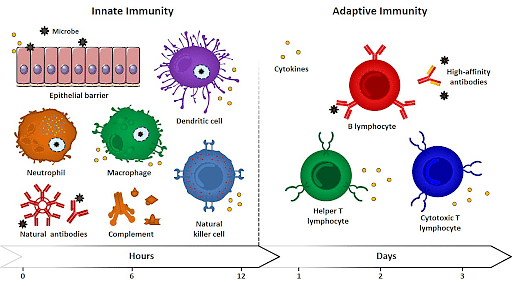
Acquired Immunity
The two types of acquired immunity include:
Active Immunity
Active immunity can be said to be present when an organism's immune system is involved actively in the production of immune competent cells and antibodies.

Active Immunity
Passive Immunity
In passive immunity, the immune competent cells as well as antibodies are transferred from one organism to another in order to increase the resistance against a pathogen.
Read More: Plant Breeding
Autoimmunity
[Click Here for Sample Questions]
Sometimes, the immune system attacks its own tissues and organs and this is known as autoimmunity. An example of autoimmune disease is type 1 diabetes, wherein, the immune system destroys the cells present in the pancreas that produce insulin.

Autoimmunity
Read More: The Sources Of Carbohydrates
Vaccines
[Click Here for Sample Questions]
Vaccination can be defined as the process of introducing inactivated or weakened pathogens or proteins (vaccine) into a person for providing protection against the diseases. Vaccines produce memory B and T-cells that recognise the pathogens on subsequent exposure and generate an immune response.

Types of Vaccines
Also Read:
| Related Articles | ||
|---|---|---|
| Difference Between DNA and RNA? | Pollination | Biomass |
| Deltoid Muscle | What is Adaptation | Calcium Deficiency |
Immune system
[Click Here for Sample Questions]
The human immune system consists of lymphoid organs, immune cells, soluble molecules and lymphoid tissues.

Immune system
Lymphoid organs are the organs where origin or maturation of lymphocytes takes place. They are of two types:
Primary lymphoid organs, which are the sites where lymphocytes mature to become antigen-sensitive, e.g. bone marrow and thymus. All the blood cells in bone marrow including lymphocytes are produced and B-lymphocytes mature.Thymus, which is present near the heart and beneath the breastbone, reduces with an increase in age.
Secondary lymphoid organs are the places where lymphocytes interact with the antigen and proliferate in order to become effector cells, e.g. spleen, lymph nodes, tonsils. Spleen is a large, bean-shaped organ that acts as a filter to trap blood-borne microbes and contains several erythrocytes. Lymph nodes are small solid structures that function to trap the microorganisms or other antigens that enter the lymph and tissue fluid.
Mucosal Associated Lymphoid Tissue (MALT) is made of the masses of lymphoid tissue, lining the mucosa of respiratory, digestive and urogenital tracts. Around half of the lymphoid tissue in the human body is made by MALT.
Read More: Radicle
Things to Remember
- Immunity is the body's ability to protect itself against disease causing organisms.
- Innate immunity is present in our bodies by birth. Natural killer cells, dendritic cells, mast cells etc. are involved in innate immunity.
- Acquired immunity also known as adaptive immunity is the one which our body acquires over time.
- Autoimmunity occurs when the immune system attacks the body's own tissues and organs.
- The human immune system consists of lymphoid organs, immune cells, soluble molecules and lymphoid tissues.
Sample Questions
Ques. What does the human immune system consist of? (4 marks)
Ans- The human immune system consists of:
(i) lymphoid organs
(ii) immune cells
(iii) soluble molecules like antibodies
(iv) lymphoid tissues.
Ques. Name any two types of cells that act as ‘cellular barriers’ and provide innate immunity in humans. (2 marks)
Ans- The two types of cells that act as ‘cellular barriers’ to provide innate immunity in humans are natural killer cells and certain type of leukocytes (such as PMNL- neutrophils, monocytes)
Ques. Name the two types of acquired immunity. (2 marks)
Ans- The two types of acquired immunity include active and passive immunity. Active immunity helps in producing immune-competent cells and antibodies. Passive immunity, on the other hand, transfers the immune-competent cells from one organism to another in order to increase resistance against a virus.
Ques. Which body part produces antibodies? (2 marks)
Ans- The lymphocytes or B cells are involved in the production of antibodies.
Ques. What is an autoimmune disease? Explain with an example. (2 marks)
Ans- Autoimmune disease is the abnormal response of an immune system, wherein it is unable to recognise ‘self' and ‘non-self’ and destroys its own cells and tissues. Rheumatoid is an example of autoimmune disease which destructs the articular cartilage.
For Latest Updates on Upcoming Board Exams, Click Here: https://t.me/class_10_12_board_updates
Check-Out:



Comments