



Content Curator
Infertility is defined as trying to get pregnant with frequent, unprotected sex for at least a year with no success. Infertility results from female factors about one-third of the time and both female and male factors about one-third of the time. The causes of female infertility include problems with ovulation, damage to fallopian tubes or uterus, or problems with the cervix. And causes of infertility in males include difficulty with ejaculation or small volumes of fluid ejaculated reduced sexual desire, or difficulty maintaining an erection. Infertility can be treated depending on the cause. Various treatments can help a couple conceive and result in successful delivery.
| Table of Content |
Key Terms: IVF, GIFT, ZIFT, Infertility, egg, embryo, tubes, pregnancy, zygote, foetus, miscarriage, sperm, birth.
What Is IVF, GIFT & ZIFT?
[Click Here for Sample Questions]
In order to get pregnant, the sperm must be powerful enough to reach the egg via the fallopian tubes. Additionally, the sperm must have the proper morphology to fertilize the egg.
- The embryo that results must be able to connect and grow in the uterus. If one or more of these conditions are not met, it will result in infertility.
- Certain infertile couples suffer from problems that prohibit sperm and egg from passing through the oviduct. Here, fertilization and the first step of cell division occur.
- The preceding infertility treatment technology (ART) techniques like IVF, ZIFT & GIFT are infrequently utilized but may increase the likelihood of fallopian tube birth.
- Every one of these therapies begins with superovulation. Injections of hormones encourage the ovaries to generate numerous eggs.
Also Check: Sexually Transmitted Diseases
Gamete Intrafallopian Transfer (GIFT)
GIFT is an assisted reproductive technology (ART) procedure used to cure infertility. Eggs and sperm are extracted, combined, and transplanted into the fallopian tubes by doctors. Reinsertion is performed by laparoscopy if the tubes are intact.
The objective is to enable the egg and sperm to fertilize normally, however assessing the effectiveness of the process is challenging. Couples that do not rely on external fertilization favor GIFT.
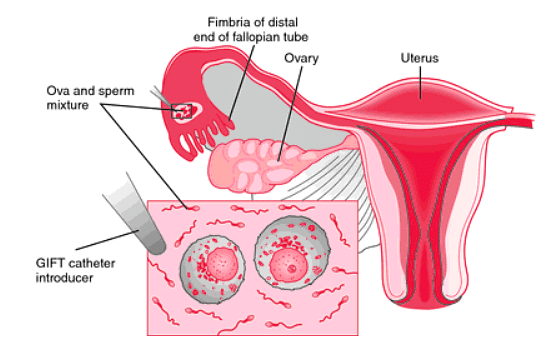
Gamete Intrafallopian Transfer
Zygote Intra-Fallopian Transfer (ZIFT)
ZIFT and GIFT have comparable stages but distinct implementations. Similar to GIFT, Zygote Intrafallopian Transplant or ZIFT involves the removal, combination, and reinsertion of the egg and sperm. The primary distinction is that fertilization happens in vitro.
Similar to GIFT, the embryo enters the fallopian tube. Both methods need laparoscopic and must be performed within 24 hours for best effectiveness.

Zygote Intra-Fallopian Transfer
In-Vitro Fertilization (IVF)
IVF is the most prevalent assisted reproductive technology (ART) therapy to date. Both GIFT and ZIFT are IVF methods. Doctors prescribe medications to increase egg production. Doctors take the eggs surgically and combine them with sperm in a laboratory to trigger conception.
After several days, the embryos will be reinserted into the uterus. IVF is the best model of ART procedures since it is utilized more often than GIFT and ZIFT altogether. IVF has a viable birth rate of as much as 40%.
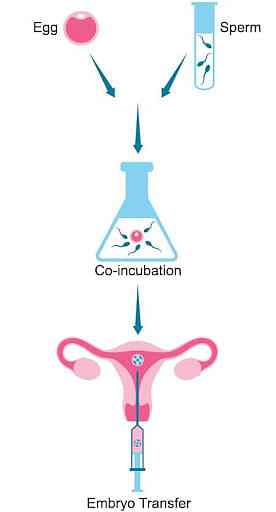
In-Vitro Fertilization
Also Check: Vitamin
Advantages Of IVF, GIFT, ZIFT
[Click Here for Sample Questions]
The advantages of these procedures for preventing infertility are as follows:
Advantages of IVF
The advantages of IVF are:
- It has a history of safety and has been utilized since 1978.
- The embryos may be checked for genetic illnesses, which is crucial for families with a kid who has already been diagnosed.
- Only healthy embryos are being used.
- Surplus eggs might be given to other couples or utilized for research.
Also Check: Implantation
Advantages of ZIFT
The advantages of ZIFT are:
- ZIFT is somewhat more comforting than GIFT.
- Since the doctor verifies that the eggs have been fertilized prior to inserting them in the fallopian tubes.
- If parents want their child to grow as organically as possible, ZIFT may be appealing.
Recent research has shown no link between reproductive medicines that induce pregnancy and cancer. Early research revealed that access to fertility medicines may increase the likelihood of ovarian cancer and other female reproductive malignancies.
Advantages of GIFT
The advantages of GIFT are:
- Conception takes place in the fallopian tube, not in the laboratory.
- This may attract one if they want their child to grow as organically as feasible.
- There are no health reasons to choose natural conception over artificial fertilization.
Also Check:
| Important PYQs Based On IVF, ZIFT, GIFT Solution For Infertility | ||
|---|---|---|
| Reproductive Health | Structure of DNA and RNA | |
Disadvantages Of IVF, ZIFT & GIFT
[Click Here for Sample Questions]
The disadvantages of these processes are:
Disadvantages Of ZIFT
Disadvantages of ZIFT are:
- Unlike IVF, transporting zygotes to the fallopian tubes needs invasive surgery.
- Several zygotes are often transported to the fallopian tubes, increasing the likelihood of having twins or more children.
- Multiple fetuses increase the danger of miscarriage and other difficulties, yet many couples see this as a gift.
- Other health hazards as with IVF, ZIFT increases the likelihood that a woman may have a preterm or low-birth-weight infant.
- If the parent’s body reacts too effectively to reproductive medicines, ovarian hyperstimulation syndrome may emerge (OHSS).
- The risk of early miscarriage is increased with all ART therapies, it is greater with ZIFT than with IVF.
Also Check: Reproductive-Health
Disadvantages Of GIFT
Disadvantages of GIFT are specified in the below points:
- As with IVF, there is an increased risk of spontaneous abortion or ovarian hyperstimulation syndrome (OHSS) when many follicles mature owing to the use of fertility medicines.
- It may not function. If one gets OHSS or if insufficient follicles grow, the therapy may be terminated.
Disadvantages Of IVF
Disadvantages of IVF are specified in the below points:
- Approximately 20-30 percent of IVF pregnancies might result in multiple births since numerous embryos are often placed back into the uterus during IVF procedures.
- There is a higher likelihood of early labor, miscarriage, the necessity for a cesarean section, stillbirth, and newborn health issues connected with subsequent pregnancies.
- To reduce the hazards of numerous pregnancies, it is essential for all reproductive clinics to establish solid regulations on solitary embryo implantation.
Also Check:
| Chapter Related Topics | ||
|---|---|---|
| Human Population | Difference Between Sperm and Ovum | Internal Fertilization |
| Reproductive System Humans | Testis | Female Hormones |
Things To Remember
- Women beyond the age of 35 are much less sufficient to make viable eggs and are more probable to have kids with birth abnormalities.
- Women with fertility problems, a disorder characterized by an early onset of menopause, may also choose a donor if they want to have a child.
- GIFT and ZIFT procedures are more similar to spontaneous conception. In ZIFT, the eggs are inserted into the oviduct as opposed to the uterus. With GIFT, fertilization occurs inside the body as opposed to a petri dish.
- In women with compromised fallopian tubes, the chance of unstable pregnancy increases after IVF therapy, to 1-3 percent.
- IVF offers couples with a male impotence issue a substantially greater probability of delivering than natural conception.
Also Check: Genetic Disorders
Sample Questions
Ques. The emotional and psychological effects of IVF therapy might be significant. Explain. (3 Marks)
Ans. Going through the process of in vitro fertilization (IVF) therapy may be a very emotionally taxing and difficult experience. Patients who are getting therapy may find that it is both physically and emotionally taxing on them.
Watching a loved one struggle through a trying time may be challenging for a person who is in a committed relationship. It is essential to place a high priority on one's mental health, since doing so is beneficial to both the mental and physical states of one's body. We anticipate that our streamlined procedures, which include fewer drugs, will assist in reducing the overall level of stress.
Ques. What is the success rate of in vitro fertilization, gifting embryos, and ZIFT? (3 Marks)
Ans. The most current research, which was compiled using data from 2015 and released in 2017, discovered the following:
- Pregnancies occurred naturally in 29.3 percent of all cycles in which the woman's actual eggs or embryos were utilized in the process.
- Pregnancies with a single embryo or foetus accounted for around 70 percent of all pregnancies.
- There were several foetuses present in 23 percent of the pregnancies, but the exact number of foetuses in 7 percent of the pregnancies was not to be identified.
- Approximately seventy percent of the cycles that were attempted did not result in a successful pregnancy.
- An unwanted pregnancy occurred in less than 1 percent of all cycles that were studied. The embryo installs itself in a location other than the uterus.
Ques. What kind of negative effects might high oestrogen have on the in vitro fertilization process? (2 Marks)
Ans. There is an increasing body of research suggesting that administering a high stimulation dose during in vitro fertilization (IVF) raises the risk of a baby being delivered preterm and with a low birth mass. This has been connected to the kid experiencing long-term health difficulties as a result. It has been hypothesized that elevated oestrogen levels may change the environment found within the uterus.
Ques. Which of them is more successful? Which one should one use? (2 Marks)
Ans. Since fertilization has already taken place during the implantation process with ZIFT, this technique may have a higher chance of success compared to GIFT. Any use of lesser eggs in ZIFT, as opposed to IVF, reduces the likelihood of having multiple children from a single pregnancy.
Ques. Are IVF injections uncomfortable? (2 Marks)
Ans. The notion of receiving regular injections might be daunting. Although injections remain a crucial component of IVF therapy, drugs that once had to be inserted into the muscle are now administered as a tiny injection beneath the skin (subcutaneous). Usually, these injections are given over a period of 10 to 12 days, followed by a single intravenous infusion of hCG, a substance that induces ovulation at the end of the stimulation cycle.
Ques. How are frozen embryos implanted? (2 Marks)
Ans. Patients with a normal menstrual cycle might have had the possibility of transferring embryos utilizing their normal menstrual cycle. In this instance, hormone therapy is unnecessary since the body's natural cycle would prep the uterus for conception. In situations when a natural cycle transmission is feasible, this technique requires less medication and supervision and is thus generally reasonably inexpensive for patients.
Ques. What are the parallels and variations between ZIFT and IVF? (3 Marks)
Ans. ZIFT and IVF are often advantageous therapies for women with severe infertility concerns, such as broken fallopian tubes.
- Each requires embryo culture.
- Both ZIFT and IVF allow the clinician to pick only embryos of the highest quality for transfer.
- ZIFT involves placing the fertilized embryo in the fallopian tube, while IVF and embryo transfers involve placing the fertilized embryo in the uterus.
- The insertion of embryos into the conduit during the ZIFT method involves an additional surgical operation termed laparoscopy.
Ques. When Should ZIFT be Used? (3 Marks)
Ans. ZIFT is the best choice if one has at minimum one fallopian tube and have previously had many unsuccessful procedures.
- ZIFT may assist one if the reason for the infertility is unclear.
- If one is experiencing Ovulation issues.
- if the partner's sperm concentration is poor.
Ques. How long does ZIFT take? (2 Marks)
Ans. One treatment session of ZIFT takes around six weeks to complete, beginning with fertility medicines and concluding with a pregnancy test. One must take fertility medicines and wait for egg maturation. Then, one and their spouse will spend around a half-day in the doctor's office or clinic, where the eggs and sperm will be extracted.
Ques. What does Genetic Testing entail? (2 Marks)
Ans. Preimplantation genetic testing (PGT) is a process wherein one or more cells are extracted from eggs or embryos (fertilized eggs) in order to determine the genetic makeup of the remaining cells in that embryo. It is performed via in vitro fertilization in a laboratory (IVF). The transference of genetically viable embryos to the uterine, where they may adhere to its lining and result in pregnancy.
Ques. What might cause Female Infertility? (2 Marks)
Ans. The most prevalent cause of female infertility is an ovarian issue. In addition to the obstructed oviduct, pelvic inflammation illness and endometriosis may also contribute to female impotence. An occasionally painful disorder characterized by contractures and cysts. Multiple miscarriages are related to genetic anomalies (birth defects) concerning the anatomy of the uterine and reproductive problems.
Ques. What causes male infertility? (2 Marks)
Ans. The most prevalent causes of male infertility are azoospermia (no sperm cells are generated) and oligospermia (low sperm count) (fewer sperm cells are produced). Occasionally, sperm cells are abnormal or perish before reaching the egg. In very rare instances, male infertility is due to a genetic disorder, including cystic fibrosis or chromosomal abnormalities.
Ques. What influence does infertility have on mental health? (2 Marks)
Ans. Frequently, infertility is among the most agonizing life circumstances a couple has ever encountered together. The incapacity to conceive for an extended period of time might trigger profound sentiments of grief. For the majority of couples, dealing with the multiplicity of medical choices and concerns that infertility entails may cause significant mental turmoil.
For Latest Updates on Upcoming Board Exams, Click Here: https://t.me/class_10_12_board_updates
Check-Out:



Comments