



Education Journalist | Study Abroad Lead
Marginal Revenue is defined as the revenue generated from the sale of an additional unit of a commodity. The total amount generated by selling goods or services is the revenue earned by an organization. On the other hand, marginal revenue is the increase in total revenue of a company for a unit increase in the company’s generation of goods or services. In simple terms, the marginal revenue formula can be represented by the change in total revenue due to the sale of an additional product or unit. Marginal revenue is extensively used by top management of companies to analyze customer demand, plan production schedules and product prices.
| Table of Content |
Key Terms: Revenue, Marginal Revenue, Goods and Services, Total Revenue, Marginal Revenue Curve, Monopoly, Perfect Competitive Market, Law of Diminishing Returns
Also read: Differential Equation
What is Marginal Revenue?
[Click Here for Sample Questions]
Marginal Revenue can be defined as the change in total revenue due to the sale of one more unit of their product. In simple words, marginal revenue is the revenue earned by a company from the sale of an additional product or unit. And marginal revenue formula is used to calculate marginal revenue. The marginal revenue remains constant up to a certain level of output and then it gradually slows down with increasing output.
Also read: First Order Differential Equation
Marginal Revenue Formula
[Click Here for Sample Questions]
The marginal revenue formula is represented as follows:
Marginal Revenue = Change in Total Revenue/ Change in Quantity
Or
MR = ΔTR/Δq
Where
- ΔTR = Change in Total Revenue
- Δq = Change in Quantity
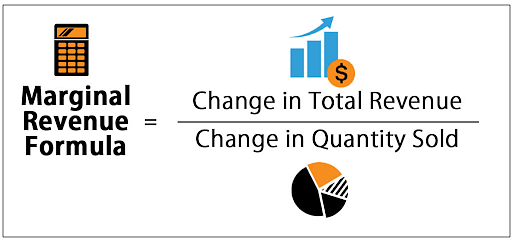
Marginal Revenue Formula
Also Read:
| Related Articles | ||
|---|---|---|
| Construction of line segment | Triangle | Are line segments measurable |
| Theorem | Constructions Revision Notes | Trigonometry |
How to Calculate Marginal Revenue?
[Click Here for Sample Questions]
As we know marginal revenue can be derived from the revenue obtained due to additional units sold, so it consists of two separate parts-
- Change in Revenue (Total Revenue – Old Revenue)
- Change in Quantity (Total Quantity – Old Quantity)
Let us understand the concept of Marginal Revenue with the help of an example:
Example: Gopal, an ice-cream vendor sells 50 units of ice cream and earns a revenue of INR 4000. His total revenue increased to INR 6000 when he sold 70 units. What will be the marginal revenue?
Solution: According to the situation,
Change in Revenue = INR 6000 - INR 4000 = INR 2000
Change in Quantity = 70 - 50 = 20
Marginal Revenue = Change in Revenue/Change in Quantity
Marginal Revenue = 2000/20 = INR 100
Read More: Average Revenue Formula
Marginal Revenue Curve
[Click Here for Sample Questions]
Mostly, Marginal Revenue changes with the number of units produced by a company. For instance, the total revenue earned by a company would be quite significant when the number of units manufactured by a company increases from 10 to 20 while it would be much smaller if the company is already producing 10,000 units. When the relationship between marginal revenue and the number of items sold by a company is graphically represented, we get a marginal revenue curve.
In a perfectly competitive market, the marginal revenue curve is a constant function while it is a decreasing function in a monopoly market.
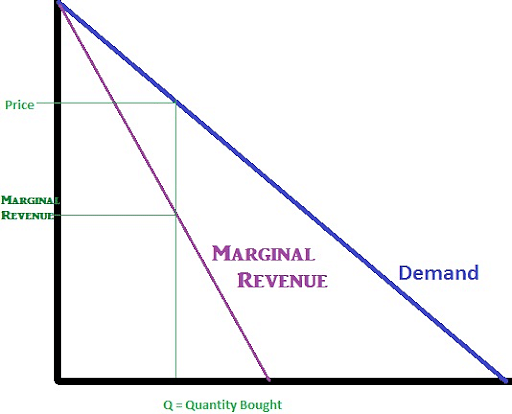
Marginal Revenue Curve Under Monopoly
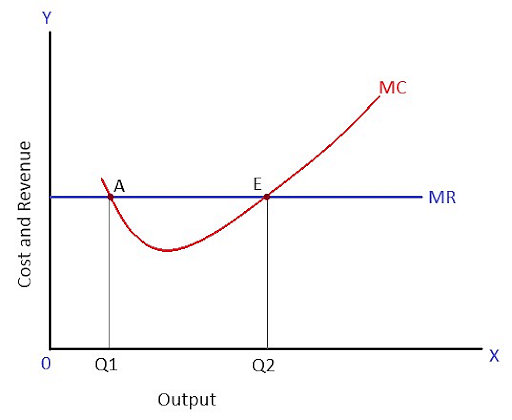
Marginal Revenue Under Perfect Competition
Things to Remember
- Marginal Revenue can be defined as the change in the total revenue due to the sale of an additional unit of a commodity. Marginal Revenue comes into play when additional units of output are produced.
- Marginal revenue remains constant up to a certain level of output and then it gradually decreases with increasing output by the Law of Diminishing Returns.
- The marginal revenue formula gives an increase in the total revenue of a company for a unit increase in the output.
- Marginal Revenue = (Change in Revenue) / (Change in Quantity)
- The relationship between marginal revenue and the number of items sold by a company is represented by the marginal revenue curve.
- Companies analyze marginal revenue to identify the revenue generated from one additional unit of production.
Also Read:
Sample Questions
Ques. A company increases the production of its steel rods by 10000 units and receives INR 200000 as revenue. Find the marginal revenue of the company. (3 Marks)
Ans. Marginal revenue can be represented as (change in revenue)/(change in quantity).
According to the problem statement,
Change in revenue = INR 200000
Change in quantity = 10000
Marginal revenue = 200000/ 10000 = 20
This implies that the marginal revenue of the company is INR 20.
Ques. Company Z produces 100 desks and sells them for INR 150 per unit to get INR 15000 as total revenue. The company decides to drop the price of each desk to INR 149 in order to sell 150 desks. Determine the marginal revenue of the company. (3 Marks)
Ans. According to the problem statement,
Change in revenue = (149*150) – (150*100) = 22,350 - 15,000
Change in quantity = 150 -100
Marginal revenue = 7350/50 = 147
This implies that the marginal revenue of the company is INR 147.
Ques. Rahul sells 10 packets of chips for INR 200. The revenue after selling the 11th packet was INR 250. What will be the marginal revenue of the 11th packet of chips? (3 Marks)
Ans. Marginal revenue can be represented as (change in revenue)/ (change in quantity).
According to the problem,
Change in Revenue = INR 250 - INR 200 = INR 50
Change in Quantity = 11 -10 = 1
Marginal Revenue = 50/1 = INR 50
Ques. A company sells 10 units of its product at INR 9 per unit for total revenue of INR 90. The 11th unit is sold at INR 8.5, resulting in total revenue of INR 93.50. Determine the marginal revenue of the 11th unit. (3 Marks)
Ans. According to the problem, the total revenue of 11 units is INR 93.50 while the total revenue of 10 units is INR 90.
The marginal revenue of the 11th unit = (93.50 – 90) = 3.50
This implies marginal revenue of the 11th unit is INR 3.50.
Ques. A toy producing company produces toys worth Rs 50 for the first 100 units. If the company sells the next 100 toys for Rs 45, calculate the revenue gained? (3 Marks)
Ans. According to the problem, the total revenue earned by selling the first 100 units is Rs 5,000 (100*50).
Similarly, the revenue earned by selling the next 100 lot for Rs 45 is Rs 4,500 (100*45).
Marginal revenue earned by selling next 100 toys= (5000 – 4500) = INR 1,500.
Ques. A cookie seller prepares homemade cookies and sells 30 packets a day. The cost of production includes the cost of raw materials, preparation cost, packing cost etc. The seller decides to sell these cookies for INR 20 per packet. One day by mistake, the seller mistakenly made 35 packets and sold them for INR 20 per packet. Determine his marginal revenue? (3 Marks)
Ans. According to the problem,
The total revenue earned by selling the first 30 packets of cookies is INR 600.
When the seller sold 35 packets, the revenue earned is INR 700.
Marginal revenue earned by selling the additional 5 packets = (700 – 600) = INR 100.
Ques. Explain the relationship between marginal revenue and average revenue with the help of their curves. (3 Marks)
Ans. The relationship between marginal revenue and average revenue can be calculated as follows:
- When the AR curve rises, MR > AR
- When the AR curve is maximum and constant, then MR = AR.
- When the AR curve falls, MR < AR.

Ques. When is the marginal revenue equal to the marginal cost? (2 Marks)
Ans. Marginal revenue becomes equal to marginal cost in a perfectly competitive market. Whenever the marginal revenue falls below the marginal cost, companies go for a cost-benefit analysis and halt production.
Ques. Company X sells 40 items for INR 4000. The management of the company decides to make an additional sale of INR 1200 by selling 12 items more. Find the marginal revenue of the company. (3 Marks)
Ans. According to the problem, the change in revenue of the company is INR 1200 while the change in quantity is 12.
Marginal Revenue = 1200/ 12= 100
This implies that the marginal revenue of the company is INR 100.
Ques. Are marginal revenue and average revenue one and the same thing? (2 Marks)
Ans. No. Marginal revenue is the net revenue a company earns by selling an additional unit of its product whereas the average revenue is the revenue earned per unit of output.
Ques. How can the marginal revenue determine the demand in the market? (3 Marks)
Ans. Following are some of the properties of marginal revenue which help in deciding the demand in the market.
- When the marginal revenue is positive, the demand is elastic.
- When the marginal revenue is negative, the demand is inelastic.
- When the marginal revenue equals zero, the demand is unitary elastic.
Ques. What are the key applications of marginal revenue? (3 Marks)
Ans. Marginal Revenue can be put to use in various scenarios, some of which are listed below:
- Analysis of customer demand
- Plan production schedules
- Set product prices
Ques. What is a marginal revenue curve? (3 Marks)
Ans. A marginal revenue curve is a graphical representation of the relation between the marginal revenue received by a company by selling its product and the quantity of output sold. A company generates maximum profit by producing the quantity of output found at the intersection of marginal revenue curve and marginal cost curve.
For Latest Updates on Upcoming Board Exams, Click Here: https://t.me/class_10_12_board_updates
Check-Out:



Comments