


NCERT Solutions for Class 10 Maths Chapter 13 Exercise 13.1

Collegedunia Team logo

Collegedunia Team

Content Curator

NCERT Solutions for Class 10 Maths Chapter 13 Surface Areas and Volume Exercise 13.1 Solutions are based on the following concepts:

Download PDF NCERT Solutions for Class 10 Maths Chapter 13 Exercise 13.1 Solutions

Check out the solutions of NCERT Solutions for Class 10 Maths Chapter 13 Exercise 13.1 Solutions
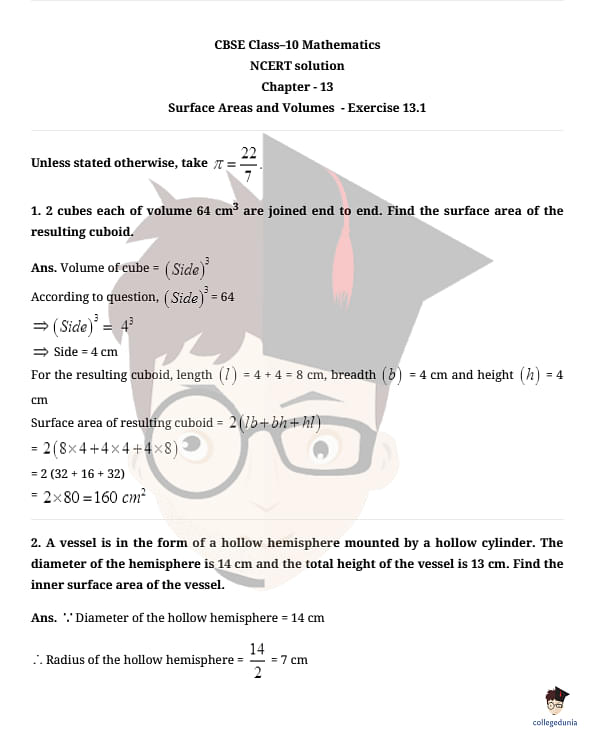
Read More: NCERT Solutions For Class 10 Maths Chapter 13 Surface Areas and Volume

Exercise Solutions of Class 10 Maths Chapter 13 Surface Areas and Volume

Also check other Exercise Solutions of Class 10 Maths Chapter 13 Surface Areas and Volume

Also Check:

Also check:

CBSE X Related Questions

  • 1.
    D is the mid-point of side BC of \(\triangle ABC\). CE and BF intersect at O, a point on AD. AD is produced to G such that \(OD = DG\). Prove that OBGC is a parallelogram.


      • 2.
        If the quadratic equation \(9x^2 + 8kx + 16 = 0\) has real and equal roots, then the value of k is

          • 3
          • –3
          • –4
          • \(\pm 3\)

        • 3.
          If the pair of linear equations : \( a_1x + b_1y + c_1 = 0 \) and \( a_2x + b_2y + c_2 = 0 \) is consistent and dependent, then

            • \( \frac{a_1}{a_2} \neq \frac{b_1}{b_2} \)
            • \( \frac{a_1}{a_2} = \frac{b_1}{b_2} = \frac{c_1}{c_2} \)
            • \( \frac{a_1}{a_2} = \frac{b_1}{b_2} \neq \frac{c_1}{c_2} \)
            • \( \frac{a_1}{a_2} = \frac{b_1}{b_2} = \frac{c_1}{c_2} \)

          • 4.
            The graph of \(y = f(x)\) is given. The number of zeroes of \(f(x)\) is :

              • 0
              • 1
              • 3
              • 2

            • 5.
              The HCF of 960 and 432 is :

                • 48
                • 54
                • 72
                • 36

              • 6.
                In the given figure, \(AB \parallel DE\) and \(AC \parallel DF\). Show that \(\triangle ABC \sim \triangle DEF\). If \(BC = 10\) cm, \(EB = CF = 5\) cm and \(AB = 7\) cm, then find the length DE.

                  Comments


                  No Comments To Show
