


NCERT Solutions for Class 10 Maths Chapter 13 Exercise 13.5 Solutions

Collegedunia Team logo

Collegedunia Team

Content Curator

NCERT Solutions for Class 10 Maths Chapter 13 Surface Areas and Volume Exercise 13.5 Solutions are based on all the topics covered in the chapter, surface areas and volumes. 

Download PDF NCERT Solutions for Class 10 Maths Chapter 13 Exercise 13.5 Solutions

Check out the solutions of NCERT Solutions for Class 10 Maths Chapter 13 Exercise 13.5 Solutions
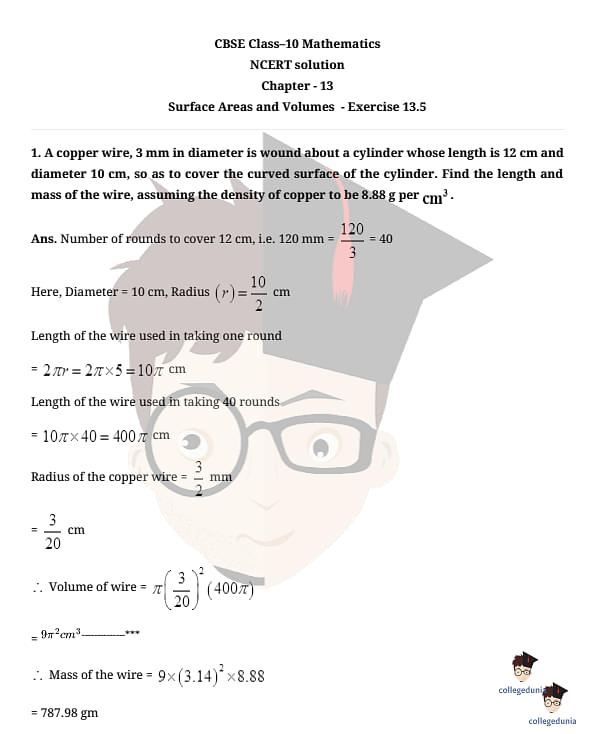
Read More: NCERT Solutions For Class 10 Maths Chapter 13 Surface Areas and Volume

Exercise Solutions of Class 10 Maths Chapter 13 Surface Areas and Volume

Also check other Exercise Solutions of Class 10 Maths Chapter 13 Surface Areas and Volume

Also Check:

Also check:

CBSE X Related Questions

  • 1.
    Two water taps together can fill a tank in $8\frac{8}{9}$ hours. The tap of larger diameter takes 4 hours less than the smaller one to fill the tank separately. Find the time in which each tap can separately fill the tank.


      • 2.
        PQ and PR are two tangents to a circle with centre O and radius 5 cm. AB is another tangent to the circle at C which lies on OP. If \(OP = 13\) cm, then find the length AB and PA.


          • 3.
            The first term of an AP is $p$ and the common difference is $q$, then its 10th term is :

              • $q - 9p$
              • $p - 9q$
              • $p + 9q$
              • $2p + 9q$

            • 4.
              Prove that :
              \(\frac{\tan \theta}{1 - \cot \theta} + \frac{\cot \theta}{1 - \tan \theta} = 1 + \tan \theta + \cot \theta\).


                • 5.
                  If the pair of linear equations : \( a_1x + b_1y + c_1 = 0 \) and \( a_2x + b_2y + c_2 = 0 \) is consistent and dependent, then

                    • \( \frac{a_1}{a_2} \neq \frac{b_1}{b_2} \)
                    • \( \frac{a_1}{a_2} = \frac{b_1}{b_2} = \frac{c_1}{c_2} \)
                    • \( \frac{a_1}{a_2} = \frac{b_1}{b_2} \neq \frac{c_1}{c_2} \)
                    • \( \frac{a_1}{a_2} = \frac{b_1}{b_2} = \frac{c_1}{c_2} \)

                  • 6.
                    The natural number 1 is :

                      • a prime number.
                      • a composite number.
                      • prime as well as composite.
                      • neither prime nor composite.

                    Comments


                    No Comments To Show
