



Content Curator
Periosteum is the outer covering of the bones. Periosteum covers the whole outer space except the joints which are referred to as articular spaces lined by the synovial membrane.
- Special cells called osteoprogenitors create osteoblasts (cells that help in the growth of bones).
- Babies and children with developing bones have lots of active osteoblasts in their periosteum.
- Osteoblasts reduce in count as a person ages.
- However, when something damages the bone, like a fracture, osteoprogenitor cells create new osteoblasts to heal the bone.
Also read: Cell Biology
Key Terms: Endosteum, Periosteum, Bones, Organs, Skeleton, Tissue and layer
Periosteum Meaning
[Click Here for Sample Questions]
The periosteum is a thin layer of connective tissue that surrounds the outside surface of a bone except at joints (which are protected by articular cartilage)
- It also supplies nutrients to the bone through blood flow. Sharpey's fibers, which go from the periosteum to the bone's outer circumferential and interstitial lamellae, connect the periosteum to the bone.
- It helps our bones to grow and heal.
- If the bones get damaged/injured, the periosteum will repair the damaged bone.
- It can be called the membrane of blood vessels and nerves that wraps around most people's bones.
- It has nociceptive nerve endings, making it extremely sensitive to manipulation. It also provides nourishment to the bone through the blood supply.
- An outside "fibrous layer" and an inner "cambium layer" make up the periosteum. Fibroblasts are found in the fibrous layer, while progenitor cells in the cambium layer evolve into osteoblasts, which are responsible for increasing bone breadth.
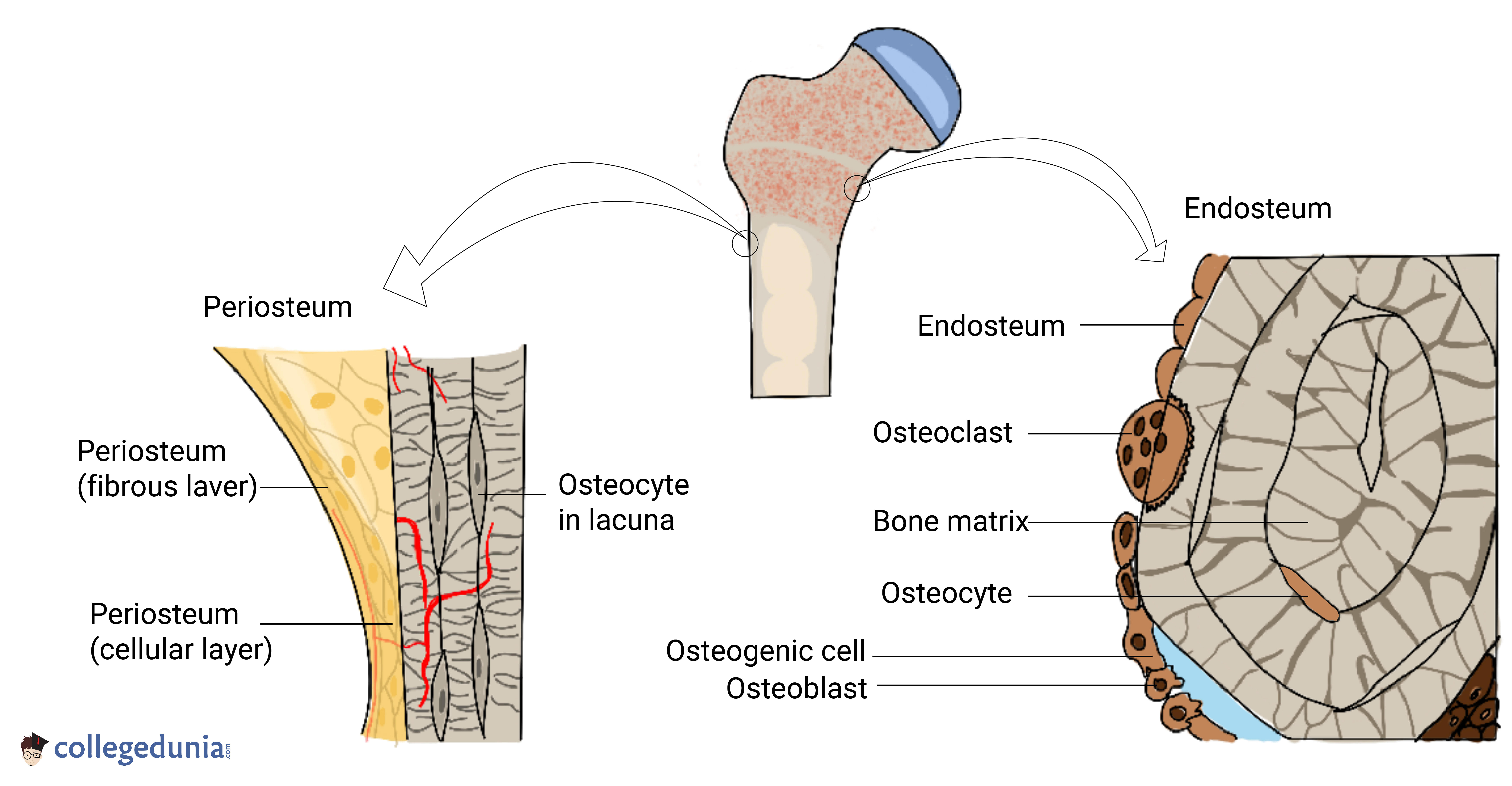
Periosteum
Also Read:
| Topic-Related Concepts | ||
|---|---|---|
| Skeletal System | Ball and Socket Joint | Difference Between Ligaments and Tendons |
| Human Body | Arthritis | Hinge Joints |
Anatomy of Periosteum
[Click Here for Previous Year Questions]
Periosteum covers the bone surface but does not cover the articular surfaces. The reason is, there are ligaments (these are bands of connective tissue that help hold bones, joints and organs in place properly) and tendons (a tendon is a fibrous connective tissue that attaches muscle to bone properly) attached to this and the areas the cartilage surrounds the bones.
The periosteum of bone is made up of 2 layers:
- Fibrous membrane made up of connective tissue (tissue that supports, protects, and gives structure to other tissues and organs in the body).
- Second one has osteoblast cells (Osteoblasts are cells that form bone tissue. These can synthesize and secrete bone matrices and participate in the mineralization of bone.
The outer layer of the periosteum is the fibrous layer which is further divided into two parts.
- The outer superficial layer of this fibrous membrane has few elastic fibers and it is made up of a collagenous matrix. Collagen is the most abundant structural protein in humans and other mammals.
- This layer also consists of blood referred to as the periosteal vessel and the nerves.
- They are the primary contributor to the blood supply to the skeletal muscle and even the bones. They can enter the bone cortex, a dense and compact layer of bone tissue beneath.
- Blood vessels enter the bone through channels called Volkmann canals. It lies perpendicular to the bone. From here, the blood vessels enter into a group of channels called Haversian canals, which run along the length of the bone.
- The deepest layer of the outer layer is more elastic because of many fibroelastic cells and is not very vascularised.
- The inner layer of the periosteum is a highly cellular cambium layer. It contains the osteoblast cells and mesenchymal progenitor cells. In the fetus stage, it has a lot of important functions to do and even during the earlier years of growth due to its osteoblastic potential it decreases with age and most gets reduced during childhood itself.
Read Also: Hardest Part of the Human Body
Differences Between Periosteum, Endosteum and Perichondrium
[Click Here for Sample Questions]
The three layers that protect our bones. Here’s a table providing key differences between Periosteum, Endosteum and Perichondrium.
| Basis | Periosteum | Endosteum | Perichondrium |
|---|---|---|---|
| Meaning | It is a layer of connective tissue that lines the bones. It leaves space for joints and tendons and ligaments. | It lines the bones along with the medullary categories as well. | It is a thick layer of connective tissues that lines the surface of growing bones' cartilage. |
| Tissue type | It is basically a dense and thick layer of cells forming tissue. | It is also made up of connective tissue and possesses a very thin layer. | It is a dense layer of fibrous connective tissue. |
| Thickness | The thickness of this layer is around 100 micrometers. | The thickness of this thin layer is around 0.1 to 0.5 micrometers. | The thickness of this layer is around 0.5 micrometers. |
| Occurrence | It lines with the outer surface of the bone. | It lines the inner surface of the bone. | It lines the outer surface of the bone. |
| Layers | The Periosteum thickness can be divided into two broad layers: the outer fibrous layer and the inner cambium layer. | It consists of a single cellular layer of loose connective tissue that lines the cavities. | It is made up of an exterior fibrous layer and an interior chondroblast layer. |
| Present in | This only lines the bones everywhere and not the joints or cavities. It also excludes the areas that are covered by the cartilage and the sesamoid bones. | The inner surface is entirely lined by the endosteum without even leaving space for anything else even on the medullary canals, the Volkman’s canal, the Haversian Canal, and even in the spongy tissue of bones. | It is present along the edges of elastic and hyaline cartilage. This can be found in numerous sites in the body, such as in the ears, nose, joints and ribs. |
| Type of cell | Here Osteoblast cells with great osteoblastic protection are present. | Here the cells which are found are hematopoietic and many fibroblast cells. | Here the cells which are found are chondroblasts and chondrocytes (cartilage cells). |
| Role | It nourishes compact bones and serves as a site for tendons and ligaments to attach. | Essential in remodeling, repair and growth of bones. | It protects bones from damage, nourishes cartilage, and promotes cartilage development. |
Functions of Periosteum
[Click Here for Previous Year Questions]
Periosteum functions are as follows:
- The periosteal vessels of the outer layer of the periosteum enter perpendicularly across Volkmann canals and enter another group of canals called Haversian canals that run along the bones. As a result, they are extremely sensitive to any bone function.
- The periosteal vessels can easily detect if any tissue is injured, damaged, or inflamed. It is due to these vessels that one can feel pain. It also contains nerve endings which transmit pain, heat, and cold sensations.
- When the nerves send a pain signal to the brain, the healing stage and process begin on their own.
- The osteoblasts cells found in the cambium layer play a vital role in bone formation.
- The periosteum does not cover the tendons and ligaments that connect the bones and provide attachment points. This is where the connective tissue appears.
- This layer is responsible for nourishing compact bones.
- It also serves as a conduit for the attachment of muscles to bones.
- The limiting layer is another name for the periosteum. This is due to the outer fibrous layer, which prevents bone tissue from leaking into neighboring tissues in the ridges and tubercles.
- The waste removal process occurs within the periosteum layer boundaries as well.
Check More:
Damage of Periosteum
[Click Here for Sample Questions]
Periosteum of a person gets damaged due to inflammation and this condition is called periostitis. It can be categorized as acute periostitis or chronic periostitis.
| Basis | Acute Periostitis | Chronic Periostitis |
|---|---|---|
| Meaning | It is basically a painful condition which is caused by an infectious consequence. It majorly happens because of autoimmune diseases like osteomyelitis or even leukemia. | This one happens when the bone is overused and under very tough friction or stress for a very prolonged period. |
| Cause | The results of infection can be seen in people with diabetes, sexually transmitted diseases and also in the ones who are suffering from urinary tract infections. This also leads to necrosis where the cell dies and infection is caused. | Here inflammatory changes are mostly seen in athletes. The most common reason for this is the lifting of the heavyweight. Jumping and running are the other two reasons. |
| Risk factors | Risk factors under this are systemic infection, open fracture, orthopedic surgery such as joint replacement surgery, atherosclerosis and ulcers. | The risk factors here are the hard or aggressive exercising that is very extreme and the Osgood Schlatter disease that is more common in children. |
| Symptoms | Symptoms here are pain, pus formation, fever, difficulty in putting weight on the affected limb, swelling of the tissue that is surrounding the bone, etc. | Here the bones become extremely sensitive to touch and ache, and temporary bouts of shin splints. Also causes inflammation and swelling. |
| Diagnosis | It can be diagnosed easily with the help of an x-ray and one needs to visit the doctor when they feel uneasy. Bone scanning and counting the blood count can also help to identify the infection. | Here much higher technique such as MRI ( Magnetic Resonance Imaging) is used, |
| Treatment | The treatment of pus and swelling most of the time is done by medicines only by using antibiotics. In the case of necrosis surgical debridement helps a lot. | Here most of the time the affected area is kept at rest and takes anti-inflammatory drugs such as ibuprofen |
Also Check: Locomotion and Movement
Things to Remember
- Periosteum is the outside layer of the bones, similar to how skin covers the surface of the human body's outer body.
- The Periosteum thickness can be divided into two broad layers: the Outer Fibrous Layer and the Inner Cambium Layer.
- The periosteum is the outer layer that protects our bones, and the endosteum is the inner layer. This is due to the outer fibrous layer, which prevents bone tissue from spilling into neighboring tissues in the ridges and tubercles.
- The waste removal process occurs within the periosteum layer boundaries.
Previous Year Questions
- Pectoral girdle consists of…
- What is the name of joint between ribs and sternum… (NEET - 2000)
- Fibrous joints play a significant role in locomotion. Fibrous joints have…
- Which of the following joints would allow no movements… (NEET - 2015)
- Which one of the following is not a synovial joint… (COMEDK UGET - 2014)
- The ball and socket joint is found in… (OJEE - 2011
- Three of the following pairs of the human skeletal parts are… (NEET - 2011)
- Which of the following statements regarding locomotion…
- Total number of bones in the hind limb of a man is… (JIPMER - 2003)
- Which of the following is made up of a single bone… (AIIMS 1994)
Sample Questions
Ques. What is Periostitis? (1 mark)
Ans. Periostitis is a condition that is characterized by the periosteum’s inflammation surrounding the tubular bones and in the tibia (also known as Shin Splints or MTSS).
Ques. What is Periosteum in the human body? (3 marks)
Ans. The Periosteum is the outer covering which is present on the bones.
- The Periosteum covers the whole outer space except the joint spaces which are referred to as articular spaces lined by the synovial membrane.
- The periosteal layer is something which protects this important part of our body.
- The periosteum helps our bones to grow and heal. If one damages or injures their bone.
- The periosteum will repair the damage and the person's bone will recover soon.
Ques. What are the types of damages that happen to Periosteum? (2 marks)
Ans. The Periosteum of a person gets inflamed and this condition is called periostitis. Shin splints are the most typical type of periostitis, but they can occur in the periosteum surrounding any muscle that is overused. Other than this, damage can also be caused due to an infection. People who in most cases experience this kind of condition are often athletes. It can be categorized as acute periostitis or chronic periostitis.
Ques. Mention some bones which are without periosteum. (3 marks)
Ans. The only bones that are not having the covering of the periosteum are sesamoid bones. These bones are embedded in the person's tendons or muscles. They comparatively take more time to heal also if they get injured. These bones are
- Patella (kneecap).
- In person's hands and wrists.
- In person's feet.
Ques. What are the symptoms of acute and chronic periostitis? (3 marks)
Ans. The symptoms of Acute and Chronic Periostitis are as follow:
- Symptoms of Acute Periostitis:
Extreme pain, difficulties bearing weight on the affected limb, pus formation, fever, chills and the enlargement of the tissue surrounding the bone
- Symptoms of Chronic Periostitis:
Chronic periostitis and temporary attacks of shin splints and other related ailments induce swelling and inflammation. Noninfectious periostitis causes bone pain and tenderness. People with chronic periostitis do not appear as sick as those with acute periostitis.
Periostitis is also mainly connected with the bones of the legs, however, it can also affect the long bones of the arms and the spine.
Ques. What distinguishes the perichondrium from the periosteum? (3 marks)
Ans. The perichondrium is a dense layer of fibrous connective tissue which covers many different forms of cartilage throughout the body, whereas the periosteum is a thin covering of membranous connective tissue that covers all bones. As a result, the periosteum supports bone formation and growth, whereas the perichondrium promotes cartilage development and growth. The periosteum promotes bone formation by enabling blood and nutrition flow to bone tissue. Both forms of tissue protect the bones from damage, however in different ways.
Ques. What are the similarities between periosteum and endosteum? (2 marks)
Ans. The periosteum and endosteum are two membranes that coat the bone lining.
- Both are composed of connective tissue.
- Both have cells such as fibroblasts, osteoblasts, and osteoprogenitor cells.
- Furthermore, these structures are important in bone remodeling.
Ques. Why do adult bones take more time to heal as compared to the bones of a small kid (fetus)? (5 marks)
Ans. A child's bones have considerably more periosteum, a rich coating of vascular connective tissue that covers their bones. This not only makes their bones thicker and stronger, but it also means they recover and mend considerably faster.
This is because the bones are significantly more oxygen-rich, allowing them to recover far more quickly after trauma.
In the fetus stage, the inner layer of the periosteum, a highly cellular cambium layer, has many important functions to do.
Even during the earlier years of growth due to its osteoblastic potential, it decreases with age and most gets reduced during childhood itself. However, because of the great thickness of children's bones, it is much more difficult to diagnose tiny fractures.
If we talk about adults the fibroblasts in the inner layer are elongated with a configuration essentially indistinguishable from the fibroblasts adjacent to it that lie in the outer layer. If an adult bone fracture occurs, osteoblasts can still be aided in repairing the injury.
Ques. How can one avoid the condition of Periostitis? (4 marks)
Ans. Mentioned below are the ways by which the condition of Periostitis can be avoided:
- If a person is diabetic then they have to manage their blood sugar level. If it is advised so also take the insulin from an external source.
- People should stay active and manage their weight.
- People should reduce cholesterol levels by avoiding oily and unhealthy foods.
- A Person's blood pressure also needs to be maintained by reducing the intake of salty foods.
- Person should always use the proper tools or equipment at home to reach things.
- Things like Alcohol and smoking only worsen the condition of the pain and infection so they must be avoided at all costs.
Ques. What function does the periosteum serve? (5 marks)
Ans. The periosteum serves three functions
- Blood supply to your bones.
- Giving them the ability to feel.
- Bone growth and repair.
The periosteum's blood arteries connect back to your circulatory system, supplying new, oxygen-rich blood to your bones.
Your periosteum aids in the growth and development of your bones. Osteoprogenitors are special cells that produce osteoblasts (the cells that grow your bones). Active osteoblasts are present in the periosteum of babies and youngsters whose bones are still growing and expanding.
There are fewer osteoblasts as you age and your bones stop growing. When anything damages your bone, such as a fracture, your osteoprogenitor cells "wake up" and produce new osteoblasts to help restore your bone.
Ques. Explain the Anatomy of the Periosteum in detail. (5 marks)
Ans. Periosteum covers the bone surface but does not cover the articular surfaces because they are covered by ligaments and tendons, nor does it cover the areas where cartilage surrounds the bones.
The fibrous layer is the periosteum's outer layer, divided into two parts. This fibrous membrane's outer superficial layer contains very few elastic fibers and primarily comprises a collagenous matrix with inter-spread elongated fibroblasts.
This layer also consists of blood which can be referred to as the periosteal vessel and the nerves, and are the most highly vascularized substratum and the primary contributor to the blood supply to the skeletal muscle and even the bones. They can pass into the dense and compact layer of bone tissue below, named the bone cortex.
The inner layer of the periosteum is a highly cellular cambium layer. It contains the osteoblast cells and mesenchymal progenitor cells, because of its cellular nature it is responsible for appositional growth.
In the fetus stage, it has a lot of important functions to do and even during the earlier years of growth due to its osteoblastic potential it decreases with age and most gets reduced during childhood itself. If we talk about adults the fibroblasts in the inner layer are elongated with a configuration essentially indistinguishable from the fibroblasts adjacent to it that lie in the outer layer.
Read also:



Comments