



Education Journalist | Study Abroad Lead
Pollen germination refers to the growth of pollen tubes from pollen as it lands on stigma. As soon as it lands on the stigma, the stigma releases a sticky organic sugary substance that allows the germination of the pollen grain. The transfer of pollen grains from male part of the flower, i.e, anther to the female part of the plant, i.e, stigma is referred to pollination. The germination is also assisted by the absorption of nutrients and water by pollen.
| Table of Content |
Key Terms: Germination, Pollen Grains, Pollen Tube, Stigma, Flower, Plant, Vegetative Cell, Generative Cell, Gametes, Pollination, Anther
Pollen Grains
[Click Here for Sample Questions]
Pollen grains are tiny powdery substances, usually spherical in shape with size ranging from 25-50 μm in diameter. Its outer layer is called exine and the inner layer is called intine. The exine consists of a complex substance called sporopollenin known as the most resistant biological material known. It can withstand high temperatures, alkalis, and strong acids, and show resistance against degradation enzymes. The intine is thin and uniform and is made up of pecto-cellulose. It comes out of the germ pore and gives rise to the pollen tube during germination of pollen.
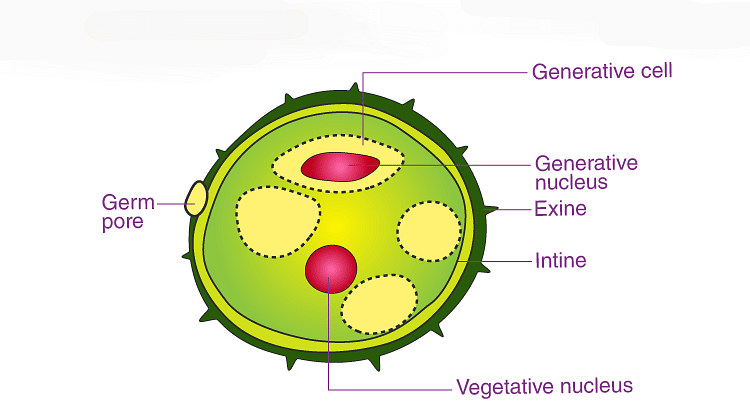
Pollen Grain
Pollen Germination
[Click Here for Sample Questions]
The process of pollen germination is described below:
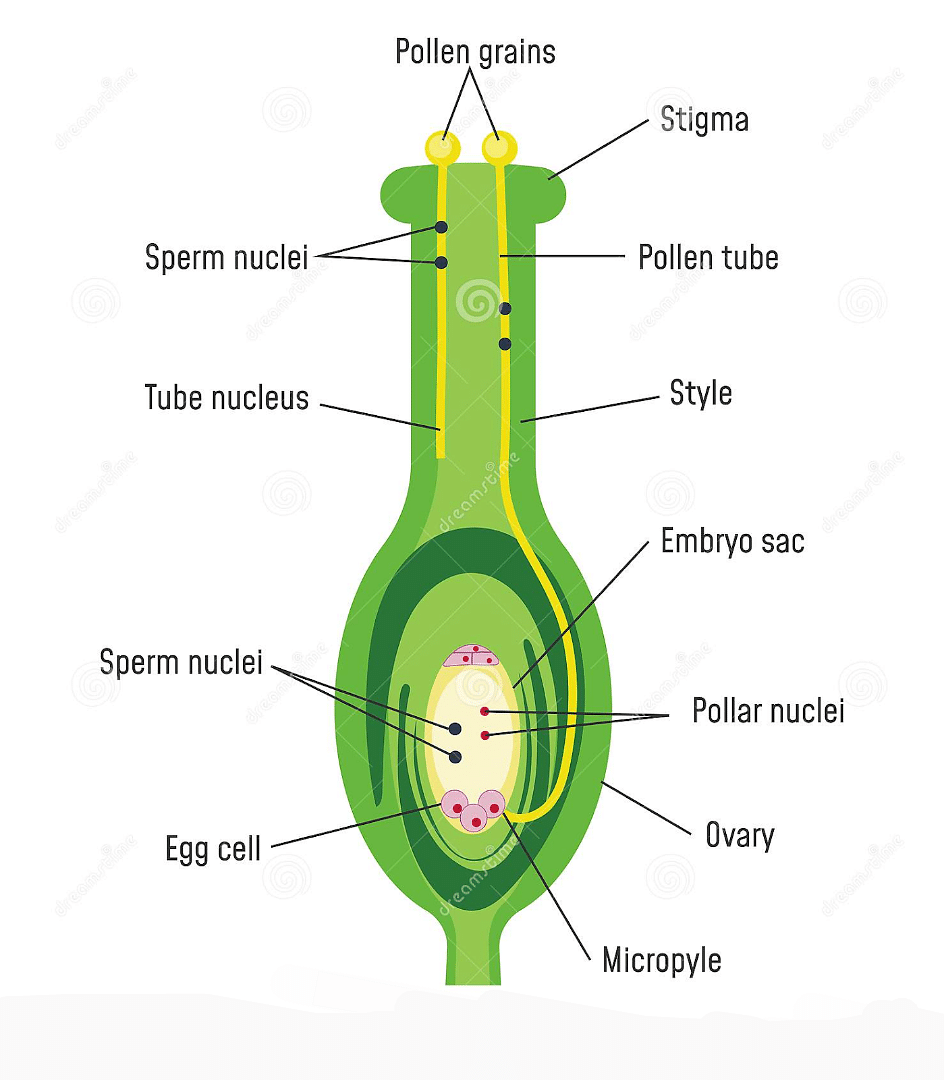
- Upon the arrival of pollen grain on the stigma of the plant, a tube emerges from the germ pore of the pollen grain and moves through stigma, style, and finally reaches the ovary.
- The pollen tube is nourished by the sugary substance and grows until it reaches the ovule in the ovary. The length of the pollen tube varies between a few millimetres to 45 cm (in maize) in different plants and depends on the length of the style.
- During the growth of the pollen tube, the vegetative cell or the tube cell enlarges and comes out of the pollen grain through the germ pore and forms the pollen tube.
- The generative cell within the pollen grain tube cell divides to form two sperm cells (male gametes).
- As the pollen tube grows, the two male gametes (present inside each pollen grain) go into the tube.
- The pollen tube finally releases two male gametes into the embryo sac to carry out the process of double fertilisation.

Experiment
[Click Here for Sample Questions]
Aim: To observe pollen germination on stigma through permanent slide.
Material Required:
- China Rose
- Boric Acid
- Forcep
- Microscope
- Sucrose (10 g)
- Coverslips
- Slide
- Dropper
Procedure:
- The first step is to prepare the nutrient rich solution by mixing sucrose and boric acid together in water.
- Pluck stigma from China rose (bisexual flower) using forcep.
- Put the stigma on the slide.
- Now with the help of a dropper, add a dropwise solution on the slide and hold for 20 seconds.
- Cover with cover slide.
- Observe under a microscope.
Observation:
The germination of pollen grains in nutrient rich medium can be seen as the vegetative cells enlarge. The nucleus grows and gives rise to a pollen tube which emerges from one of the germ pores. Followed by the growth of the pollen tube, two male gametes (spherical or lenticular in shape) are formed. The pollen grains that germinate are known as viable pollen grains whereas the pollen grains which do not germinate are known as non-viable pollen grains.
Precautions:
Some precautions as mentioned below should be taken while conducting the experiment:
- Use freshly plucked flowers only.
- Use fresh and dry slides.
- Use only 1-2 drops of sucrose solution, otherwise it may hinder the process of germination of pollen.
Things to Remember
[Click Here for Sample Questions]
- Pollens are powdery substances of different shape and size present in anther, consisting of a bulk of microspores. These microspores undergo two mitotic divisions to form male gametophyte.
- First mitotic division results in vegetative cells (non-reproductive) whereas second mitotic division results in formation of generative cells that give rise to two male gametes.
- The generative cell is small and enclosed within the cytoplasm of the vegetative cell.
- When pollen lands on stigma, they first identify whether they are of their own species or different. If they are of different species, it does not allow them to germinate.
- During pollen germination, vegetative cells enlarge and come out of the pollen grain through the germ pore and form the pollen tube.
- Pollen tube goes through stigma, style and finally reaches the ovary.
- The generative cell within the pollen grain tube cell divides to form two sperm cells (male gametes). It releases gametes into ovules for double fertilisation.
- To study the germination of pollen on stigma, the pollen must be present on stigma. China rose was preferred as it has both male and female reproductive parts in one flower.
Sample Questions
Ques. Why was the sucrose solution taken for an experiment? (2 marks)
Ans. Sucrose is a sticky and sugary solution. The germination of pollen begins when stigma releases sugary substances. To imitate the process, the sucrose solution was taken for the growth of the pollen tube. However, the use of sucrose solution must be appropriate otherwise it may hinder the process of germination of the pollen tube.
Ques. Are pollens allergic? (2 marks)
Ans. Yes, pollen is allergic. Pollen grains from grasses, weeds, or trees can cause hay fever and other respiratory infections such as asthma and bronchitis. Pollen of Parthenium (carrot grass) is well known for causing the allergy. It is responsible for skin inflammation, eczema, asthma, black spots, burning, and blisters around the eyes etc. The seed of this plant is imported to India from wheat from the USA.
Ques. How are pollen products useful to humans? (2 marks)
Ans. Pollen grains are rich in nutrients. They consist of carbohydrates 24-48%, proteins 7-26% and fats 0.9-14.5%. For example- they are used in cosmetics, as food and health supplements. In western countries, they are taken in the form of tablets and syrups. These supplements are taken by athletes to increase their performance. They are also used to increase performances in racehorses.
Ques. Why are pollen and pistil interactions important? (2 marks)
Ans. Pollen and pistil interactions are important for double fertilisation in plants. Fertilisation helps in the formation of seeds and fruit. Therefore, it is very necessary to have pollen and pistil interactions. If pollen and pistil interaction is not there, then no progenies will be made of plants and can get extinct soon. Pollen consists of male gametes. Each pollen grain consists of two male gametes. They reach the embryo sac through a pollen tube for double fertilisation.
Ques. On what basis pollens are preserved as fossils? (2 marks)
Ans. The exine of pollen consists of a complex substance called sporopollenin. It is the most resistant biological material known to date. It can withstand high temperatures, alkalis, and strong acids, and show resistance against degradation enzymes. These are the factors, on the basis of which pollen is preserved as fossils.
Ques. What is autogamy and geitonogamy? (2 marks)
Ans. The process of transfer of pollen grains from anther to the stigma of the same flower is called autogamy. For example, cleistogamous flowers. The process of transfer of pollen grains from anther to the stigma of another flower of the same plant is called geitonogamy. It is similar to autogamy but functionally involves cross-pollination.
Ques. What is germ pore in pollen? (2 marks)
Ans. Germ pore is the pore or region present on the pollen exine layer. Sporopollenin is absent in this region. One germ pore is present in monocotyledons whereas three germ pores are present in dicotyledons. Germ pore plays a major role in the initiation of the pollen tube as it emerges from these pores during pollen germination.
Ques. How many meiotic divisions are required to form 102 pollen grains? (2 marks)
Ans. 4 pollen grains are formed by 1 meiotic division of the Pollen mother cell.
4 pollen grains= 1 meiotic division
1 pollen grain= 1/4 meiotic division
102 pollen grains = 1/4 x 102
= 25.5 Meiotic divisions
However, it is not possible to form half pollen, so 26 meiotic divisions will take place.
Ques. Why do insect-pollinated flowers have sticky pollen? (2 marks)
Ans. Pollination by insects (bees, butterflies, moths, wasps, beetles, etc) is known as entomophily. They help in cross-pollination. The insect-pollinated flowers are big and sticky so that when insects sit on the flower, the pollens get stuck to their legs. When these insects go to another flower for cross-pollination , they drop pollen.
Ques. Insects sit on multiple flowers and carry different species of pollen on their body. What happens when different species of pollen land on stigma? (2 marks)
Ans. Insects carry different species of pollen while sucking nectar. When a different pollen species lands on the stigma, then no pollen germination will take place. Pollen germination begins only when stigma releases sticky sugary substances. Stigma does not allow other pollen species to germinate. If no pollen germination takes place, then there will be no fertilisation.
Read More:



Comments