



Content Curator
Preparation of Acetanilide can be done through two processes. Acetanilide is a white organic solid substance that is typically employed in chemical synthesis. This substance is also known as N-phenylacetamide, acetanilide, and acetanil. Antifebrin was the brand name for a drug that was used to treat fever and headaches in the past. The composition used to be a standard test in beginning organic chemistry lab classes, but it has since been largely replaced by the preparation of paracetamol or aspirin, both of which teach the same practical techniques (particularly product recrystallization) but eliminate the use of aniline, a suspicious carcinogen.
| Table of Contents |
Key terms: Acetanilide, composition, acetamidobenzenesulfonyl, N-phenylethanamide, Ethyl, Beilstein, trinitroaniline.
What is Acetanilide?
[Click Here for Sample Questions]
Acetanilide is a colorless, odorless solid substance that resembles a leaf or flake. It was previously known as Antifebrin and was also known as N-phenylacetamide, acetanil, or acetanilide. Acetanilide is made by combining acetic anhydride and aniline:
C6H5NH2 + (CH3CO)2O → C6H5NHCOCH3 + CH3COOH
Acetanilide is water-insoluble yet stable under most conditions. Pure crystals are plate-shaped and range in hue from white to colorless.
Application of Acetanilide
[Click Here for Sample Questions]
The main applications of Acetanilide are-
- Acetanilide is a hydrogen peroxide breakdown agent that is also used to stabilize cellulose esters varnish.
- It's also used as an intermediary in the production of rubber accelerators, colors and dye intermediates, and camphor.
- Acetanilide is used to make 4-acetamidobenzenesulfonyl chloride, which is a critical intermediary in the synthesis of sulfa medicines.
- Acetanilide was one of many chemicals employed as an experimental picture developing in the nineteenth century.
Preparation of Acetanilide
[Click Here for Sample Questions]
Aim
The aim of this procedure is to prepare Acetanilide by using aniline, glacial acetic acid (acetic anhydride), and zinc dust.
Theory
When aniline interacts with acetic anhydride/glacial acetic acid in the presence of zinc dust, acetanilide is formed. To obtain acetic anhydride precipitated, a combination of aniline, glacial acetic acid, acetic anhydride, and zinc dust is refluxed under anhydrous conditions and then put into ice-cold water. The acetic anhydride crude precipitated is recrystallized to produce pure acetanilide crystals.
The following reactions might take place throughout the chemical reaction-
- During the chemical process, zinc is utilized to prevent aniline from oxidizing. Acetanilide is a vital component of medicine that is used as a febrifuge.
- Acetylating aniline with acetic anhydride in the presence of high concentration hydrochloric acid could also yield acetanilide.
- Aniline is dissolved in hydrochloric acid, then acetic anhydride is added and thoroughly mixed.
- Pour the mixture into a glass of water containing sodium acetate.
- Ethyl alcohol can also be used to separate and recrystallize the acetanilide that is produced.
N-phenylacetamide, N-phenylethanamide, Acetanil are some of the other labels for this compound.
Requirements
Here are the things required for this preparation-
- Glacial acetic acid 40 ml
- Aniline 20 ml
- Anhydride of acetic acid
- distilled water Zinc dust
- Flask with a round bottom of 100 ml
- Beaker
- pipette
- Condenser for recirculation
- Funnel
- Stirrer
- Bunsensurner
- Electronic balance
- Filter paper
- Iron stand
- Measuring cylinder
Procedure
The procedure includes the following steps-
- Before beginning the experiment, thoroughly clean all of the apparatus with filtered water.
- In a 100 mL round bottom flask, combine 20 mL aniline with a 40 mL mixture of acetic anhydride and glacial acetic acid.
- Continue to stir the reaction mixture.
- Zinc dust should now be added to the flask.
- Using connectors and an iron stand, secure a water Pasteur pipette to the round bottom bottle containing the reaction mixture.
- Using squat support, wire gauze, and sand bath, place the round bottom flask on the burner to heat the reaction mixture.
- Continue to cook the mixture for another 30-40 minutes.
- Continue to whisk the mixture.
- Transfer the reaction mixture from the round bottom flask into an ice-cold water-filled beaker.
- Continue to whisk the mixture.
- Separate the reaction mixture once all of the acetanilide has formed.

Acetanilide Overview
Crystallization
Crystallization must be conducted in order to obtain pure crystals. Heat the crude sample carefully in a small beaker containing 20 ml of water.
- If the mixture is colored, a small amount of activated carbon can be added.
- Using a funnel, strain the heated solution.
- Cool the mixture for 30 minutes to extract the white, gleaming acetanilide crystals.
- Remove the crystals with a filter, wash them with water, and dry them in the folds of filter paper.
For recrystallization
Using only a beaker and stirrer, mix crude acetanilide in 50 mL distilled water. Add some ethanol to the mix as well. Heat this mixture until it becomes clear, stirring constantly. The solution should now be cooled and filtered. Allow time for the crystals to dry. The crystallization process can be repeated two times if one wants more pure acetanilide crystals.
Observation table
So with the above experiment we get the following observations:
| Crystal’s color | White |
| Crystal’s shape | Plate like shape |
| Cystal’s odor | Odourless |
| Crystal’s appearance | Flasky |
| Melting point of crystals | 114.5° C |
Result:
The resulting acetanilide crystals weighed as the preparation element quantities. It has a melting point of 114.5 degrees Celsius.
Precautions to be taken while the process:
Here are some precautions that are need to be taken during the process-
- Because aniline is a carcinogen, it must be handled with extreme caution.
- Avoid inhaling acetic anhydride vapors.
- To eliminate any moisture-related errors, constantly dry the crystals before calculating their weight and melting point.
- Throughout the experiment, stir occasionally the reaction mixture.
- When the combination is introduced to ice-cold water, vigorous heating is required.
Alternative method for preparation of Acetanilide
[Click Here for Sample Questions]
Aim
The aim of this preparation is to Prepare Acetanilide through an alternative way.
Theory
In the introduction of glacial acetic acid, one hydrogen atom of aniline — NH2 group is replaced by a CH3CO– group. Acetanilide is produced.
- Acetylation is commonly done in the laboratory with acetic anhydride.
- If acetic anhydride is unavailable, acetyl chloride can be used to acetylate the compound.
- In most cases, acetylation with CH3COCl is done in the presence of pyridine.
Requirements:
Here are the things required for this preparation-
- Beaker 250 ml
- Funnel
- Round-bottomed flask 100 ml
- Condenser of air
- Sand bath
- Iron stand and clamp
- Stone made of pumice
- Aniline for melting point assembly : 5 mL
- Anhydride of acetic acid/acetyl chloride : 5 mL
- Acetic acid/pyridine: 5 ml
Procedure:
The procedure includes the following steps-
- In a 100 mL round bottom flask, combine 5 mL aniline with 5 mL acetic anhydride and 5 mL glacial acetic acid to make an acetylating mixture. As an alternative, 5 mL acetyl chloride and 5 mL dry pyridine can be used as the acetylating solution.
- After adding some more pumice stones to the opening of the round bottom flask, place an air condenser on the opening and gently reflux the liquid for 10-15 minutes in a sand bath.
- Cool the reaction mixture and carefully pour it into 150-200 mL of ice cold water, stirring constantly.
- Filter the solid, rinse it with cold water, then recrystallize a small portion of it in heated water with some drops of methanol or ethanol.
- Record the output as well as the compound's melting point.
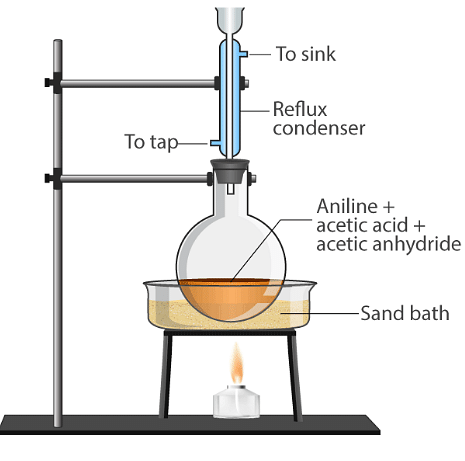
Preparation of Acetanilide
Result:
The resulting acetanilide crystals weighed will be as per the element quantities that are used in this process. It has a melting point of 114.5 degrees Celsius.
Precautions:
Here are some precautions that are need to be taken during the process-
- Acetic anhydride and acetyl chloride should be handled with caution because they irritate the eyes and acetyl chloride aggressively stinks in the air.
- Keep acetyl chloride in a dry place.
- Pyridine should be handled with great care. Dispense it in a well-ventilated area and use biodegradable safety glasses when using it.
- Pyridine should be distilled before use since it absorbs moisture and the reaction cannot occur in damp conditions.
- Clean the substance with cold water 2-3 times until the solution is litmus-neutral.
- Calculate the melting point of a sample that has been properly dried and recrystallized.
Various Acetanilide Tests
[Click Here for Sample Questions]
Various Acetanilide tests are mentioned in this part-
Beilstein test
During the Beilstein test, the acetylation process will normally transform aniline to acetanilide. The amine will be transformed into its acetamide equivalent via the acetylation process. The purpose was to compare the results of two reactions in order to discover an unknown amine/acetamide compound. During such a procedure, aniline HCl (concentrated HCl, 37 percent w / w) is employed.
- Experiment process
- Mix the aniline 500 mg in 14 mL of water. It should be highlighted that aniline is not water-resistant, necessitating the use of two layers. A strong acid solution of 0.45 mL is added.
- Start preparing a 530 mg sodium acetate solution in 3 mL water and 0.6 mL anhydride. Immediately add the sodium acetate solution after swiping the aniline hydrochloride anhydride solution in water.
- The reaction turns white as the acetanilide passes. Before vacuum filtration to collect solid acetanilide, the mixture was allowed to cool in an ice bath. Only a minimal amount of water is required to rehydrate water made from 95 percent ethanol.
Cleanse the copper cord by holding it in position for a few moments to begin the Beilstein test. After touching the chord in a composite sample, put it back in the oven. The appearance of blue in the flames indicates the existence of halogen. It's a good way to check the method on a halogen-containing chemical before trying it on your own.
Green method
In a very spherical flask, acetanilide dissolves in ethanol. The membrane and ceric nitrate are then dissolved in water. The add-on now includes this solution. During the bottom flask, this mixture was introduced to the acetanilide solution. After the introduction is complete, the reaction mixture is stirred for 10 minutes in the heat to create white crystals. Now pour yourself a glass of cool water to sip. A dry Buchner panel was used to isolate the solid from the white crystals. The melting point is 114.3 degrees Celsius.
- Even though aniline cannot be substituted by p - due to re-activation (aniline nitration yields trinitroaniline), acetylation comes first.
- Monosubstituted related compounds, as a result, are undetectable.
- Electrophilic proportional action at the o- and p-positions when aniline is utilized, however in acetanilide, electrons are exposed to the ring and C carbonyl is rarely present, resulting in electron deficiency due to polarization.
- Zinc is used to prevent aniline from oxidizing during chemical processes.
- Acetanilide is a key component of the medication that acts as a febrifuge.
- Acetanilide can be made by acetylating aniline including anhydride in strong acids.
- After dissolving aniline in acid, anhydride is added and thoroughly combined.
- Pour the mixture into a glass of sodium acetate-containing water.
- The isolate is frequently absorbed by ethyl alcohol, which also works on acetanilide.
Things to Remember
- Acetanilide is a white solid chemical substance that is widely used in chemical synthesis.
- It is also known as N-phenylacetamide, acetanilide, and acetanil.
- Acetanilide can be prepared by using aniline, glacial acetic acid (acetic anhydride) and zinc dust.
- There are Various Acetanilide tests- Beilstein test, Green method
Solved Questions
Ques 1. What does acetanilide have as a chemical property? (5 marks)
Ans. Acetanilide is a white to gray solid with the molecular formula CH3CONHC6H5. It is also known as N Phenylacetamide, acetanil, or acetanilide. It's a crystalline powder or flakes that are odorless, colorless, and shiny.
- Furthermore, it was determined that acetanilide had intolerable harmful consequences, hence it is no longer utilized as a medicine.
- Acetanilide is primarily used as a plasticizer in the polymer industry and as an activator in the rubber industry.
- It is also used as an intermediate in the synthesis of pharmaceuticals and dyes, as an additive for hydrogen peroxide and cellulose ester varnishes, and as an additive for hydrogen peroxide and cellulose ester varnishes.
Ques 2. What is the purpose of adding zinc to acetanilide preparation? (2 marks)
Ans. We need to add zinc to Acetanilide preparation because zinc is added to the process to prevent aniline from oxidizing. It lowers the concentration of coloured contaminants in the solution.
Ques 3. What is the acetylation of acetanilide underlying principle? (2 marks)
Ans. Acetylation of aniline with acetic anhydride in the presence of glacial acetic acid produces acetanilide. Aniline, also known as phenylamine, is a basic primary amine. Acetic anhydride, which is an anhydride of acetic acid, serves as an acyl group source here.
Ques 4. What is the need of preparing acetanilide? (4 marks)
Ans. The purpose for preparing Acetanilide is:
- Acetanilide is a hydrogen peroxide breakdown inhibitor that is also used to stabilize cellulose ester varnishes.
- It is also used as an intermediary in the production of rubber accelerators, colors and dye intermediates, and camphor.
- Acetanilide is used to make 4-acetamidobenzenesulfonyl chloride, which is a critical intermediary in the synthesis of sulfa medicines.
Ques 5. Is acetanilide poisonous to humans? (3 marks)
Ans. Yes because in the human body, acetanilide is transformed into a phenolic metabolite that has analgesic properties, although some of it is changed to aniline (amino benzene), which is poisonous. As the half-life in blood plasma for a single dose of 10 mg/kg of acetanilide was determined to be 191.5 ± 27.8 minutes.
Ques 6. Why is sodium acetate required in the production of acetanilide? (2 marks)
Ans. The intermediate must be deprotonated before it can be acetanilide. The sodium acetate functions as the base in this reaction, abstracting the proton from the intermediate. Thus, sodium acetate is required in the production of acetanilide.
Ques 7. Is acetanilide a basic or acidic compound? (2 marks)
Ans. Acetanilide is basic in nature. Although aniline is a base, the substitution of a hydrogen atom by the COCH3 group results in a significant reduction in basicity, making acetanilide a weak base (pKb = 12.9–13.4).
Ques 8. What do you understand by recrystallization? (5 marks)
Ans. Recrystallization is the process of replacing deformed crystal structure grains with a fresh set of stress-free grains that nucleate and develop until all of the original grains are eaten. The procedure is carried out by heating the material to temperatures higher than those required for crystallization.
- This procedure is used in steel annealing to eliminate any strain hardening effects, such as significant plastic deformation caused by cold working.
- So, for the process of recrystallization combine crude acetanilide and 50 mL distilled water in a beaker with a stirrer.
- Also, add some ethanol to the mix. Cook, stirring regularly until the mixture becomes clear.
- The solution should be cooled and filtered at this point.
- Give the crystals time to dry. If you merely want pure acetanilide crystals, you can perform the recrystallization process two times. Determine the melting point of the crystals you've gathered.
Ques 9. What happens if you add too much solvent to the sample? (2 marks)
Ans. Organic compounds are frequently recrystallized in water since they DO NOT want to dissolve in such a very polar liquid. However, above 100 degrees Celsius, the intermolecular interactions diminish, causing the organic to disintegrate.
Also Read:
| Chapter Related Articles | ||
|---|---|---|
| Isomerism | Oxidizing Agents | Volumetric Analysis |
| Thermochemistry | Chemical Kinetics | Electrochemistry |
| Quantitative Analysis | Organic Compounds | Oxalic Acids |
Also Read:



Comments