



Content Curator
The elevation of the boiling point states that the growth of a solvent's boiling point is over the addition of a solute. The resulting solution has a greater boiling point when a non-volatile solute is functional than a pure solvent. The boiling point of sodium chloride, the Salt solution, is greater than the pure water.
| Table of Content |
Keyterms: Boiling Point, Solvent, Solute, Solution, Salt, Water, Colligative property, Elevation, Vapor Pressure
What is Boiling Point Elevation?
[Click Here for Sample Questions]
The elevation of boiling points is a colligative property of matter which depends on the solvent-to-solvent ratio but not on the individuality of the solute. This clearly explains that the elevation of a solution's boiling point hangs on the amount of solution enforced to it. The greater the solute concentration in the solution, the greater the elevation of the boiling period.
A graph explaining the elevation in the boiling point of water over the extension of sucrose is given above. At 1atm of pressure, the pure water is boiled at 100oC. Though, a 10 molal solution of sucrose in water boils at around 105oC.
Also Read:
| Chapter Related Links | ||
|---|---|---|
| Colligative properties | Azeotropic Distillation | Atomic Mass of Elements |
| Mass Percent Formula | Sandmeyer reaction | Mole Fraction |
Why Does Boiling Elevation Point Occur?
[Click Here for Previous Year Questions]
The boiling measure of a liquid is the temperature at which its vapor pressure is equivalent to the pressure of the near environment. Non-volatile substances do not willingly endure evaporation and have very low vapor pressure which is assumed to be zero. When a non-volatile solute is equivalent to a solvent, the vapor pressure is lesser than the pure solvent.
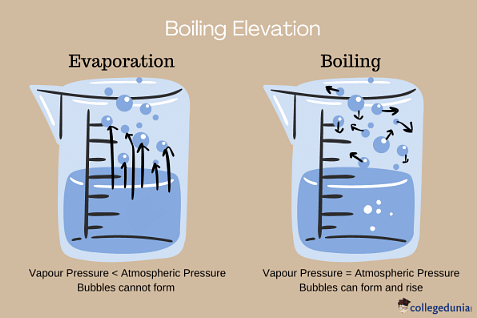
Consequently, a superior amount of heat should be delivered to the solution for it to boil. This growth in the boiling point of the solution is the boiling point elevation. Growth in the concentration of additional solute is followed by an additional decrease in the vapor pressure of the solution and an elevation in the boiling point of the solution.
The boiling point of a non-volatile solute comprising solution can be explained as follows:
The boiling point of solution = pure solvent boiling point + elevation of the boiling point.
The boiling point elevation signified as (ΔTb) is related to the solute concentration in the solution and the following equation permits it to be measured-
ΔTb = i*Kb*m
Wherever,
- It is the Van't Hoff reason.
- Kb is the ebullioscopic constant.
- The m is signified as the molality of the solute.
It is significant to reminisce that when the solute concentration is high, this formula turns out to be less accurate. This formula in volatile solvents matters does not hold any truth.
With oC/molal, or oC. kg.mol-1, the ebullioscopic constant (Kb) is expressed. Below the Kb values for few common solvents are tabularized:
Kb Values for Some Common Solvents
| Solvent | Kb Value (in oC. kg.mol-1) |
|---|---|
| Water | 0.512 |
| Phenol | 3.04 |
| Acetic Acid | 3.07 |
| Chloroform | 3.63 |
| Benzene | 2.53 |
With the shore of the boiling point elevation formula, the degree of dissociation of the solute and the molar mass of the solute can be measured.
Relationship of Boiling Point Elevation and Vapor Pressure
[Click Here for Sample Questions]
In details of vapor pressure, boiling point elevation can be explained. Vapor pressure is well-defined as the pressure used at a given temperature by a vapor in thermodynamic equilibrium with its abbreviated stages. It is merely an amount of the capability of the solvent molecules, in layman's words, to emit by entering the gas phase. Whenever the vapor pressure is equivalent to the air pressure, a liquid boils.
Boiling Point - The boiling measure of a liquid in its purest form. The liquid must boil when the vapor pressure of the liquid equivalents the ambient pressure.
Things to Remember
- The elevation of the boiling point states that the growth of a solvent's boiling point is over the addition of a solute. The resulting solution has a greater boiling point when a non-volatile solute is functional than a pure solvent.
- The greater the solute concentration in the solution, the greater the elevation of the boiling period.
- The boiling measure of a liquid is the temperature at which its vapor pressure is equivalent to the pressure of the near environment.
- Growth in the concentration of additional solute is followed by an additional decrease in the vapor pressure of the solution and an elevation in the boiling point of the solution.
- Vapor pressure is well-defined as the pressure used at a given temperature by a vapor in thermodynamic equilibrium with its abbreviated stages.
Also Read:
Previous Year Questions
- If glucose of 36g weight is dissolved in 2kg of H2O then, change in boiling point (ΔTb) at 1.013 bar will be (Kb for H2O is 0.52Kkgmol−1)
- Volume of acid required to make 1 litre of 0.1MH2SO4 solution is:
- With increase in temperature, which one of these changes?
- Molarity is expressed as
- Which salt shows maximum osmotic pressure in its 1 M solution?
- The blood cells retain their normal shape in solutions which are
- The mole fraction of pentane in the vapour phase would be
- According to Raoult’s law, the relative lowering of vapour pressure for a solution is equal to
- What would be the freezing point of aqueous solution containing 17g of C2H5OH in 1000g of water?
- The elevation of the boiling point of the solution is 0.75K. The molecular weight of the solute in gmol−1 is
- 200mL of water is added to a 500mL of 0.2M solution. What is the molarity of this diluted solution?
- The mass of water in grams present in the solution is (Kf=1.86Kkgmol−1)
- what is the weight % and degree of dissociation (in %) of acetic acid in benzene?
- What is the molecular weight of the unknown solute?
- The degree of dissociation (α) of a weak electrolyte AxBy is related to van?t Hoff factor (i) by the expression
Sample Questions
Ques. Determine the boiling point measure of a 3.5% result by weight of sodium chloride in water. (5 marks)
Ans. The 1 kg of the specified solution contains 0.035kg of NaCl and 0.965kg of H2O. Meanwhile, the molar mass of NaCl is 58.5, the number of moles of NaCl in 1 kg of the solution is: (35g)/(58.5g.mol-1) = 0.598 moles
The molality of NaCl in 1kg of the solution can be considered as:
m = (0.598mol)/ (0.965 kg) = 0.619 molal
The boiling point elevation continuous of water is 0.512 oC.kg/molal. Since NaCl distances into 2 ions, the Van’t Hoff factor for this compound is 2. Consequently, the boiling point elevation (ΔTb) can be determined as follows:
ΔTb = 2*(0.52oC/molal) *(0.619 molal) = 0.643oC
Boiling point of solution = boiling measure of pure solvent + boiling point elevation
= 100oC + 0.643oC = 100.643oC
Accordingly, the boiling measure of the 3.5% NaCl solution is 100.643oC.
Ques. Clarify the Boiling Point Elevation with Examples? (5 marks)
Ans. Salted water's boiling point is more advanced than pure water's boiling point. Salt is an electrolyte that detaches into solution ions, thus having a comparatively important effect on the point of boiling. Reminisce that non-electrolytes, comprising sugar, frequently increase the boiling point. Though, subsequently, a nonelectrolyte does not separate to method numerous particles, the effect per mass is less than that of a soluble electrolyte.
Boiling Point Elevation Equation -
A mixture of the Clausius-Clapeyron comparison and Raoult's law is the formula used for determining boiling point promotion. It is thought that the solvent is non-volatile.
ΔTb = Kb · bB
someplace,
- ΔTb is the boiling point elevation.
- Kb is the ebullioscopic constant, which builds on the solvent.
- bB is the molality of the solution usually found in a table.
The boiling point elevation is straight proportional to a chemical solution's molal concentration.
Ques. 10 grams of a non-volatile and non-dissociating solute is dissolved in 200 grams of benzene. The resulting solution boils at a temperature of 81.2oC. Discover the molar mass of the solute. (4 marks)
Ans. The first step is, consider x = number of moles of solute. The boiling indication of pure benzene is 80.1oC and its ebullioscopy is 2.53oC/molal. The following relation can be obtained from the boiling point elevation formula:
(81.2oC – 80.1oC) = (1) *(2.53oC.kg.mol-1) (x/0.2 kg)
x = (1. 1oC*0.2kg)/(2.53oC.kg.mol-1)
x = 0.0869 moles
Since 0.0869 moles of the solute has a mass of 10 grams, 1 mole of the solute shall have a mass of 10/0.0869 grams, which is equivalent to 115.07 grams. Thus, the molar mass of the solute is 115.07 grams per mole.
For Latest Updates on Upcoming Board Exams, Click Here: https://t.me/class_10_12_board_updates
Check-Out:



Comments