



Exams Prep Master
Ratio analysis plays an essential role in understanding a business's financial condition. Business owners and accountants use this technique to determine profitability, operational efficiency, and liquidity by studying its financial reports, like the income statement and balance sheet. This technique does not only help business owners to understand their financial conditions but also helps them to understand where they stand in the market. Knowing financial conditions also helps business owners to make the right decisions for business growth. Not only this, but it also helps them to understand which of their services are beneficial for their business growth. In this article, the student will learn how the ratio analysis formulas work and take a handful of examples to better understand ratio analysis and its types.
| Table of Content |
Key Takeaways: Ratio analysis, Liquidity ratios, Activity ratio, Solvency ratio, Limitations of Ratio Analysis, Profitability, Operational efficiency, Liquidity
Also read: Isosceles Triangle Theorems
What is Ratio Analysis?
[Click Here for Sample Questions]
Regarding business financial health, ratio analysis is a vital tool that can help interpret and determine the relationships between the items of financial statements. The primary purpose of ratio analysis is to provide an understandable report of an enterprise's performance and financial position by using ratio analysis formulas. These accounting and financial formulas help find out the information related to the asset and cash flows of the company.

As these formulas are specially designed to showcase the genuine picture of the company's working with accuracy. After preparing a financial report, many formulas, including ratio analysis, a quantitative formula is applied to assess all financial conditions of the business. These formulas help determine the operational efficiency, profitability, and the liquidity by observing all financial reports and statements. Now, let’s move to the types of ratio analysis to better understand the formulas.
Also Read:
| Related Articles | ||
|---|---|---|
| Ratio to Percentage | How to Calculate Percentage | Calculus Formula |
| Real Numbers Formula | Real Numbers Important Questions | Polynomials |
Types of Ratio Analysis
[Click Here for Sample Questions]
The ratio analysis is divided into four parts. They are:
-
Liquidity Ratios
Liquidity is a form of assets or security. The liquidity can be converted into money without consequences on the market outlay. A firm can sell or buy an asset for productivity without getting through a drastic change in the asset price. Moreover, the liquidity ratio applies ratio analysis equations to find out a business's short-term cash flow. The liquidity ratio has two sub ratio formulas.
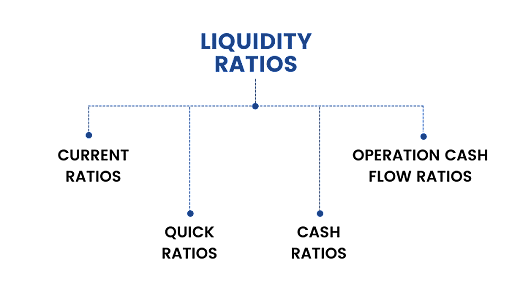
They are:
Current Ratio: Current ratio provides an idea of the short-term liquidity of a company. The formula is:

Quick Ratio: The quick ratio helps to find out the company's liquidity for up to six months. The formula of the quick ratio is:

-
Profitability Ratio
The profit is an essential part of every business. Every person seeks profit in his/her business. And the profitability ratio helps to determine whether the company is fetching any profit or not. It provides the data of the business success rate over the time. The primary beneficiaries of these ratios are the business owners, stakeholders, government and the tax holders. The profitability ratio does not only help to get to know the success rate but also helps the entrepreneur to get loans. Because when it comes to granting the loan, all bank officials prefer to check out the company's profitability status to determine whether the business will be able to return the loan amount or not.

-
Activity Ratio
Activity Ratio, also known as turnover ratio formula, is applied for the estimation of a company's efficiency by converting the goods and services into cash. This ratio works on the basis of time period. The activity ratio has two sub formulas. They are:
Inventory turnover ratio: Inventory turnover ratio always updates on the conversion frequency of product to cash.

Receivable turnover ratio: The receivable turnover ratio helps to update the supply frequency of credits.

-
Solvency Ratio
The solvency ratio helps check the business's facts to determine the capability to pay the long-term deficit of a firm. The solvency ratio has two sub ratio formulas. They are:
Debt Equity Ratio: Debt Equity Ratio helps to consider the steadiness of the long-term economic approaches of a company.

Proprietary Ratio: Proprietary Ratio helps to determine the firmness of the business's capital structure.

Also read: First Order Differential Equation
Limitations of Ratio Analysis
[Click Here for Sample Questions]
Ratio analysis comes in handy when a person needs to derive the essential information for business finance. Still, some limitations come with ratio analysis. These limitations are:
- If the person does not have adequate or old data, it can induce a misreading of ratio analysis.
- In ratio analysis, we use the data or trends from the past to predict future growth that can not always be correct or reliable.
- In ratio analysis, you need to be knowledgeable to proceed without mistakes.
- As mentioned above, you can not rely on ratio analysis because it does not always show a factual basis. Because when you proceed with ratio analysis, you use historical data.
- You can not use ratio analysis to compare distinct companies because each firm uses other accounting techniques to determine their financial health.
Also Read:
Things to Remember
- Ratio Analysis is the best way to compare the financial statements of various businesses. It can be a valuable source for outside critics.
- Ratio analysis facilitates and outlines the statement on economic reports.
- Critics can acquire an opinion about the efficiency of a company by reading the data on ratio analysis statements.
- It can also assist in understanding past flaws and future trends.
- Ratio analysis is not valuable for inner surveillance, but investors and stakeholders utilize it.
- The abilities of a critic specify the precision of a Ratio Analysis information since it does not always characterize an authentic portrait.
- The tool for estimating any business's financial situation is comprehended as Ratio Analysis, and it can be utilized for any business, whether it is small scale or large scale.
Sample Questions
Ques: Working Capital Rs. 40,000; Current Ratio 3:1; Inventory Rs. 20,000. Calculate Current Assets, Current Liabilities and Quick Ratio. (4 marks)
Ans: Current Ratio = 3:1
Let the Current Liabilities be = Rs.x
The Current Assets = Rs. 3x
Working Capital = Current Assets – Current Liabilities
40,000 = 3x – x
40,000 = 2x
X = Rs. 20,000
The Current Liabilities = 20,000
The Current Assets = 3 × 20,000 = 60,000
Now, to find Quick Ratio
Liquid Assets = Current Assets – Inventory
= 60,000 - 20,000
= 40,000
Quick Ratio = Liquid Assets : Current Liabilities
= 40,000 : 20,000
= 2:1
Ques: Calculate Current Ratio from the following information: (4 marks)

Ans: Current Assets = Inventories + Trade receivables + Advance tax + Cash and equivalents
= 60,000 + 60,000 + 4,000 + 36,000 = 1,60,000
Current Liabilities = Trade payables + Short-term borrowings
= 90,000 + 4,000 = 94,000
Current Ratio = Current Assets/Current Liabilities
= 1,60,000/94,000 = 8 : 4.7
Ques: Calculate Quick Ratio from the following information: (4 marks)

Ans: Current Asset= Inventories + Trade receivables + Advance tax + Cash and cash equivalents
= 1,00,000 + 1,00,000 + 4,000 + 30,000 = 2,34,000
Quick Assets = Current assets – (Inventories + Advance tax)
= 2,34,000 - (1,00,000 + 4,000)
= 2,34,000 - 1,04,000 = 1,30,000
Current Liabilities = Trade payables + Short-term borrowings
= 2,00,000 + 4,000 = 2,04,000
Quick Ratio = Quick Assets/Current Liabilities
= 1,30,000 / 2,04,000 = 0.63 : 1
Ques: Calculate ‘Liquid Ratio’ from the following information: (4 marks)

Ans: Liquid Assets = Current assets – (Inventories + Prepaid expenses + Advance tax)
= 1,00,000 - (25,000 + 5,000 + 10,000)
= 1,00,000 - 40,000 = 60,000
Liquid Ratio = Liquid Assets / Current Liabilities
= 60,000 / 40,000 = 3 : 2
Ques: A company has a current ratio of 5:1 and quick ratio of 3:1. If excess of current assets over quick assets represented by inventories is Rs. 30,000, calculate current assets and current liabilities. (4 marks)
Ans: Current Ratio = 5:1
Quick Ratio = 3:1
Let Current liabilities = x
Current assets = 5x
and Quick assets = 3x
Inventories = Current assets – Quick assets
30,000 = 5x – 3x
30,000 = 2x
x = Rs.15,000
Current Liabilities = Rs.15,000
Current Assets = 5x = 5 × Rs. 15,000 = Rs. 75,000.
Verification :
Current Ratio = Current assets : Current liabilities
= Rs. 75,000 : Rs. 15,000
= 5 : 1
Quick Ratio = Quick assets : Current liabilities
= Rs. 45,000 : Rs. 15,000
= 3 : 1
Ques: Calculate the current ratio from the following information: (4 marks)

Ans: Current assets = Total assets - Non-current assets
= 4,00,000 - 1,00,000
= 3,00,000
Total assets = Equity and Liabilities
Current liabilities = Total assets - Shareholders’ Funds - Non-current liabilities
= 4,00,000 - 1,50,000 - 2,00,000
= 4,00,000 - 3,50,000
= 50,000
Current Ratio = Current Assets / Current Liabilities
= 3,00,000 / 50,000
= 6 : 1
Ques: The debt equity ratio of X Ltd. is 0.5 : 1. Which of the following would increase/decrease or not change the debt equity ratio? (5 marks)
(i) Further issue of equity shares
(ii) Cash received from debtors
(iii) Sale of goods on cash basis
(iv) Redemption of debentures
(v) Purchase of goods on credit.
Ans: The change in the ratio relies on the original ratio.
Assume that external funds are = Rs. 6,00,000
And internal funds are = Rs. 12,00,000.
Now analyze the effect of given transactions on the debt equity ratio.
- Let’s assume the worth of equity shares are issued = Rs. 1,00,000
- This will increase the internal funds to Rs. 13,00,000
- The new ratio will be 0.45 : 1 (6,00,000/13,00,000).
- Thus, it is clear that further issue of equity shares decreases the debt-equity ratio.
- Cash accepted from debtors will leave the external and internal funds intact as this will only impact the formatting of current assets. Hence, the debt-equity ratio will stay unmoved.
- It will also leave the ratio intact as the sale of products on a cash base neither impacts Debt nor equity.
- Assume that the redeemed cash by debentures = Rs. 1,00,000
- This will decrease the long-term debt to Rs. 5,00,000.
- The new ratio will be 0.42 : 1 (5,00,000/12,00,000).
- Redemption of debentures will decrease the debt-equity ratio.
- This will also leave the ratio unchanged as purchase of goods on credit neither affect Debt nor equity.
Ques: Current liabilities of a company are Rs. 5,60,000, current ratio is 2.5:1 and quick ratio is 2:1. Find the value of the Inventories. (3 marks)
Ans: Current Ratio = 2.5:1
Quick Ratio = 2:1
Let Current liabilities = 5,60,000
Current assets = 2.5 × 5,60,000 = 14,00,000
and Quick assets = 2 × 5,60,000 = 11,20,000
Inventories = Current assets – Quick assets
= 14,00,000 - 11,20,000
= 28,000
For Latest Updates on Upcoming Board Exams, Click Here: https://t.me/class_10_12_board_updates
Check-Out:



Comments