



Content Curator
Phosphorus is a chemical element with symbol P and atomic number 15 and is placed in the 3rd period and 15th group in the modern periodic table. Elemental phosphorus is found in two forms, namely, white phosphorus and red phosphorus. Red phosphorus is versatile and more stable than white phosphorus. It is characterized by deep red colour and powdery texture.
| Table of Content |
Key Terms: Phosphorous, White phosphorus, Allotopes of phosphorus, Nitrogen, Amorphous, Carbon, Carbon disulphide, Iron, Atmosphere, Black phosphorus, Atomic number
Definition
[Click Here for Sample Questions]
Red Phosphorus is an allotrope of phosphorus and a derivation of the P4 molecule. Austrian Chemist Anton Von Schrotter discovered it first in 1845. He procured it by heating red phosphorus in the presence of nitrogen. It is amorphous, reddish in colour, non-toxic, odourless, non-poisonous and insoluble in water as well as in carbon disulphide. It does not show the property of phosphorescence and has iron grey lustre.
Red Phosphorus is procured by heating white phosphorus at 573K in an inert atmosphere for several days. When red phosphorus is heated under high pressure, a series of black phosphorus is formed.
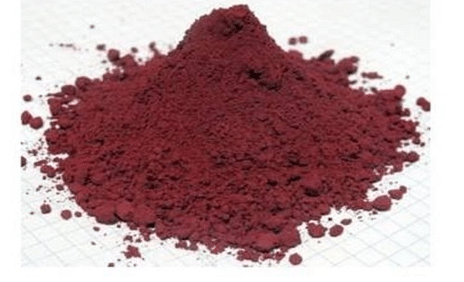
Red Phosphorus
Read Also: Sulphur Dioxide
Structure
[Click Here for Sample Questions]
Red Phosphorus is polymeric, consisting of chains of P4 tetrahedra linked together in the manner as shown below:

Structure of Red phosphorus
From the above structure, we can also say that the structure of Red Phosphorus exhibits similarity to the P4 molecule. If one bond is broken, the structures can bond with neighbouring phosphorus atoms and form polymer-like structures.
Read Also: Phosphorus Cycle
Properties
[Click Here for Sample Questions]
Below mentioned are the properties of Red Phosphorus:
- The molar mass of Red Phosphorus is 30.974 grams per mole and the density is 2.34 grams per cubic centimetre.
- At standard temperature and pressure, it exhibits solid state.
- The melting point of red phosphorus is 860 Kelvins.
- It is odorless and has a deep red color.
- It is harmless to humans and safer than white phosphorus.
- Its segment is strong in shape and assumes a cubic structure in its crystal lattice.
- Upon heating to temperatures above 300 degree celsius, red phosphorus undergoes crystallization.
- The stability of red phosphorus is more than white phosphorus and less than black phosphorus.
Read Also:
Periodic Properties Of ElementsPreparation
[Click Here for Sample Questions]
Red Phosphorus can be yielded by following two methods as mentioned below:
From White Phosphorus:
- White phosphorus submerged in water is heated under 550K in a steel pot for 3 to 4 days to fabricate red phosphorus.
- The wastage of phosphorus is prevented with the help of a system which condenses the reflux to form vapour.
- The temperature is increased to 673K in an effort to distill residual red phosphorus after two-days mark.
- Eliminating the water from the mixture, sodium carbonate is added and subsequent boiling removes traces of white allotrope.
- The mixture must be dried in vacuum to achieve red phosphorus.

From Bone Ash to Phosphorus-Rich Rocks:
- Obtain a finely ground powder from rocks that are rich in phosphorus or animal bone.
- The bone ash is treated with sulphuric acid and phosphoric acid is yielded along with calcium sulphate.
- Phosphoric acid heated with charcoal gives white phosphorus which gives red phosphorus product on further heating.
- When white phosphorus is heated to sunlight, red phosphorus is added.
Read Also: Laws of Chemical Combinations
Applications
[Click Here for Sample Questions]
- It is applied in the production of semiconductors and matchsticks.
- It is applied in production of pyrotechnics, fertilizers and pesticides.
- It is applied in electroluminescent coatings.
- It is carried out in many natural organic synthesis reactions.
- Due to its stable but reactive nature, it is applied in smoke bombs.
- It is an important component of steel production.
- Few of its compounds are applied in water softening as well.
Read Also: Degree of Unsaturation Formula
Things to Remember
- Red Phosphorus is one of the most widely used allotropes of phosphorus.
- It is more stable than white phosphorus and a derivative of the P4 molecule.
- It reacts with water vapors and oxygen in air to form extremely toxic phosphine gas, phosphorus oxyacids, white phosphorus, and phosphoric acid.
- It is less reactive due to presence of covalent bonds between phosphorus atoms in a particular tetrahedral unit.
Also Read:
Sample Questions
Ques. Which paragon of phosphorus is the most stable? (2 marks)
a.White phosphorus
b.Red phosphorus
c.Black phosphorus
d.Phosphine
Ans. Black Phosphorus
Explanation: Black phosphorus is thermodynamically the most stable paragon of phosphorus and does not burn in air even up to 673 K. It has a sharp melting point of 860 K. Like graphite, it is fairly a good conductor of electricity.
Ques. Which paragon of phosphorus is the most reactive? (2 marks)
a.White phosphorus
b.Metal phosphorus
c.Red phosphorus
d.Beta-black phosphorus
Ans. White Phosphorus
Explanation: The three allotropic forms of phosphorus differ widely in their chemical reactivity in which white phosphorus is the most responsive while black and red phosphorus are less responsive. White phosphorus is made up of discrete P4 tetrahedra which are subjected to very excessive angular pressure because the angle is 60 stages. This high angular strain makes white phosphorus risky and fairly reactive.
Ques. Red phosphorus is kept under water to protect it from air. (2 marks)
a.True
b.False
Ans. False
Explanation: White phosphorus is a highly reactive element and must be stored underwater for safekeeping to intercept it from catching hearth spontaneously in the air. In water, white phosphorus reacts with oxygen within hours or days. In water with low oxygen, white phosphorus may additionally demean to a notably poisonous compound called phosphine, which in the end evaporates to the air and is changed to less harmful chemicals.
Ques. From which type of phosphorus is alpha -black phosphorus formed? (2 marks)
a.Phosphide
b.White phosphorus
c.Black phosphorus
d.Red phosphorus
Ans. Red Phosphorus
Explanation: Alpha-black phosphorus is the maximum common paragon of black phosphorus. Alpha-black phosphorus is procured from red phosphorus. When red phosphorus is heated in a sealed tube at 803 K, it forms alpha-black phosphorus.
Ques. Beta-black phosphorus is prepared by heating white phosphorus. (2 marks)
a.True
b.False
Ans. True
Explanation: Yes, Beta-black phosphorus is procured by heating white phosphorus at 473 K under high pressure (4000-12000 atm) in an inert surrounding. It is in layer shape in which each phosphorus atom is covalently bonded to three neighbouring phosphorus atoms.
Ques. Like white phosphorus, which phosphorus also exists as P4? (2 marks)
a.Black phosphorus
b.Red phosphorus
c.Phosphine
d.Beta-black phosphorus
Ans. Red Phosphorus
Explanation: Like white phosphorus, red phosphorus also exists as P4 tetrahedra but these are linked together through covalent bonds to give a polymeric structure. Because of polymeric structure, its melting point (883 K) is much higher than that of white phosphorus (317 K).
Ques. Which allotrope of phosphorus does no longer catch fire without difficulty? (2 marks)
a.White phosphorus
b.Alpha- black phosphorus
c.Beta- black phosphorus
d.Red phosphorus
Ans. Red Phosphorus
Explanation: Red phosphorus is a relatively roosted allotrope of phosphorus at room temperature. Its ignition temperature (543 K) is a great deal better than that of white phosphorus (303 K). As a result, it does seize fire effortlessly.
Ques. White phosphorus can be reconverted to red phosphorus. (2 marks)
a.True
b.False
Ans. True
Explanation: Yes, red phosphorus transcendent on heating giving vapours which are the same as by white phosphorus. When those vapours liquefy, white phosphorus is obtained. This gives us an easy procedure of reconverting red phosphorus into white phosphorus.
Ques. Which allotrope of phosphorus is also called yellowish phosphorus? (2 marks)
a.Black phosphorus
b.Red phosphorus
c.Beta- black phosphorus
d.White phosphorus
Ans. White Phosphorus
Explanation: White phosphorus on exposure to light, it turns yellowish. It blazes greenish in the dark (when exposed to oxygen) and is extraordinarily burnable and pyrophoric (self-igniting) upon contact with air. Consequently, it is called yellowish phosphorus.
Ques. What is the paragon of phosphorus in which the P-atom completes its octet? (2 marks)
a.Alpha-black phosphorus
b.Beta-black phosphorus
c.White phosphorus
d.Red phosphorus
Ans. White Phosphorus
Explanation: White phosphorus exists as P4 units. The four sp3 hybridized phosphorus atoms lie at the corners of a regular tetrahedron with an angle of 60 degree. Every phosphorus atom is joined to three other P-atoms by way of covalent bonds so that every p-atom completes its octet.
For Latest Updates on Upcoming Board Exams, Click Here: https://t.me/class_10_12_board_updates
Check-Out:



Comments