



Content Writer
Redox reactions are chemical reactions in which the reactants undergo oxidation and reduction simultaneously. The term ‘redox’ is a short form of reduction-oxidation.
- In redox reactions, reductants are responsible for transferring electrons to oxidants.
- It increases or decreases oxidation number simultaneously.
- Electron transfer and atom transfer are two classes of redox reactions.
- The oxidizing and reducing agents involved in the reaction are called redox pairs.
- Reducing agents transfer electrons to another substance.
- Oxidizing agent receives electrons from another substance.
- The reactions can be carried out slowly or quickly depending on the type of reactions.
- Reduction and oxidation reaction taking place alone is known as a half-reaction.
- Photosynthesis, Respiration and Corrosion are real life examples of redox reactions.
- The reaction carried out in the cell where the potential difference is:
Eocell = Eocathode – Eoanode
Key Terms: Redox Reactions, Oxidation, Reduction, Electron, Photosynthesis, Oxidizing and Reducing agents, Oxidation Number, Respiration, Corrosion, Displacement Reaction, Combination Reaction, Decomposition Reaction
What are Redox Reactions?
[Click Here for Sample Questions]
Redox reactions are chemical reactions where oxidation and reduction take place simultaneously. In this type of reaction, there is a gain of electrons for one chemical species while the other loses electrons or transfer of electrons.
- The species that loses electrons is oxidized while the one that gains electrons is reduced.
- It is a type of chemical reaction in which electrons are transferred between two reactants.
- Both physical and biological phenomenon are related with the reactions.
- The addition of oxygen and removal of hydrogen is called oxidation.
- The removal of oxygen and addition of hydrogen is called reduction.
Example of What are Redox Reaction?Example: Combustion: Combustion takes place in high temperature and pressure and can be specified as an exothermic redox reaction. An oxidant is required for this reaction to take place.
Combustion Reaction Example 2: Cellular Respiration: In this reaction, the glucose undergoes oxidation and forms carbon dioxide by losing hydrogen while oxygen gains hydrogen and undergoes reduction. In simpler terms when glucose reacts with oxygen, the chemical reaction results in the formation of carbon dioxide and water.  Cellular Respiration Example 3: Photosynthesis: It is a process of photosynthesis by which plants prepare food. In the presence of sunlight and chlorophyll, carbon dioxide reacts with water and produces carbohydrates along with oxygen. 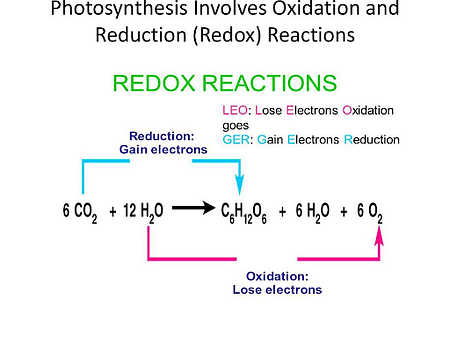 Photosynthesis Example 4: Corrosion: Rusting of Iron is an example of Corrosion. Iron rusts in the presence of moisture and atmospheric oxygen due to redox chemical reaction. The image below explains the phenomena.  Corrosion |

The video below explains this:
Redox Reaction Detailed Video Explanation:
Oxidation and Reduction
Types of Redox Reactions
[Click Here for Sample Questions]
Redox reactions can be differentiated into four categories namely combination reactions, decomposition reactions, displacement reactions and disproportionation reactions. Each are explained separately below:
Combination Reaction
As the name states, in combination reactions, the molecules combine to form new compounds.
Example of Combination ReactionExample: When magnesium reacts to nitrogen. |

Combination Reaction
Decomposition Reaction
Decomposition reaction are opposite to the combination reaction which involves breakdown of compounds to more simpler substances.
Example of Decomposition ReactionExample: Electrolysis of water. |

Decomposition Reaction
Read More:
| Chapter Related Concepts | ||
|---|---|---|
| Coupling Reaction | Sandmeyer reaction | Abnormal Molecular Mass |
| Carbylamine Reaction | Hinsberg’s Reagent | Lithium |
Displacement Reaction
In displacement reaction, the more reactive metal will displace the less reactive one in a chemical reaction. The reactivity of an element is represented in a series called the reactivity series (arranged in decreasing order of reactivity) which makes it easier to determine the chemical reaction and its products.
Example of Displacement ReactionExample: |


Displacement Reaction
Disproportionation Reaction
This is a peculiar type of reaction where an element showing a particular oxidation state will be oxidized and reduced simultaneously. Another thing to note is that these reactions will always have an element that can exhibit three oxidation states.
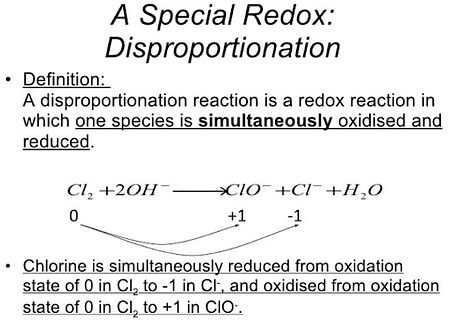
Disproportionation Reaction
Oxidation and Reduction
[Click Here for Sample Questions]
The process of oxidation and reduction is as follows:
Oxidation
In an oxidation reaction, electrons are taken away. During the process oxygen is gained during oxidation. There is a loss of hydrogen in oxidation. It is more electropositive element.

Oxidation
Example of OxidationExample: 2S(s) + O2 (g) → SO2 (g) CH4 (g) + 2O2 (g) → CO2 (g) + 2H2O (l) |
Reduction
In reduction, electrons are gained. There is a loss of oxygen in reduction. Reduction can be defined as a gain of hydrogen. It is more electronegative element.
Example of ReductionExample: 2FeCl3 (aq) + H2 (g) → 2FeCl2 (aq) + 2HCl (aq) Example: Take the example of magnesium reacting with oxygen, here magnesium oxidation went from 0 to +2 while oxygen is reduced from 0 to -2. The image below shows the overall chemical reaction as well as the oxidation and reduction reactions separately.  Oxidation and Reduction |

Oxidizing and Reducing Agents
[Click Here for Previous Year's Questions]
The oxidizing and reducing agents are as follows:
Oxidizing Agents
Oxidizing agents help in gaining electrons. They are electronegative in nature and after gaining electrons, these substances are reduced. They are also said to be electron accepting.
- Oxidizing agents are also known as oxidants.
- Oxidants oxidize other substances while undergoing reduction themselves.
Example of Oxidizing AgentsExample: Halogen, hydrogen peroxide, nitric acid etc. |
Reducing Agents
Reducing agents or reductant/reducer aid loses electrons and gets oxidised. They are electron donors. Contrary to the behaviour of oxidants, reducing agents reduce other substances while they get oxidized.
- In most cases reduction occurs when oxygen is present.
Example of Reducing AgentsExample: Sulfite compounds, formic acid, oxalic acid, earth metals etc. |

Oxidation Number
[Click Here for Sample Questions]
When an atom of an element changes from its elemental state to free state, it develops a charge, this charge known as its oxidation number. These numbers can be positive or negative whole numbers, fractions and even zero.
In relation to oxidation number oxidation and reduction can be remembered as
- Oxidation: In case of oxidation,oxidation number increases
- Reduction: In case of reduction, oxidation number decreases
Rules for Calculating Oxidation Number
When assigning oxidation number to atoms, certains rules need to be followed
- In the case of neutral or uncharged compounds, the oxidation number is zero while in an ion it is equal to its charge.
- The oxidation number of allotropic forms is zero.
- For nitrogen and hydrogen the oxidation number is zero, while in Mg2+ it is 2 and Al3+it is 3.
- Hydrogen shows different oxidation numbers in relation to metals and non metals.
- In reaction with non-metals, hydrogen shows +1 while for metal oxides and metals it is -1.
- Oxygen commonly shows an oxidation number of -2.
- When in a reaction to metals it remains -2.
- However it can change in certain reactions such as with peroxide the oxidation state will be -1 and in fluorine it is shown to be +2.
- The oxidation number is +1 for a substance like O2F2.
- When the electronegativity is more, the element will give a negative oxidation number.
- Positive oxidation will be expressed by the less electronegative element.
- An example would be NaCl, where Na is +1 while Cl shows -1.
- Now look at a compound like HCl where Cl shows oxidation state of -1 but in HOCl it will be +1.
- In a compound, the sum total of the oxidation number of all the atoms will be zero.
- It was earlier mentioned that in NaCl, Na is +1 and Cl is -1, the total would be +1-1=0.
- Alkali metals have an oxidation number of +1 and +2 for alkali earth metals.
- For complex ions, the sumtotal of oxidation numbers of the atoms will be equivalent to the charge of the ion.
- Fluorine mostly shows an oxidation state of -1 due to its high electronegativity.
- Metal amalgams show oxidation number zero.
Applications of Redox Reactions
[Click Here for Sample Questions]
The application of redox reactions are as follows:
- Redox reactions are used in the field of electrochemistry that is used to produce electrical energy.
- It is used in sanitising water and bleaching materials.
- The cleaning products used in industrial process undergoes the oxidation process.
- Smelting of metal sulphides that is used in separation of ores.
- It is used in caustic soda, chlorine which are produced using redox reactions.

Redox Reactions
Read More:
| Class 11 Chemistry Related Concept | ||
|---|---|---|
| Cis Trans Isomerism | Azeotropic Distillation | Atomic Mass of Elements |
| Mass Percent Formula | Factors affecting Solubility | Mole Fraction |
Important Topics for JEE MainAs per JEE Main 2024 Session 1, the number of questions asked from Redox Reactions is four, and some important topics included in the chapter Redox Reactions are as follows
Some memory based important questions asked in JEE Main 2024 Session 1 include: 1. Cr2O72- + xH+ + ye → 2Cr3+ + AH2O. Balance the above reaction and find x, y and A. 2. x Cl2 + y OH → z Cl + p CIO. Balance the equation and find the values of x, y, z, and p. 3. Find out the sum of the coefficients of all the species involved in the balanced equation: 2MnO4 +1 (in the presence of a slightly alkaline medium) → Product 4. Cr2O72 + xH+ + ye→ 2Cr3+ + AH2O Balance the above reaction and find x, y and A. |
Things to Remember
- In a redox reactions both oxidation and reduction takes place simultaneously.
- Oxidising agents help in gaining electrons while reducing agents held in losing electrons.
- The oxidation number of an atom is equivalent to the charge of its ion.
- Ion electron method and oxidation number method are two ways to balance redox reactions.
- Individuals are provided with Redox Reactions Important Questions and NCERT Solutions For Class 11 Chemistry Chapter 8: Redox Reactions for examination.
- Important MCQs on Redox Reactions with Explanation are provided for practical examination.
Previous years questions
- Calculate the equivalent weight of ferrous ion
- Among the following elements, which one exhibits both positive and negative oxidation states?
- Choose the disproportionation reaction among the following redox reactions
- The average oxidation state of sulphur in Na2S4O6Na2S4O6 is
- In the reaction,2KMnO4+16HCl→5Cl2+2MnCl2+2KCl+8H2O reduction product is
- Nitrogen shows different oxidation states in the range
- How many moles of H202H202 are oxidized by 1 mole of ClO2ClO2 ?
- Which of the following is not a reducing agent?
- The correct stoichiometric coefficients of MnO−4,C2O2−4 and H+ are
- Which of the following is not an example of redox reaction?
- What is the oxidation number of gold in the complex [AuCl4]1−[AuCl4]1− ?
- In aqueous alkaline solution, two electron reduction of HO−2 gives
- Identify the weakest oxidising agent among the following.
- The correct set of reactions which give gaseous product is
- What is the volume (in litres) of 10−4MKMnO410−4MKMnO4 required to completely oxidise 0.5 L of 10−2M10−2M oxalic acid in acid medium?
- what will be the equivalent wt. of Na2S2O3 and I2 in the following reaction? \ce2S2O2−3+I2−>S4O2−6+2
- When a manganous salt is fused with a mixture of KNO3 and solid NaOH the oxidation number
Important Questions
Ques: In the reactions given below, identify the species undergoing oxidation and reduction. (1 Mark)
H2S (g) + Cl2 (g) 2HCl (g) + S (S)
Ans: H2S is oxidized because a more electronegative element, Chlorine is added to hydrogen. As a result, hydrogen has been removed from S. Chlorine is reduced by the addition of hydrogen to it.
Ques: Explain the formation of sodium chloride. (1 Mark)
Ans: In this reaction sodium and chlorine chemically react to form sodium chloride. The oxidation number of Na goes from 0 to +1 while for the Cl atom it will be from 0 to -1.
Ques: Give some examples for oxidation processes (1 Mark)
Ans: Some of the oxidation reactions that occur in daily basis include
- Bleaching
- Combustion
- Antiseptic
- Corrosion
Ques. How do you balance redox reactions? (2 Marks)
Ans: There are two methods by which redox reactions can be balanced, one is the ion electron method and the other is the oxidation number method.
In the ion electron method, you have to first write the reaction in ionic form ,then split it into oxidation and reduction halves. You can then balance from each half except the H and O atoms which should be dealt with last.
For the oxidation number method, you'll first have to jot down the skeletal form of the equation. Then balance the atoms except for H and O. Then equalize the equation and finally balance H and O.
Ques: What is the difference between direct redox reaction and indirect redox reaction? (2 Marks)
Ans:
| Direct Redox Reaction | Indirect Redox Reaction |
|---|---|
| Oxidation and reduction take place simultaneously in the same vessel. | Oxidation and reduction take place in separate half cells. |
| In usual cases there is generation of heat. | Electrical energy is generated in most cases. |
Ques: What is the limitation of the concept known as oxidation number? (2 Marks)
Ans: In case of oxidation , there is an increase in oxidation number by loss of electrons. For reduction the opposite case occurs, there is gain of electrons. The limitation is that when oxidation takes place, electron density decreases but it increases for the atom that undergoes reduction.
Ques: What are some of the reduction reactions that happen in daily life? (2 Marks)
Ans: Some processes that involve reduction are
- Photosynthesis
- Metallurgy
- Photography
- Antioxidants
Ques: Justify that the following reactions are redox reactions: (4 Marks)
(a) CuO(s) + H2(g) Cu(s) + H2O(g)
(b) Fe2O3(s) +3CO(g) 2Fe(s) + 3CO2(g)
(c) 4BCl3(g) +3LiAlH4(s) 2B2H6(g) + 3LiCl(s) + 3AlCl3(s)
Ans:
Here, CuO is reduced to Cu as O is removed from it while H2O is oxidised as O is added to H2 to form H2O.
The Oxidation Number of Cu decreases from + 2 in CuO to 0 in Cu but that of H increases from 0 in H2 to +1 in H2O. Hence, CuO is reduced to Cu but H2 is oxidised to H2O. Thus, it is a redox reaction.

In this reaction, the Oxidation number of Fe decreases from +3 to 0 in Fe2O3 while that of C increases from +2 in CO to +4 in CO2. Also, oxygen is removed from Fe2O3 and added to CO. So, Fe2O3 is reduced while CO is oxidised. Thus, this is a redox reaction.

In this reaction, the oxidation number of B decreases from +3 in BrCl3 to -3 in B2H6 while that of H increases from -1 in LiAlH4 to +1 in B2H6. Therefore, BCl3 is reduced while LiAlH4 is oxidised. Also, H is removed from LiAlH4 and is added to BCl3. So, BCl3 is reduced while LiAlH4 is oxidised. Thus, it is a redox reaction.
Here, each K atom loses one electron to form K+ while F2 has gained two electrons to form two F- ions. Therefore, K is oxidised while F2 is reduced. Thus, it is a redox reaction.
Ques: Calculate the oxidation number of sulphur, chromium and nitrogen in H2SO5, Cr2O2 and NOT. Suggest structure of these compounds. Count for the fallacy. (3 Marks)
Ans: The oxidation number of S in H2SO5 by conventional method is
2 (+1) + x + 5 (-2) = 0
x = +8
This is impossible because the maximum oxidation number of S cannot be more than six because it has only six electrons in the valence shell. This can be overcome if we calculate the Oxidation Number of S by chemical bonding method. The structure of H2SO5 is

So, the oxidation number of S is +6.

There is no fallacy in the oxidation number of N in NO3– whether calculated by conventional method or by chemical bonding method.
Ques: Identify the substance oxidised, reduced, oxidising agent and reducing agent for each of the following reactions. (4 Marks)

Ans:
Ques: Consider the elements: Cs, Ne, I, F
(a) Identify the element that exhibits -ve oxidation state.
(b) Identify the element that exhibits +ve oxidation state.
(c) Identify the element that exhibits both +ve and -ve oxidation states.
(d) Identify the element which neither exhibits -ve nor +ve oxidation state. (4 Marks)
Ans: (a) Fluorine being the most electronegative element shows only a -ve oxidation state of -1.
(b) Alkali metals exhibit an oxidation state of +1 because of the presence of a single electron in the valence shell. So, Cs exhibit +ve oxidation state.
(c) I show an oxidation state of -1 because of the presence of seven electrons in the valence shell or an oxidation state of +1 compounds because of the presence of d-orbitals, it also exhibits +ve oxidation states of +3, +5 and +7.
(d) Ne is an inert gas. Hence, it neither exhibits -ve nor +ve oxidation states.
Ques: Chlorine is used to purify drinking water. Excess chlorine is harmful. The excess chlorine is removed by treating it with sulphur dioxide. Present a balanced equation for the reaction for this redox change taking place in water. (4 Marks)
Ans: The skeletal equation is:

Do Check Out:



Comments