



Education Content Expert
Degrees and Radians are the two most commonly used units of measurement of an angle. The measure of an angle is the amount of revolution made to get the terminal side from the initial side.
- Degree is a unit of measuring the angle in a plane and is denoted by the symbol (°).
- One Radian is the angle subtended at the center by an arc of length 1 unit in a unit circle.
- One complete rotation is denoted as 360° in Degrees and is equal to 2π in Radians.
Relation between Degree and Radian is used to convert the given measurement of an angle from one unit to another unit. Relation between Degree and Radian is given as:
| 2π Radian = 360° |
Read More: NCERT Solutions for Class 11 Mathematics Trigonometric Functions
Key Terms: Radian, Degree, Angles, Geometry, Unit Circle, Rotation, Arc, Measurement of Angles, Circle, Minutes
What is Radian?
[Click Here for Sample Questions]
Radian is a unit of measurement of angle commonly used in Geometry and Trigonometric Functions.
- One radian is the angle formed at the center of a circle by an arc whose length is equal to the radius (r) of the circle.
- It is represented by ‘pi’(π) which has a value of 3.14 or 22/7.
- One complete counterclockwise rotation (360o) equals 2π in radians.
- A straight angle, i.e. a 180o angle, is expressed as π radians.
- A right angle, i.e. a 90o angle is expressed as π/2 radians.
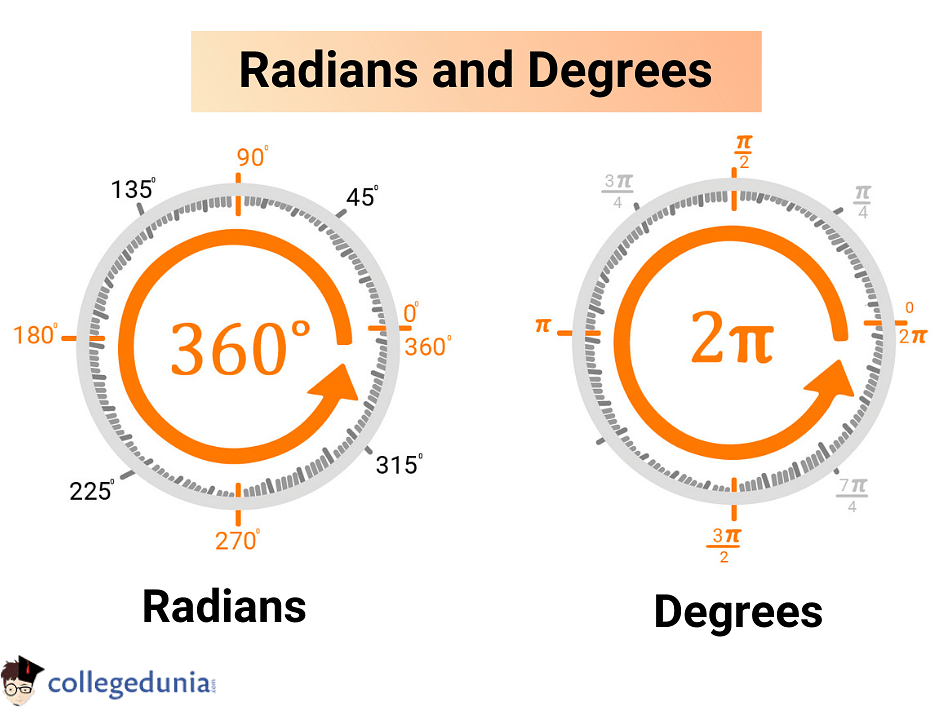
Radians and Degrees
What is Degree?
[Click Here for Previous Years’ Questions]
Degree is a unit of measurement of a plane angle in Geometry.
- It is also referred to as the Degree of Arc or Arc Degree.
- It is represented by the symbol (°).
- A complete rotation of an angle is denoted by the angle measuring 360°.
- Protractor is a tool used to measure an angle in degrees in Geometry.
Read More:
Relation Between Degree and Radian
[Click Here for Sample Questions]
Relation between Degree and Radian is useful to convert the measurement of an angle from one unit to another. One complete rotation of an angle is denoted as 360° in Degrees and 2π in radians. It means a circle subtends an angle whose radian measure is 2π and its degree measure is 360° at the center.
Relation between Degree and Radian can be expressed as:
| 2π Radian = 360° |
On simplification, it can also be written as:
| π Radian = 180° |
The given Relation between Degree and Radian allows determining a radian measure in degree measure and a degree measure in radian measure. The approximate value of pi (π) is 22/7. On substituting the value, we get
1 Radian = 180°/π = 57° 16′ (Approx)
1° = π/80 Radian = 0.01746 Radian (Approx)
Trigonometric Functions Detailed Video Explanation
Relation Between Radian, Degree and Minutes
[Click Here for Previous Years’ Questions]
Relation between Radians, Degrees, and Minutes is described as follows:
| 1 Radian = 180°/π = 57° 16′ (Approx) |
Where
- 1° = 60′ (1 Degree = 60 Minutes)
- 1′ = 60″ (1 Minute = 60 Seconds)
It means that one-sixtieth of a degree is called a minute and one-sixtieth of a minute is called a second. Any measure of angle can be converted to other units of measuring angles using this relationship.
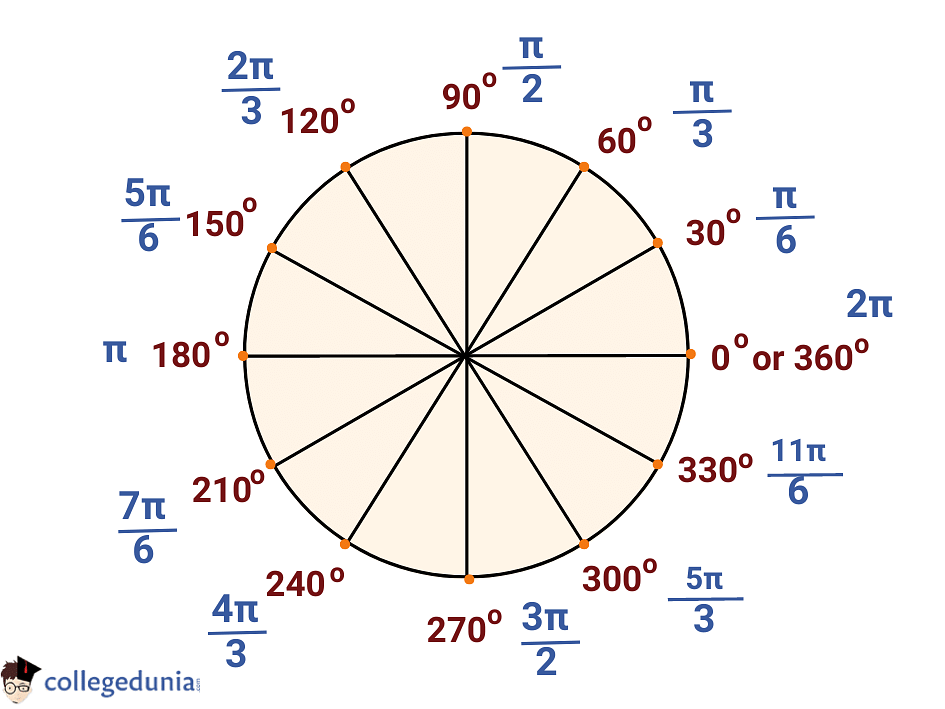
Degree and Radian Measures
Degrees to Radians Conversion
[Click Here for Sample Questions]
Degrees and Radians are the units used for representing the measurement of angles in Geometry. In geometry, one complete revolution in an anticlockwise direction is determined by 360° (in Degrees) or 2π (in Radians). Degrees to Radians Conversion is useful when measuring the different angles in Geometry.
How to Convert Degrees to Radian?
To convert any angle from the degrees to the radians, multiply the value by π/180 where the value of 180° is equal to π radians. Degrees to Radians Conversion is done using the formula:
| Angle in Radian = Angle in Degree x π/180 |
The steps that need to be followed to convert the degree measure to radians are:
- Enter the numerical value of the angle measure in degrees.
- Use the numerical value to multiply by π/180.
- Simplify the expression though canceling the numerical common factors.
- After the simplification, the outcome value will become the angle measure in radians.
Solved ExampleExample: Convert 60 Degrees to Radians. Solution: The given angle is 60 Degrees (60°). Using the Degrees to Radian Conversion Formula, Angle in Radian = Angle in Degree x (π/180) = 60 x (π/180) = π/3 Hence, 60 Degrees is equal to π/3 in Radians. |
How to Convert Radians to Degrees?
In order to convert Radians to Degrees, the given formula needs to be used:
| Angle in Degrees = Angle in Radians x (180/π) |
Solved ExampleExample: Convert π/2 into Degrees. Solution: The given angle in Radians is π/2. Using the Radian to Degrees Conversion Formula, Angle in Degrees = Angle in Radians x (180/π) = π/2 x (180/π) = 180/2 = 90 Degrees Hence, π/2 is equal to 90 Degrees. |
Read More: Trigonometric Functions Important Questions
Degrees to Radians Chart
[Click Here for Previous Years’ Questions]
Given below are the most commonly used conversions from degrees to radians:
| Measure of Angle in Degrees | Measure of Angle in Radians |
|---|---|
| 0° | 0 |
| 30° | 30° × (π/180°) = π/6 = 0.524 Rad |
| 45° | 45° × (π/180°) = π/4 = 0.785 Rad |
| 60° | 60° × (π/180°) = π/3 = 1.047 Rad |
| 90° | 90° × (π/180°) = π/2 = 1.571 Rad |
| 120° | 120° × (π/180°) = 2π/3 = 2.094 Rad |
| 150° | 150° × (π/180°) = 5π/6 = 2.618 Rad |
| 180° | 180° × (π/180°) = π = 3.14 Rad |
| 210° | 210° × (π/180°) = 7π/6 = 3.665 Rad |
| 240° | 240° × (π/180°) = 4π/3 = 4.188 Rad |
| 270° | 270° × (π/180°) = 3π/2 = 4.713 Rad |
| 300° | 300° × (π/180°) = 5π/3 = 5.235 Rad |
| 330° | 330° × (π/180°) = 11π/6 = 5.764 Rad |
| 360° | 360° × (π/180°) = 2π = 6.283 Rad |
Degrees and Radians Solved Examples
[Click Here for Sample Questions]
Here are some solved examples on Degrees and Radians for a better understanding of Relation between Degree and Radian:
Example 1: Convert an angle of 450 Degrees into Radians.
Solution: The angle is given as 450 Degrees (450°).
Using the Degrees to Radian Conversion Formula,
Angle in Radian = Angle in Degree x (π/180)
Angle in Radian = 450 × π/180 = 7.854 Rad
Thus, 450 Degrees is equal to 7.854 in Radians.
Example 2: Convert π/6 Radians into Degrees.
Solution: The given angle in Radians is π/6.
Using the Radian to Degrees Conversion Formula,
Angle in Degrees = Angle in Radians x (180/π)
= π/6 x (180/π) = 180/6
= 30 Degrees
Hence, π/6 is equal to 30 Degrees.
Check More:
Things to Remember
- Degrees and Radians are two units of measuring angles in Geometry.
- Degree is used to measure a plane angle and is denoted by (°).
- Radians is the angle subtended by an arc of length 1 unit at the center in a unit circle.
- In Geometry, one complete rotation is denoted by 360° in Degrees and 2π in Radians.
- Relation between Degree and Radian is given as 2π Radian = 360° or π Radian = 180°.
- Degrees to Radians Conversion is beneficial when measuring the different angles in Geometry.
- Angle in Radian = Angle in Degree x π/180
- Angle in Degrees = Angle in Radians x (180/π)
For Latest Updates on Upcoming Board Exams, Click Here: https://t.me/class_10_12_board_updates
Previous Years’ Questions
- Convert 6 radians into degree measure…
- Find the degree measure corresponding to…
- If one side of a triangle is double the other and the angles opposite… (KCET - 2009)
- If a and b are positive numbers such that, a>b, then the… (KEAM)
- Consider a triangular plot ABC with sides AB = 7m,BC = 5m… (JEE Main - 2019)
- In a triangle PQR, A, B and C are the angles opposite to the… (JKCET - 2017)
- In any triangle ABC, the simplified form of… (KCET - 2011)
- Consider a triangular plot ABC with sides AB = 7m, BC = 5m… (JEE Main - 2019)
- If the sum of all the solutions of the equation… (JEE Main - 2018)
- Which one of the following is not true… (AMUEEE - 2013)
Sample Questions
Ques. What is the Value of 1 Radian in Degrees? (3 Marks)
Ans. Relation Between Degree and Radian is given as:
2π Radians = 360°
Ons simplification, we ger
π Radians = 180°
Dividing the above equation by π,
1 Radian = 180°/π
1 Radian = 57.296°
Thus, 1 Radian is 57.296° Degrees.
Ques. Convert 20 Degrees to Radians. (2 Marks)
Ans. The given angle is 20 Degrees (20°).
Using the Degrees to Radian Conversion Formula,
Angle in Radian = Angle in Degree x (π/180)
= 20 x (π/180)
= π/9
Hence, 20 Degrees is equal to π/9 in Radians.
Ques. How to Convert Negative Degrees into Radians? (3 Marks)
Ans. The method to convert negative degrees to radians is similar to the way in which the positive degrees are converted. The given value of the angle in degrees needs to be multiplied by π/ 180.
Example: If -180 degrees has to be converted into radian, then
Radian = (π/ 180) x Degrees
Radian = (π/180) x (-180°)
Angle in Radian = -π
Ques. What is the Value of 1 Degree in Radians? (1 Mark)
Ans. The value of 1 Degree is equal to 0.0174533 Radians.
Ques. Find out the Degree measures that correlate with the following Radian measures. (Use π = 22/7)
(a) 5π/3
(b) 7π/6 (3 Marks)
Ans. (a) The given angle in Radians is 5π/3.
Using the Radian to Degrees Conversion Formula,
Angle in Degrees = Angle in Radians x (180/π)
= 5π/3 x (180/π) = 300°
Hence, 5π/3 is equal to 300 Degrees.
(b) The given angle in Radians is 7π/6.
Using the Radian to Degrees Conversion Formula,
Angle in Degrees = Angle in Radians x (180/π)
= 7π/6 x (180/π) = 210°
Hence, 7π/6 is equal to 210 Degrees.
Ques. A wheel makes 360 revolutions in one minute. Through how many Radians does it turn in one second? (2 Marks)
Ans. Number of Revolutions made by Wheel in 1 Minute = 360
Number of Revolutions made by Wheel in 1 second = 360/60 = 6
In one complete revolution, the wheel turns an angle of 2π radian.
Therefore, in 6 complete revolutions, it will turn an angle of 6 x 2π Radian = 12π Radian
Ques. Convert an angle of 200 Degrees into Radians. (3 Marks)
Ans. The angle is 200 Degrees (200°).
Using the Degrees to Radian Conversion Formula,
Angle in Radian = Angle in Degree x (π/180)
= 200 x (π/180)
= 10π/9 = 3.491 Rad
Hence, 200 Degrees is equal to 3.491 Radians.
Ques. Explain how Pi Radians is equal to 180 degrees. (2 Marks)
Ans. One complete revolution in a counterclockwise direction, in an XY plane, will be equal to 2π (in Radians) or 360° (in Degrees). Thus, it can be said that,
2π = 360°
Or
π = 180°
Hence Proved that Pi is equal to 180 Degrees.
Ques. Convert 90 Degrees to Radians. (2 Marks)
Ans. To convert 90 degrees to radians, multiply the 90° angle by π/180°.
Using the formula,
Radians = (Degrees × π)/180°
Radians = (90° × π)/180° = π/2 = 0.785 Rad.
Therefore, a right angle is expressed as π/2 radians.
Ques. Where are Radians used in Everyday Life? (3 Marks)
Ans. Radians are used in everyday life in the following situations:
- They are used to calculate the area of a sector and the length of an arc.
- They help to approximate the length of a chord when the central angle and radius are given.
- Radians are also used to solve problems involving angular speed.
Check-Out:



Comments