



Content Writer
Rhenium is a rare element that is widely scattered in nature that was discovered by the Japanese chemist, Masataka Ogawa in 1908. After Francium, scientists could discover only Rhenium as an isotope because most of the other metals discovered up till then were radioactive elements.
- It has a silvery-grey appearance and has a solid-state at 200C.
- Rhenium is known to be a transition metal and is present in the d-block in the periodic table.
- It is considered the rarest element in the Earth’s crust.
- The oxidation state of Rhenium ranges from – 1 to + 7.
- The most common uses of Rhenium include the production of superalloys and the processing of gas turbines.
In this article, we will read about Rhenium, its physical and chemical properties, and various other associated concepts.
Read Also: Group 15 Elements
| Table of Content |
Key Terms: Elements, Periodic Table, Isotope, Transition Metal, Melting Point, Boiling Point, Atomic Mass, Superalloys, earth material, Earth’s crust
What is Rhenium?
[Click Here for Sample Questions]
Rhenium comes under the category of the rare earth material which was discovered in 1908. It is an extremely heavy element that is usually found in the whitish-silver color at multiple regions in the entire Earth’s crust.
- As defined by the scientists, Rhenium tends to belong to group 7 of the periodic table and it is placed in the third row of the table which symbolizes the transition metals.
- Rhenium is mainly extracted from the ores of platinum or molybdenite.
- Re is the symbol that is used to represent rhenium.

For more specific details about the element follow the table below.
| Particulars | Details |
|---|---|
| Element Name | Rhenium |
| Symbol of the element | Re |
| Atomic Number | 75 |
| Atomic Mass | 186.23 g.mol -1 |
| Key Isotopes | 187Re |
| Group | 7 |
| Period | 6 |
| Electron configuration | [Xe] 4f14 5d5 6s2 |
| Melting point | 3185°C 5765°F 3458 K |
| Boiling point | 5590°C 10094°F 5863 K |
Read Also: Periodic Trends
Physical Properties of Rhenium
[Click Here for Sample Questions]
The physical properties usually define the characteristics and the nature of the elements. Some of the physical properties of Rhenium are as follows.
- Rhenium is a rare element found on the earth’s crust which is identified in whitish-silver color.
- Rhenium is considered a heavy metal that is extracted from platinum and molybdenite ores.
- The structure of Rhenium is hexagonal shaped which is almost closely packed making it a solid substance at the state of 20 degrees Celsius.
- Scientists have found that Rhenium does not carry any of the mineral properties but works as a superalloy.
- Rhenium is a transition metal that is located in the d-block and third row of the 7th group in a periodic table.

Element rhenium in periodic table
Read More: Synthetic Polymers
Chemical Properties of Rhenium
[Click Here for Sample Questions]
The chemical properties usually define the intrinsic features of the elements. Some of the chemical properties of Rhenium are as follows.
- The atomic number of rhenium is 75 whereas, the atomic mass and the relative atomic mass of rhenium are 186.23 g.mol -1 and 186.207 respectively.
- Rhenium is considered to have a low melting point at the rate of 3185°C, 5765°F, or 3458 K.
- Rhenium is an element that possesses a stable condition even under a high-temperature environment.
- The electronic configuration of rhenium looks like [Xe] 4f14 5d5 6s2, this ultimately helps in defining the valence structure of the element.
- The boiling point of rhenium is almost 5590°C, 10094°F, or 5863 K which is also comparatively low.

Isotopes of Rhenium
[Click Here for Sample Questions]
The range of isotopes of rhenium varies from 180 Re to that of 194 Re, combining almost a total of thirty–three isotopes of Rhenium. Almost all the isotopes of rhenium come under the category of unstable elements, whereas, there is only one isotope with a half-life of seven days, that is, 183 Re.
- The isotope 183 Re is also similar to that of rhenium and is considered the rarest element on the surface of the earth and is found in the metals of tellurium or indium.
- Another isotope of Rhenium is 187 Re which possesses a comparatively good beta decay value especially during the dating of the ores of the rhenium and that of the osmium.
- Rhenium also has two naturally emerging isotopes, 187 Re and 185 Re. These isotopes have a half-life of about 1010 years.
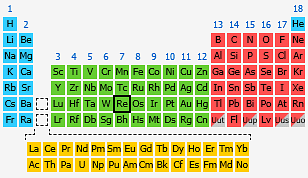
Rhenium in periodic table
Also Read:
| Related Articles | ||
|---|---|---|
| VSEPR Theory | Ionic Bond (Electrovalent Bond) | Combined Gas Law |
Applications of Rhenium
[Click Here for Sample Questions]
Rhenium as an element has multiple uses. Some of them are as mentioned below.
- Rhenium is a ductile element and that is why it is used in making a wire along with the tungsten.
- Thus, rhenium and tungsten collectively develop a good wiring system.
- Rhenium also acts as a superalloy which is applied in gas – turbine engines having a higher temperature.
- The element has a stable condition under the high temperature due to which it helps in strengthening the higher temperature-related properties of the superalloys like that of nickel.
- The petroleum industry also makes good use of this element in acting as a catalyst for reformation.
- Rhenium has various other applications in jet engines, the filaments of ovens, and so on.

Applications of Rhenium
Read More: Critical temperature
Things to Remember
- Rhenium is an important element that has widespread use in the photography sector, especially in photoflashes.
- This element is usually combined along with the tungsten or molybdenum to form an effective alloy which in turn reveals multiple applications.
- Rhenium acts as an effective element for the purpose of the hydrogenation of the chemicals.
- Rhenium along with other metals has the capability of developing into a good wiring system.
- It is one of the rarest earth materials which has an expensive cost and is not found so easily.
Also Read:
Sample Questions
Ques. Define Rhenium in the context of its physical properties. (4 marks)
Ans. Rhenium comes under the category of the rare earth material which was discovered in 1908. It is an extremely heavy element that is usually found in the whitish-silver color at multiple regions in the entire earth’s crust. As defined by the scientists, Rhenium tends to belong to group 7 of the periodic table and it is placed in the third row of the table which symbolizes the transition metals. Rhenium is mainly extracted from the ores of platinum or molybdenite.
The physical properties usually define the characteristics and the nature of the elements. Some of the physical properties of Rhenium are as follows.
- Rhenium exists in a whitish–silver color.
- Rhenium is considered a heavy metal that is extracted from platinum and molybdenite ores.
- Rhenium is hexagonal shaped.
- Scientists have found that rhenium does not carry any of the mineral properties but works as a superalloy.
- Rhenium is a transition metal located in the d-block and third row of the 7th group in a periodic table.
Ques. Explain the chemical properties of Rhenium. (4 marks)
Ans. The properties of the Rhenium could be classified into two types, the physical and the chemical properties. The chemical properties usually define the intrinsic features of the elements. Some of the chemical properties of Rhenium are as follows.
- The atomic number of rhenium is 75.
- The atomic mass and the relative atomic mass of rhenium are 186.23 g. mol -1 and 186.207 respectively.
- The electronic configuration of rhenium looks like [Xe] 4f14 5d5 6s2, this ultimately helps in defining the valence structure of the element.
- The boiling point of rhenium is almost 5590°C, 10094°F, 5863 K which is also comparatively low.
Ques. Define Rhenium. Mention its few applications. (3 marks)
Ans. Rhenium comes under the category of the rare earth material which was discovered in 1908. Rhenium as an element has multiple uses. Some of them are mentioned below.
- Rhenium is a ductile element and that is why it is used in making a wire along with the tungsten. Thus, both collectively develop a good wiring system.
- Rhenium also acts as a superalloy which is applied in gas-turbine engines having a higher temperature.
Ques. Give a detailed description of the isotopes of rhenium. (3 marks)
Ans. The range of isotopes of rhenium varies from 180 Re to that of 194 Re, combining almost a total of thirty-three isotopes of Rhenium.
- There is one isotope with a half-life of seven days, that is, 183 Re.
- The isotope 183 Re is found in the metals of tellurium or indium.
- 187 Re possesses a comparatively good beta decay value especially during the dating of the ores of the rhenium and that of the osmium.
- 187 Re and 185 Re have a half-life of about 1010 years.
Ques. What are the different uses of rhenium in different industries? (3 marks)
Ans. A few of the uses of the rhenium are as follows.
- Rhenium is a ductile element and it helps in developing a good wiring system.
- Rhenium also acts as a superalloy applied in the gas – turbine engines.
- The petroleum industry also makes good use of this element in acting as a catalyst for reformation.
- Rhenium has various other applications in jet engines, the filaments of ovens, and so on.
Ques. Illustrate the melting and the boiling points of Rhenium. (2 marks)
Ans. Rhenium is considered to have a low melting point at the rate of 3185°C, 5765°F, 3458 K which lies next to that of tungsten. The boiling point of rhenium is almost 5590°C, 10094°F, 5863 K which is also comparatively low.
Ques. Explain the property of rhenium in context with the high temperature. (2 marks)
Ans. The element has a stable condition under the high temperature due to which it helps in strengthening the higher temperature-related properties of the superalloys like that of nickel. Rhenium also acts as a superalloy which is applied in gas – turbine engines having a higher temperature.
Ques. What is the relative atomic mass and electronic configuration of the rhenium element. (2 marks)
Ans. The relative atomic mass and electronic configuration of the rhenium element are [Xe] 4f14 5d5 6s2 and 186.21 respectively.
Ques. From which ores rhenium is extracted. (1 mark)
Ans. Platinum and Molybdenite Ores are used in the extraction of Rhenium metal.
Ques. What will happen when dirhenium decacarbonyl compound react with bromine metal. (2 marks)
Ans. When dirhenium decacarbonyl compound react with bromine metal then it will form a compound called bromopentacarbonylrhenium(I).
Re2(CO)10 + Br2 → 2 Re(CO)5Br
Ques. How rhenium improves the properties of Tungsten metal. (2 marks)
Ans. When rhenium is added to tungsten metal, it will increase the ductility of the metal. It will help in the improvement of room temperature fabricability and increase the strength of the metal.
Ques. What is the reaction involved when rhenium reacts with oxygen. (2 marks)
Ans. When rhenium reacts with oxygen, the moist air will make the rhenium tarnish and form rhenium (VII) oxide, which is represented by the equation as follows:
4Re(s) + 7O2(g) → 2Re2O7
Ques. In which countries rhenium is recovered most. (1 mark)
Ans. Rhenium is recovered most in Chile, the US, Poland, Uzbekistan, and Kazakhstan.
Ques. What will happen when rhenium reacts with fluoride. (2 marks)
Ans. When rhenium is heated with fluoride, a combustion reaction will occur, which results in the formation of rhenium(VI) fluoride and rhenium(VII) fluoride.
Re(s) + 3F2(g) → ReF6(s)
2Re(s) + 7F2(g) → 2ReF7(s)
Ques. What are the health issues related to the use of rhenium metal. (3 marks)
Ans. The health issues related to the use of rhenium metal are as follows:
- Exposure to rhenium dust will cause diseases like lung fibrosis.
- It will cause irritation to the eyes and skin.
- The consumption of rhenium metal can damage the digestive tract.
For Latest Updates on Upcoming Board Exams, Click Here: https://t.me/class_10_12_board_updates
Check-Out:



Comments