



Content Writer
Trigonometric Equation is an equation that has either one or more trigonometric ratios of undefined angles. Trigonometric Equations are expressed by the functions, namely sine (sin), cosine (cos), tangent (tan), cotangent (cot), secant (sec), and cosecant (cosec) angles.
- Trigonometry expresses the relationship between the length and angles of the sides of triangles.
- It is derived from a combination of two Greek words, namely trigonon (triangle) and metron (measure).
- For instance, cos2x + sin2x = 1 is a trigonometric equation.
- All possible solutions of a trigonometric equation are known as principal solutions or general solutions.
- It is an equation involving one or more trigonometric functions with a variable.
- Trigonometric equations can be used to find unknown angles or sides of a right-angled triangle.
Read More: NCERT Solutions for Class 11 Mathematics Trigonometric Functions
Key Terms: Trigonometry, Trigonometric Equations, Trigonometric Values, Trigonometric Ratios, Cosine, Sine, Tangent
What are Trigonometric Equations?
[Click Here for Sample Questions]
Trigonometric Equation is a form of algebraic equation that involves one or more trigonometric ratios of unknown angles. There are three primary trigonometric ratios, namely sin, cos, and tan.
- The three other trigonometric ratios, sec, cosec, and cot, are the reciprocals of sin, cos, and tan, respectively.
- All trigonometric equations are solved for the value of θ.
- A solution can be easily calculated for an equation by drawing a graph.
- The linear equation of the form ax + b = 0 can be represented in the trigonometry equation as aSinθ + b = 0.
- The identities of a trigonometric function do not refer to a particular figure.
Examples of trigonometric equations are:
- Sin4x - Sin6x + Sin2x = 0
- 2Cos2x + 4Sinx = 0
- Cos4x = Cos2x
Read More:
Trigonometric Equations and Their Solutions
[Click Here for Previous Year Questions]
Equations containing trigonometric functions of a single variable are known as Trigonometric Equations. For Example: cos2x + 5 cosx – 7 = 0 .
- The solutions of equations for a trigonometric function in variable x, where x lies between 0 ≤ x ≤ 2π, are the principal solutions.
- If the solution has the integer ‘n’, it is known as the general solution.
- Trigonometric equations are solved for right-angled triangles.
- The domain of the trigonometric function must be assumed first before determining a valid solution.
- To solve an equation, check for patterns, factors and common denominators.
The table below explains the solutions for numerous trigonometric equations.
| Trigonometric Equations | General Solutions |
|---|---|
| sin θ = 0 | θ = nπ |
| cos θ = 0 | θ = (nπ + π/2) |
| cos θ = 0 | θ = nπ |
| sin θ = 1 | θ = (2nπ + π/2) = (4n+1) π/2 |
| cos θ = 1 | θ = 2nπ |
| sin θ = sin α | θ = nπ + (-1)n α, where α ∈ [-π/2, π/2] |
| cos θ = cos α | θ = 2nπ ± α, where α ∈ (0, π] |
| tan θ = tan α | θ = nπ + α, where α ∈ (-π/2, π/2] |
| sin 2θ = sin 2α | θ = nπ ± α |
| cos 2θ = cos 2α | θ = nπ ± α |
| tan 2θ = tan 2α | θ = nπ ± α |
Let us consider the proof for the equation sin x = sin y implies x = nπ + (-1)n y, where n € Z and x and y are any real numbers.
- Suppose sin x = sin y, then sin x – sin y =0 i.e. 2 cos(x+y)/2 sin(x-y)/2 =0
- It outputs value is equivalent to cos (x+y)/2 = 0 or (x+y)/2 = (2n + 1) π/2
- In similar way, sin (x-y)/2 = 0 or (x-y)/2 = nπ which implicates x = (2n+1) π – y; or x= 2nπ +y
- Thus, x = (2n+1) π + (-1)2n+1 y; or x = 2nπ + (-1)2n y
- Adding these two outputs, we obtain x = nπ + (-1)n y, where n ∈ Z.
Hence proving the equation sin x = sin y
Proofs of Trigonometric Equations
[Click Here for Sample Questions]
Here are the proofs of solutions of all trigonometric equations:
If x and y are real numbers, sin x = sin y implies x = nπ + (-1)n y, where n is an integer.
Suppose sin x = sin y, then sin x - sin y = 0.
- Using the formula, sin A - sin B = 2 cos (A+B)/2 .sin (A-B)/2
- This equation can be transformed into 2 cos (x+y)/2. sin (x-y)/2 = 0.
- It can further be simplified as either cos (x+y)/2 = 0 or sin (x-y)/2 = 0.
- Knowing that cos A = 0 when A = (2n+1)π/2 and sin A = 0 when A = nπ, where n is an integer, this means that (x+y)/2 = (2n+1)π/2 or (x-y)/2 = nπ.
- Substituting the values of (x+y)/2 and (x-y)/2 in the above step, x = (2n+1)π - y or x = 2nπ + y.
Combining these results, x = nπ + (-1)n y, where n is an integer.
If x and y are real numbers, cos x = cos y implies x = 2nπ ± y, where n is an integer:
Suppose cos x = cos y, then cos x - cos y = 0.
- Using the formula, cos A - cos B = -2 sin (A+B)/2 * sin (A-B)/2, this can be transformed into -2 sin (x+y)/2 .sin (x-y)/2 = 0.
- This can further be simplified as either sin (x+y)/2 = 0 or sin (x-y)/2 = 0.
- Knowing that sin A = 0 when A = nπ, where n is an integer, this means that (x+y)/2 = nπ or (x-y)/2 = nπ.
- Substituting the values of (x+y)/2 and (x-y)/2 in the above step, x = 2nπ - y or x = 2nπ + y.
Hence, x = 2nπ ± y, where n is an integer.
If x and y are not odd multiples of π/2, then tan x = tan y implies x = nπ + y, where n is an integer.
Suppose tan x = tan y, then tan x - tan y = 0.
- Using the formula, tan x - tan y = (sin x / cos x - sin y / cos y) / (cos x cos y), this can be transformed into (sin x cos y - cos x sin y) / (cos x cos y) = 0.
- Using the formula, sin (A - B) = sin A cos B - sin B cos A, this can be further simplified as sin (x-y) / (cos x cos y) = 0.
- Knowing that sin A = 0 when A = nπ, where n is an integer, this means that sin (x-y) = 0.
Hence, x - y = nπ, where n is an integer and finally, x = nπ + y, where n is an integer.
Solving Trigonometric Equations
[Click Here for Previous Year Questions]
Trigonometric equations differ from normal algebraic equations. In trignometric equation, the number of solutions is based on the angle of the trigonometric function rather than the degree of the variable.
- For instance, the equation 2cosθ - 1 = 0 has a solution of cosθ = 1/2, which corresponds to angles of π/3, 5π/3, 7π/3, 11π/3, and so forth.
- These values repeat after every 2π radians and cos x is positive in the first and fourth quadrants.
To solve trigonometric equations, two types of solutions exist:
Principal Solution
Principal Solution refers to the initial values of angles for the trigonometric functions.
- The solutions of the sinθ and cosθ equations repeat after an interval of 2π, while the solution of the tanθ equation repeats after an interval of π.
- The solutions for x values between 0 and 2π are referred to as the principal solutions.
- For example principal solution of sinθ = ½ are π/6 and 5π/6 as these two solutions lie between 0 to 2π.
General Solution
General Solution refers to the consolidated values of the angles for the same answer of the trigonometric function. The solutions beyond 2π are expressed as a general solution. The general solutions for Sinθ, Cosθ, and Tanθ are as follows:
- For example general solution of sinθ = ½ is 5π/6 as this solution lie beyond 2π.
- Sinθ = Sinα, with the general solution being θ = nπ + (-1)nα, where n ∈ Z
- Cosθ = Cosα, with the general solution being θ = 2nπ + α, where n ∈ Z
- Tanθ = Tanα, with the general solution being θ = nπ + α, where n ∈ Z.
Steps to Solve Trigonometric Equations
[Click Here for Sample Questions]
The process of solving a trigonometric equation requires the following steps:
Simplification
The process followed in case of simplification is as follows:
- Simplify the equation by transforming it into an equation with only one trigonometric function, such as sin, cos, or tan.
- This may involve converting multiple angles or submultiple angles into a single angle.
Polynomial or Equation Form
In this step write the equation in polynomial or equation form, for instance, as a linear, quadratic, or polynomial equation.
Solving the Equation
The process followed in case of solving an equation is as follows:
- Solve the equation as you would solve any other algebraic equation.
- Use the methods of algebra, such as factoring, completing the square, or using the quadratic formula.
Finding the Angle
The process followed in case of finding the angle is as follows:
- Once the equation is solved, the value of the trigonometric function represents the solution of the equation.
- The angle of the trigonometric function can be found using the inverse functions, such as inverse sine, inverse cosine, or inverse tangent.
Principal Solution
The process followed in case of principle solution is as follows:
- Remember to consider the restriction of the principal solution while finding the solution of the equation.
- The initial values of angles for trigonometric functions are referred to as the principal solutions.
- These solutions repeat after an interval of 2π for sine and cosine and π for tangent.
Examples of Solving Trigonometric Equations
[Click Here for Previous Year Questions]
Here are some solved examples on Trigonometric equations:
| Example 1: Find the solution of tan x = 1. Solution: In this case, we will find the general solution of tan x = 1. We know that tan π/4 = 1, so we have tan x = 1 ⇒ tan x = tan π/4 ⇒ x = nπ + (π/4), where n ∈ Z ---- [Using Tanθ = Tanα, and the general solution is θ = nπ + α, where n ∈ Z] Therefore, the general solution of tan x = 1 is x = nπ + (π/4), where n ∈ Z. Example 2: Find the solution of sin x = -√2/2. Solution: To find the principal solutions of sin x = -√2/2, we know that sin -π/4 = -√2/2 and sin (π - (-π/4)) = -√2/2 ⇒ sin -π/4 = sin (2π - π/4) = -√2/2 We can find other values of x such that sin x = -√2/2, but we need to find only those values of x such that x lies in [0, 2π] because a principal solution lies between 0 and 2π. So, the principal solutions of sin x = -√2/2 are x = -π/4 and 7π/4. Example 3: Find the solution of cos x = -1/2. Solution: In this case, we will find the general solution of cos x = -1/2. We know that cos -30° = -1/2, so we have cos x = -1/2 ⇒ cos x = cos -30° ⇒ x = 2nπ + (-30°), where n ∈ Z ---- [Using Cosθ = Cosα, and the general solution is θ = 2nπ + α, where n ∈ Z] Therefore, the general solution of cos x = -1/2 is x = 2nπ + (-30°), where n ∈ Z. |
Trigonometric Ratios
[Click Here for Sample Questions]
Trigonometry is built on three main functions which are sine (sin), cosine (cos), and tangent (tan). These functions take an angle as input and return a value that represents a ratio of the sides of a right triangle.
- The three formulas of trignnometry are collectively known by the abbreviation SohCahToa
- It is based on the concept of Pythagoras Theorem.
Sine Function
The sine function of an angle is the ratio of the side opposite the angle to the hypotenuse (the longest side) of a right triangle.
Cosine Function
The cosine function of an angle is the ratio of the adjacent side (the side next to the angle) to the hypotenuse of a right triangle.
Tangent Function
The tangent function of an angle is the ratio of the opposite side to the adjacent side of a right triangle.
Assume a right-angled triangle (as shown below in figure). From the figure, ∠A made is an acute angle (less than 90).

Right-Angled Triangle
From the figure, the following trigonometric ratios are formed
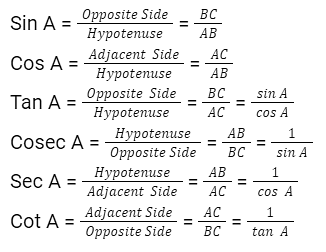
Trigonometric Ratios
Each of these trigonometric ratios can be calculated at various angles such as 30, 60, 90, and 180. few of the important standard angles at values are mentioned below in the table.
Trigonometric Ratios of Standard Angles can be depicted in a tabular form as shown below:
| Angle θ / Ratios | 0O | 30O | 45O | 60O | 90o |
|---|---|---|---|---|---|
| Sin θ | 0 | \(\frac{1}{2}\) | \(\frac{1}{√2}\) | \(\frac{√3}{2}\) | 1 |
| cos θ | 1 | \(\frac{√3}{2}\) | \(\frac{1}{√2}\) | \(\frac{1}{2}\) | 0 |
| tan θ | 0 | \(\frac{1}{√3}\) | 1 | √3 | ∞ |
| cosec θ | ∞ | 2 | √2 | \(\frac{2}{√3}\) | 1 |
| sec θ | 1 | \(\frac{2}{√3}\) | √2 | 2 | ∞ |
| cot θ | ∞ | √3 | 1 | \(\frac{1}{√3}\) | 0 |
Pythagoras Theorem
[Click Here for Previous Year Questions]
Pythagoras Theorem states that in a right triangle, the square of the hypotenuse (the longest side) is equal to the sum of the squares of the other two sides. This theorem is used to find the length of a missing side of a right triangle.
- We know that the right triangle ABC applies Pythagoras property as AB2 = AC2 + BC2. By Dividing into both sides with AB2, we get, 1 = cos2A + sin2A.
- Similarly, we can obtain other identities which are as follows:
sin2A + cos2A = 1
sec2A – tan2A = 1
cosec2A – cot2A = 1
Check More:
Trigonometric Ratios of Complementary Angles
[Click Here for Sample Questions]
Trigonometry is a branch of mathematics that deals with the relationships between the sides and angles of triangles. One of the key concepts in trigonometry is the idea of complementary angles, which are pairs of angles that add up to 90 degrees.
- In trigonometry, it is often useful to know the trigonometric ratios of complementary angles, as these ratios can be used to solve problems involving triangles.
- Trigonometric ratios of complementary angles are simply the trigonometric ratios of the two angles in a complementary pair.
- For example, if one angle in a complementary pair is 30 degrees, then the other angle must be 60 degrees.
- The trigonometric ratios for these two angles can be found and used in calculations.
- These ratios are important in a variety of fields, including engineering, physics, and navigation.
- They provide a foundation for solving more complex problems.
We know that ∠A + ∠B = 90° or ∠B = 90° – ∠A. let us consider the value for the sine of ∠B, be sin B = sin ( 90° – ∠A ) = AC/AB. But AC/AB is equal to cos A.
Thus, we can obtain sin (90° – ∠A) = cos A. Similarly, we can calculate other trigonometric ratios for complementary angles as follows:
- sin (90°– ∠A) = cos A
- cos (90°– ∠A) = sin A
- tan (90°– ∠A) = cot A
- cot (90°– ∠A) = tan A
- sec (90°– ∠A) = cosec A
- cosec (90°– ∠A) = sec A
Trigonometry Identities
[Click Here for Previous Year Questions]
Trigonometric Identities are mathematical equations that relate the trigonometric functions to one another. Some of the most commonly used identities include
- sin2θ + cos2θ = 1
- tan θ= sinθ/cosθ
Trigonometric Formulas
[Click Here for Sample Questions]
Trigonometry is a branch of mathematics that studies the relationships between the sides and angles of triangles. One of the key tools in trigonometry is a set of formulas that describe the relationships between the sides and angles of triangles.
- These formulas, known as trigonometric formulas, are used to solve a wide range of problems in mathematics, science, and engineering.
- Some of the most commonly used trigonometric formulas include the Pythagorean theorem, the formulas for the sine, cosine, and tangent functions.
Trigonometric functions (sine, cosine, tangent, etc.) are important mathematical tools for solving problems in fields such as mathematics, physics, engineering, and more.
Here is a list of some of the basic trigonometric equations and formulas:
Cosine and Sine of a Sum or Difference of Angles
Some of the equation and formulas for sum or difference of angles are as follows:
- cos (x + y) = cos x cos y – sin x sin y
- sin (x + y) = sin x cos y + cos x sin y
- cos (x - y) = cos x cos y + sin x sin y
- sin (x - y) = sin x cos y - cos x sin y
Double Angle Formulas
Some of the equation and formulas for double angles are as follows:
- cos 2x = cos2 x - sin2 x = 2 cos2 x - 1 = 1 - 2 sin2 x = 1 - tan2 x / (1 + tan2 x)
- sin 2x = 2 sin x cos x = 2 tan x / (1 + tan2 x)
Half-Angle Formulas
Some of the equation and formulas for half angles are as follows:
- sin (x/2) = ±√[(1 - cos x) / 2]
- cos (x/2) = ±√[(1 + cos x) / 2]
Sum-to-Product Formulas
Some of the equation and formulas for sum to product are as follows:
- cos x + cos y = 2 cos ( (x + y)/2 ) cos ( (x - y)/2 )
- cos x - cos y = -2 sin ( (x + y)/2 ) sin ( (x - y)/2 )
- sin x + sin y = 2 sin ( (x + y)/2 ) cos ( (x - y)/2 )
- sin x - sin y = 2 cos ( (x + y)/2 ) sin ( (x - y)/2 )
Trigonometric Functions of Complementary Angles
Some of the equation and formulas for complementary angles are as follows:
- cos (π - x) = -cos x
- sin (π - x) = sin x
- cos (π + x) = -cos x
- sin (π + x) = -sin x
Trigonometric Functions of Multiples of π
Some of the equation and formulas for a multiple of π are as follows:
- cos (2nπ + x) = cos x
- sin (2nπ + x) = sin x
- cos (-x) = cos x
- sin (-x) = -sin x
Trigonometric Functions of Angles with a Measure of π/2
Some of the equation and formulas for a multiple of π/2 are as follows:
- cos (π/2 + x) = -sin x
- sin (π/2 + x) = cos x
Conversion between Degree and Radian Measures
The formula for conversion between degree and radian are as follows:
- Radian Measure = Degree Measure x π/180
- Degree Measure = Radian Measure x 180/π
Periodicity Identities (in Radians)
Some of the formulas for a trigonometry in terms of radians are as follows:
- sin (π/2 – A) = cos A & cos (π/2 – A) = sin A
- sin (π/2 + A) = cos A & cos (π/2 + A) = – sin A
- sin (3π/2 – A) = – cos A & cos (3π/2 – A) = – sin A
- sin (3π/2 + A) = – cos A & cos (3π/2 + A) = sin A
- sin (π – A) = sin A & cos (π – A) = – cos A
- sin (π + A) = – sin A & cos (π + A) = – cos A
- sin (2π – A) = – sin A & cos (2π – A) = cos A
- sin (2π + A) = sin A & cos (2π + A) = cos A
Cofunction Identities (in Degrees)
Some of the formulas for a trigonometry in terms of degrees are as follows:
- sin(90°−x) = cos x
- cos(90°−x) = sin x
- tan(90°−x) = cot x
- cot(90°−x) = tan x
- sec(90°−x) = cosec x
- cosec(90°−x) = sec x
Sum & Difference Identities
Some of the formulas for a trigonometry for sum and difference are as follows:
- sin(x+y) = sin(x)cos(y)+cos(x)sin(y)
- cos(x+y) = cos(x)cos(y)–sin(x)sin(y)
- tan(x+y) = tan x+tan y/1-tan x.tan y
- sin(x–y) = sin(x)cos(y)–cos(x)sin(y)
- cos(x–y) = cos(x)cos(y) + sin(x)sin(y)
- tan(x-y) = tan x-tan y/1+tan x.tan y
Inverse Trigonometry Formulas
Some of the formulas for a inverse trigonometry are as follows:
- sin-1 (–x) = – sin-1 x
- cos-1 (–x) = π – cos-1 x
- tan-1 (–x) = – tan-1 x
- cosec-1 (–x) = – cosec-1 x
- sec-1 (–x) = π – sec-1 x
- cot-1 (–x) = π – cot-1 x
Things to Remember
- Trigonometric Equation is an equation involving one or more trigonometric ratios of unknown angles.
- Trigonometry is based on three main functions namely sine (sin), cosine (cos), and tangent (tan), which represent ratios of sides of a right triangle.
- Trigonometric Ratios can be calculated for standard angles such as 30, 60, 90, and 180 degrees.
- If two real numbers x and y satisfy the equation sin x = sin y, then it follows that x = nπ + (-1)n y, where n is an integer.
- In the case where cos x = cos y, the conclusion is that x = 2nπ ± y, again with n being an integer.
- If x and y are not odd multiples of π/2, and if tan x = tan y, then x = nπ + y, where n is an integer.
- It's important to note that when sin A equals 0, A must equal nπ, with n being an integer.
- If cos A equals 0, A must equal (2n + 1)π/2, with n being an integer.
Previous Year Questions
- If cosec θ − cot θ = 2017, then quadrant in which θ lies is… (TS EAMCET - 2017)
- Find the value of cos(29π/3)... (JKCET - 2014)
- A value of θ satisfying sin 5θ − sin3θ + sinθ = 0 such that…
- In any triangle ABC, the simplified form of… (KCET - 2011)
- Consider a triangular plot ABC with sides AB = 7m, BC = 5m… (JEE Main - 2019)
- If the sum of all the solutions of the equation… (JEE Main - 2018)
- Let a vertical tower AB have its end A on the level ground. Let… (JEE Main - 2017)
- Which one of the following is not true… (AMUEEE - 2013)
- The number of solutions of the equation ∣cotx∣… (COMEDK UGET - 2015)
- What is the value of sin1950o− cos1950o…
Sample Questions
Ques. What are the three important Trigonometric Equations? (5 Marks)
Ans. The three most important trigonometric equations are the Pythagorean identity, the reciprocal identity, and the quotient identity.
Pythagorean Identity states that in any right triangle, the square of the length of the hypotenuse (the longest side) is equal to the sum of the squares of the lengths of the other two sides. This equation is expressed as:
sin2θ + cos2θ = 1
Reciprocal Identity states that the reciprocal of sine, cosine, and tangent are cosecant, secant, and cotangent respectively. This equation is expressed as:
cosec θ = 1/sin θ, sec θ = 1/cos θ, cot θ = 1/tan θ
Quotient Identity relates tangent to sine and cosine. This equation is expressed as:
tan θ = sin θ / cos θ
These three trigonometric equations form the basis for many other equations and are widely used in geometry, physics, and engineering to solve various problems.
Ques. If f(x) = tan 3x, g(x) = cot (x – 50) and h(x) = cos x, find x given f(x) = g(x). And, if h(x) = 4/5, find the value of cosec x + tan3x. (3 Marks)
Ans. If f(x) = g(x), i.e., tan 3x = cot (x – 50)
⇒ cot (90 – 3x) = cot (x-50)
⇒ 90 – 3x = x – 50
or x = 35
If h(x)=cos x and h(x) = 4/5, we get cos x = 4/5.
Hence, sin x = 3/5, cosec x = 5/3 and tan x = 4/5
Or else, cosec x + tan3x = (5/3) + (4/5)3 = 817/375 = 2.178
Ques. Find the principal solutions for the equation tan x = – 1/(√3). (3 Marks)
Ans. We have tan(π/6) = 1/(√3)
Also, tan (π – π/6 ) = -tan(π/6) = – 1/(√3)
We also have tan (2π – π/6) = -tan(π/6) = – 1/(√3)
Thus, the principal solutions of the equation are tan (π – π/6) = tan (5π/6) and tan (2π – π/6 ) = tan (11π/6).
Ques. Evaluate the value of the equation in (11π/12). (3 Marks)
Ans. Sin (11π/12) which can also be written as sin (2π/3 + π/4)
Making use of the formula we obtain, sin (x + y) = sin x cos y + cos x sin y
sin (11π/12) = sin (2π/3 + π/4) = sin(2π/3) cos π/4 + cos(2π/3) sin π/4
= (√3)/2 × √2/2 + (-1/2) × √2/2
= √6/4 – (√2)/4
= (√6-√2)/4
Ques. Evaluate the value of cosec x = 2. (1 Marks)
Ans. Since we know, cosec x = cosec π/6 = 2 or sin x = sin π/6 = 1/2.
Or, x = n π + (-1)n π/6
Ques. Solve the equation 5 cos2y + 2 sin y = 0. (3 Marks)
Ans. We have 5 cos2y + 2 sin y = 0
Also 5 (1 – sin2 y) + 2 sin y = 0
Else 5 sin2y – 2 sin y – 5 =0
i.e., sin y = 1.2 or sin y = -0.8.
As sin y can not be greater than 1,
sin y = – 0.8 = sin ( π + π/3 )
or sin y = sin 4π/3, and thus, the solution of the given is y = n π + (-1)n 4π/3.
Ques. Find the principal solutions of sin x = (√3)/2. (2 Marks)
Ans. We know that, sin π/3 = (√3)/2 and sin 2π/3 = sin (π – π/3 ) = sin π/3 = (√3)/2
Hence, the principal solutions are x = π/3 and 2π/3.
Ques. Find out the principal and general solutions of the given equation, sec x = 2. (5 Marks)
Ans. We know that, secπ3 = 2, So, secπ3 = sec(2π–π3) = sec5π3
Thus, the principal solutions of sec x = 2 are,
- x = π3 and
- x = 5π3
Here, we know that sec x = 1 cos x
Thus, sec x = secπ3 implies
cosx = cosπ3
By making use of the Theorems, x = 2nπ ± π3, where n ∈ Z.
The general solution is sec x = 2.
Ques. What is a Tangent Formula? (3 Marks)
Ans. Tangent Formula is a mathematical equation used to calculate the tangent of an angle in a right triangle. It is defined as the ratio of the length of the side opposite the angle to the length of the adjacent side. In mathematical terms, it is represented as:
Tangent (θ) = Opposite Side / Adjacent Side = sin (θ) / cos (θ)
- Tangent Angle Formula is in general used to find the angle of the right triangle.
- Furthermore, in a right-angled triangle, the tangent of an angle is generally the size of the opposite side when it is divided by the size of the adjoining side.
- It is important to note that the tangent formula is only applicable to right triangles, where the angle being calculated is one of the two smaller angles in the triangle.
- The tangent formula can be used in a variety of applications, including trigonometry, geometry, and physics.
Ques.If cos A = 4/5, then find the value of tan A. (3 Marks)
Ans. Given,
cos A = ⅘
As we know, from trigonometry identities
1 + tan2A = sec2A
sec2A – 1 = tan2A
(1/cos2A) -1 = tan2A
Putting the value of cos A = ⅘.
(5/4)2 – 1 = tan2 A
(25 – 16)/16 = tan2 A
tan2A = 9/16
tan A = ¾
Ques. What are the three main trigonometric functions. (1 mark)
Ans. The three main trigonometric functions are sin θ, cos θ and tan θ.
Ques. What is the value of (sin 30° + cos 30°). (2 marks)
Ans. Given, (sin 30° + cos 30°)
= (½) + (√3/2)
The required value is (1+ √3) / 2
Ques. If cos A = 3/5, then find the value of tan A. (2 marks)
Solution: Given, cos A = 3 / 5
- cos A = adj / hyp
- Now using pythagoras theorem: hyp2 = adj2 + opp2 where hyp = 5 and adj = 3
- 5 x 5 = 3 x 3 + opp2
- opp = 4
- So tan A = opp / adj = 4/3
Ques. At what angle is the value of tan theta equivalent to cot theta. (1 mark)
Ans. The value of tan theta is equivalent to cot theta when theta is equivalent to 45 degrees.
Ques. What is the general solution of the equation tanx = 1. (1 mark)
Ans. The general solution of the equation tanx = 1 is nπ + π/4.
For Latest Updates on Upcoming Board Exams, Click Here: https://t.me/class_10_12_board_updates
Check-Out:



Comments