



Content Curator
The secant formula is derived from the inverse cosine (cos) ratio. In a right-angled triangle when the length of the hypotenuse, the largest side and opposite to the right angle, is divided by the size of the adjacent side, it gives the secant of the angle. Secant is denoted as 'sec'. Inverse of the cosine function is the secant funtcion.
| Table of Content |
Key Terms: Secant, Cosine, Sine, Tangent, Cotangent, Cosecant, Trigonometry
What is Secant?
[Click Here for Sample Questions]
Trigonometry mainly deals with triangles and their angles. It provides popular relationships between the lengths and angles of triangles. There are six ratios which are the core of trigonometry. These ratios are:
- Sine
- Cosine
- Tangent
- Cotangent
- Secant
- Cosecant
Out of these six trigonometry ratios, sine, cosine and tangent are basic and the other three are derived ratios. Secant is derived from the cosine ratio. It is abbreviated as ‘sec’ and has a period of 2\(\pi\), which is similar to sine and cosine. The secant function is the reciprocal of the cosine function, thus, the secant function becomes undefined whenever the cosine function is equal to zero (0).
Secant Formula
[Click Here for Sample Questions]
A right-angled triangle has three sides that are hypotenuse, perpendicular (the opposite side) and base (the adjacent side). With reference to an angle, the largest side is the hypotenuse, the side opposite to the angle is the perpendicular and the side where both hypotenuse and opposite rest is the base. The length of the hypotenuse, when divided by the length of the base, gives the secant of the angle in a right-angled triangle. Therefore, the formula for the secant of an angle is:
| \(sec x = \frac{Hypotenuse}{Base}\) |
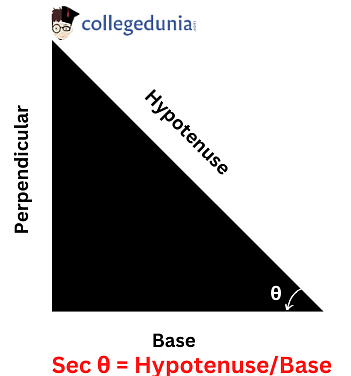
Also, the secant is the reciprocal of the cosine value. Thus,
| \(sec x = \frac{1}{cosx}\) |
One can also use the Pythagoras Theorem to calculate the secant value which is as follows:
\(sec \ 2x \ - \tan2x = 1\)
This equation is similar to the squared relationship between sin X and cos X and is extremely helpful to solve critical trigonometry problems.
Secant Ratios Table
The secant ratio table for various standard angles with their respective value is given below:
| Angle | Value |
|---|---|
| sec 0° | 1 |
| sec 30° | \(\frac{2}{\sqrt{3}}\) |
| sec 45° | √2 |
| sec 60° | 2 |
| sec 90° | Undefined |
| sec 180° | - 1 |
Secant Function in Quadrants
The secant function has different signs in different quadrants which is described below:
| Degree | Quadrant | Sign of Secant Function |
|---|---|---|
| 0° to 90° | First | positive |
| 90° to 180° | Second | negative |
| 180° to 270° | Third | negative |
| 270° to 360° | Fourth | positive |
Examples of Secant
[Click Here for Sample Questions]
Secant is one of the trigonometric ratios and has significance in mathematical calculations. To understand better a few examples are illustrated below.
| Example 1: Find Sec X if Cos x = 3⁄8 Solution: As we know, \(Secx = \frac{1}{Cosx}\) = 1/(⅜) = \(\frac{8}{3}\) Thus, Sec x = \(\frac{8}{3}\) Example 2: Find sec x if tan x = \(\frac{6}{8}\) Solution: As we know, sec2x – tan2x = 1 ⇒ sec2x = 1 + (\(\frac{6}{8}\))2 = 100/64 Thus, secx = \(\frac{10}{8} = \frac{5}{4}\) Example 3: Find the side of a right-angled triangle whose hypotenuse is 14 units and base angle with the side being 60°. Solution: Given that,θ = 60° and H = 14 units and let the base be B units Using the secant formula, secθ = \(\frac{H}{B}\) sec60° = \(\frac{14}{B}\) 2 = \(\frac{14}{B}\) B = \(\frac{14}{2}\) B = 7 Therefore, the base side of a right-angle triangle is 7 Units. |
Also Read:
| Topic Related Concepts | ||
|---|---|---|
| Trigonometry Table | Sine Function | Tangent Function |
| Cosec Cot Formula | Cosecant Function | Cotangent Function |
Things to Remember
- In a right-angle triangle when the length of the hypotenuse is divided by the size of the adjacent side, it gives the secant of the angle.
- There are six ratios which are the core of trigonometry: sine, cosine, tangent, cotangent, secant and cosecant.
- Secant is the reciprocal of cosine value.
- The secant function becomes undefined whenever the cosine function is equal to zero.
- The Pythagoras theorem to calculate the secant value is: sec2x + tan2x = 1
Sample Questions
Ques: Find sec θ using the secant formula if hypotenuse = 4.9 units, the base of the triangle = 4 units, and perpendicular = 2.8 units. [2 marks]
Ans: Given: P = 2.8, B = 4, and H = 4.9
Using the secant formula,
secθ = H/B
secθ = 4.9/4
secθ = 1.225
Therefore, sec θ is 1.225
Ques: Find Secθ if Cosθ is given as 4/8 using a secant formula. [2 marks]
Ans: Given, Cos θ = 4/8 = 1/2
Using the reciprocal secant formula,
sec θ = (1/cosθ)
sec θ = 1/½
sec θ = 2
Therefore, sec θ is 2.
Ques: What is the Formula to Find the Secant of a Right-Angled Triangle? [2 marks]
Ans: The secant function of a right-angle triangle is its hypotenuse divided by its base. Thus, the secant formula of a given triangle can be expressed as;
sec θ = H/B
Where, H = hypotenuse and B = base
Ques: Determine the value of sec θ, if tanθ is given as 1, in a right-angled triangle. [2 marks]
Ans: We know that sec2θ - tan2θ = 1
Therefore, sec2θ = 1 + 1 = 2
Thus, sec θ = √2
Ques: What is the secant value of a negative angle? [2 marks]
Ans: The secant of a negative angle is always equal to the secant of the angle.
sec(-θ) = secθ
Ques: What will be the value of the secant of an angle if its sine value is given? [2 marks]
Ans: sec θ = 1/cos θ
From the Pythagorean identities we have;
cos2θ + sin2θ = 1
⇒ cosθ = √1 – sin2θ
Hence, secθ = ± 1/√(sin2θ – 1
Ques: What will be the value of the secant of an angle if its cosec value is given? [2 marks]
Ans: We have,
sec θ = 1/√(1 - sin2θ)
We know that sin θ = 1/cosecθ
By substituting sin θ = 1/cosecθ in the above equation, we get
secθ = 1/√(1 – (1/cosec2θ)
Hence, secθ = (cosecθ)/√(cosec2θ – 1).
Ques: What will be the value of the secant of an angle if its cotangent value is given? [2 marks]
Ans: From the Pythagorean identities, we have,
sec2θ – tan2θ = 1
⇒ sec2θ = 1 + tan2θ
We know that tan θ = 1/cot θ
By substituting tan θ = 1/cot θ in the above equation, we get
⇒ sec2θ = 1 + (1/cot2θ)
⇒ sec2θ = (cot2θ + 1)/cot2θ
Hence, sec θ = ±√(cot2θ + 1)/cot θ
Ques: If cosec a = 25/24, then find the value of sec a. [2 marks]
Ans: cosec a = 25/24
We know that,
cosec a = 25/24 = hypotenuse/opposite side
adjacent side = √[(hypotenuse)2 – (opposite side)2]
= √[(25)2 – (24)2] = √(625 – 576)
= √49 = 7
Now, sec a = hypotenuse/adjacent side = 25/7
Hence, sec a = 25/7
Ques: Determine the side of a right-angled triangle whose hypotenuse is 15 units and whose base angle with the side is 45 degrees. [2 marks]
Ans: Here, θ = 45 degree
Hypotenuse = 15 units
Using the secant formula,
sec θ = hypotenuse/base
sec 45 =15/B
√2 = 15/B
B = 15/√2 = 15√2/2
B = 7.5√2
Hence, the base of the triangle is 7.5√2 units.
Also Read:



Comments