



Education Content Expert
Slime Moulds are unrelated eukaryotic organisms that were formerly categorized as fungi, but were eventually included other tiny multicellular and unicellular eukaryotic species in the Kingdom Protista.
- The term "slime" derives from the visible slime moulds' gelatinous or jelly-like appearance.
- Slime Moulds come in various sizes ranging from a few centimetres to several square metres.
- They can exist as unicellular organisms, particularly cellular slime moulds when there is an abundance of food.
- These organisms join forces and move as a single body when food is scarce.
- Under unfavourable circumstances, acellular or plasmodial slime moulds form aggregation.
Read More: NCERT Solutions for Class 11 Biology Biological Classification
Key Terms: Slime Moulds, Amoeba, Fungi, Protoplast, Accellular Slime Moulds, Cellular Slime Moulds, Eukaryotic Organisms
What are Slime Moulds?
[Click Here for Sample Questions]
Slime Mould is an unrelated eukaryotic organism with a life cycle that includes a free-living single-celled stage and the production of spores.
- Macroscopic multicellular or multinucleate fruiting structures that can form through aggregation or fusion are frequently where spores are created.
- Though no longer included in the kingdom of fungi, slime moulds were once categorised there.
- The paraphyletic group Protista have them, despite the fact that they do not form a single monophyletic clade.
- They feed any kind of decaying plant material that has microorganisms.
- They consume bacteria and fungi and aid in the breakdown of dead plants.
- Since they generally grow on deciduous logs, slime moulds are typically found on the forest floor, in soil, and on lawns.
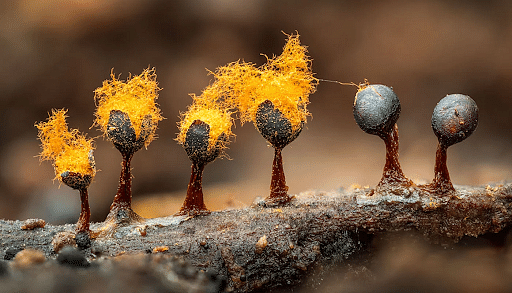
Slime Moulds
Slime Moulds Classification
[Click Here for Previous Year Questions]
Slime Moulds are classified within the Mycetozoa phylum in the current taxonomy. They fall under the category of Kingdom Protista. They also resemble protozoa and fungi. They are further divided up into numerous classes.
- Dictyostelium: These plasmodial slime moulds are cellular slime moulds in general. They remain distinct and do not aggregate into massive coenocytes.
- Myxomycetes: Through many nuclear cell divisions without further cell division, these plasmodia are multinucleated. The plasmodial stage and syncytial are what define them.
- Acrasia: Similar to dictyostelids in behaviour, cellular slime moulds feature amoebae that act differently and have eruptive pseudopodia.
- Protostelia: These fall in between dictyostelids and myxomycetes. slime moulds that are tiny, straightforward, and amoeboid.
- Labyrinthula: An amoeba without pseudopodia can freely move through a network of tubes formed by marine slime nets.
- Plasmodiophomycetes: Mostly parasitic slime moulds are present here. Both powdery scab tuber disease and cabbage club root disease are caused by parasitic protists. These affect plants internally as parasites.
- Fonticula: These are cellular slime moulds that develop into multicellular fruiting bodies in the shape of "volcanos."
Read More:
General Characteristics of Slime Moulds
[Click Here for Sample Questions]
The general characteristics of Slime Moulds are listed below:
- Slime moulds can be found creeping on waste, decomposing on twigs or leaves, in soil, on tree canopies, on the forest floor, and in cold and dark environments.
- In the vegetative phase, there is no cell wall to enclose the protoplast.
- They consume dead organic materials and feed on bacteria, fungi, and yeasts since they lack chlorophyll and are saprophytic.
- The roots of cabbage and other plants in the Brassicaceae family contain a small number of parasitic slime moulds.
- Plasmodial stages resemble protozoa, and fruiting bodies produce spores that resemble those of fungi.
- Spores have cellulose-based cell walls that are resistant to harsh environments. They have a long lifespan.
Acellular Slime Moulds
[Click Here for Previous Year Questions]
Acellular Slime Moulds are also known as Plasmodial Slime Moulds. A multinucleate protoplasm's bulk, or plasmodium, is the feeding stage.
- When food is in short supply and moisture levels are low, they reproduce asexually.
- Overleaf litter, decomposing logs, and moist areas can be seen creeping as a slimy mass.
- It consumes organic materials that have decomposed and dead bacteria. They can expand to a diameter of one foot.
- The acellular slime moulds Cribaria, Physarum, Lycogala, Tubifera, and Fuligo are a few examples.

Acellular Slime Moulds
Life Cycle of Acellular Slime Moulds
- As plasmodium dries, it develops stalked fruiting bodies that contain sporangia.
- Meiosis occurs in sporangia and produces haploid spores.
- They have a strong cell wall and are quite resilient to harmful environments.
- These spores germinate under favourable conditions to produce haploid cells.
- These gametes are haploid cells. Depending on the availability of moisture, different types of cells are created.
- When the environment is moist, biflagellated swarm cells develop; otherwise, amoeboid myxamoebas develop. They serve as gametes.
- A diploid zygote is created when these haploid gametes combine.
- Since the diploid zygote doesn't go through cytoplasmic division, it goes through numerous mitoses, resulting in a multinucleated plasmodium (cytokinins).
Read More: Biological Classification Important Questions
Cellular Slime Moulds
[Click Here for Sample Questions]
An amoeboid with one cell that lives alone serves as the feeding stage in cellular slime moulds. Individual cells in freshwater creep on freely flowing or decomposing logs, feeding on the bacteria and other food material.
- They resemble amoebas more closely. Each cell contains a haploid nucleus and can divide mitotically, just like an amoeba.
- They congregate when there is a percentage of less food available, but they maintain their individuality due to the presence of a thin plasma membrane, and they reproduce asexually by the development of spores.
- Cells move toward the cAMP as a result of the chemical's subsequent diffusion and binding to the receptors on the surface of surrounding cells (Cyclic Adenosine Monophosphate).
- They emit cAMP-mediated chemical signals when the food or moisture levels are low.

Cellular Slime Moulds
Life Cycle of Cellular Slime Moulds
- A multicellular slug formed by the accumulation of thousands of cells crawl for a short distance before settling
- Every cell in the slug is distinct and still has its plasma membrane.
- Fruiting bodies, which carry spores, are created in the slug after it has settled.
- When favourable conditions are met, spores are released and germinate into a single haploid amoeboid cell, which is the vegetative stage.
- Spore formation is an asexual mode of reproduction.
- The flagellated gamete stage and sexual reproduction are absent from the majority of them.
Reproduction in Slime Moulds
[Click Here for Previous Year Questions]
Reproduction in slime moulds is quite simple and basic. Two sets of chromosomes are found in the plasmodia's nucleus.
- Plasmodium grows into a brief stalk with a tiny, mushroom-like cap when this organism is exposed to sunlight.
- The stalks' nuclei go through meiosis, where chromosomes are redistributed and the nucleus divides to produce haploid spores (i.e. just one set of chromosomes).
- The term "sporangia" refers to these fruiting bodies.
- The creation of these spore capsules kills slime moulds, putting an end to the organism.
- However, these spores are spread by the wind and germinate in damp areas.
- The spores develop into an amoeba and spread by consuming the nearby bacteria.
- They then reproduce by mitotically dividing into two.
- Typically, there are two different types of gametes: one is large and immobile, and the other is smaller and equipped with flagella.
- However, in this instance, isogamy applies since slime moulds have comparable sorts of gametes that are the same size and shape.
- The gametes and nuclei of two amoebae that have compatible mating cells combine when they come together.
- The nuclei change from haploid to diploid after fusion.
- Following this procedure, the cell grows and creates a new plasmodium while the nucleus ceases to divide.
Economic Importance of Slime Moulds
[Click Here for Sample Questions]
The economic importance of Slime Moulds is described as follows:
- The degradation and decomposition of the organic matter in the soil is brought on by slime moulds. This raises the amount of nutrients in the soil.
- Slime moulds provide a colour that has artistic value.
- For the study of the structure and physiology of protoplasm, slime moulds' plasmodium is an ideal material.
Check More:
Things to Remember
- Slime Moulds are organisms that were once considered to be fungi, but they are now included in the kingdom Protista along with other small, unicellular eukaryotic creatures.
- Some slime moulds are parasitic in the roots of plants in the Brassicaceae family, such as cabbage.
- There are primarily two types of Slime Moulds namely Acellular Slime Moulds and Cellular Slime Moulds.
- Acellular Slime Moulds are also known as Parasitic slime moulds.
- The feeding stage in Acellular Slime Moulds is a multinucleate mass of protoplasm, i.e. plasmodium.
- The feeding stage in Cellular Slime Moulds is a single-celled amoeboid, which lives as a solitary organism.
Previous Years’ Questions
- Which one of the following is a slime mould… (NEET - 2007)
- Spore dispersal in slime moulds is with the help of…
- The thalloid body of a slime mould (Myxomycetes) is known as… (NEET - 2006)
- Which one of the following is a saprophytic protist… (KEAM - 2012)
- These are saprophytic protists…
- The kingdom protista was established by…
- Kingdom protista includes… (OJEE - 2005)
- In five kingdom classification the desmids and diatoms…
- Algae are useful because they… (AIIMS - 2002)
- Plasmodium, the malarial parasite, belongs to class… (AIPMT 2 - 1990)
Sample Questions
Ques. What are Slime Moulds? (2 Marks)
Ans. Slime Moulds are uncomplicated organisms made up of an acellular mass of gelatinous protoplasm that contains nuclei. It produces a significant number of spore cases once it reaches a certain size. They got their name because they looked slimy and gelatinous.
Ques. What are the characteristics of Slime Moulds? (5 Marks)
Ans. The various features of slime moulds are as follows:
- Slime moulds are chlorophyll-less saprophytes.
- They can spread and increase widely when favourable conditions allow them to form aggregates termed plasmodium.
- Under unfavourable circumstances, the plasmodium produces spores.
- The spores are exceedingly resilient to unfavourable circumstances and have real cell walls.
- Although spores have a cell wall that is rich in cellulose, the vegetative phase does not.
- They have an amoeboid body structure at a certain stage.
- They can be found on lawns and damp fields, mainly in decaying places.
- They may reproduce asexually as well as sexually. employing the gametes for sexual purposes and spores for asexual purposes.
Ques. What use do Slime Moulds serve? (3 Marks)
Ans. Slime moulds have several significance which is as follows:
- They mostly consume germs that are found on all kinds of dead plant and animal materials.
- They provide a significant contribution to the breakdown of dead plants and animal remnants.
- They function in the food web as biological decomposers and recyclers of nutrients.
- They feed on fungus, yeast, and bacteria.
Ques. In what ways Slime Moulds reproduce? (3 Marks)
Ans. Slime Mould life cycle includes several steps in the reproductive stage.
- The mature amoebae aggregate (through chemotaxis) in the presence of favourable conditions to produce a mass of cells known as a plasmodium in the case of acellular moulds and a "pseudoplasmodium" in the case of cellular moulds.
- The slime mass or slug then sports a fruiting body with a stalk-like structure attached that, given the right circumstances, generates spores and desiccates.
- They may reproduce asexually as well as sexually. employing the gametes for sexual purposes and spores for asexual purposes.
Ques. What distinguishes the Cellular and Acellular varieties of Slime Moulds? (5 Marks)
Ans. The term "Cellular slime moulds" refers to slime moulds that live in their vegetative state as uninucleate ameboid cells, as opposed to "Acellular" slime moulds, which are encased within a single membrane without walls and are one giant cell.
- While cellular slime moulds spend most of their lives as unicellular protists, acellular slime moulds are multinucleate sacks of cytoplasm with millions of distinct nuclei.
- Cellular slime moulds cluster in response to chemical cues, whereas Acellular slime moulds dwell in a "supercell."
- Acellular slime moulds have a diploid somatic phase, whereas cellular slime moulds have a haploid somatic phase.
- Acellular slime moulds do not aggregate before the development of sporangia, whereas cellular slime moulds do so and create a pseudoplasmodium first.
- While the sporangium of cellular slime moulds is bare, that of acellular slime moulds is covered with peridium.
- The sporangium of acellular slime moulds contains capitalum, but the sporangium of cellular slime moulds does not.
- Meiosis takes place inside the acellular slime moulds' spores, but not in the spores of cellular slime moulds.
Ques. Briefly describe the key phases in the life cycle of Slime Moulds. (2 Marks)
Ans. The primary phases of the life cycle of slime moulds are as follows:
- Stage of unicellular growth (during which the spore develops into small amoebae and vegetative growth takes place)
- Stage of multicellular development (during which the amoebae aggregate and form slime mass and later the fruiting body to produce and release spores).
Ques. What kind of food is stored in Slime Molds? (2 Marks)
Ans. Since slime moulds are essentially collections of amoeba-like cells, they ingest minute bacteria through a process known as phagocytosis, in which pseudopodia-like appendages grab food particles or microbes, which are then broken down in vacuoles within the cell. In the event of food scarcity, the digested food may then be kept in the form of scratch molecules for a predetermined period of time.
Ques. Describe some Cellular and Acellular Slime Moulds. (2 Marks)
Ans. Moulds that produce cellular slime moulds are Dictyostelium, Polysphondylium, and Acytostelium.
Slime moulds that are acellular slime moulds are hysarum, Physarella, Fuligo, Dictydium, Lycogala, and Tubifera.
Ques. Explain the environment of Slime Moulds. (3 Marks)
Ans. Slime Moulds are frequently discovered in locations with decaying twigs, leaves, wood logs, and other organic matter.
- They flourish in areas that are wet and full of rotting plant materials. likewise present during wet seasons and in woodland locations.
- Additionally, these moulds can be found in the humus, which is the top layer of moist soil.
- They are a class of decomposers that, like fungi, assist in recycling minerals and significant chemicals like carbon and nitrogen. therefore the term "false fungi."
- They are known as "animal fungi" because, like animals, they reproduce by forming spores with chitinous cell walls, which is a fungal trait. Cell walls are missing when they are not reproducing, which is a characteristic of animals.
Ques. What are Protostelids? (5 Marks)
Ans. Protostelids are another group of cellular slimes, albeit they don't seem to be as well-known as their relatives the Dictyostelids or the plasmodial slime moulds, as each of the latter groups comprises a model organism that has been used by biologists to investigate a particular system.
- Like other cellular moulds, protostelids produce simple fruiting bodies with stalks and spores at the tip (much like the Dictyostelids previously studied).
- One intriguing member of this group is the slime mould Ceratiomyxa, which closely resembles a plasmodial slime mould in appearance.
- The slime mould's stalked fruiting bodies cover the outside of the tentacle-like structures, concealing its tiny spores, which are only visible upon close inspection.
- Despite the fact that Ceratiomyxa's petite, stalked fruiting bodies resemble those discovered in true protostelids, some contend that the species may not actually belong to the protostelid group.
For Latest Updates on Upcoming Board Exams, Click Here: https://t.me/class_10_12_board_updates
Check-Out:



Comments