



Education Journalist | Study Abroad Lead
Sodium Acetate is a chemical compound with the chemical formula CH3COONa. It is made by neutralising acetic acid. Depending on the use, sodium acetate can be identified as a food additive by its group name, substance name, or shortened term. Acetic acid is a kind of sodium salt. Sodium salt or sodium acetate anhydrous are other names for it. Combining sodium acetate with an alkyl halide such as bromoethane is a way to make an ester. It appears as monoclinic crystals in its white granular powder form. It has a hygroscopic character and is water-soluble. It is generally odourless, but it emits a vinegar or acetic acid-like odour when heated to decompose.
| Table of Contents |
Key Terms: Sodium Acetate, Acetic Acid, Sodium Acetate Anhydrous, Ions, Buffer Solution, Hydrochloric Acid, Electrolyte Replenisher
Sodium Acetate
[Click Here for Sample Questions]
Sodium acetate, often known as CH3COONa, is a hygroscopic powder that is very soluble in water. Food, industry, concrete manufacturing, heating pads, and buffer solutions could benefit from sodium acetate. Sodium acetate is a vital component as an electrolyte replenisher when delivered intravenously. It's used to treat hyponatremic people who have low salt levels. It can also be used to treat metabolic acidosis and to alkalinize the urine.
The sodium salt version of acetic acid is sodium acetate anhydrous. In water, sodium acetate anhydrous separates into sodium ions (Na+) and acetate ions. Sodium is the most abundant cation in extracellular fluid and is used extensively in fluid and electrolyte replenishment. For restoration of acute extracellular fluid losses without disrupting average electrolyte balance, it is employed as an electrolyte replenisher in an isosmotic solution.

Sodium Acetate
Structure of Sodium Acetate
The structure of Sodium Acetate is as follows:
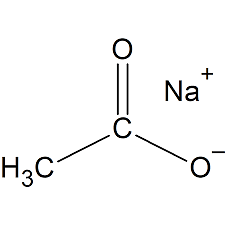
Structure of Sodium Acetate
Read More:
| Related Concepts | ||
|---|---|---|
| Cis Trans Isomerism | Azeotropic Distillation | Atomic Mass of Elements |
| Mass Percent Formula | Melting and Boiling Point | Mole Fraction |
Properties of Sodium Acetate
[Click Here for Sample Questions]
Different properties of sodium acetate are given here in the table:
| Chemical Name | Sodium Acetate |
| Formula | CH3COONa |
| Molecular Weight/ Molar Mass | 82.03 g/mol |
| Boiling Point | 881.4 °C |
| Melting Point | 324 °C |
| Density | 1.528 g/cm3 |
Uses of Sodium Acetate
[Click Here for Sample Questions]
Different uses for sodium acetate are enlisted here:
- Biotechnological: The carbon source for cultivating bacteria is sodium acetate. Sodium acetate can also boost ethanol precipitation yields for DNA isolation.
- Food: Sodium acetate, occasionally in sodium diacetate, can be used to season food. It's commonly used to give potato chips a salt and vinegar flavour, and because it doesn't impart moisture to the finished product, it can be used as a substitute for vinegar. As a shelf-life extender and pH control agent, sodium acetate (anhydrous) is commonly utilised.
- Buffer solution: A buffer solution of sodium acetate and acetic acid can be used to maintain a consistent pH level. This is particularly beneficial in pH-dependent biological activities in the mildly acidic region (pH 4–6).
- Heating pad: Heating pads, hand warmers, and hot ice include sodium acetate.
- Industrial: In the textile industry, sodium acetate is used to neutralise sulfuric acid waste streams and as a photoresist when aniline colours are utilised. It's also used as a pickling agent. It prevents chloroprene vulcanization in synthetic rubber manufacture. Sodium acetate is employed to avoid static charge development when processing cotton for disposable cotton pads.
- Longevity of concrete: Sodium acetate is used as a concrete sealer to prevent water damage to concrete. It is also more environmentally friendly and less expensive than the epoxy alternative for sealing concrete against water infiltration.
Preparation of Sodium Acetate
[Click Here for Sample Questions]
Sodium acetate is a cheap laboratory chemical usually purchased rather than manufactured. It is sometimes made in a lab experiment by reacting acetic acid, frequently found in the 5–8% solution known as vinegar, with sodium carbonate, sodium bicarbonate, or sodium hydroxide. Either of these processes produces sodium acetate and water. The carbonate anion from sodium bicarbonate or carbonate interacts with the hydrogen from the carboxyl group (-COOH) in acetic acid to generate carbonic acid when a sodium and carbonate ion-containing molecule is employed reactant.
Under typical conditions, carbonic acid decomposes quickly into gaseous carbon dioxide and water. This reaction occurs in the well-known "volcano" that erupts when baking soda and vinegar are mixed.

Chemical Reactions of Sodium Acetate
[Click Here for Sample Questions]
Sodium acetate can react with different substances. Some examples are given below:
- When sodium acetate interacts with hydrochloric acid, it produces acetic acid and sodium chloride. The reaction is as follows:
HCl+NaCH3COO→NaCl+CH3COOH
- An ester is formed when sodium acetate interacts with an alkyl halide like bromoethane. The reaction is as follows:
CH3COONa+BrCH2CH3→CH3COOCH2CH3+NaBr
- The generation of methane occurs when sodium acetate is pyrolyzed in the presence of sodium hydroxide under forced circumstances. The reaction's chemical equation is as follows:
CH3COONa+NaOH→CH4+Na2CO3
- Acetic anhydride and sodium chloride are formed when sodium acetate interacts with acetyl chloride. The reaction's chemical equation is as follows:
CH3COONa+CH3COCl→(CH3CO)2O+NaCl
Things to Remember
- Sodium acetate is a low-cost laboratory chemical that is frequently bought rather than made. Acetic acid is commonly present in the 5–8% solution known as vinegar.
- It is sometimes generated in a lab experiment by reacting it with sodium carbonate, sodium bicarbonate, or sodium hydroxide.
- When administered intravenously, sodium acetate serves as an electrolyte replenisher. It is used to treat hyponatremia patients with low salt levels.
- It can be used to alkalinize the urine and treat metabolic acidosis.
- Sodium acetate is used as a spice in food. It is used in rubber to prevent chloroprene from vulcanizing in synthetic rubber.
- It prevents static electricity from accumulating in cotton pads. It's also utilised to boost the yield of DNA isolation and pH-regulating agents.
Read More:
Sample Questions
Ques. Describe sodium acetate and its uses. (3 Marks)
Ans. Sodium acetate, often known as CH3COONa, is a hygroscopic powder that is very soluble in water. Food, industry, concrete manufacturing, heating pads, and buffer solutions could benefit from sodium acetate. Sodium acetate is a vital component as an electrolyte replenisher when delivered intravenously. It's used to treat hyponatremic people who have low salt levels. It can be used to treat metabolic acidosis and to alkalinize the urine.
Ques. Describe the route of elimination for sodium acetate. (3 Marks)
Ans. Sodium acetate is converted to bicarbonate in the liver. Acetate is hydrolyzed slowly to carbon dioxide and water, which are then transformed into bicarbonate by adding a hydrogen ion. The sodium and bicarbonate ions are primarily eliminated in the urine. Small amounts of sodium are excreted in saliva, sweat, bile, and pancreatic secretions, and some sodium is excreted in the faeces.
Ques. Describe the sodium acetate formula. (3 Marks)
Ans. One sodium (Na) atom, two oxygen (O) atoms, two carbon (C) atoms, and three hydrogens (H) atoms make up the chemical compound Sodium Acetate. The sodium salt of acetic acid is referred to as sodium acetate. The formula for sodium acetate is NaCH3COO.NaCH3COO or C2H3NaO2C2H3NaO2 is another way to write it.
Ques. Describe the mechanism of sodium acetate's effect. (3 Marks)
Ans. It functions as a source of sodium ions, particularly in hyponatremic patients. Extracellular fluid volume is mainly controlled by sodium. It regulates water distribution, fluid and electrolyte balance, and bodily fluid osmotic pressure. Nerve conduction, muscle contraction, acid-base balance, and cell food uptake are all affected by sodium.
Ques. Describe the process of making sodium acetate. (5 Marks)
Ans. In the laboratory, sodium acetate can be made by mixing acetic acid (vinegar) with sodium carbonate, sodium bicarbonate, or sodium hydroxide. The following procedures can be used to make sodium acetate:
- When acetic acid reacts with sodium carbonate, sodium acetate is formed. The reaction is as follows:
2CH3COOH + Na2CO3 → 2CH3COONa + CO2 + H2O
- Sodium bicarbonate forms sodium acetate when it interacts with acetic acid. The reaction is as follows:
CH3COOH + NaHCO3 → CH3COONa + H2CO3
- Sodium acetate is formed when sodium hydroxide reacts with acetic acid. The reaction is as follows:
CH3COOH + NaOH → CH3COONa + H2O
- Along with the release of hydrogen gas, the interaction between acetic acid and sodium metal creates sodium acetate. The reaction is as follows:
CH3COOH + 2Na → 2CH3COONa + H2
Ques. Write a short note on the physical properties of Sodium Acetate. (3 Marks)
Ans. The physical properties of Sodium Acetate are
- Sodium acetate is white.
- It has a delectable flavour. This means it has a proclivity for absorbing and dissolving moisture from the air.
- Water, alcohol, hydrazine, and sulphur dioxide are all soluble.
- Sodium acetate has a melting temperature of 597 degrees Fahrenheit and a boiling point of 1154.4 degrees Fahrenheit.
- Sodium acetate has a density of 1.528g/cm3.
Ques. Is sodium acetate water soluble? (3 Marks)
Ans. Yes, sodium acetate is quite a water-soluble chemical. When the temperature is increased, its solubility increases. Anhydrous sodium acetate, for example, has a solubility in water of 1190 grams per litre at 0 degrees Celsius. The solubility of this chemical in water increases to 1629 grams per litre when the temperature is raised to 100 degrees Celsius (in its anhydrous form). This compound's trihydrate is less water-soluble, with a solubility of 464 grams per litre at 20 degrees Celsius.
Ques. Is sodium acetate a strong or weak base? (3 Marks)
Ans. In anhydrous or molten form, sodium acetate (CH3COONa) is a salt and cannot be considered an acid or basic. Although sodium acetate is an ionic molecule, it dissociates in water to provide the sodium ion Na+ and the acetate ion CH3COO-. When these ions come into contact with water, they produce NaOH and CH3COOH. The resultant solution is basic in nature since NaOH is a strong base and CH3COOH is a weak acid.
Ques. What happens when sodium acetate is dissolved in a small amount of water? (3 Marks)
Ans. The oppositely charged ions dissociate when sodium acetate, CH3–COO– Na+, is dissolved in a small amount of water. The ions do not form crystals when left undisturbed and cooled, and the sodium acetate stays a liquid, considerably below its melting point. If the solution is agitated or a small sodium acetate crystal is injected, the oppositely charged ions (CH3–COO– and Na+) soon form a solid crystal structure. The process is exothermic, meaning it releases heat energy, so it's known as "hot ice."
Ques. Describe how sodium acetate is used in the textile business. (3 Marks)
Ans. In the textile industry, sodium acetate is used to neutralise sulphuric acid waste streams and as a photoresist when aniline colours are utilised. It's also used to make pickles. In synthetic rubber manufacturing, it resists chloroprene vulcanization. When preparing cotton for disposable cotton pads, sodium acetate is used to prevent static charge formation.
Check-Out:



Comments