



Content Curator
Structure of Nose includes the Bone, Nasal Framework, Cartilage, Cavity, Septum, Passage, and many more parts. Nose is the body's primary organ of smell and it also functions as part of the body's respiratory system. Nose is important for health as it filters the air we breathed in, removing dust, germs, and irritants. Hairs in Nose clean the air of foreign particles. Air comes into the body through Nose. As it passes over the specialized cells of the olfactory system, the brain recognizes and identifies smells.
| Table of Content |
Keyterms: Bone, Nose, Nasal Framework, Cartilage, Cavity, Septum, Passage, olfactory system, air, germs, dust, irritants
Read Also: Hormonal Imbalance
Structure of Nose
[Click Here for Sample Questions]
In humans, Nose is located in the middle of the face, above the mouth. The two openings in Nose are called nostrils. Nasal breathing is also most critical in newborns who breathe through their noses almost all the time. Nose is an important organ, or body part, for breathing and smelling. Many other animals also have a nose. When a person breathes, the air enters the nostrils which then travels through the throat and goes down into the lungs.
A wall of tough, bendable tissue called cartilage separates the nostrils into two tubes or nasal passages. When air enters the nasal passages it brings different scents with it. Tiny nerve endings in the lining of the nasal passages pick up these scents. They carry information about the scents to the brain. Nose is a prominent structure between the eyes that serves as the passage to the respiratory system and contains the olfactory organ.
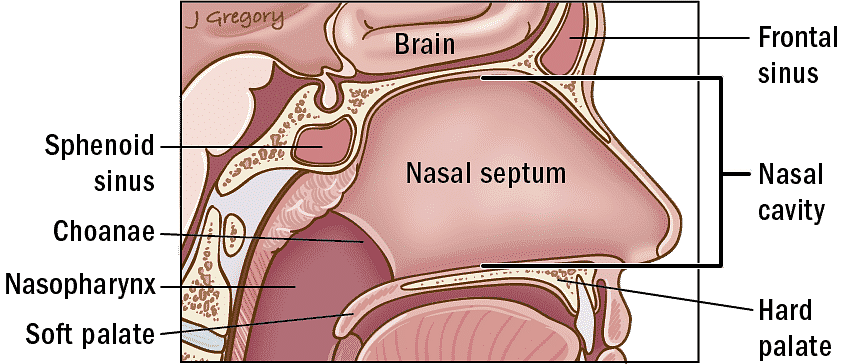
The structure of Nose includes:
- Bone- It provides support to the bridge of Nose.
- Nasal framework- The nasal is situated on the bony skull and represents a bony outline of the nasal cavity which is the beginning of the respiratory tract.
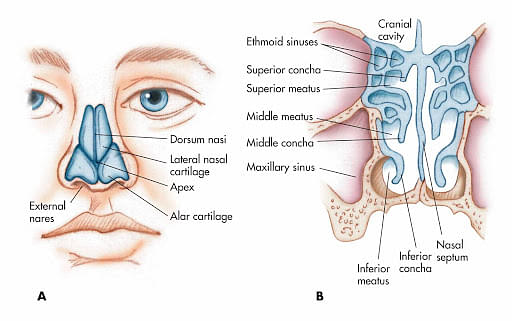
- Nasal Cartilage- The cartilage provides shape to the nostrils and nose tips. The front of Nose consists of connective tissue with embedded small pieces of cartilage. The upper cartilage provides support to the sides of Nose and the lower cartilage adds width and height to Nose.
- Nasal cavity- The nasal cavity has a lateral wall, medial wall, roof, and floor. It is the hollow space through which the air flows. The main nasal cavity extends from the inner nostril all the way to the back till it reaches the choanae.
- Internal nose- The inner part of Nose is formed by the main nasal cavity which includes the nasal concha, nasal passages, and paranasal sinus.
- Nasal septum- The nasal septum divides the inside of Nose into two chambers. It is a thin wall made of bones and cartilage. The nasal septum consists of four structures such as vomer bone, the perpendicular plate of the ethmoid bone, maxillary crest, and septal nasal cartilage.
- Nasal passage- Nasal passages are the established openings with several important anatomical structures, and the inhaled airstream can be heated and moistened more effectively because of the increased surface area.
- Mucus membrane- The mucus membrane lines Nose, sinuses, and throat. It also forms sticky mucus that prevents dust and other small particles into Nose. It moistens and warms the air we breathe in.
- Turbinate- Each side of Nose contains curved turbinate. The bony ridges are lined with a mucus membrane.
- Sinuses- The bone around Nose contains hollow, air-filled chambers known as sinuses.
Read More: Genes
Functions of Nose
[Click Here for Sample Questions]
The functions of Nose are:
- Nose humidifies the air we breathe.
- Nose helps in inhalation
- Nose cleans the air we breathe which means that Nose purifies the air we inhale.
- Nose regulates the temperature of our breath.
- Nose senses the taste of the food we eat by working together with our taste buds.
- Nose protects us through smell.
- The smell is important in identification, memory, and emotion.
- Nose acts as facilitating the sneeze reflex
- Nose shapes the sound of our voice
- Nose and sinuses are powerful duos
- Nose carries the signal to the brain in order to identify the smell.
Dysfunctions of Nose
[Click Here for Sample Questions]
Some of the common dysfunctions or disorders of Nose are:
- Cerebral spinal fluid leaks
- Deviated septum
- Smell disorders
- Chronic sinusitis without polyps
- Chronic sinusitis with polyps
- Tumor on Nose
- Allergic rhinitis
- Nosebleed
- Foreign substances
- Epistaxis
- Nasal septum deviation
- Fractures

Also Read:
Things to Remember
- Nose helps to breathe and smell. The inner part of the nose is above the roof of the mouth.
- The nose is made up of:
- External meatus. Triangular-shaped projection in the center of the face.
- External nostrils. Two chambers divided by the septum.
- Septum. Made up mainly of cartilage and bone and covered by mucous membranes. The cartilage also gives shape and support to the outer part of the nose.
- Nasal passages. Passages that are lined with mucous membranes and tiny hairs (cilia) that help to filter the air.
- Sinuses. Four pairs of air-filled cavities, also lined with mucous membranes.
- Ethmoid sinus is located inside the face, around the area of the bridge of the nose. It is present at birth, and continues to grow.
- Maxillary sinus is located inside the face, around the area of the cheeks. It is also present at birth, and continues to grow.
- Frontal sinus is located inside the face, in the area of the forehead. It does not develop until around 7 years of age.
- Sphenoid sinus is located deep in the face, behind the nose. It does not typically develop until the teen years.
Sample Questions
Ques. What is the structure of Nose? (2 Marks)
Ans. Nose is a prominent structure between the eyes that serves as the entrance to the respiratory system and contains the olfactory organ. It provides air for respiration serves the sense of smell conditions the air by filtering, warming, and moistening it, and cleans itself of foreign debris extracted from inhalations.
Ques. What are some of the common diseases of Nose? (2 Marks)
Ans. Some of the common diseases of Nose are Smell disorders Chronic sinusitis without polyps, Chronic sinusitis with polyps, Tumor on Nose, Allergic rhinitis, Nosebleed, Foreign substances, etc.
Ques. Why is nose hair important for our nose? (2 Marks)
Ans. Nose hairs are important for our health as it filters the air you breathe, removing dust, germs, and irritants. They act as the body's defense system by keeping allergens, dust, and other small particles from entering our lungs. The nose is also filled with microscopic hairs called cilia. These cilia help push mucus and other debris away from your lungs.
Ques. Why is nose important to us? (3 Marks)
Ans. Nose helps us in cleaning or purifying the air we breathe/inhale, Nose carries the signal to the brain in order to identify the smell, and the most important part is that nose helps in the inhalation of air.
Nose is involved in several important bodily functions:
- Allows air to enter the body.
- Contributes to the physical personality and sound when someone speaks.
- Filters and cleans air to remove particles and allergens.
- Provides a sense of smell.
- Warms and moistens air so it can move comfortably into the respiratory system.
Ques. What is nose made up of? (4 Marks)
Ans. Our nose is made up of cartilage covered outside by skin and inside partially by skin & hairs and partially by mucous membrane because cartilage does not hold up against gravity, it is supported by the nasal bone of the skull.
Nose helps in breathing and smelling. The inner part of the nose is above the roof of the mouth. The nose is made up of:
External meatus: Triangular-shaped projection in the center of the face.
External nostrils: Two chambers divided by the septum.
Septum: Made up mainly of cartilage and bone and covered by mucous membranes. The cartilage also gives shape and support to the outer part of the nose.
Nasal passages: Passages that are lined with mucous membranes and tiny hairs (cilia) that help to filter the air.
Sinuses: Four pairs of air-filled cavities, also lined with mucous membranes.
Ques. Which study is concerned with the disease of Nose? (4 Marks)
Ans. Rhinology includes studies concerned with the disease of Nose.
Tests and procedures included in Rhinoplasty:
- Balloon catheter dilation (balloon sinuplasty)
- Endoscopic sinus surgery
- Endoscopic skull base surgery
- Endoscopic orbital surgery
- Rhinoplasty
- Septoplasty
- Transnasal pituitary surgery
- Turbinate surgery
When a patient visits a nose and sinus specialist (rhinologist), they consult with experts in allergy, pulmonology, neurology, neurosurgery, gastroenterology and sleep medicine, or with other medical professionals as needed.
Ques. How many types of sinuses are there in Nose? (4 Marks)
Ans. There are 4 types of sinuses in Nose. They are as follows:
- Maxillary sinus- The pyramid-shaped maxillary sinus is the largest paranasal sinus, and it drains into the middle meatus of Nose. The medial wall of the maxillary sinus corresponds to the lateral wall of the main nasal cavity.
- Ethmoid sinus- The ethmoid sinus, or ethmoid air cells of the ethmoid bone, consists of numerous thin-walled cavities that are situated in the ethmoidal labyrinth and completed by the maxilla, frontal, lacrimal, sphenoidal, and palatine bones.
- Sphenoid sinus- The sphenoid sinus is found within the sphenoid bone. The floor is formed by the roof of the nasopharynx, and from the front wall, there is a connection to the upper nasal passage (meatus).
- Frontal sinus- The frontal sinus is found within the frontal bone and is often very large and chambered but can also be entirely non-existent. The orbital roof forms the lower boundary.
Also Read:



Comments