



Education Journalist | Study Abroad Lead
Thermal Expansion refers to the tendency of an object to increase its dimension in length or volume due to heat. As a material is heated, its kinetic energy increases. Thermal Expansion Formula is of three types – linear expansion, area expansion, and volume expansion. A substance contracts on cooling while it expands on heating.
Key Terms: Thermal Expansion Formula, Heat, Cooling, Linear Expansion, Area Expansion, Volume Expansion
Thermal Expansion Formula
[Click Here for Sample Questions]
In thermal expansion, a body expands when heat is applied. When the substance is heated it increases its kinetic energy. The relative expansion of the material divided by the change in temperature is known as the coefficient of thermal expansion. Thermal expansion is divided into three types –
- Linear expansion
- Area expansion
- Volume expansion
The different thermal expansion formula for linear expansion, area expansion, and volume expansion are as given below.
Linear Expansion Formula
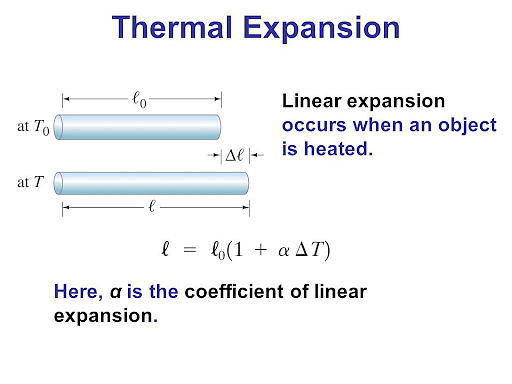
Objects which have negligible breadth as compared to their length undergo linear expansion, e.g metallic rods, wires, etc. When their temperature increases it undergoes an increase in its breadth as well as length but the increase in breadth is negligible to the increase in length and hence overall the expansion occurs linearly. Linear expansion is the change in the length of an object due to heat.
Relative linear expansion formula
The formula of the coefficient of linear thermal expansion can be derived as follows:-
Let L be the original length of an object that undergoes linear expansion. L’ is the final length. Hence, the change in length is L 0 = L’- L
\(ΔL \over Lo\)= αLΔT
- L0 = original length,
- L = expanded length,
- α = length expansion coefficient,
- ΔT = temperature difference,
- ΔL = change in length
The coefficient of linear thermal expansion is-
αL = \(ΔL \over Lo\)/ T
Also read:
| Relation between celsius and fahrenheit | Sensible heat formula | Heat load formula |
| Specific heat capacity | Calorimetry | Change of state |
| Blackbody Radiation | Colorimeter | Latent Heat |
Area Expansion Formula
Objects that have negligible height as compared to length and breadth, i.e, a sheet-like appearance undergo an expansion in the area. The area increases with an increase in temperature. This is known as Area expansion. The formula for the coefficient of area thermal expansion can be derived as follows-
Let the initial area of the sheet of an object be A and its final area be A’. Then the change in the area of the object is A 0 = A’ – A
Relative area expansion Formula
\(ΔA \over Ao\) = α A ΔT
The coefficient of area expansion is
α A = (A0 /A) / T
Volume Expansion Formula
Objects that undergo an increase in size three-dimensionally when their temperature is increased undergo Volume expansion. The size increases from all sides. The increase in volume depends on the coefficient of volume expansion of the material.
Let the initial Volume of an object be V and its final volume be V’. Then the increase in volume is,
V 0 = V’- V
Relative Volume expansion Formula:
\(ΔV \over Vo\) = αv ΔT
Thermal Expansion Formula – Solved ExampleExample: A rod of 5m length heated to 40°C. If the length increases 7 m after a few time. Find the thermal expansion coefficient. The room temperature is 30°C. Solution: Given: Initial length Lo = 5 m, Expanded length L = 7 m Change in length Δ L = 7 – 5 = 2 m Temperature difference Δ T = 40°C – 30°C = 10°C Absolute temperature T = 10°C + 273 =283 K The linear expansion formula is given by, \(\begin{array}{l}\frac{\Delta L}{L_{o}}=\alpha _{L}\Delta T\end{array}\) Therefore, the length expansion coefficient is given by \(\begin{array}{l}\alpha _{L}=\frac{\Delta L}{L_{o}\times \Delta T}\end{array}\) \(\begin{array}{l}\alpha _{L}=14\times 10^{-4}K^{-1}\end{array}\) |
Also read:
What is Thermal Expansion?
[Click Here for Sample Questions]
Thermal expansion tends to increase the dimensions of the object in length, area, or volume. The expansion caused in any substance (solid, liquid, or gaseous) by virtue of the increase in its temperature is termed thermal expansion.

A common example is when we put a tightly closed lid of a bottle into hot water. The hot water changes the temperature of the metallic lid which causes it to expand a bit, and hence the lid opens up easily without much effort. Solids expand in a linear manner, in an areal manner, and in a volumetric manner. Liquids and gases undergo only volumetric expansion.
How does Thermal Expansion occur?
[Click Here for Sample Questions]
Temperature is the average kinetic (or movement) energy of the molecules in a substance.
- A higher temperature means that the molecules are moving faster on average.
- When a material is heated, the molecules inside that material start moving faster and, as a result, they take up more space.
- They tend to move into areas that were previously empty. This increases the size of the object.
Applications of Thermal Expansion
[Click Here for Sample Questions]
Materials with high linear coefficients are very stable and are used in the construction of massive structures.
- A thermometer is made on the basis of the Thermal Expansion of mercury.
- The property of Thermal expansion is utilized in fitting an iron rim around a wooden wheel.
- Riveting is another example where the two steel plates are held tightly together by putting a hot rivet between the plates and when the rivet cools it brings the plates very close together.
- Thermostat is a heat regulating device that works on the principle of Thermal expansion.
Read More:
Things to Remember
- Thermal expansion is the increase in dimensions and size of an object when its temperature rises.
- The three parameters of Thermal Expansion are linear expansion, area expansion, and volume expansion.
- The extent of expansion in a particular object depends upon the coefficient of expansion of the material.
- The coefficient of expansion is the relative expansion divided by a change in temperature.
- Gases have the largest coefficient of Thermal Expansion while liquids are very less and solids have the smallest coefficient of thermal expansion.
- Thermometers and thermostats are two devices that are based on the principle of Thermal expansion.
Sample Questions
Ques: Name the two devices that works on the principle of Thermal expansion. (1 mark)
Ans: Thermometers and thermostats are two devices that are based on the principle of Thermal expansion.
Ques: What are the two factors on which Thermal Expansion depends. (1 mark)
Ans: Thermal expansion depends on
- Temperature T, and is directly proportional to it.
- The coefficient of Thermal Expansion of the material, and is directly proportional to it.
Ques: A metallic rod has a length of 4 m at room temperature of 27 °C, when it was heated to 37°C the length increases to 7 m. Find the coefficient of linear thermal expansion. (3 marks)
Ans: Initial length,L = 4 m
Final length, L’ = 7 m
L 0 = 7-4 = 3 m.
T = 37 – 27 =10
273 + 10= 283 K
Therefore the coefficient of linear expansion is-
α L = (L 0/ L)/ T
= (3/4)/283
=0.00265 K -1 Ans.
Ques: What is the area expansion of a thin metallic sheet of negligible height with coefficient of area expansion is .0011 and the change in temperature is 12°C. (3 marks)
Ans: Given that,
α A = .0011
T = 12
= 273+12 =285 ( in absolute scale)
Relative area expansion:
(A 0 /A) = α A × T
(A 0 /A)= .0011 × 285
(A 0 /A) =0.3135
Ques: Find the rise in temperature of an iron rod whose length changes from 3 m to 5 m on heating. (The coefficient of linear expansion of iron is = 11.7 × 10 -4 K -1). (3 marks)
Ans: Initial length, L = 3 m
Final length, L’ = 5 m
L 0 = 5-3 = 2m.
α L = = 11.7 × 10 -4 K -1
A T = (L 0/ L)/ T
(L 0/ L)/ A = T
T = (2/5) / 11.7 × 10 -4 K -1 = 341.88 K
= 341.88 – 273 = 68.88°C.
Ques: A cube undergoes an increase in temperature of 18°C. Each side of the cube was 6m. The coefficient of Volume expansion of the material of the cube is 3.456 × 10 -4 K -1 .Find the final length of the sides of the cube. (4 mark)
Ans: Initial volume of the cube, V = 6×6×6 = 216 m 3
α V = 3.456 × 10 -4 K -1
T = 18+ 273 = 291
Relative Volume expansion:
= V 0 /V = 3.456 × 10 -4 × 291
(V’ – V)/ V = 3.456 × 10 -4 × 291
= (V’ – V) = 3.456 × 10 -4 × 291×216
= (V’ – V) = 21.72
= V’ = 21.72 +216
= V’ = 237.72
Final length of sides of the cube = 6.19 m
Read More:



Comments