



Content Writer
A short nucleotide RNA chain is known as transfer RNA (tRNA). Transfer RNA is a molecule that converts three-nucleotide codon sequences in mRNA into the proper amino acid. The genetic code is determined by tRNAs, which serve as a connection between amino acids and nucleic acids. The realization of the diversified roles of RNAs is continuously rising, from protein translation to the great complexity of biology in modern life, as the exponential development of information regarding tRNA sequences in the post-genomic era continues.
Read Also:
| Table of Content |
Key Terms: Transfer RNA, t-RNA, Catalytic elements, RNA, mRNA, protein, amino acid, nucleic acids, genetic code, ribosome, codon
Transfer RNA ( t-RNA)
[Click Here for Sample Questions]
A transfer RNA (tRNA) molecule aids in the translation of a messenger RNA (mRNA) sequence into a protein. Transfer-RNA function at specific places in the ribosome during translation is the process by which an mRNA molecule is converted into a protein.
Also Read:
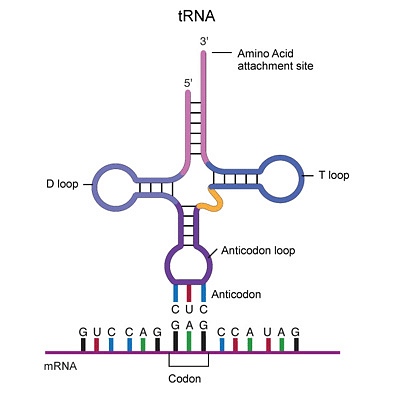
Diagram of Transfer RNA ( t-RNA)
[Click Here for Sample Questions]
Functions of Transfer RNA (t-RNA)
[Click Here for Sample Questions]
- Transfer RNA or t-RNA are transported by the Amino acids. The ribosomal particle's t-RNA reads the codons encoded in mRNA. Each triplet of t-RNA carries the relevant amino acid and transports it to the correct site on the ribosome. The tertiary structure of all t-RNA molecules is L-shaped. In the tertiary structure of tRNA, the hydrophobic interaction is a strong stabilizing force. The folded structure of the tRNA molecule resembles a three-leafed clover with three hairpin loops.
- An anticodon sequence in one of these hairpin loops can detect and interpret an mRNA codon. The appropriate amino acid is linked to the end of each Transfer-RNA. When a tRNA recognizes and binds to its associated codon in the ribosome then the corresponding amino acid is transported to the end of the forming amino acid chain, after that the ribosome and tRNAs keep decoding the mRNA molecule until the entire sequence is translated into a protein.
Structure of Transfer RNA (t-RNA
[Click Here for Sample Questions]
- Anticodon loop: tRNA has an anticodon loop with complementary bases to the coding and an amino acid acceptor end that binds to amino acids.
- Amino acid acceptor end: tRNA are clover-shaped and specific for each amino acid.

Things to Remember
- During translation mRNA acts as a template, tRNA transports amino acids and reads the genetic code and rRNAs serve as structural and catalytic elements.
- The tRNA molecule is also known as sRNA (soluble RNA) serves as an adaptor.
- Transfer RNA or tRNA molecule acts as a translator between genetic instructions encoded in nucleic acid sequences and protein products encoded in genes.
- A sequence of RNA flanked by start and stop codons that codes for a polypeptide are called an mRNA translational unit.
- An anticodon is a set of three nucleotides found in each Transfer RNA or tRNA molecule.
- Increased virulence and resistance to cationic antimicrobial peptides are conferred by tRNA-dependent aminoacylation of bacterial outer-membrane lipids.
Also Read:
Sample Questions
Ques: What role does tRNA play in protein synthesis? ( 1 Mark)
Ans: The function of tRNA in protein synthesis is to use its anticodon to decode a specific codon of mRNA in order to transfer a specific amino acid to the end of a chain in the ribosome.
Ques: Is tRNA formed from DNA? ( 1 Mark)
Ans: tRNA is produced in eukaryotic cells by a specific protein that reads the DNA code and generates a pre-tRNA.
Ques: Why is tRNA known as soluble RNA? ( 1 Mark)
Ans: Transfer RNA (tRNA) also known as soluble RNA because it is soluble in 1M NaCl.
Ques: What are anticodons in tRNA and what do they do? ( 1 Mark)
Ans: Anticodons can be present on tRNA molecules. During translation tRNA work is to base pair with the codon on a strand of mRNA.
Ques: What happens when tRNA molecules depart a ribosome? ( 1 Mark)
Ans: tRNA connects to amino acids in the cytosol and returns to the ribosome to be translated if the same codons are present in the mRNA sequence.
Ques: What is the relationship between DNA's primary and secondary structure? ( 2 Marks)
Ans: The primary structure of a peptide bond is the order in which amino acids are bonded to one another. Secondary structure describes how amino acid chains combine to produce beta barrels and alpha helices.
Ques: What is the mechanism by which tRNA transfers information from mRNA to rRNA? ( 2 Marks)
Ans: Transfer RNA or tRNA transport amino acids to the ribosome and connect with complimentary codons during translation. The formed amino acids are then linked together as the ribosome moves along the mRNA molecule in a ratchet-like motion with its resident rRNA.
Ques: What are the functions of tRNA? (5 Marks)
Ans: The Role of tRNA
- It plays a crucial role in the production of proteins.
- It serves as an adapter molecule, connecting amino acids to their respective codons in mRNA.
- The first step in protein synthesis is the aminoacylation of tRNA.
- Each amino acid has its own tRNA, which carries it during the translation process in the ribosomal subunits.
- The amino acid is transferred to the growing polypeptide chain in the ribosomes by the tRNA, which has three binding sites, A, P, and E, which correspond to aminoacyl, peptidyl, and exit, respectively.
- This process of specific tRNAs decoding mRNA codons continues until the entire polypeptide chain sequence is translated.
Ques: Describe the cloverleaf structure of tRNA? (5 Marks)
Ans: The secondary folded structure of tRNA has three hairpin loops, which give it an appearance of three-leaved clover. The main constituents of tRNA are:
- Acceptor arm
- It is formed by the base pairing of 7-9 nucleotides of 5’ terminal and 3’ terminal. The 5’ terminal has a phosphate group and the 3’ ends with a specific sequence of CCA or CCA tail. The amino acid attaches to the 3’ hydroxyl group of the acceptor arm.
- The aminoacylation of tRNA or charging of tRNA is the first step of the translation press. The enzyme aminoacyl tRNA synthetases catalyse the reaction.
- DHU Loop
D arm has a stem of 3-4 base pairs and it ends in a loop called D loop as it generally contains dihydrouridine, a modified nucleotide.
- Anticodon Loop
It has a 5 base pair long stem. It has an anticodon loop, which contains the complementary codon (3 nucleotides sequence) present on mRNA for the amino acid it carries. These united bases of the Antedon loop pair with the mRNA codon. Eh codon is identified by a pacific tRNA.
- TΨC Loop
The T arm consists of a stem of 4-5 p and a loop containing pseudouridine, modified uridine.
For Latest Updates on Upcoming Board Exams, Click Here: https://t.me/class_10_12_board_updates
Check-Out:



Comments