



Education Journalist | Study Abroad Lead
Photometry refers to the science which deals with the measurement of the light’s intensity of brightness as can be perceived by our human eye. It measures the visual response of our eyes to the light. It differs from radiometry as radiometry basically deals with predicting and measuring the levels of optical radiation. The fundamental unit used to measure the intensity of brightness of light in photometry is the lumen. In this article, we will explore the science of photometry, understand the working of photometers, and learn about the various types of photometry.
| Table of Content |
Keyterms: Light, Human eye, Photometer, Wavelength, Frequesncy, Electromagnetic radiation, Time, Vision, Photometry, Radiometry, vVisible light, Lumen, Single Beam Photometer, Double Beam Photometer
What is Photometry?
[Click Here for Sample Questions]
Photometry refers to a branch of optics that discusses the intensity of light that is emitted by a source. Our human eye reacts to light that is within distinct frequencies of 360-800 nm. While radiometry is concerned with the electromagnetic radiation of all wavelengths and frequencies, photometry, on the other hand, deals with only that part of the spectrum of electromagnetic radiation that our eyes can perceive and that animates vision in our eyes. The total amount of visible light that is emitted by a specific source per unit of time is known as Lumen.

Measuring the intensity of light through photometry
Types of Weighting Functions
Modern photometry deals with weighing the radiant power at each and every wavelength of light on the basis of sensitivity of brightness through a function of luminosity. The weighting function can be classified into two types:
- Photopic Sensitivity Function that pertains to dealing with light conditions.
- Scotopic Sensitivity Function that pertains to dealing with the dark conditions.
Check more:
Types of Photometry
[Click Here for Previous Year Questions]
There are two types of photometry that are:
- Differential Photometry
The object to be studied in differential photometry is observed in reference to the related comparison stars. Both objects are measured and their values are noted and then compared in order to find out the difference between them. This difference in the count is further used to derive the difference in brightness of both the items. Hence, this deals with the relative measurement of the brightness of the object.
- Absolute Photometry
In absolute photometry, the object is observed without comparing or relating it with other nearby stars. The count is then analyzed in order to measure the object’s brightness. It is comparatively difficult to get the absolute value of an object’s brightness through absolute photometry than getting the relative values through differential photometry.
Human Eye and Photometry
[Click Here for Sample Questions]
Photometry as discussed above deals with the sensitivity of our eye to wavelengths of light as our human eye reacts in different ways to the various wavelengths of visible light. Luminosity function is referred to as the standard visual response of our eyes to different wavelengths. The response of the eyes differs according to the wavelength function: adapting to light and dark conditions.

Human Eye and Photometry
Photometry is primarily based on photopic vision and photopic responses which deal with light. Therefore, the measurements that are taken through photometry might not exactly predict or recognize the brightness of light in conditions of dim light. For instance, these photometric measurements might not be accurate under starlight or moonlight.
History of Photometry
[Click Here for Previous Year Questions]
Photometry was made a part of modern science by Commission Internationale de l’Eclairage (CIE) in the year 1924. The commission also explained the average response of the human eye by experimenting with the light-adapted eyes on a group of people. The measured data was jotted as a photopic curve which revealed further that people in the experiment strongly responded to the green color while they were least sensitive to the color at the extremes of the spectrum such as violet and red.
Photometer
[Click Here for Sample Questions]
A photometer refers to a device that is used for measuring the intensity of light in photometry. It measures so by using a photoresistor, photodiode, and photomultiplier to convert light into electric current. It measures the strength of the electromagnetic radiation within the range of spectrum of infrared radiation to ultraviolet radiation, also including the part of visible light.

Photometer
Transmittance (T)
The photometric instruments measure the transmittance of light which refers to the ratio of the intensity of the emergent light to the intensity of the incident light. It is expressed within a range of 0 to 100%. It can be denoted by:
T = Ie/Io
where T refers to the Transmittance of light,
Ie is the intensity of the transmitted or emergent light, and
Io refers to the intensity of the incident light
Photometers basically measure the following parameters:
- Fluorescence of light
- Illuminance
- Phosphorescence
- Reflection
- Scattering
- Phosphorescence
- Luminescence
- Irradiance
- Absorption of Light
Principle of Photometer
[Click Here for Previous Year Questions]
- Photometers deals with the interaction of light with various reflective materials.
- They work on the principle of observing how light reflects and or absorbs various wavelengths of light.
- Photometers convert light into an electric current and then measure the intensity of the electric current that is produced by the light.
- When we pass light through a colored solution, certain wavelengths of light are absorbed. This gives a plot of the solution’s absorption spectrum.
- Maximum absorption of light occurs at a particular wavelength known as an absorption maximum of the solution, denoted by λmax.
- Some wavelengths of light are not absorbed but are transmitted by the solution which in turn gives the solution its color.
- Some photometers work by shooting a white light at a surface, in turn, measuring the amount of reflected light through the instrument.
Applications of Photometry and Photometers
[Click Here for Sample Questions]
- Photometers are used to measure the illuminance of the screens of theater, the reflectance of textiles, ceramics, and papers, transmittance of filters, etc.
- They are used for reliable and rapid testing of cockpit displays and automotive dashboards.
- Goniophotometers are used to observe or measure the luminance or contrast of the flat panel’s display over wide angles of an array.
- The contrast ratios of liquid crystal displays (LCDs), cathode ray tubes, flat panel displays, and the uniformity of projection systems are also measured using photometers.
Single Beam Photometer
[Click Here for Previous Year Questions]
The single-beam photometers work in the following way:
- The light produced through a source is subjected to a solution.
- Some wavelength of light is absorbed by the solution while the rest is transmitted through it.
- The photocurrent is produced as the transmitted light falls on the detectors. This current is proportional to the incident light’s intensity.
- Readings are measured and observed when the photocurrent is passed through a measuring device known as a galvanometer.
- The intensity of light emitted by the source is adjusted through an intensity control circuit in a way that 100% of the current is passed to the galvanometer so that an accurate reading can be observed.
- The reading is measured using the given formula:
Qa = (Qs x IQ)/IS
Where Qa refers to the unknown sample’s concentration,
QS is the concentration of the reference sample,
IQ is the unknown reading, and
IS is the reference reading.
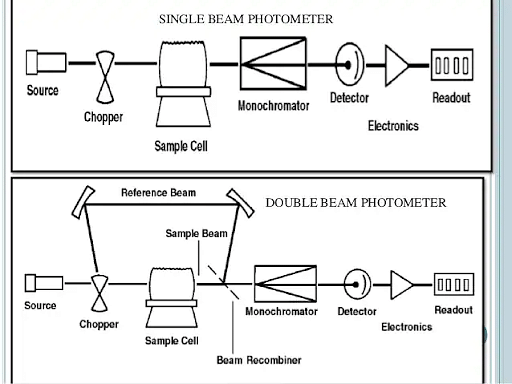
Single and Double Beam Photometer
Things to Remember
- Photometry refers to the science which deals with the measurement of the light’s intensity of brightness as can be perceived by our human eye.
- Our human eye reacts to light that is within distinct frequencies of 360-800 nm.
- The total amount of visible light that is emitted by a specific source per unit of time is known as Lumen.
- The object to be studied in differential photometry is observed in reference to the related comparison stars.
- In absolute photometry, the object is observed without comparing or relating it with other nearby stars.
- Luminosity function is referred to as the standard visual response of our eyes to different wavelengths.
- Photometry is primarily based on photopic vision and photopic responses which deal with light.
- A photometer refers to a device that is used for measuring the intensity of light in photometry.
- The photometric instruments measure the transmittance of light which refers to the ratio of the intensity of the emergent light to the intensity of the incident light.
T = Ie/Io
Also Read:
Previous Year Questions
- A concave lens of glass, refractive index 1.5 has both surfaces of same radius of curvature…? [JEE 1999]
- Two plano-concave lenses (1 and 2) of glass of refractive index 1.5 have radii of curvature…? [BITSAT 2017]
- A convex lens of glass is immersed in water compared to its power in air, its power…? [CBSE 2017]
- A concave mirror is placed on a horizontal table with its axis directed vertically upwards…? [JEE 1998]
- A convex lens ′A′ of focal length 20cm and a concave lens ′B′ of focal length…? [JIPMER 2021]
- Two thin biconvex lenses have focal lengths f1 and f2. A third thin … [KCET 2021]
- A thin convex lens is made of two materials with refractive indices n1 and n2, as shown…? [JEE 2019]
- Colour of light having maximum speed … [KCET 1997]
- A container is filled with water (μ = 1.33) up to a height of 33.25 cm. A concave mirror is placed…? [JEE 2005]
- A student performed the experiment of determination of focal length of a concave mirror by…? [KEAM 2009]
- The focal length of a spherical mirror made of steel is 150cm. If the temperature of the mirror…? [AP EAPCET 2009]
- A spherical surface of radius of curvature R, separates air … [NEET 1998]
- If in the following figure, height of object is H1=+2.5cm, then height of…? [DUET 2007]
- A lens of large focal length and large aperture is best suited as an objective … [NEET 2021]
Sample Questions
Ques. Write a brief note on Photometry. (3 marks)
Ans. Photometry refers to a branch of optics that discusses the intensity of light that is emitted by a source. Our human eye reacts to light that is within distinct frequencies of 360-800 nm. Photometry refers to the science which deals with the measurement of the light’s intensity of brightness as can be perceived by our human eye. It measures the visual response of our eyes to the light. The fundamental unit used to measure the intensity of brightness of light in photometry is the lumen. The total amount of visible light that is emitted by a specific source per unit of time is known as Lumen.
Ques. How does Photometry differentiate from Radiometry? (3 marks)
Ans. Photometry differs from radiometry as radiometry basically deals with predicting and measuring the levels of optical radiation. While radiometry is concerned with the electromagnetic radiation of all wavelengths and frequencies, photometry, on the other hand, deals with only that part of the spectrum of electromagnetic radiation that our eyes can perceive and that animates vision in our eyes.
Ques. What are the uses of photometers and photometry? (3 marks)
Ans. Photometers are used in various fields:
- In chemistry, photometry is used to study the properties of solutions and liquids. It observes the mass of inorganic and organic materials in a liquid.
- In astronomy, photometry is used to block specific wavelengths of light and allow other wavelengths of light to pass.
- The device also allows astrophysicists and scientists to observe and capture the images of various celestial bodies.
- Goniophotometers are used to observe or measure the luminance or contrast of the flat panel’s display over wide angles of an array.
Ques. List down the various photometric quantities. (3 marks)
Ans. The various photometric quantities are:
- Luminous Flux
- Radiant Flux
- Efficiency
- Luminous Intensity
- Illuminance
Ques. Describe what is a photometric test? (2 marks)
Ans. Photometric Test is a laboratory test that is used to analyze and measure the light distribution and light intensity. Various components of light in the spectrum distribution are observed like variations of color, emitted light’s spatial spreading, quantity, and the quality of light.
Ques. What is Transmittance? (2 marks)
Ans. The photometric instruments measure the transmittance of light which refers to the ratio of the intensity of the emergent light to the intensity of the incident light. It is expressed within a range of 0 to 100%. It can be denoted by:
T = Ie/Io
where T refers to the Transmittance of light,
Ie is the intensity of the transmitted or emergent light, and
Io refers to the intensity of the incident light
Ques. What occurs in differential photometry? (3 marks)
Ans. In differential photometry, the object to be studied is observed in reference to the related comparison stars. Both objects are measured and their values are noted and then compared in order to find out the difference between them. This difference in the count is further used to derive the difference in brightness of both the items. Hence, this deals with the relative measurement of the brightness of the object.
Ques. What are the two types of weighting functions? (2 marks)
Ans. Modern photometry deals with weighing the radiant power at each and every wavelength of light on the basis of sensitivity of brightness through a function of luminosity. The weighting function can be classified into two types:
- Photopic Sensitivity Function that pertains to dealing with light conditions.
- Scotopic Sensitivity Function that pertains to dealing with the dark conditions.
Ques. When was photometry discovered as a branch of modern science? (2 marks)
Ans. Photometry was made a part of modern science by Commission Internationale de l’Eclairage (CIE) in the year 1924. The commission also explained the average response of the human eye by experimenting with the light-adapted eyes on a group of people revealing a photopic curve through which it was observed that people in the experiment strongly responded to the green color while they were least sensitive to the color at the extremes of the spectrum such as violet and red.
Ques. How reading is measured in a single-beam photometer? (2 marks)
Ans. The reading is measured using the given formula:
Qa = (Qs x IQ)/IS
Where Qa refers to the unknown sample’s concentration,
QS is the concentration of the reference sample,
IQ is the unknown reading, and
IS is the reference reading.
For Latest Updates on Upcoming Board Exams, Click Here: https://t.me/class_10_12_board_updates
Check-Out:



Comments