




WBJEE preparation for 2027 starts with Mathematics. Mathematics carries 100 of the 200 marks, with 75 questions in 120 minutes in Paper 1. Physics and Chemistry carry 50 marks each, with 40 questions each, in a combined 2-hour Paper 2.
WBJEE is an offline, OMR-based exam with a 3-category marking scheme. Around 85% of the WBJEE syllabus overlaps with JEE Main. Cover additional topics retained in WBJEE.
- Master Electrodynamics as it accounts for approximately 25–30% of Physics. Revise Electrostatics, Current Electricity and Magnetism.
- Balance Chemistry Preparation by allocating time to Organic (35–40%), Inorganic (30–35%) and Physical Chemistry (30%).
- Practise Category 2 & 3 questions, as these offer 50 marks without negative marking. Practise multiple-correct questions and option elimination.
- Practise OMR-based tests, as the WBJEE exam is offline. Take full-length mocks to improve bubbling speed and accuracy.
- Solve 10–15 Years of PYQs: Identify recurring concepts, question patterns and frequently tested chapters. Prioritise NCERT Chemistry, Modern Physics, Semiconductors and Electromagnetic Waves.
- Choose WBJEE-Specific Books: Use S.N. Dey for Mathematics, H.C. Verma for Physics, N. Awasthi for Physical Chemistry and M.S. Chouhan for Organic Chemistry.
Related Links:
- WBJEE Question Paper (Available), Download Previous Years' Question Paper and Answer Key PDFs
- WBJEE Exam Pattern 2027: Total Questions, Marking Scheme, Syllabus, Weightage and Sample Papers
Key Summary
- Paper 1 is Mathematics (100 marks, 75 questions, 120 minutes). Paper 2 is Physics and Chemistry (100 marks, 80 questions, 120 minutes).
- Calculus is the heaviest Maths unit, at about 35–40%. Electrodynamics is the heaviest Physics unit, at about 25–30%. Organic Chemistry is the heaviest Chemistry branch, at about 35–40%.
- NCERT is the starting point, and it is not enough alone. Add S.N. Dey, N. Awasthi, M.S. Chouhan, and chapter-wise PYQs.
- 10 to 15 years of PYQs is the minimum. 25–30 full-length mocks suit top-college targets.
- Study time ranges from 1–2 months for JEE Main aspirants to 1.5–2 years for Class 11 students.
How to Prepare for WBJEE 2027 Along with JEE?
The core syllabus of WBJEE overlaps heavily with JEE Main. WBJEE covers Physics, Chemistry, and Mathematics, so pairing it with JEE is natural.
- Leverage JEE Preparation: Around 85% of the WBJEE syllabus overlaps with JEE. Cover additional Class 11–12 topics retained in WBJEE but removed from JEE Main.
- Prioritise Mathematics: It carries 100 of 200 marks. Focus on Calculus, Coordinate Geometry, Algebra, and Trigonometry.
- Adapt to WBJEE's Exam Pattern: Practise all three marking categories, attempt Category 2 and 3 questions strategically, and take full-length OMR-based mock tests to improve accuracy and time management.
| Feature | WBJEE 2027 | JEE Main 2027 |
|---|---|---|
| Subjects | Physics, Chemistry, Maths | Physics, Chemistry, Maths |
| Exam Mode | Offline (Pen & Paper / OMR) | Online (CBT) |
| Highest Weightage | Mathematics (50% of marks) | Equal across all 3 subjects |
| Negative Marking | Only in Category 1 (-1/4) | Yes (-1 for wrong answers) |
Ques. Can I prepare for WBJEE along with JEE Main?
Ans. Yes. JEE preparation covers about 85% of the WBJEE syllabus. Add the 3-category scheme, OMR practice, and the board topics JEE Main removed.
Ques. Can I prepare for WBJEE along with NEET?
Ans. Yes, if you have Mathematics in Class 12. Add 1.5 to 2 hours of daily Maths practice.
Check Out:
WBJEE Physics Preparation Tips 2027
WBJEE Physics carries 50 of 200 marks, with 40 questions. It is combined with Chemistry in Paper 2, which gives about 1.5 minutes per question.
- Class 12 topics make up 55% to 60% of the Physics paper. Many questions are direct formula applications or ask for the correct conceptual graph.
- Keep a pocket notebook of formulas, dimensional formulas, and standard relationships, such as E vs. r graphs.
- Paper 2 has 5 multiple-correct questions (2 marks each, no negative marking). Practise derivations and theoretical edge cases.
- Chemistry should take 45–50 minutes, which leaves 70–75 minutes for Physics.
| Unit / Topic | Expected Weightage | Key Areas to Master |
|---|---|---|
| Electrodynamics | ~25–30% | Electrostatics, Current Electricity (circuits & instruments), Capacitance, and Magnetic Effects of Current |
| Modern Physics | ~15–20% | Photoelectric Effect, Bohr's Model, Radioactivity, and Semiconductors (Logic Gates) |
| Mechanics | ~20–25% | Rotational Motion, Work-Energy-Power, Gravitation, and Laws of Motion |
| Optics & Waves | ~15% | Ray Optics (lenses, prisms), Wave Optics (YDSE), and Simple Harmonic Motion (SHM) |
| Heat & Thermodynamics | ~10% | Laws of Thermodynamics, Kinetic Theory of Gases (KTG), and Heat Transfer |
Ques. Which Physics unit has the highest weightage in WBJEE?
Ans. Electrodynamics, at about 25–30%, is the highest weightage topic in WBJEE.
Also Check:
WBJEE Chemistry Preparation Tips 2027
WBJEE Chemistry carries 50 of 200 marks, with 40 questions in Paper 2. It is considered the highest-scoring and fastest section in the exam.
- Organic Chemistry (35–40%): Prioritise GOC, Hydrocarbons, Carbonyl Compounds, Alcohols and Biomolecules. Memorise named reactions, reagents and acidity/basicity trends.
- Inorganic Chemistry (30–35%): Focus on Chemical Bonding, Coordination Compounds, p-Block and d- & f-Block elements. Revise NCERT exceptions, hybridisation, magnetic properties, and colour trends.
- Physical Chemistry (30%): Practise Chemical Kinetics, Electrochemistry, Thermodynamics, Solutions and Atomic Structure, focusing on numerical speed and accuracy.
- Practise 15 Years of PYQs: Identify repeated reaction mechanisms and direct factual questions. Check the latest WBJEEB syllabus for retained and deleted chapters.
| Chemistry Branch | Most Important Chapters | Target Solving Time (Paper 2) |
|---|---|---|
| Organic | GOC, Aldehydes/Ketones, Amines, Biomolecules | 18 – 20 Minutes |
| Inorganic | Chemical Bonding, Coordination Compounds, p-Block | 10 – 12 Minutes |
| Physical | Electrochemistry, Chemical Kinetics, Thermodynamics | 15 – 18 Minutes |
Ques. Is NCERT enough for WBJEE Chemistry?
Ans. NCERT is the primary resource for Inorganic and Organic Chemistry. Many direct 1-mark and 2-mark questions come from its lines, tables, and exceptions. Add N. Awasthi for Physical numericals and check the WBJEE syllabus for parts the new NCERT removed.
WBJEE Maths Preparation Tips 2027
WBJEE Mathematics carries 100 of 200 marks, with 75 questions in 120 minutes. It is the rank-decider for top colleges like Jadavpur University.
- Prioritise Geometry: Coordinate and 3D Geometry together account for nearly 60% of the Maths paper.
- Manage Time & Use Shortcuts: Allocate around 96 seconds per question. Use value substitution, option elimination and differentiation of options in Integration questions.
- Maximise Category 2 & 3 Scores: These include 25 questions worth 50 marks with no negative marking. Attempt all questions, while managing Category 1's negative marking (−0.25).
| Unit | Expected Weightage | High-Yield Chapters |
|---|---|---|
| Calculus | ~35–40% | Definite & Indefinite Integration, Differential Equations, Area Under Curves, Continuity & Differentiability, Maxima & Minima |
| Coordinate Geometry | ~20–25% | Straight Lines, Circles, Parabola, Ellipse, and Hyperbola |
| Algebra | ~25–30% | Matrices & Determinants, Quadratic Equations, Complex Numbers, Permutations & Combinations, Probability, Sequences & Series |
| Trigonometry & Vectors | ~10–15% | Inverse Trigonometric Functions, Trigonometric Equations, Vector Algebra, and 3D Geometry |
Ques. How to prepare for WBJEE Maths?
Ans. Start with Calculus and Coordinate Geometry. Use value substitution, keep a standard-results notebook, and solve 30–50 questions daily under time limits.
This YouTube video by the channel “Udan Bangla” discusses if it’s possible to get under 1000 rank in WBJEE 2027 in 6 months, how to prepare for WBJEE 2027 with limited time, and how to prioritize Physics, Chemistry, and Mathematics. It also discusses the importance of concepts, problem-solving, and PYQs, how to manage time, and avoid common preparation mistakes.
WBJEE Sample Paper 2027: Download PDF
| WBJEE Subject-wise Sample Paper | Sample Paper |
|---|---|
| WBJEE Mathematics Sample Paper | Download PDF |
| WBJEE Physics Sample Paper | Download PDF |
| WBJEE Chemistry Sample Paper | Download PDF |
How to Crack WBJEE in One Month?
To crack WBJEE in one month, prioritise high-weightage chapters, solve at least 10 years of PYQs, and practise full-length OMR-based mock tests instead of starting new, low-priority topics.
- Prioritise Calculus, Coordinate Geometry and Algebra in Mathematics; Chemical Bonding, GOC and Coordination Compounds in Chemistry; and Current Electricity, Modern Physics and Optics in Physics.
- Practise 10-Year PYQs: Solve chapter-wise and full-length WBJEE previous-year questions to identify repeated concepts, improve speed, and understand the three-category marking scheme.
- Practise Mathematics between 11 AM and 1 PM and Physics and Chemistry between 2 PM and 4 PM to build familiarity with the exam schedule.
| Phase | Days | Preparation Focus | Daily Target |
|---|---|---|---|
| High-Weightage Revision | Days 1–12 | Revise important chapters using short notes and formula sheets. | 2 chapters + 60–80 chapter-wise PYQs |
| PYQ Practice | Days 13–22 | Solve previous-year papers under timed exam conditions. | 1 full-length paper + 2 hours of mistake analysis |
| Mock Tests & Revision | Days 23–30 | Practise OMR-based mocks and revise formulas, reactions and weak topics. | 4–5 full-length mocks + daily revision |
Ques. How to crack WBJEE in 1 month?
Ans. The first month builds the foundation. Students already preparing for JEE Main need 1–2 months of dedicated adaptation. Students with clear Class 11–12 concepts need 3–4 months to cover the pattern and 15 years of PYQs.
WBJEE Question Paper with Solution PDF
| Paper | Question Paper PDF | Solution PDF |
|---|---|---|
| WBJEE 2026 Physics & Chemistry Question Paper | Download PDF | Check Here |
| WBJEE 2025 Physics & Chemistry | Download PDF | Check Here |
| WBJEE 2025 Physics | Download | Check Solutions |
Best Books for WBJEE Preparation 2027
The WBJEE preparation books list below covers all three subjects. Each subject has an NCERT base, one or two reference books, and a chapter-wise PYQ bank.
- NCERT is the base for Physics and Chemistry. It is essential for Modern Physics, Semiconductors, and Electromagnetic Waves, and non-negotiable for Inorganic and Organic Chemistry.
- S.N. Dey (Chhaya Prakashani) is the gold standard for WBJEE Maths. Many exam questions closely mirror its solved examples and MCQs.
- Every subject needs a chapter-wise PYQ bank from Arihant or MTG.
- Skip heavy JEE Advanced books for Maths. Board-level textbooks with WBJEE PYQs are enough.
| Subject | Book / Resource | How It Helps |
|---|---|---|
| Physics | NCERT Physics (Class 11 & 12) | Essential for Modern Physics, Semiconductors, Electromagnetic Waves, and conceptual graphs |
| Concepts of Physics by H.C. Verma (Vol 1 & 2) | Ideal for building conceptual clarity and practicing standard objective exercises | |
| Chapter-Wise WBJEE PYQ Bank | Mandatory for understanding the exact difficulty level and recurring question patterns from the past 10–15 years | |
| Chemistry | NCERT Chemistry (Class 11 & 12) | Non-negotiable primary resource, especially for Inorganic and Organic Chemistry |
| N. Awasthi (Physical Chemistry) | Best for practicing objective numericals at the JEE Main/WBJEE level | |
| M.S. Chouhan (Elementary Problems in Organic Chemistry) | Great for building speed in reaction mechanisms and conversions | |
| Chapter-Wise WBJEE Explorer / PYQ Book | Essential for benchmarking your accuracy against actual past-year questions | |
| Mathematics | NCERT Class 11 & 12 Mathematics | Build foundational concepts and solve all miscellaneous exercises first |
| Chhaya Prakashani (S.N. Dey) Class 11 & 12 | Widely considered the gold standard for WBJEE, as many exam questions closely mirror its solved examples and MCQs | |
| R.D. Sharma (Objective Mathematics) or Arihant Skills in Mathematics | Great for extra practice in Calculus and Coordinate Geometry | |
| 15–20 Years Chapter-Wise WBJEE PYQs | Mandatory for mastering WBJEE's specific question style and difficulty level |
Ques. Which are the best books for WBJEE preparation?
Ans. NCERT for all subjects, H.C. Verma for Physics, N. Awasthi and M.S. Chouhan for Chemistry, S.N. Dey for Maths, and chapter-wise PYQ banks from Arihant or MTG.
Is NCERT Enough for WBJEE Preparation?
NCERT is an essential starting point, especially for Chemistry. It is not enough alone to secure a top rank. WBJEE needs faster problem-solving, higher-level objective practice, and coverage of West Bengal (WBCHSE) board topics.
- NCERT vs WBJEE Pattern: NCERT focuses on subjective questions, while WBJEE tests objective, multiple-correct and shortcut-based problem-solving.
- Practise Advanced Maths Questions: Supplement NCERT with objective problems from Definite Integration, Coordinate Geometry and Algebra.
- New NCERT editions have deleted topics such as parts of p-Block, States of Matter and Mathematical Reasoning that may remain relevant to WBJEE.
- Read Chemistry NCERT Thoroughly: Focus on exceptions, tables, named reactions, graphs and important trends.
- Prioritise Selected Physics Chapters: Revise Semiconductors, Atoms, Nuclei and Electromagnetic Waves, including NCERT's Points to Ponder.
| Area | Gap in NCERT Alone | What to Add |
|---|---|---|
| Mathematics | Too few objective problems in Definite Integration, Coordinate Geometry, and Algebra | S.N. Dey, R.D. Sharma or Arihant Skills in Mathematics, and chapter-wise PYQs |
| Syllabus coverage | New NCERT deleted parts of p-Block, States of Matter, and Mathematical Reasoning | WBCHSE-aligned material and the official WBJEEB syllabus |
| Question style | Subjective proofs and derivations | Timed objective practice with elimination techniques |
| Chemistry | Physical Chemistry numericals are limited | N. Awasthi for numericals and M.S. Chouhan for Organic mechanisms |
| Physics | Graph and concept questions for Category 3 | NCERT "Points to Ponder" plus H.C. Verma |
Ques. Is NCERT enough for WBJEE preparation?
Ans. No. It is the starting point. Add objective practice books and 10 to 15 years of chapter-wise PYQs.
How Much Time Is Required for WBJEE Preparation?
6 to 12 months of focused study is generally enough for a top rank. The WBJEE syllabus aligns closely with Class 11 and 12 board curricula and with JEE Main. Students already preparing for boards or national exams need less separate preparation.
- With clear Class 11 and 12 NCERT concepts, the WBJEE pattern and 15 years of PYQs take 3 to 4 months.
- Starting from scratch needs at least 8 to 10 months.
- Maths speed needs extra time. Students who struggle with calculation speed need extra months for timed practice.
- Top branches at Jadavpur University need a top 100–500 rank, typically 120+ marks out of 200. That calls for a 1-year cycle with 25–30 full-length mock tests.
- Solid private or state government colleges need a shorter 4-to-6-month high-yield push.
- The dropper plan runs 6 to 8 months at 8 to 10 hours a day. The Class 12 plan runs 8 to 12 months at 4 to 6 hours a day.
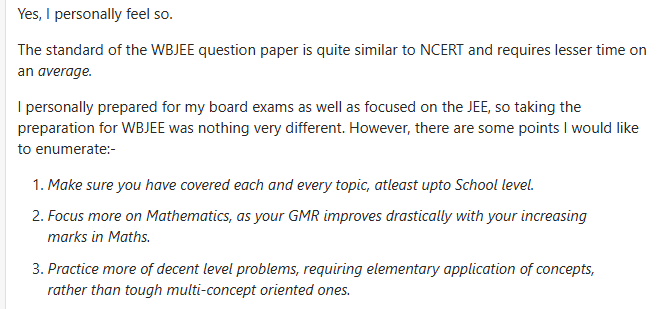
As per students on Quora, below are some tips for WBJEE preparation 2027:
- Start Early: Use a 10-month preparation timeline and practise NCERT-level questions to build speed and accuracy.
- Align Board & JEE Preparation: Cover board and JEE topics alongside WBJEE preparation.
- Complete the Syllabus: Study every WBJEE topic at least to the Class 11–12 board level.
- Prioritise Mathematics: Dedicate extra practice time to Maths to improve your GMR.
- Practise Basic Applications: Solve more elementary and moderate-level problems instead of spending excessive time on complex questions.

Source: Quora
WBJEE 2027: Questions Attempt Strategy
The attempt strategy follows the 3-category marking scheme and the no-calculator, OMR-based format. Categories 2 and 3 have zero negative marking, so blank answers there leave free marks.
- Category 1 is single-choice at +1 with -0.25. Attempt only when sure, or after eliminating 2 or more options.
- Category 2 is single-choice at +2 with no negative marking. Attempt every question. Use educated guesses if needed.
- Category 3 is one-or-more-than-one correct at +2 with partial marking and no negative marking. Attempt every question. Mark only confident options.
- Category 3 partial marking. Marking only correct options gives 2 × (correct options marked ÷ total correct options). One wrong option gives 0 marks. Never guess extra options.
| Category | Question Type | Marks per Question | Negative Marking | Attempt Rule |
|---|---|---|---|---|
| Category 1 | Single-choice MCQ | +1 Mark | -0.25 Marks | Attempt only if sure or after eliminating 2+ options |
| Category 2 | Single-choice MCQ | +2 Marks | No Negative | Attempt 100% of questions (use educated guesses if needed) |
| Category 3 | One-or-more-than-one correct | +2 Marks | No Negative | Attempt 100% of questions (mark only confident options) |
Ques. How should I attempt Category 3 questions in WBJEE?
Ans. Attempt all of them. Mark only the options you are confident about, since one wrong option gives 0 marks.
Ques. How many mock tests should I take for WBJEE?
Ans. 25–30 full-length mocks for top-college targets such as Jadavpur University, with OMR mocks in the final 3 to 4 weeks.
Ques. How do I use WBJEE chapter-wise PYQs?
Ans. Start chapter-wise PYQs in Week 3 alongside textbook exercises. Use Arihant or MTG chapter-wise banks. Solve 10 to 15 years at the minimum.
WBJEE Preparation Tracker: How to Track Your Progress
Track daily practice with three metrics. Track mock tests with five.
- Solve the last 10 years of PYQs under timed conditions. WBJEE repeats question concepts and patterns.
- Keep a formula notebook. Physics and Physical Chemistry have many direct, formula-based numericals.
- Daily question count: 40–50 Maths questions, 25–30 Physics numericals, and 30–35 Chemistry questions.
- Timed accuracy rate: (Correct Answers ÷ Total Attempted) × 100. Keep Category 1 accuracy above 85%.
- Time-per-question ratio: record how long a 30-question Maths set takes. Bring the average from 2.5 minutes per question to under 1.5.
- After every full-length OMR mock, spend 2 hours logging performance across the three categories.
- The score targets add up to 130–155+ out of 200. Paper 1 target is 65–80+ out of 100. Paper 2 target is 65–75+ out of 100.
WBJEE Preparation FAQs
Ques. How to prepare for WBJEE 2027?
Ans. Start with Mathematics, use NCERT plus objective practice books, solve 10 to 15 years of chapter-wise PYQs, and take full-length OMR mocks in the final 3 to 4 weeks.
Ques. What is the best WBJEE preparation strategy?
Ans. Give Maths the largest daily block, attempt all Category 2 and 3 questions, finish Chemistry in 45–50 minutes, and track accuracy after every mock.
Ques. Which is the best book for WBJEE preparation?
Ans. S.N. Dey (Chhaya Prakashani) for Maths, H.C. Verma for Physics, N. Awasthi and M.S. Chouhan for Chemistry, with NCERT as the base.
Ques. How to crack WBJEE in 1 month?
Ans. One month builds the foundation. Students with clear concepts need 3 to 4 months. JEE Main aspirants need 1 to 2 months of dedicated adaptation.
Ques. How much weightage does Maths have in WBJEE?
Ans. 50% of the marks, which is 100 out of 200, across 75 questions in 120 minutes.
Ques. How is WBJEE Chemistry weightage split?
Ans. Organic about 35–40%, Inorganic about 30–35%, and Physical about 30%.
Ques. What is the WBJEE Maths preparation order?
Ans. Calculus (35–40%), Algebra (25–30%), Coordinate Geometry (20–25%), then Trigonometry & Vectors (10–15%).
Ques. Is there negative marking in WBJEE?
Ans. Only in Category 1, at -0.25 per wrong answer. Categories 2 and 3 have none.
Ques. Can a PCB student appear for WBJEE?
Ans. A PCB-only student cannot apply for B.Tech courses. WBJEE scores are used for specific Pharmacy admissions.



Comments