



Education Journalist | Study Abroad Lead
Simple Microscope is typically a laboratory instrument used in various fields of science to see small objects which need to be studied in detail. It allows the investigation of objects and structures that are not clearly visible to the naked eye. It can be used to view objects having a size in the range of 0.4 – 0.7 µm. The image produced by the magnification process is a virtual one and cannot be projected on a screen like a real image.
Key Terms: Simple Microscope, Convex Lens, Double Convex Lens, Real Image, Compound Microscope, Virtual Image, Magnification process, Magnifying glass
What is a Simple Microscope?
[Click Here for Previous Year Questions]
Simple Microscope is a laboratory instrument used in various fields of science to see small objects which need to be studied in detail. The image produced by the magnification process is a virtual one and cannot be projected on a screen like a real image.
| “Simple Microscope is a scientific device used to magnify tiny things to be made visible to the naked eye.” |
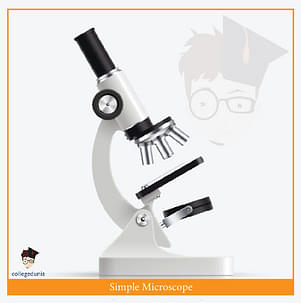
Antonie Van Leeuwenhoek, a Dutch scientist, invented the first simple microscope, consisting of a small single high-powered converging lens to inspect the small micro-organisms of freshwater. This was primarily designed based on a light microscope.
Convex lens used in a magnifying glass is the same principle through which a simple microscope works but when there is a requirement of higher magnification/magnifying power a compound microscope is used, which has two or more than two convex lenses. When an object is placed within the focal length of a convex lens, the image that is produced is virtual, erect, and enlarged, which enables viewing by the observers.
Also Read:
Parts of a Simple Microscope
[Click Here for Previous Year Questions]
A simple microscope is made up of various optical parts and supporting mechanical components. Some of these components are included here with their functions –
- Eyepiece: It is the lens that is used to study the samples and is placed at the top. It has a magnification of 10X to 15X.
- Base: It provides support to the whole microscope structure.
- Tube: It connects the eyepiece to the objective lenses.
- Objective lenses: It is used to precisely view the specimen/ object. These are colour-coded and are found with the magnification of 10X, 40X, and 100X. The shortest lens is the lower power lens while the longest lens is the higher power lens.
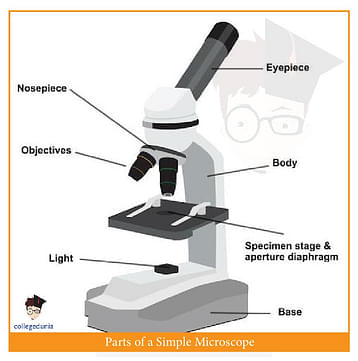
- Revolving Nose-piece: It is also known as the turret. This is used for holding other objective lenses and can be rotated according to the need while viewing any samples.
- Diaphragm: The amount of light that passes through the stage is controlled by the usage of the diaphragm.
- Specimen Stage: It is the platform used for placing the slides with samples.
- Stage Clip: These are used to hold the slides in the proper place and keep the sample steady for viewing.
- Coarse Adjustment Knob: It is used to focus on scanning.
- Fine Adjustment Knob: It is used to focus on oil.
- Arm: This connects and supports the tube to the base of the microscope.
- Power Switch: It is used to turn on or off the microscope.
- Condenser: It makes the light focus on the sample and 400X power lenses are used to zoom on the specimen to a much greater extent.
Magnification of a Simple Microscope
[Click Here for Sample Questions]
The magnifying power formula of a simple microscope is:
Where,
- D = Least Distance of the Distinct Vision
- F = Focal Length of the Convex Lens
Difference between Simple and Compound Microscope
[Click Here for Previous Year Questions]
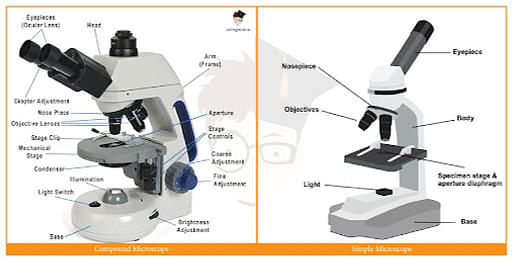
The difference between simple and compound microscope are:
| Simple Microscope | Compound Microscope |
|---|---|
| It comprises a single biconvex lens used as a magnifying glass. | It comprises 2 or more convex lenses where one lens is an eyepiece and the other one is the objective lens. |
| Natural light is used as the source to see the object. | Usually, an illuminator is used as a source to see the object. |
| It has a small hollow cylindrical knob attached to the base which is used to hold the microscope in position. | It has a curved knob that is used to hold the microscope in place. |
| Sometimes the condenser lens is not present. | The condenser lens which helps in allowing the appropriate intensity of the light is always present. |
| It has Non-adjusting magnification i.e. only one level of magnification is provided which depends on the lens used in the microscope. | It has Variable Magnification i.e. multiple levels of magnification are provided as it uses both the eyepieces and objectives. |
| It has one adjustment screw which focuses on the object by moving the limb up and down. | It has a multiple adjustment screw for the sharp and fine focus of the object. |
| The magnifying power is up to 300 times | The magnifying power is up to 2000 times |
| The mirrors are concave and the reflecting type is used. | The mirrors are plane on one side and concave on the other. |
| It is used for basic purposes. Examples – reading lens and magnifying glass. | It is used in advanced level micro-scoping such as for scientific research. Examples – to see the details of living microorganisms such as algae and fungi. |
Working of a Simple Microscope
[Click Here for Sample Questions]
Working principle of a simple microscope is that when an element or object is placed under it, then a virtual, erect and magnified image forms at the least distance of distinct vision.
Working of Simple Microscope
A convex lens of short focal length is used in the mechanism of a simple microscope. It is widely used in the field of Microbiology. Usually, light from the light source is made to pass through a thin and transparent object. To enhance an image the lens must be brought closer to the sample.
A contrast of the sample can also be obtained. At first, the sample is stained and then the size and intensity of the light beam are modified with the help of a condenser or the diaphragm to gain the desired results.
Simple Microscope Experiments
[Click Here for Previous Year Questions]
Aim: To make a simple microscope with the help of water.
Apparatus Required: A glass of water, fuse wire, and the object to be viewed.
Procedure: Make a loop with a wire of about 2 mm wide and dip it into the water. The drop formed within the loop must be held as close to the eye as possible to have a magnified image of the object.
Conclusion: This experiment is similar to the first experiments done with the help of tiny glass globules of water to view an object. The water droplet forms a shape of the convex lens that refracts the light and converges it to the point which makes the virtual image be seen clearly. Modern microscopes have grounded glass and multiple lenses in them. It helps us to observe even more minute particles than before.
Frequently Asked Questions Related to Simple MicroscopeQues. How does a Simple Microscope form an image? (1 mark) Ans. The working of simple microscope is based on the principle that when a tiny element or object is placed under it, then a virtual, erect, and magnified image of the object is seen to develop at the least distance of distinct vision from the eye held close to the lens. Ques. How many lenses does a Simple Microscope have? (1 mark) Ans. Simple microscope only has a single lens, which is also called a loupe. One of the major examples of it is reading or magnifying glass. |
Uses of Simple Microscope
[Click Here for Sample Questions]
A simple microscope has various uses. Some are listed below:
- Simple Microscope is used in pedology i.e., the study of soil particles.
- Simple Microscope is widely used in biology to study cells and other living microorganisms.
- Simple Microscope is used by jewellers in order to magnify the view of the fine parts of a piece.
- Simple Microscope is used by doctors to study a sample.
Also Read:
Previous Year Questions
- Rainbow is formed due to … [KCET 2004]
- A microscope is having objective of focal length … [KCET 2014]
- The refractive index of a particular material is … [KCET 2004]
- A fish looking up through the water sees the outside world contained in a circular horizon … [KCET 2003]
- An object approaches a convergent lens from the left of the lens … [KCET 2020]
- Which colour of the light has the longest wavelength … [NEET 2019]
- When a biconvex lens of glass having refractive index 1.47 … [NEET 2012]
- Ray optics is valid, when characteristic dimensions … [NEET 1994]
- In total internal reflection when the angle of incidence is equal to the critical angle … [NEET 2019]
- In an astronomical telescope in normal adjustment a straight black line … [NEET 2015]
- If the focal length of objective lens is increased … [NEET 2014]
- For a normal eye, the cornea of eye provides a converging power … [NEET 2013]
- Focal length of a convex lens of refractive index … [NEET 1988]
- Find the value of the angle of emergence from the prism … [NEET 2021]
- Assume that light of wavelength 600nm is coming from a star … [NEET 2020]
- An object is placed at a distance of 40 cm … [NEET 2018]
- An equiconvex lens has power P … [NEET 2019]
- You are asked to design a shaving mirror assuming … [JEE Mains 2015]
- What is the position and nature of image formed by lens combination … [JEE Mains 2019]
- Light is incident from a medium into air at two possible angles … [JEE Mains 2013]
Things to Remember
- A microscope is typically a laboratory instrument used to magnify tiny things to be made visible to the naked eye, which would have been invisible without the aid of a microscope.
- Condenser makes the light focus on the sample and 400X power lenses are used to zoom on the specimen to a much greater extent.
- The magnifying power formula of a simple microscope is M = 1 + D/F, where D is the least distance of the distinct vision and F is the focal length of the convex lens.
- The magnifying power is up to 300 times.
- One major difference between a simple microscope and a compound microscope is that a simple microscope has one adjustment screw. Whereas, a compound microscope has multiple adjustment screws.
- Widely used in the field of microbiology, a convex lens of short focal length is used in the mechanism of a simple microscope.
Sample Questions
Ques. How many types of microscopes are used? (2 marks)
Ans: Though the simple microscope is the most widely used apparatus in schools and laboratories, there are other microscopes such as the electron, ultraviolet, interference, scanning probe, fluorescence, and compound microscope.
Ques. Who discovered the first microscope? (1 mark)
Ans: A Dutch scientist named Antonie Van Leeuwenhoek invented the first simple microscope in history.
Ques. Who coined the term microscope? (1 mark)
Ans: Giovanni Faber coined the name microscope for the first time.
Ques. What led to the discovery of microscopes? (1 mark)
Ans: The discovery of cells by Robert Hooke and his publication led to a significant rise in interest in microorganisms. This resulted in the improvisation and discovery of the modern light microscope.
Ques. What is the first type of microscope to be popularized? (2 marks)
Ans: The optical microscope was the first instrument to be widely available and used to further our scientific understanding of biology. It uses lenses to refract visible light that passed through a thinly sectioned sample to produce an observable image.
Ques. Write two uses of a simple microscope. (1 mark)
Ans: Simple Microscopes are used by doctors for studying samples. It is also used in Pedology (study of soil particles)
Ques. What kind of Image does a magnifying glass form? (1 mark)
Ans: A magnifying glass forms a virtual image.
Ques. What is the working principle of a Simple Microscope? (5 marks)
Ans. Working principle of a simple microscope is that when an element or object is placed under it, then a virtual, erect and magnified image forms at the least distance of distinct vision. A convex lens of short focal length is used in the mechanism of a simple microscope.
Usually, light from the light source is made to pass through a thin and transparent object. To enhance an image the lens must be brought closer to the sample. A contrast of the sample can also be obtained. At first, the sample is stained and then the size and intensity of the light beam are modified with the help of a condenser or the diaphragm to gain the desired results. The magnifying power formula of a simple microscope is M = 1 + D/ F, where D is the least distance of the distinct vision and F is the focal length of the convex lens.
Ques. What is a Compound Microscope? (2 marks)
Ans. Compound microscope is a microscope that has multiple lenses. Compound Microscope has a combination of multiple lenses and two optical parts which are called the objective lens and eyepiece or ocular lens.
For Latest Updates on Upcoming Board Exams, Click Here: https://t.me/class_10_12_board_updates
Check-Out:



Comments