


What is the chemical name of water

Collegedunia Team logo

Collegedunia Team

Content Curator

The chemical name of water is "dihydrogen oxide". It consists of two hydrogen atoms and one oxygen atom, with the chemical formula H2O.

  • It is a colorless, tasteless, and odorless liquid.
  • It is a polar molecule with a partial positive charge on hydrogen atoms and a partial negative charge on oxygen atoms.
  • It is essential for life and is used for many biological processes.
  • It is a good solvent, meaning it dissolves many substances.
  • It has a high heat capacity and high surface tension.
  • It has a unique property of expanding when it freezes, which allows ice to float.
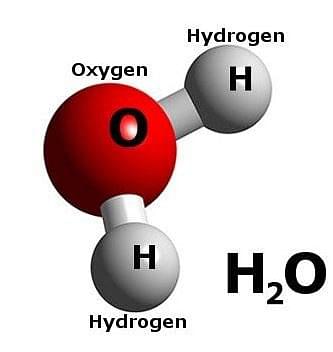
dihydrogen oxide

Dihydrogen Oxide

Check out:

CBSE CLASS XII Related Questions

  • 1.

    A reaction \( \mathrm{A \rightarrow B} \) follows second order kinetics. How will the rate of reaction be affected if the concentration of (i) A is increased by three times, and (ii) A is reduced to half ?


      • 2.
        Consider the decomposition of hydrogen peroxide \( (\mathrm{H_2O_2}) \) as per the equation given below : \[ 2\mathrm{H_2O_2} \xrightarrow[\text{Alkaline medium}]{I^-} 2\mathrm{H_2O} + \mathrm{O_2} \] The mechanism for this reaction was found to be : Step I : \( \mathrm{H_2O_2} + I^- \longrightarrow \mathrm{H_2O} + IO^- \) (slow) Step II : \( \mathrm{H_2O_2} + IO^- \longrightarrow \mathrm{H_2O} + I^- + \mathrm{O_2} \) (fast) (a) Write the rate law expression. (b) Determine the order of reaction with respect to \( \mathrm{H_2O_2} \), \( I^- \) and overall order of reaction. (c) What is the molecularity of the reaction in Step II ?


          • 3.

            Match Column I with Column II and choose the correct option :

            Column IColumn II
            a. Osmotic pressurei. \( \Delta \mathrm{T_f} = \mathrm{K_f}\,m \)
            b. Elevation of boiling pointii. \( \pi = CRT \)
            c. Depression of freezing pointiii. \( \frac{\mathrm{P_1^0 - P_1}}{\mathrm{P_1^0}} = \frac{\mathrm{W_2 \times M_1}}{\mathrm{M_2 \times W_1}} \)
            d. Relative lowering of vapour pressureiv. \( \Delta \mathrm{T_b} = \mathrm{K_b}\,m \)

              • a-i, b-ii, c-iii, d-iv
              • a-ii, b-i, c-iii, d-iv
              • a-iv, b-iii, c-ii, d-i
              • a-ii, b-iv, c-i, d-iii

            • 4.

              (a) Define 'Denatured Protein' with an example.

              (b) What happens when glucose reacts with HCN ? Write the reaction involved.

              (c) Name the disease caused by the deficiency of Vitamin C.


                • 5.

                  (i) Why do Zr and Hf exhibit similar properties ?

                  (ii) "\( E^\circ \) for \( \mathrm{Mn^{3+}/Mn^{2+}} \) couple is more positive than that for \( \mathrm{Fe^{3+}/Fe^{2+}} \)." Justify the statement.

                  [Atomic number : Mn = 25, Fe = 26]


                    • 6.

                      (a) Write two structural differences between DNA and RNA.

                      (b) Which component of starch is a branched chain polymer of \( \alpha \)-D-(+)-glucose ? Write its one characteristic feature.

                      (c) Which types of bonds hold the polypeptide chains in fibrous proteins ?

                        CBSE CLASS XII Previous Year Papers

                        Comments


                        No Comments To Show
