


What is the meaning of magnitude in physics?

Jasmine Grover logo

Jasmine Grover

Education Journalist | Study Abroad Lead

The magnitude of a quantity refers to a number that indicates how large or small the measurement of the quantity is as compared to a given reference value (mostly taken to be zero).

  • Magnitude in physics is simply understood as “quantity or distance”.
  • It denotes the absolute or relative direction or size in which a particular object moves.
  • A Magnitude is a quantitative number whereas intensity describes the idea of an impact. 
  • In physics, magnitude defines the size of an entity or an object’s speed when it is moving.
  • For example, if a car travels faster than an adjacent bike, the magnitude of the speed of the car is greater than the speed of the bike.
  • There are two types of quantity – vector quantity and scalar quantity. Magnitude is a common factor for both these quantities.
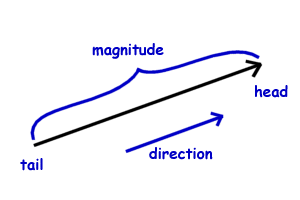
Magnitude in physics

In physics, the magnitude of a quantity gives us an idea of how large it is with respect to some reference value. In mathematics, a physical quantity is represented by a numerical value and a unit. 


Read More:

CBSE CLASS XII Related Questions

  • 1.
    Draw a circuit diagram of a full-wave rectifier using p-n junction diodes. Explain its working and show the input-output waveforms.


      • 2.
        Two thin lenses of focal length \( f_1 \) and \( f_2 \) are placed in contact with each other coaxially. Prove that the focal length \( f \) of the combination is given by \[ f = \frac{f_1 f_2}{f_1 + f_2}. \]


          • 3.
            Two small identical metallic balls having charges \( q \) and \( -2q \) are kept far at a separation \( r \). They are brought in contact and then separated at distance \( \frac{r}{2} \). Compared to the initial force \( F \), they will now:

              • attract with a force \( \frac{F}{2} \)
              • repel with a force \( \frac{F}{2} \)
              • repel with a force \( F \)
              • attract with a force \( F \)

            • 4.
              Two parallel plate capacitors X and Y are connected in series to a 6 V battery. They have the same plate area and same plate separation but capacitor X has air between its plates, whereas capacitor Y contains a material of dielectric constant 4. Calculate the capacitances of X and Y, if the equivalent capacitance of the combination of X and Y is \( 4 \, \mu\text{F} \). Calculate the potential difference across the plates of X and Y.


                • 5.
                  What is displacement current (\( i_d \))? Considering the case of charging of a capacitor, show that \( i_d = \varepsilon_0 \frac{d\Phi_E}{dt} \). What is the value of \( i_d \) for a conductor across which a constant voltage is applied?


                    • 6.
                      If both the number of protons and the neutrons are conserved in each nuclear reaction, in what way is mass converted into energy (or vice versa) in a nuclear reaction? Explain.

                        CBSE CLASS XII Previous Year Papers

                        Comments


                        No Comments To Show
