


Write the full form of CGS, FPS, MKS, and SI.

Jasmine Grover logo

Jasmine Grover

Education Journalist | Study Abroad Lead

Full forms of different standard systems:

CGS System

CGS stands for Centimeter-Gram-Second. It is a system of measurement in which the fundamental units are the centimetre for length, the gram for mass, and the second for time. This system is commonly used in the fields of physics, chemistry, and engineering.

FPS System

FPS stands for Foot-Pound-Second. It is a system of measurement in which the fundamental units are the foot for length, the pound for force or weight, and the second for time. This system is commonly used in the United States for engineering and physics applications, but it is less common internationally.
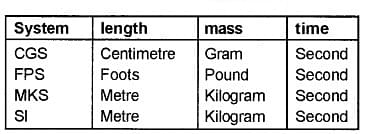
System of units

MKS System

MKS stands for Meter-Kilogram-Second. It is a system of measurement in which the fundamental units are the meter for length, the kilogram for mass, and the second for time. This system is commonly used in scientific and engineering applications, and it is the primary system of measurement used in most countries outside of the United States.

SI System

SI stands for International System of Units. It is the modern form of the metric system and is the most widely used system of measurement in the world. The SI system is based on the MKS system, but it has expanded to include additional units and prefixes for very large and very small quantities. The SI system is used in science, industry, and commerce, and it provides a standard for measurement that is consistent and internationally recognized.

Also Read: 

CBSE CLASS XII Related Questions

  • 1.
    If both the number of protons and the neutrons are conserved in each nuclear reaction, in what way is mass converted into energy (or vice versa) in a nuclear reaction? Explain.


      • 2.
        Two heaters rated as \((P_1,V)\) and \((P_2,V)\) are connected in series across a dc source of \(V/2\) volt. The power consumed by the combination will be –

          • \((P_1+P_2)\)
          • \(\dfrac{P_1+P_2}{2}\)
          • \(\dfrac{P_1P_2}{2(P_1+P_2)}\)
          • \(\dfrac{P_1P_2}{4(P_1+P_2)}\)

        • 3.
          Write any two features of nuclear forces.


            • 4.
              Draw a circuit diagram of a full-wave rectifier using p-n junction diodes. Explain its working and show the input-output waveforms.


                • 5.
                  The figure shows three point charges kept at the vertices of triangle ABC. The net electric field, due to this system of charges, at the midpoint M of base BC will be:

                    • \( \frac{q}{4 \pi \epsilon_0 l^2} \) pointing along MA
                    • \( \frac{q}{\pi \epsilon_0 l^2} \) pointing along AM
                    • \( \frac{q}{2 \pi \epsilon_0 l^2} \) pointing along AM
                    • Zero

                  • 6.
                    Draw the number of scattered particles versus the scattering angle graph for scattering of alpha particles by a thin foil. Write two important conclusions that can be drawn from this plot.

                      CBSE CLASS XII Previous Year Papers

                      Comments


                      No Comments To Show
