




The class 11 biology formula sheet chapter 2 biological classification gathers every key fact, group and defining feature tested in the CBSE Boards, NEET, CUET and other entrance exams. It maps the five-kingdom system of Whittaker, the traits of Monera, Protista and Fungi, and the acellular agents like viruses, viroids and prions so students can revise the whole chapter fast.
Biological Classification builds directly on the taxonomy terms from Chapter 1, and its five-kingdom framework is one of the most repeated topics in NEET Biology.
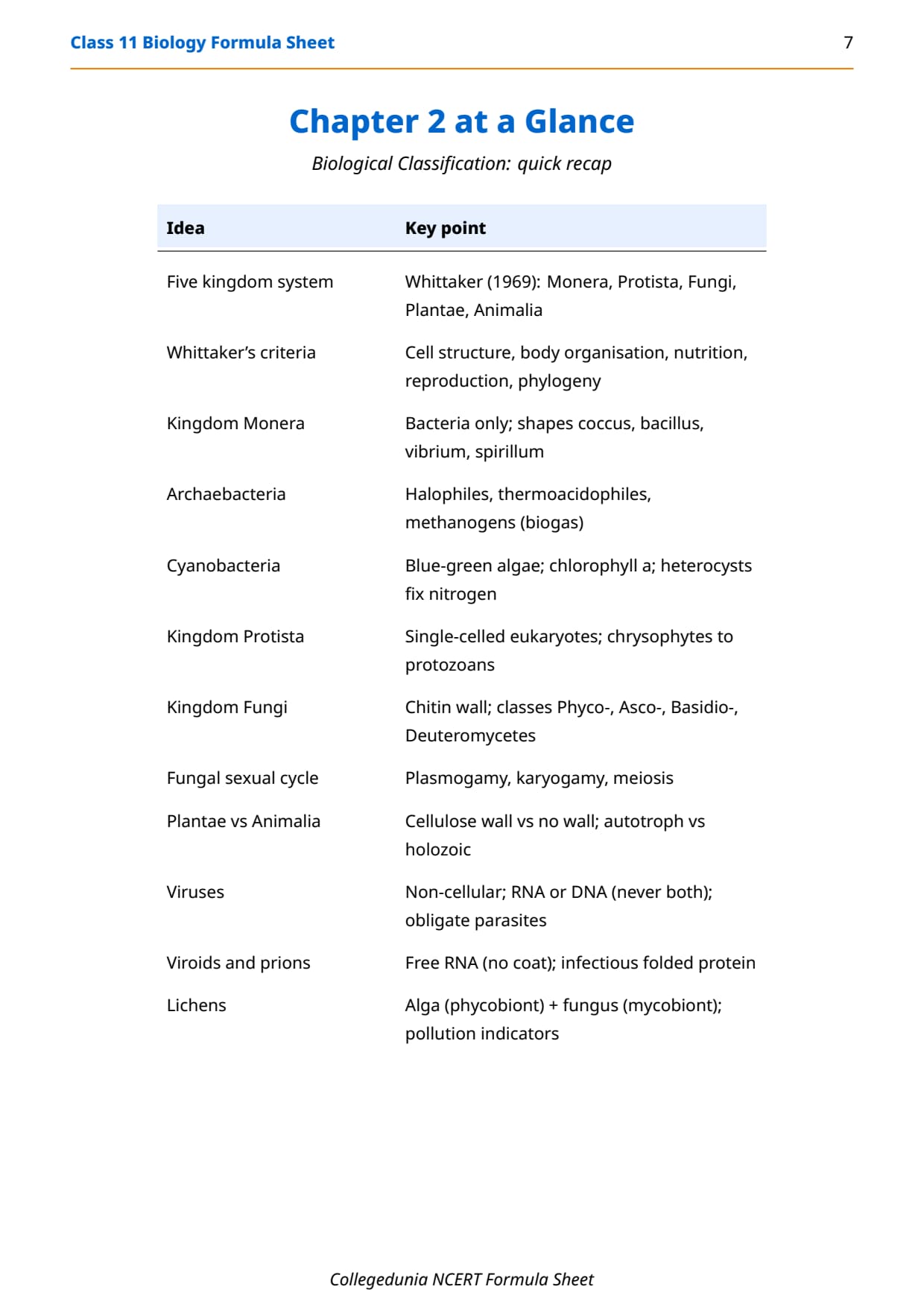
- Covers the five-kingdom classification of Whittaker (1969) and the five criteria behind it.
- Lists the key groups of Monera, Protista and Fungi with named examples and diseases.
- Summarises the acellular agents viruses, viroids and prions, plus lichens as a symbiosis.
This class 11 biology formula sheet chapter 2 biological classification is curated by subject experts and checked against the 2026-27 NCERT and recent CBSE and NEET papers.
The Five Kingdoms at a Glance
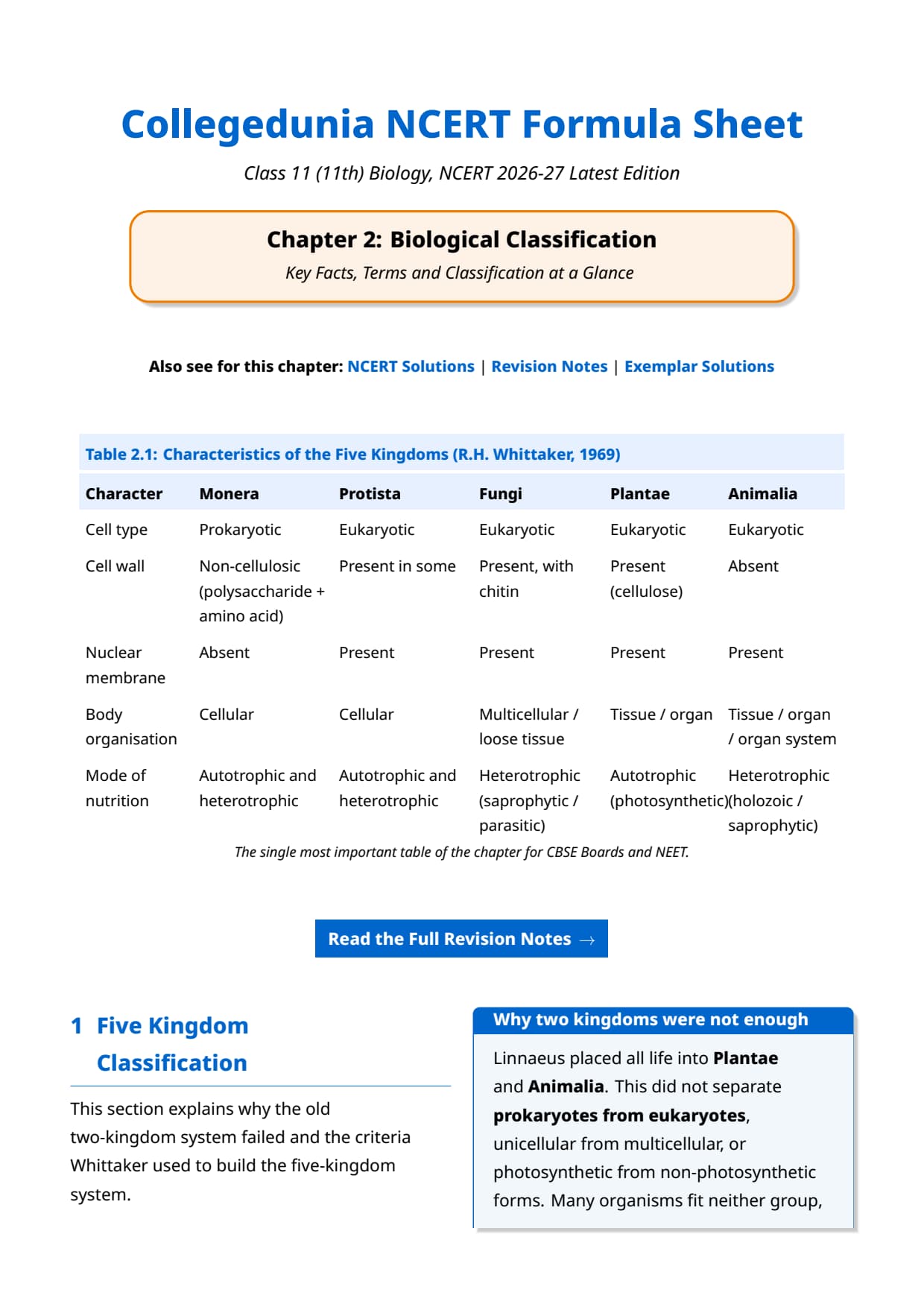
R.H. Whittaker proposed the five-kingdom system in 1969 using cell structure, body organisation, nutrition, reproduction and phylogeny. Learn this comparison row by row, since NEET and the Boards ask kingdom-level differences almost every year.
| Kingdom | Cell type | Cell wall | Nutrition | Examples |
|---|---|---|---|---|
| Monera | Prokaryotic | Non-cellulosic (polysaccharide + amino acid) | Autotrophic and heterotrophic | Bacteria, Nostoc, Anabaena, Mycoplasma |
| Protista | Eukaryotic | Present in some | Autotrophic and heterotrophic | Diatoms, Euglena, Amoeba, Paramoecium |
| Fungi | Eukaryotic | Present, with chitin | Heterotrophic (saprophytic / parasitic) | Rhizopus, Penicillium, Agaricus |
| Plantae | Eukaryotic | Present (cellulose) | Autotrophic (photosynthetic) | Algae, mosses, ferns, angiosperms |
| Animalia | Eukaryotic | Absent | Heterotrophic (holozoic / saprophytic) | Sponges, insects, fishes, mammals |
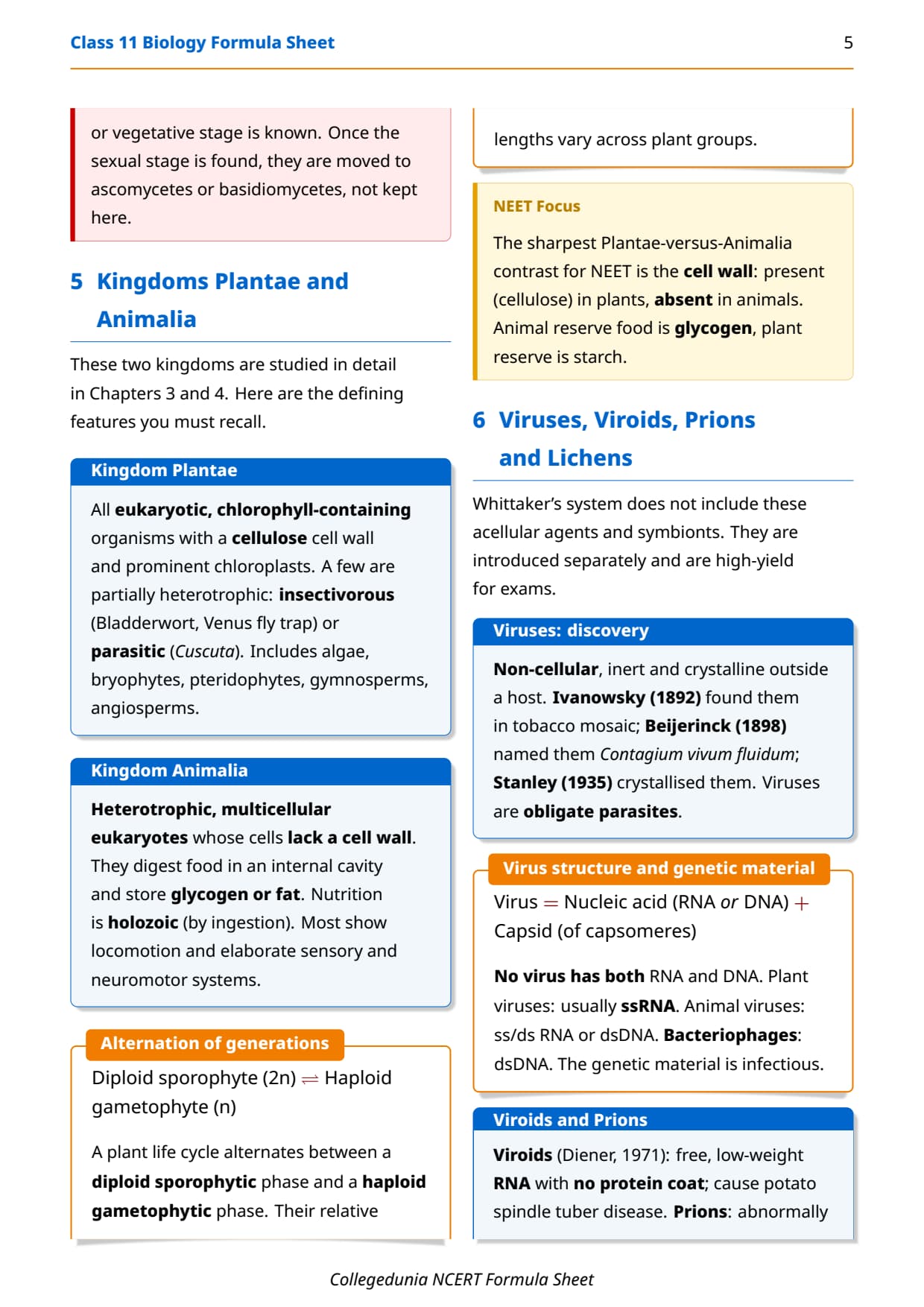
The single sharpest exam contrast is the cell wall: cellulose in Plantae and absent in Animalia, while Fungi have a chitin wall and Monera a non-cellulosic one.
Kingdoms Monera, Protista and Fungi
These three kingdoms hold the microbes and lower eukaryotes, and their named groups are the highest-yield part of the chapter. The table below fixes each group with its key feature and example.
| Group | Key feature | Example |
|---|---|---|
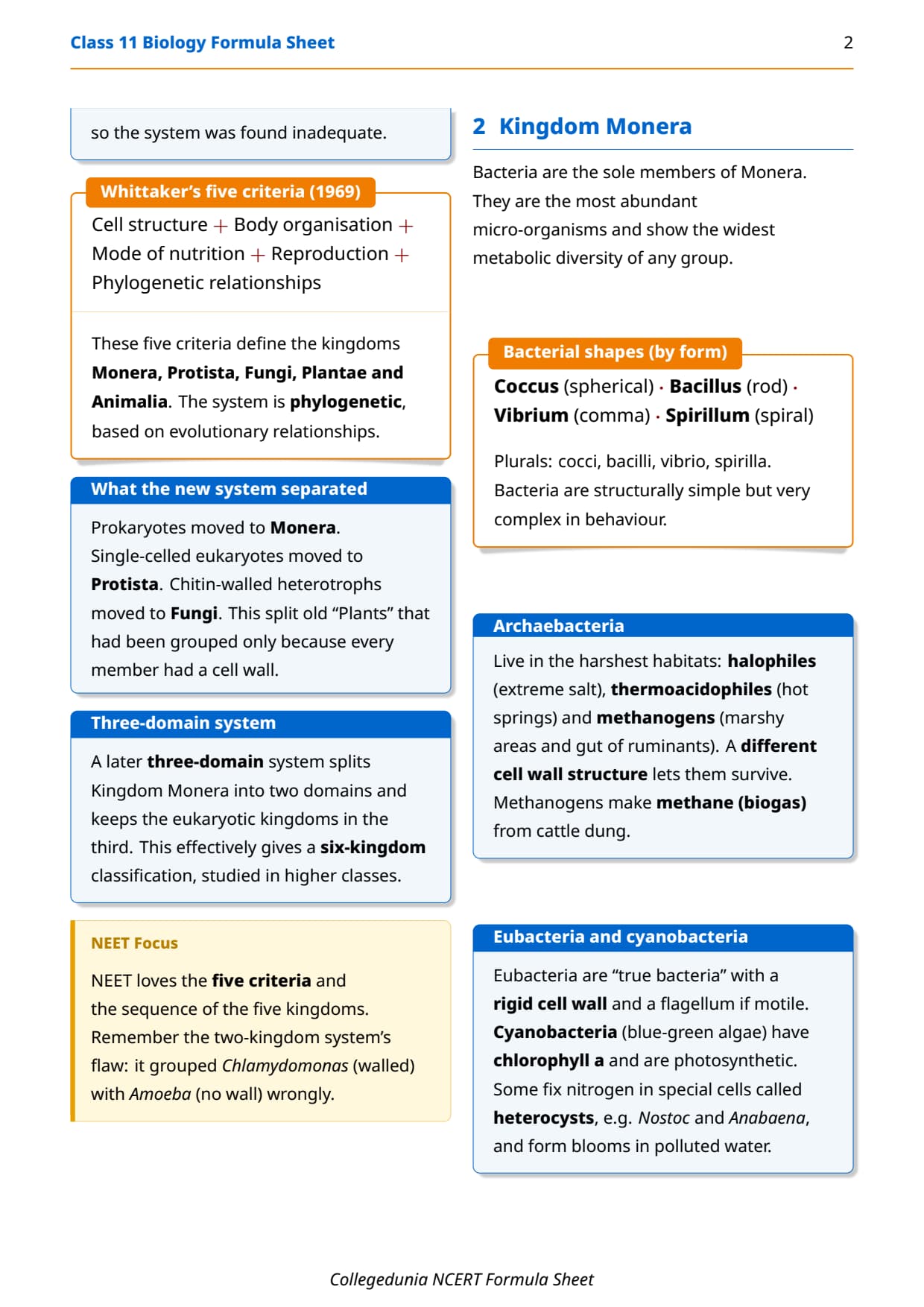
| Bacterial shapes (Monera) | Coccus (spherical), bacillus (rod), vibrium (comma), spirillum (spiral) | Wide metabolic diversity |
| Archaebacteria | Live in extreme habitats; different cell wall; methanogens make biogas | Halophiles, thermoacidophiles, methanogens |
| Cyanobacteria | Blue-green algae with chlorophyll a; heterocysts fix nitrogen | Nostoc, Anabaena |
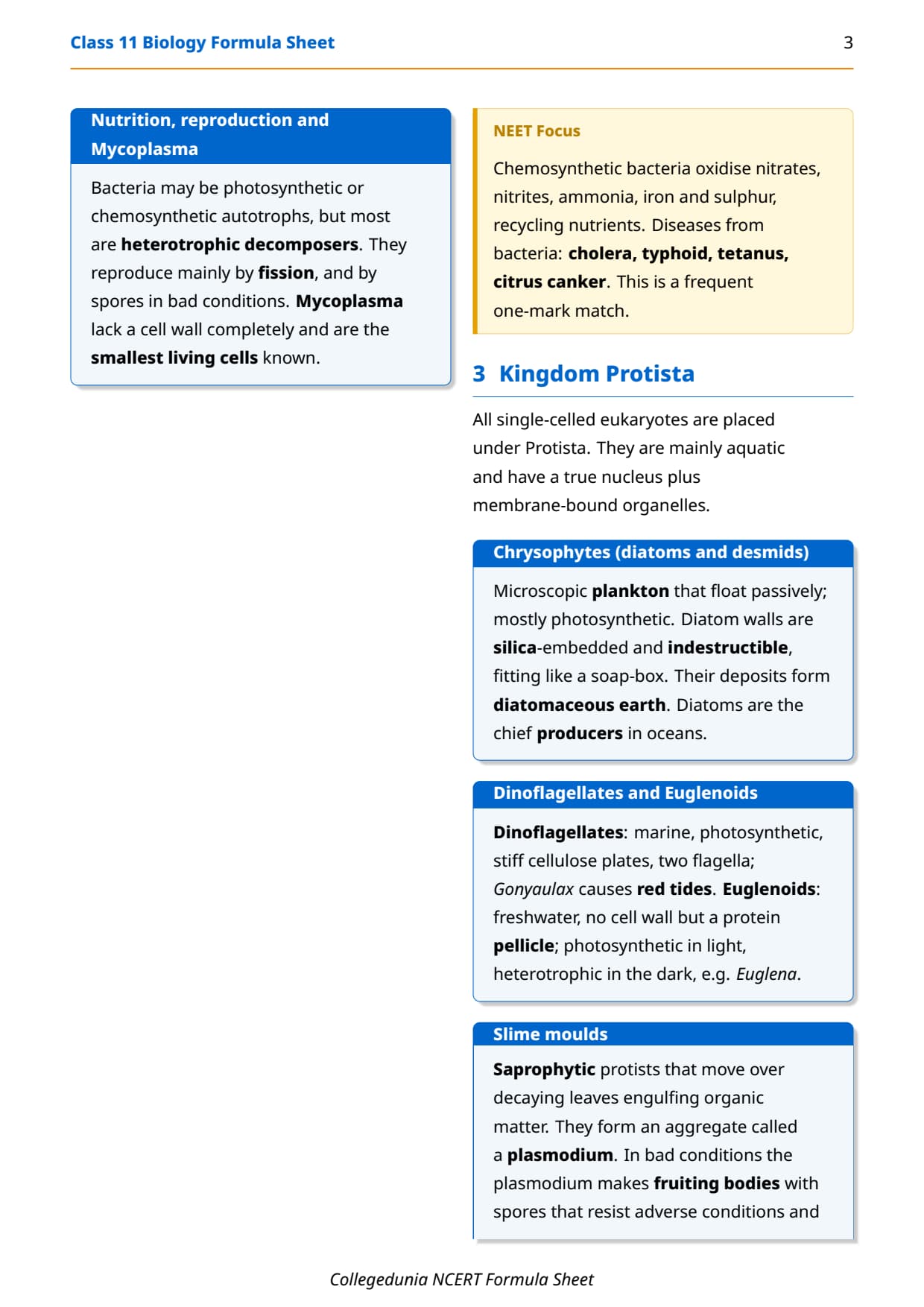
| Chrysophytes (Protista) | Diatoms with indestructible silica walls; chief ocean producers | Diatoms, desmids |
| Dinoflagellates and Euglenoids | Cellulose plates causing red tides; euglenoids have a protein pellicle | Gonyaulax, Euglena |
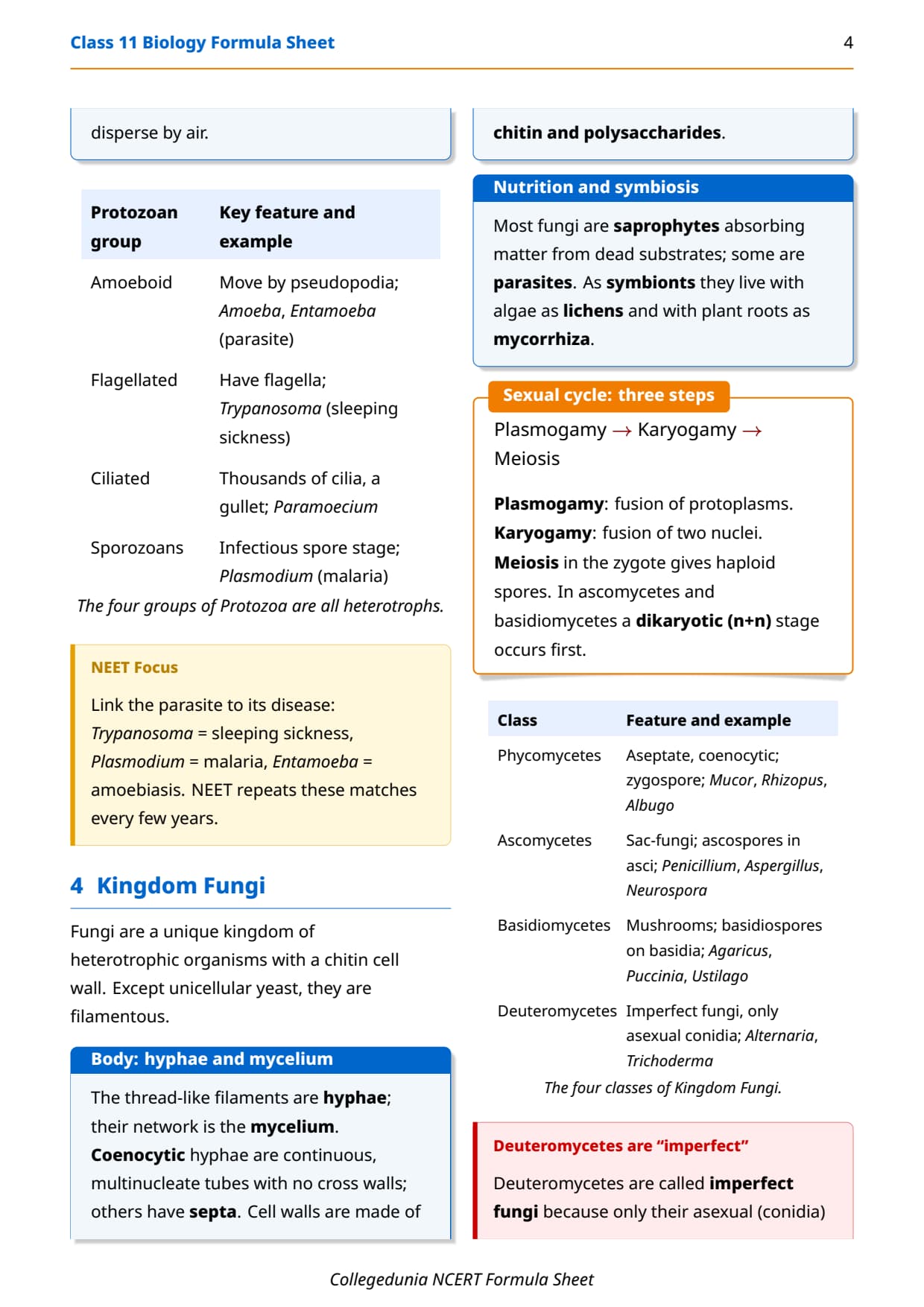
| Protozoa | Amoeboid, flagellated, ciliated and sporozoan heterotrophs | Amoeba, Trypanosoma, Paramoecium, Plasmodium |
| Phycomycetes (Fungi) | Aseptate, coenocytic hyphae; zygospores | Mucor, Rhizopus, Albugo |
| Ascomycetes | Sac-fungi; ascospores borne in asci | Penicillium, Aspergillus, Neurospora |
| Basidiomycetes | Mushrooms; basidiospores on basidia | Agaricus, Puccinia, Ustilago |
| Deuteromycetes | Imperfect fungi; only asexual conidia known | Alternaria, Trichoderma |
The fungal sexual cycle runs plasmogamy → karyogamy → meiosis, and link each protozoan parasite to its disease: Trypanosoma to sleeping sickness, Plasmodium to malaria and Entamoeba to amoebiasis.
Viruses, Viroids, Prions and Lichens
Whittaker's system leaves out these acellular agents and symbionts, so NCERT introduces them separately. They are high-yield for both the Boards and NEET, especially as match-the-column and assertion-reason items.
| Agent | Nature | Key fact |
|---|---|---|
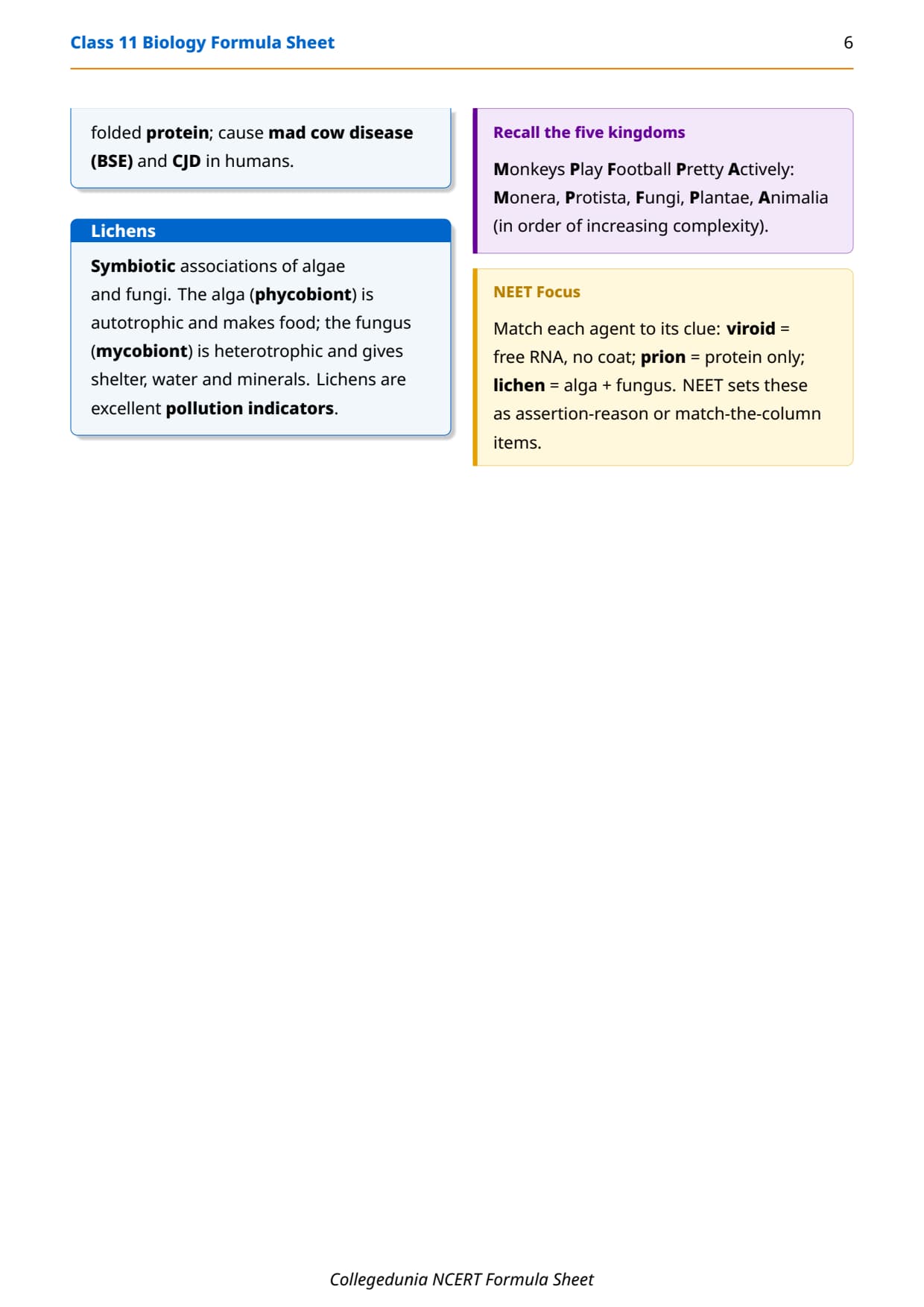
| Viruses | Non-cellular; nucleic acid + protein capsid | Carry RNA or DNA, never both; obligate parasites. Named by Beijerinck; crystallised by Stanley (1935) |
| Viroids | Free low-weight RNA with no protein coat | Discovered by Diener (1971); cause potato spindle tuber disease |
| Prions | Abnormally folded protein only | Cause mad cow disease (BSE) and CJD in humans |
| Lichens | Symbiosis of alga and fungus | Alga (phycobiont) makes food; fungus (mycobiont) gives shelter; excellent pollution indicators |
Remember that bacteriophages carry double-stranded DNA while most plant viruses carry single-stranded RNA, and that the genetic material of a virus is itself infectious.
How to Revise Biological Classification Before the Exam
This chapter rewards clean group names and examples more than long answers. A short, ordered revision fixes the classification in memory before the exam.
- Write the five kingdoms in order and place a named example under each, using the mnemonic Monkeys Play Football Pretty Actively.
- Memorise Whittaker's five criteria and why the old two-kingdom system failed.
- Match each protozoan and fungal example to its group, disease or product.
- Learn the acellular agents: viroid is free RNA with no coat, prion is protein only, and a lichen is alga plus fungus.
Student Feedback on the Biological Classification Formula Sheet
In a survey of 1,150 NEET aspirants who used this sheet, 84% said the single-page five-kingdom table made the differences easy to recall under time pressure. Toppers reported that revising the protozoan and fungal example tables twice a week turned the match-the-column questions into guaranteed marks.
Other Biological Classification Class 11 Biology Resources
Pair this formula sheet with the solved answers, notes and textbook PDF for the same chapter.
| Resource | Link |
|---|---|
| NCERT Solutions | Biological Classification Class 11 NCERT Solutions |
| Revision Notes | Biological Classification Class 11 Notes |
| NCERT Book PDF | Biological Classification Class 11 Book PDF |
NCERT Formula Sheet for Class 11 Biology: All Chapters
Revise every chapter from one place. Each link opens the formula sheet for that chapter.
| Chapter | Formula Sheet |
|---|---|
| Chapter 1 | The Living World |
| Chapter 2 | Biological Classification |
| Chapter 3 | Plant Kingdom |
| Chapter 4 | Animal Kingdom |
| Chapter 5 | Morphology of Flowering Plants |
| Chapter 6 | Anatomy of Flowering Plants |
| Chapter 7 | Structural Organisation in Animals |
| Chapter 8 | Cell: The Unit of Life |
| Chapter 9 | Biomolecules |
| Chapter 10 | Cell Cycle and Cell Division |
| Chapter 11 | Photosynthesis in Higher Plants |
| Chapter 12 | Respiration in Plants |
| Chapter 13 | Plant Growth and Development |
| Chapter 14 | Breathing and Exchange of Gases |
| Chapter 15 | Body Fluids and Circulation |
| Chapter 16 | Excretory Products and their Elimination |
| Chapter 17 | Locomotion and Movement |
| Chapter 18 | Neural Control and Coordination |
| Chapter 19 | Chemical Coordination and Integration |
FAQs on Biological Classification Class 11 Biology Formula Sheet
Biological Classification Formula Sheet - Frequently Asked Questions
Ques. What does the class 11 biology formula sheet chapter 2 biological classification cover?
Ans. This class 11 biology formula sheet chapter 2 biological classification covers Whittaker's five-kingdom system and its five criteria, the key groups of Monera, Protista and Fungi with named examples and diseases, and the acellular agents viruses, viroids and prions along with lichens as a symbiosis.
Ques. What are the five kingdoms proposed by Whittaker?
Ans. R.H. Whittaker proposed the five kingdoms Monera, Protista, Fungi, Plantae and Animalia in 1969. He classified organisms using cell structure, body organisation, mode of nutrition, reproduction and phylogenetic relationships, arranging the kingdoms in order of increasing complexity.
Ques. How are viruses, viroids and prions different?
Ans. A virus is made of nucleic acid, either RNA or DNA but never both, wrapped in a protein capsid, and is an obligate parasite. A viroid is a free, low-weight RNA molecule with no protein coat that causes potato spindle tuber disease. A prion is an abnormally folded protein that causes mad cow disease and CJD.
Ques. What is the difference between Plantae and Animalia cell walls?
Ans. Kingdom Plantae contains eukaryotic, photosynthetic organisms with a cellulose cell wall, whereas Kingdom Animalia contains heterotrophic, multicellular eukaryotes whose cells lack a cell wall. Plant reserve food is starch while the animal reserve is glycogen, and this cell wall contrast is a frequent NEET question.



Comments