




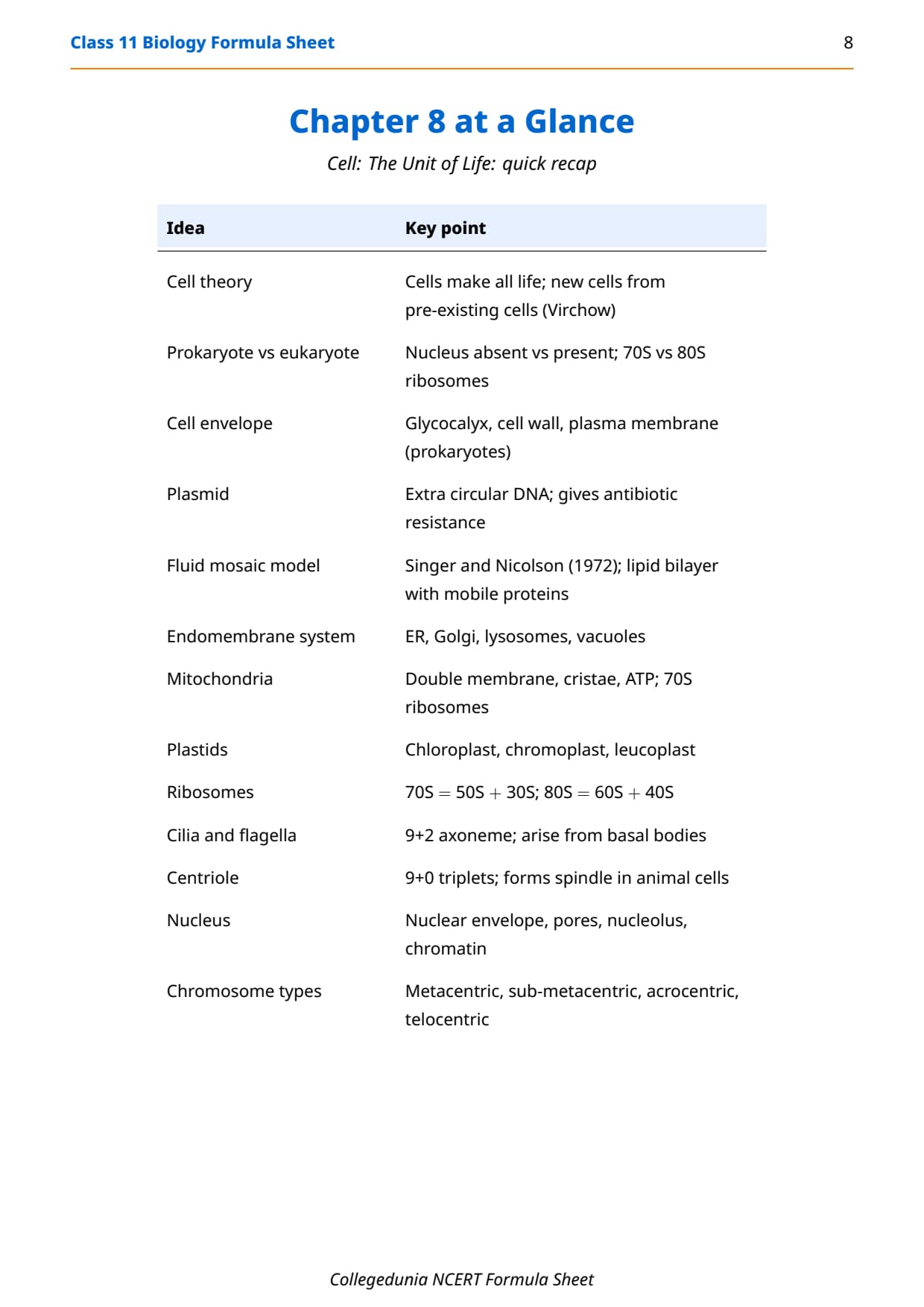
The class 11 biology formula sheet chapter 8 cell the unit of life gathers every key fact, structure and function tested in the CBSE Boards, NEET, CUET and other entrance exams. It lists cell theory, the prokaryotic and eukaryotic cell types, the organelles and their jobs, and the ribosome S values so students can revise the whole chapter fast.
Cell: The Unit of Life is one of the most heavily weighted chapters in Class 11 Biology, and its organelle facts return in nearly every NEET paper.
- Compares the prokaryotic and eukaryotic cell, with 70S and 80S ribosomes as the classic exam point.
- Lists every cell organelle and its function, from the nucleus to the mitochondria and plastids.
- Sets out the plant cell versus animal cell differences that fetch full marks in board answers.
This class 11 biology formula sheet chapter 8 cell the unit of life is curated by subject experts and checked against the 2026-27 NCERT and recent CBSE and NEET papers.
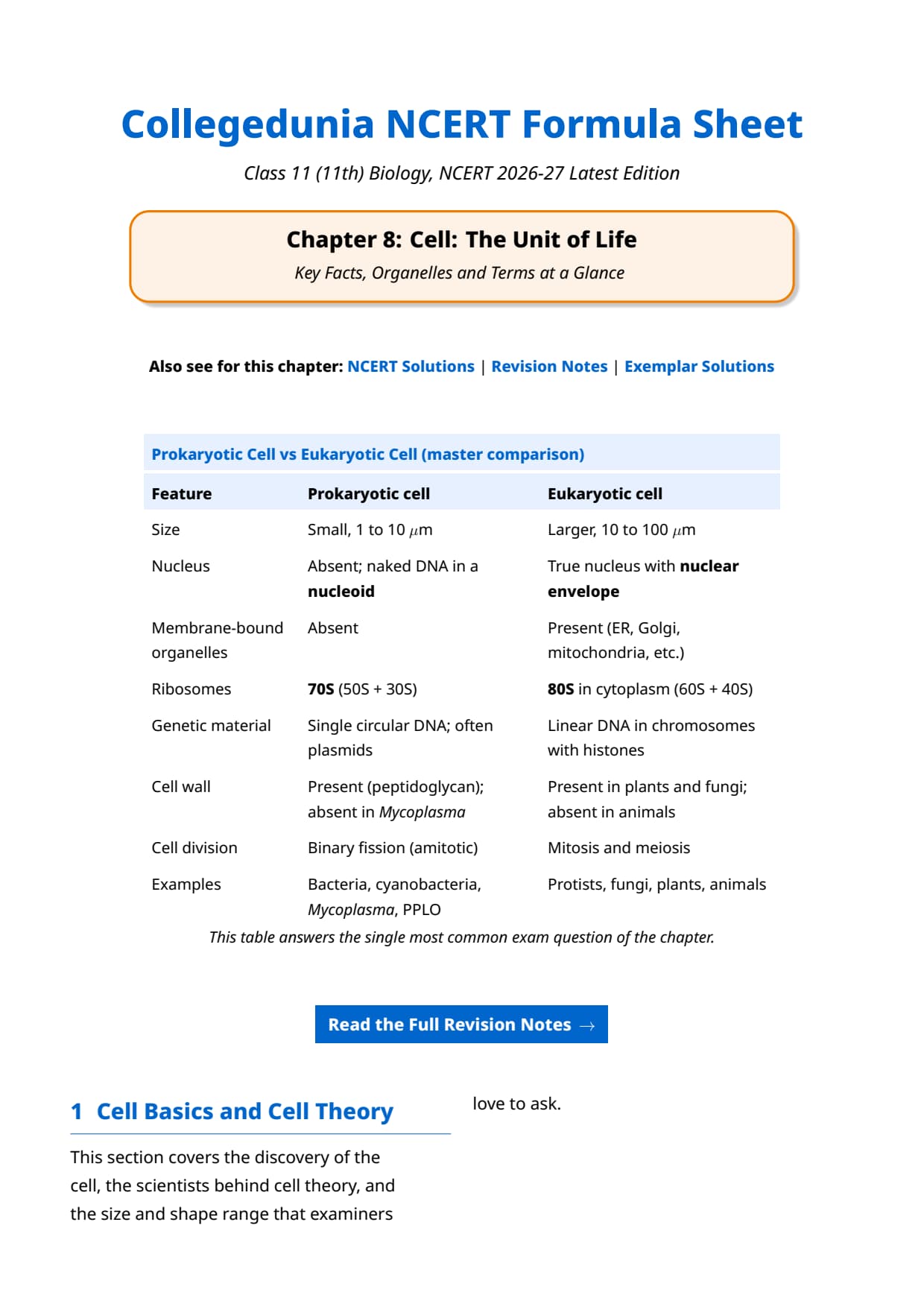
Prokaryotic vs Eukaryotic Cell at a Glance
The difference between the two great cell types is the single most common question of this chapter. Learn the ribosome and nucleus rows by heart, since NEET asks them almost every year.
| Feature | Prokaryotic cell | Eukaryotic cell |
|---|---|---|
| Size | Small, 1 to 10 µm | Larger, 10 to 100 µm |
| Nucleus | Absent; naked DNA in a nucleoid | True nucleus with a nuclear envelope |
| Cell wall | Present (peptidoglycan); absent in Mycoplasma | Present in plants and fungi; absent in animals |
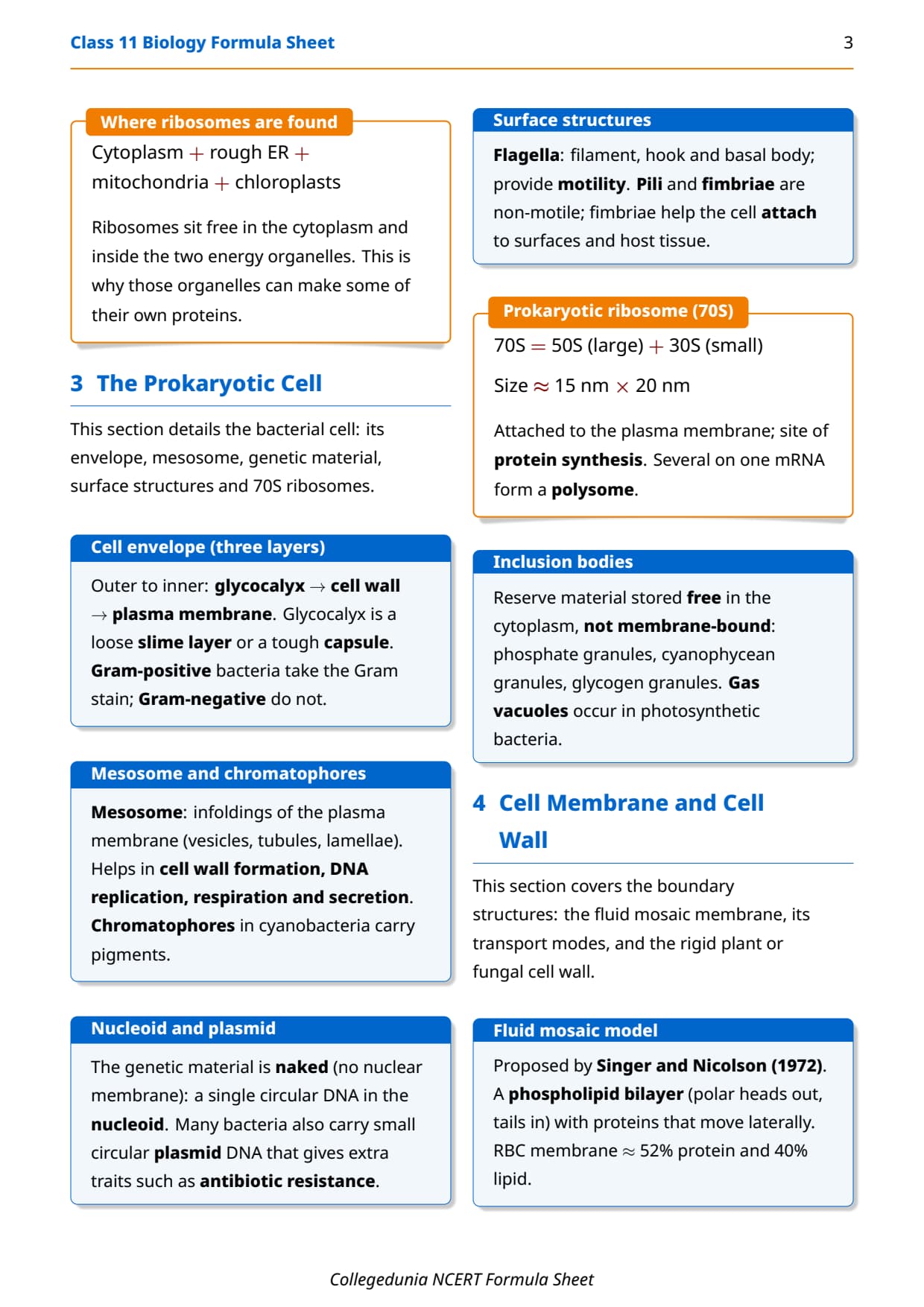
| Ribosomes | 70S (50S + 30S) | 80S in cytoplasm (60S + 40S) |
| Examples | Bacteria, cyanobacteria, Mycoplasma, PPLO | Protists, fungi, plants, animals |
Both cell types share a plasma membrane, cytoplasm and ribosomes; only the eukaryotic cell has a membrane-bound nucleus and membrane-bound organelles.
Cell Organelles and Their Functions
Each organelle has one headline function that examiners test. Match every organelle to its job, since one-mark and assertion-reason questions in the Boards and NEET are built directly from this table.
| Organelle | Function |
|---|---|
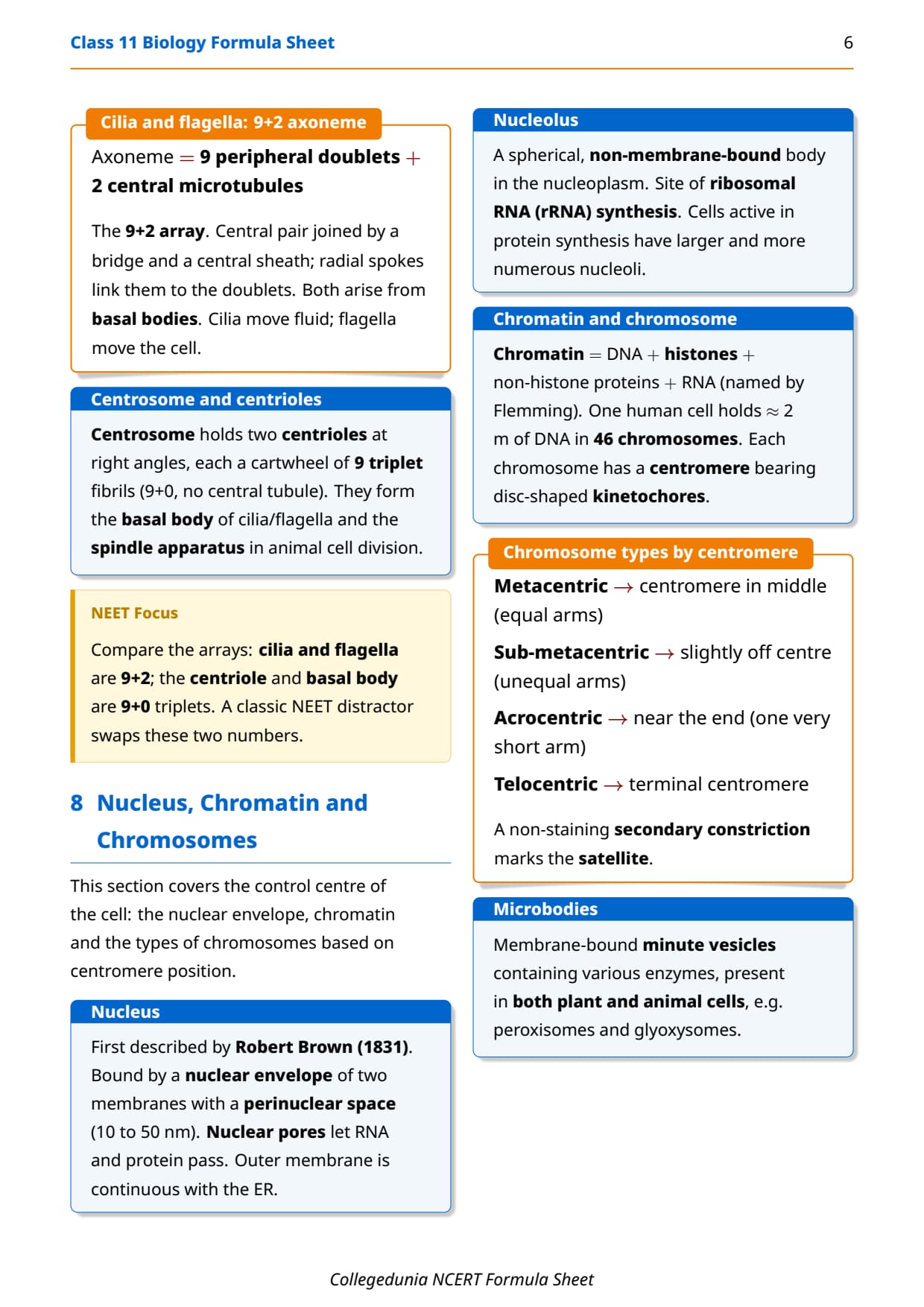
| Nucleus | Control centre; holds chromatin (DNA) and directs cell activity through the nuclear envelope and pores |
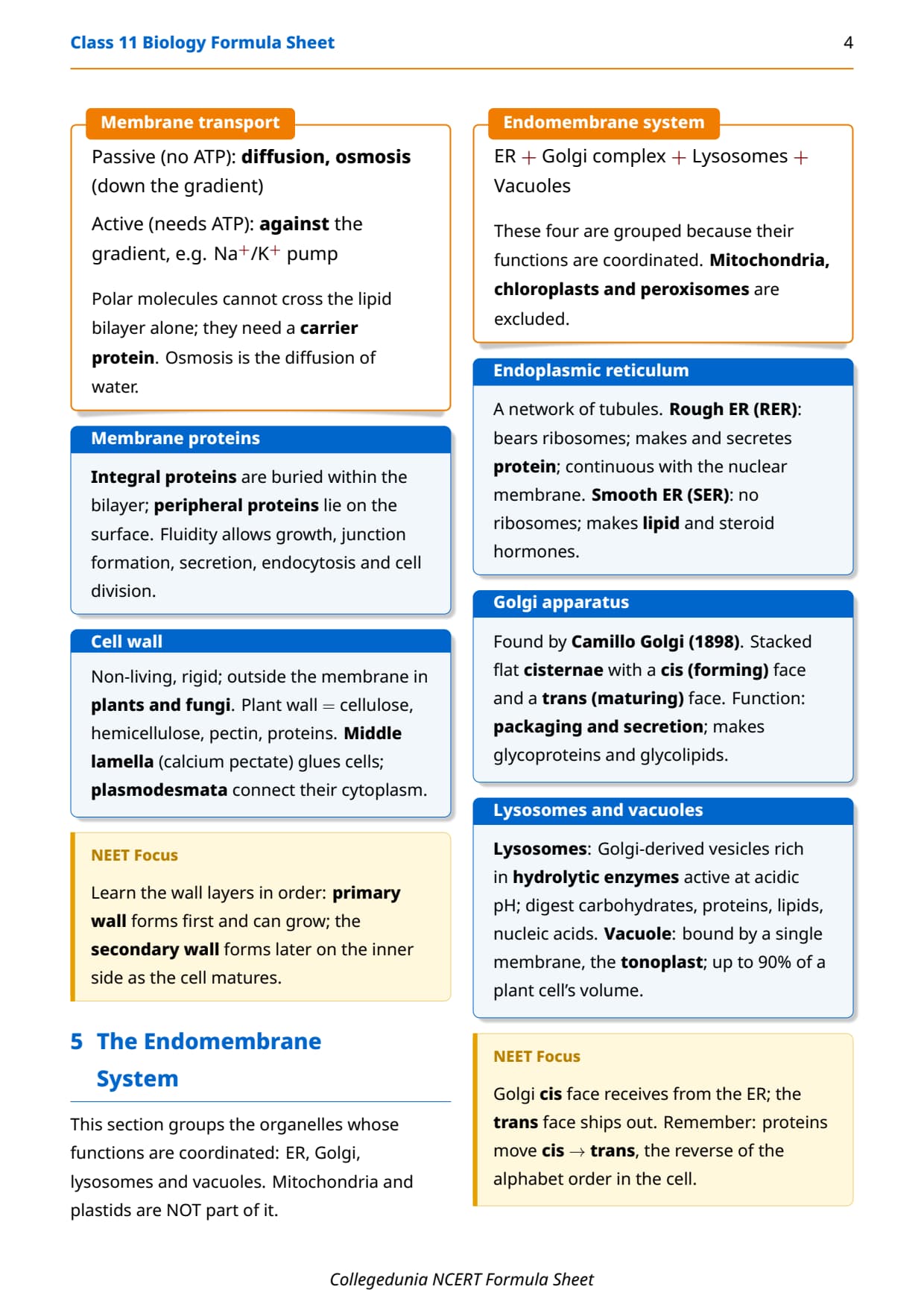
| Endoplasmic reticulum | Rough ER makes and secretes protein; smooth ER makes lipid and steroid hormones |
| Golgi apparatus | Packaging and secretion; makes glycoproteins and glycolipids, moving material from the cis to the trans face |
| Lysosome | Golgi-derived vesicle rich in hydrolytic enzymes that digest carbohydrates, proteins, lipids and nucleic acids |
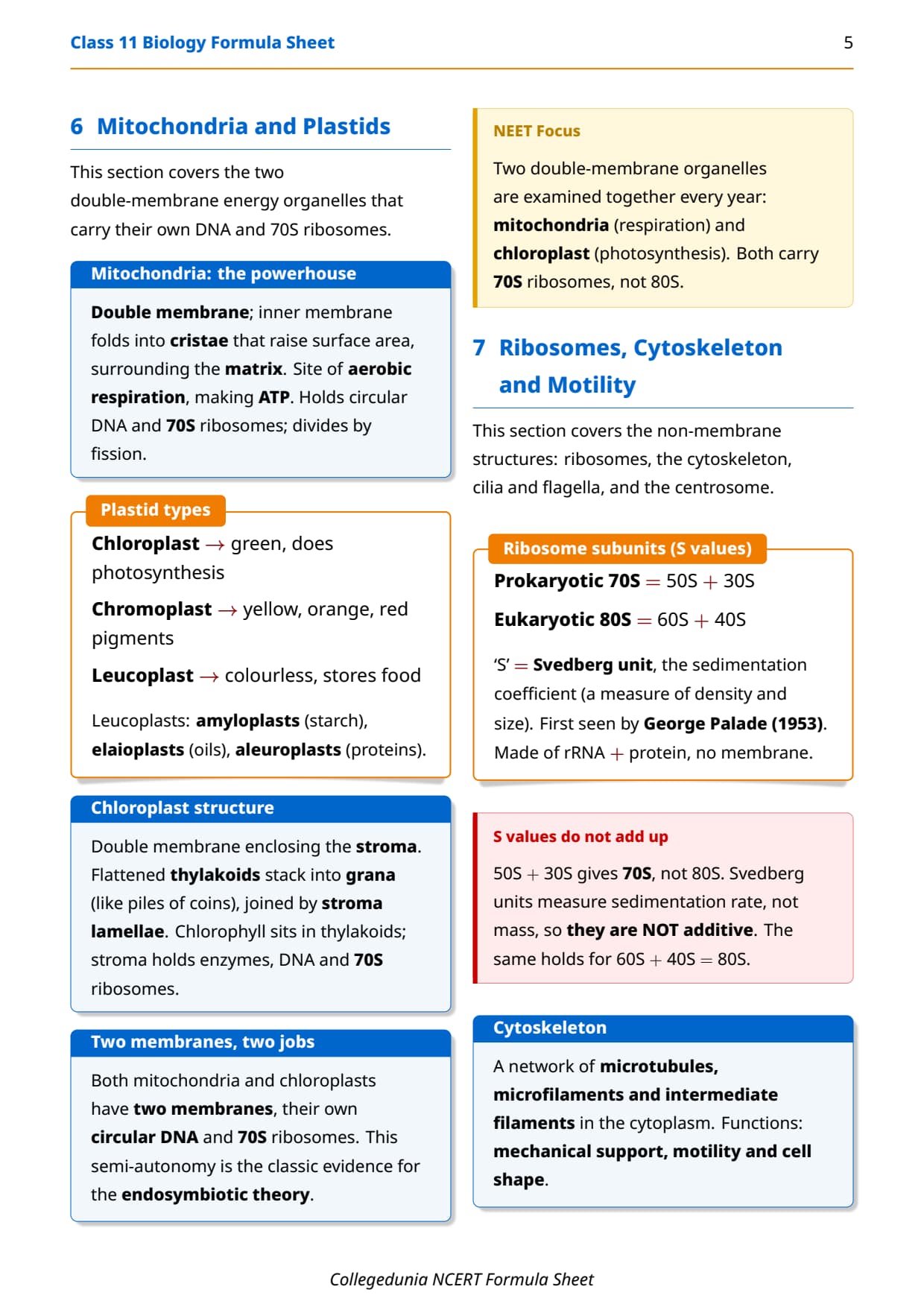
| Mitochondria | Powerhouse; site of aerobic respiration that makes ATP, with cristae and its own 70S ribosomes |
| Plastids | Chloroplast does photosynthesis; chromoplast holds pigments; leucoplast stores food |
| Ribosomes | Site of protein synthesis; made of rRNA and protein, with no membrane (70S or 80S) |
Plant Cell vs Animal Cell
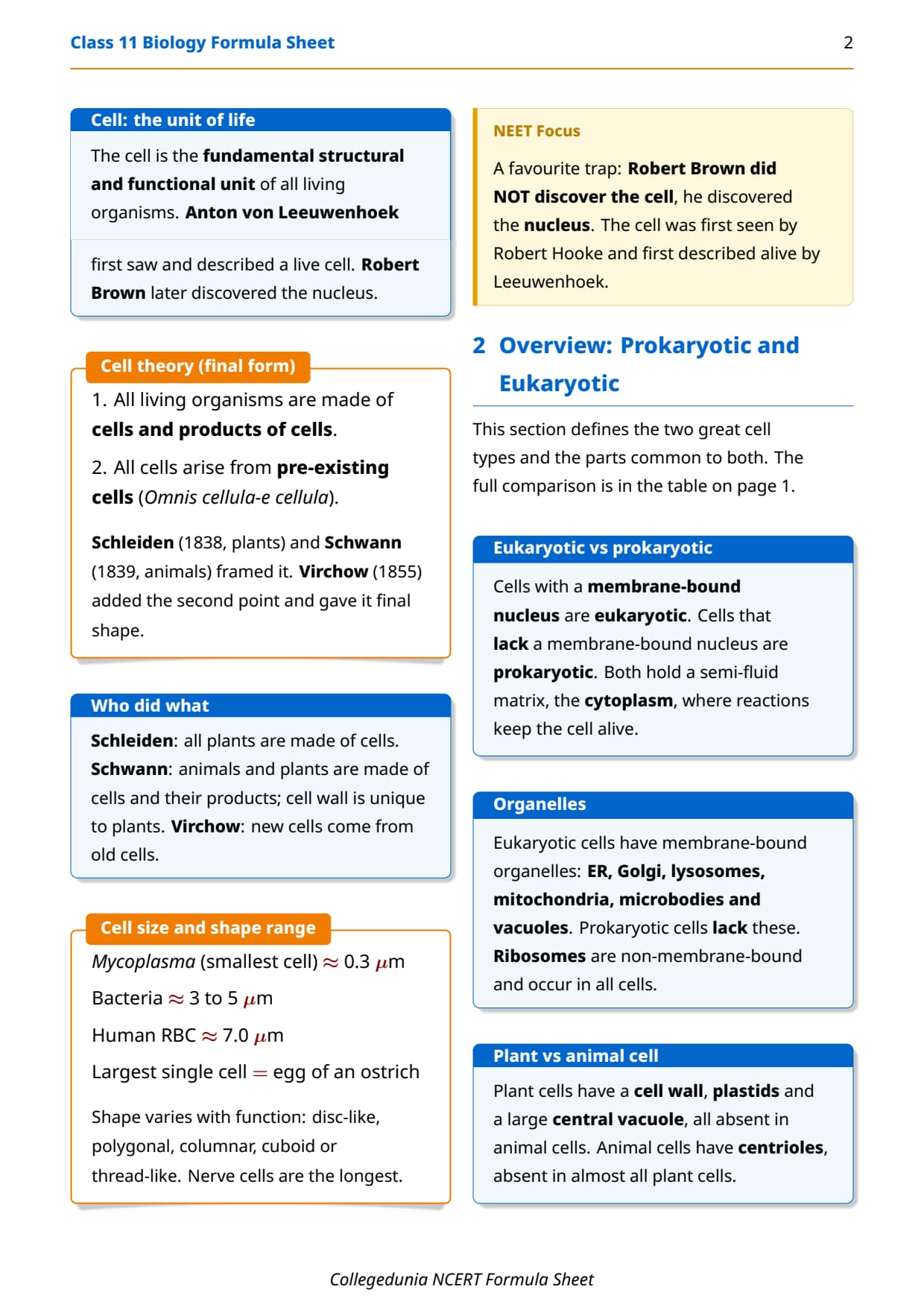
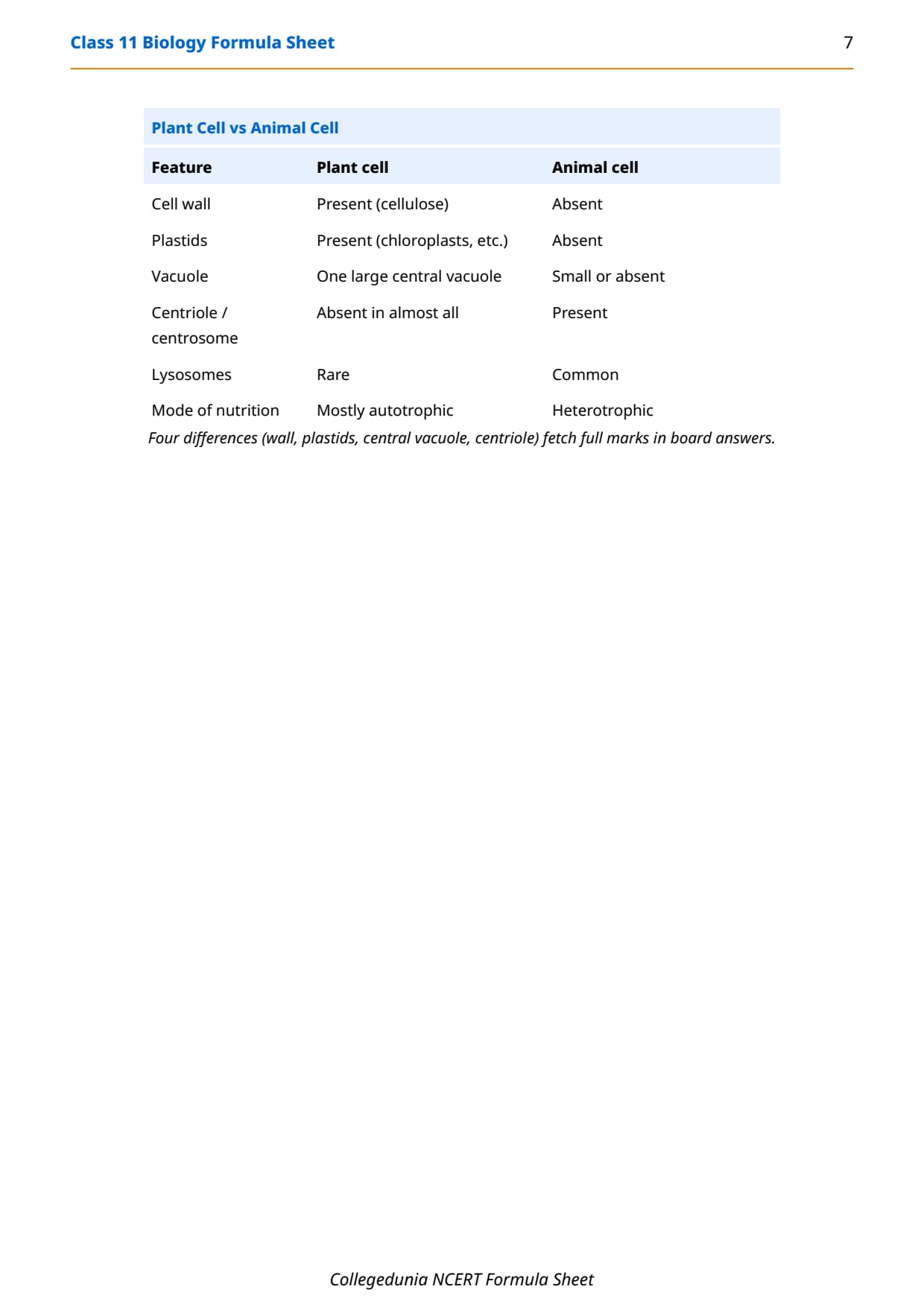
Four structures separate the two cells and fetch full marks in board answers. Note the cell wall, plastids, central vacuole and centriole as the reliable difference points.
| Feature | Plant cell | Animal cell |
|---|---|---|
| Cell wall | Present (cellulose) | Absent |
| Plastids | Present (chloroplasts, etc.) | Absent |
| Central vacuole | One large central vacuole | Small or absent |
| Centriole / centrosome | Absent in almost all | Present |
| Lysosomes | Rare | Common |
| Mode of nutrition | Mostly autotrophic | Heterotrophic |
How to Revise Cell: The Unit of Life Before the Exam
This chapter rewards clean structure-function pairs more than long answers. A short, ordered revision fixes the facts in memory.
- Write the prokaryotic versus eukaryotic table, then say the 70S and 80S subunit splits out loud.
- Match each organelle to its function, and note which ones carry their own DNA and 70S ribosomes.
- List the four plant versus animal cell differences: cell wall, plastids, central vacuole and centriole.
- Learn the key numbers: the 9+2 axoneme of cilia and flagella, and the 9+0 triplets of the centriole.
Student Feedback on the Cell: The Unit of Life Formula Sheet
In a survey of 1,200 NEET aspirants who used this sheet, 84% said the single-page organelle table made the functions easy to recall. Toppers reported that revising the 70S and 80S ribosome split twice a week stopped them losing easy marks on the classic distractor.
Other Cell: The Unit of Life Class 11 Biology Resources
Pair this formula sheet with the solved answers, notes and textbook PDF.
| Resource | Link |
|---|---|
| NCERT Solutions | Cell: The Unit of Life Class 11 NCERT Solutions |
| Revision Notes | Cell: The Unit of Life Class 11 Notes |
| NCERT Book PDF | Cell: The Unit of Life Class 11 Book PDF |
NCERT Formula Sheet for Class 11 Biology: All Chapters
Revise every chapter from one place. Each link opens the formula sheet for that chapter.
| Chapter | Formula Sheet |
|---|---|
| Chapter 1 | The Living World |
| Chapter 2 | Biological Classification |
| Chapter 3 | Plant Kingdom |
| Chapter 4 | Animal Kingdom |
| Chapter 5 | Morphology of Flowering Plants |
| Chapter 6 | Anatomy of Flowering Plants |
| Chapter 7 | Structural Organisation in Animals |
| Chapter 8 | Cell: The Unit of Life |
| Chapter 9 | Biomolecules |
| Chapter 10 | Cell Cycle and Cell Division |
| Chapter 11 | Photosynthesis in Higher Plants |
| Chapter 12 | Respiration in Plants |
| Chapter 13 | Plant Growth and Development |
| Chapter 14 | Breathing and Exchange of Gases |
| Chapter 15 | Body Fluids and Circulation |
| Chapter 16 | Excretory Products and their Elimination |
| Chapter 17 | Locomotion and Movement |
| Chapter 18 | Neural Control and Coordination |
| Chapter 19 | Chemical Coordination and Integration |
FAQs on Cell: The Unit of Life Class 11 Biology Formula Sheet
Cell the Unit of Life Formula Sheet - Frequently Asked Questions
Ques. What does the class 11 biology formula sheet chapter 8 cell the unit of life cover?
Ans. This class 11 biology formula sheet chapter 8 cell the unit of life covers cell theory, the master comparison of prokaryotic and eukaryotic cells, every cell organelle and its function, the plant versus animal cell differences, and the 70S and 80S ribosome subunit splits.
Ques. What is the difference between a prokaryotic and a eukaryotic cell?
Ans. A prokaryotic cell lacks a membrane-bound nucleus and membrane-bound organelles, holds naked circular DNA in a nucleoid, and has 70S ribosomes. A eukaryotic cell has a true nucleus with a nuclear envelope, membrane-bound organelles and 80S ribosomes in its cytoplasm. Bacteria are prokaryotic; protists, fungi, plants and animals are eukaryotic.
Ques. What are the ribosome S values for prokaryotic and eukaryotic cells?
Ans. The prokaryotic ribosome is 70S, made of a 50S large subunit and a 30S small subunit. The cytoplasmic eukaryotic ribosome is 80S, made of a 60S and a 40S subunit. The "S" is the Svedberg unit, so the values measure sedimentation rate and do not add up. Mitochondria and chloroplasts carry the 70S type.
Ques. What are the main differences between a plant cell and an animal cell?
Ans. A plant cell has a cellulose cell wall, plastids such as chloroplasts, and one large central vacuole, all absent in an animal cell. An animal cell has a centriole and centrosome, absent in almost all plant cells. These four points, wall, plastids, central vacuole and centriole, fetch full marks in board answers.



Comments