




The class 11 biology formula sheet chapter 16 excretory products and their elimination gathers every key value, definition and pathway tested in the CBSE Boards, NEET, CUET and other entrance exams. It lists the three modes of nitrogenous excretion, the parts of the nephron and the key kidney numbers so students can revise the whole chapter fast.
Excretory Products and their Elimination is a high-yield human physiology chapter, and its values return in almost every NEET paper.
- Compares the three modes of excretion, ammonotelism, ureotelism and uricotelism, by waste, water need and examples.
- Maps the nephron regions and the three steps of urine formation, filtration, reabsorption and secretion.
- Lists the key kidney values, GFR, filtrate volume, urine output and the regulators ADH, JGA and ANF.
This class 11 biology formula sheet chapter 16 excretory products and their elimination is curated by subject experts and checked against the 2026-27 NCERT and recent CBSE and NEET papers.
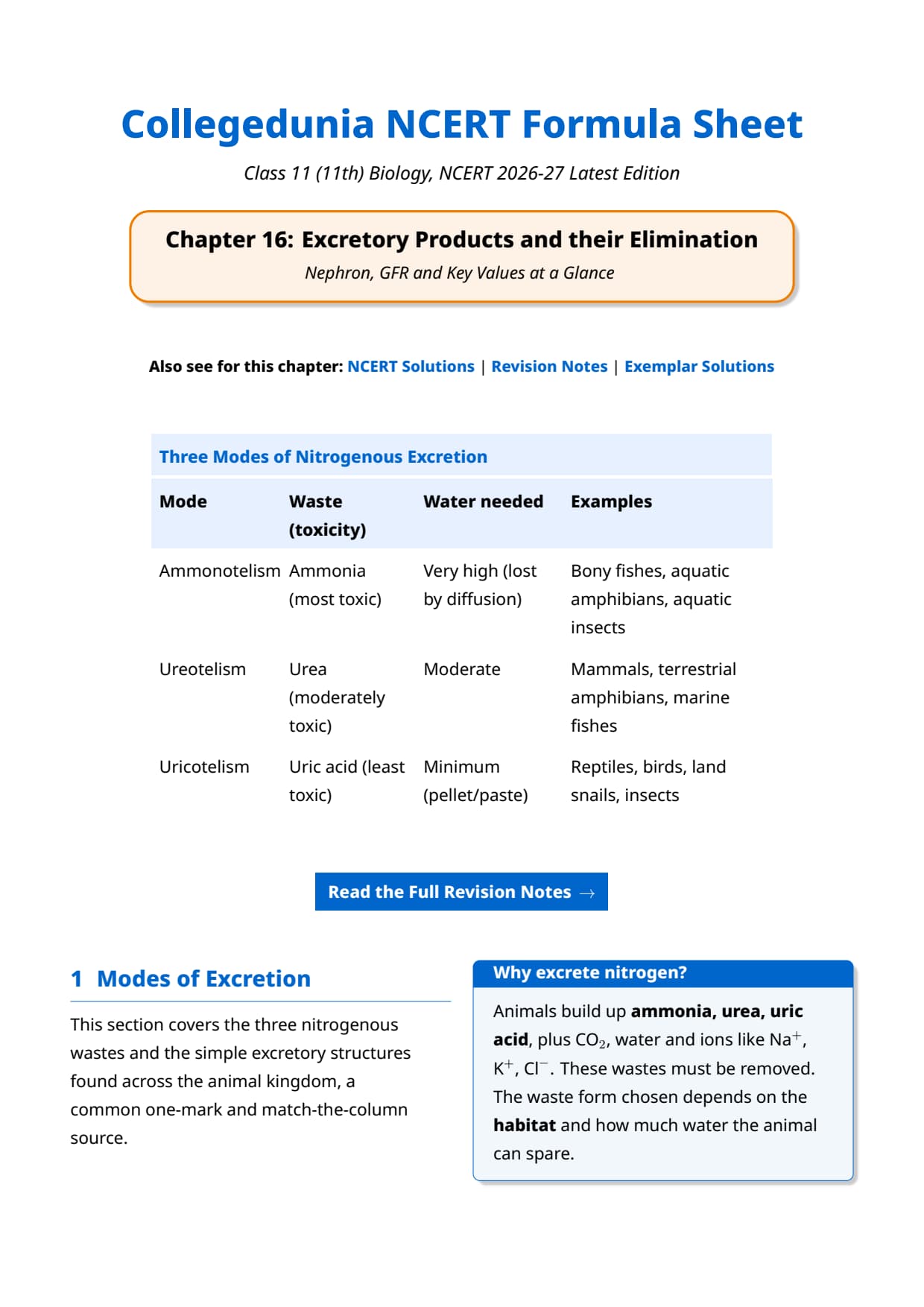
Modes of Excretion at a Glance
Animals remove nitrogen as one of three wastes, and the choice depends on how much water the habitat allows. Learn this table by heart, since NEET regularly asks you to match an animal to its mode of excretion.
| Mode | Waste (toxicity) | Water needed | Examples |
|---|---|---|---|
| Ammonotelism | Ammonia (most toxic) | Very high (lost by diffusion) | Bony fishes, aquatic amphibians, aquatic insects |
| Ureotelism | Urea (moderately toxic) | Moderate | Mammals, terrestrial amphibians, marine fishes |
| Uricotelism | Uric acid (least toxic) | Minimum (pellet or paste) | Reptiles, birds, land snails, insects |
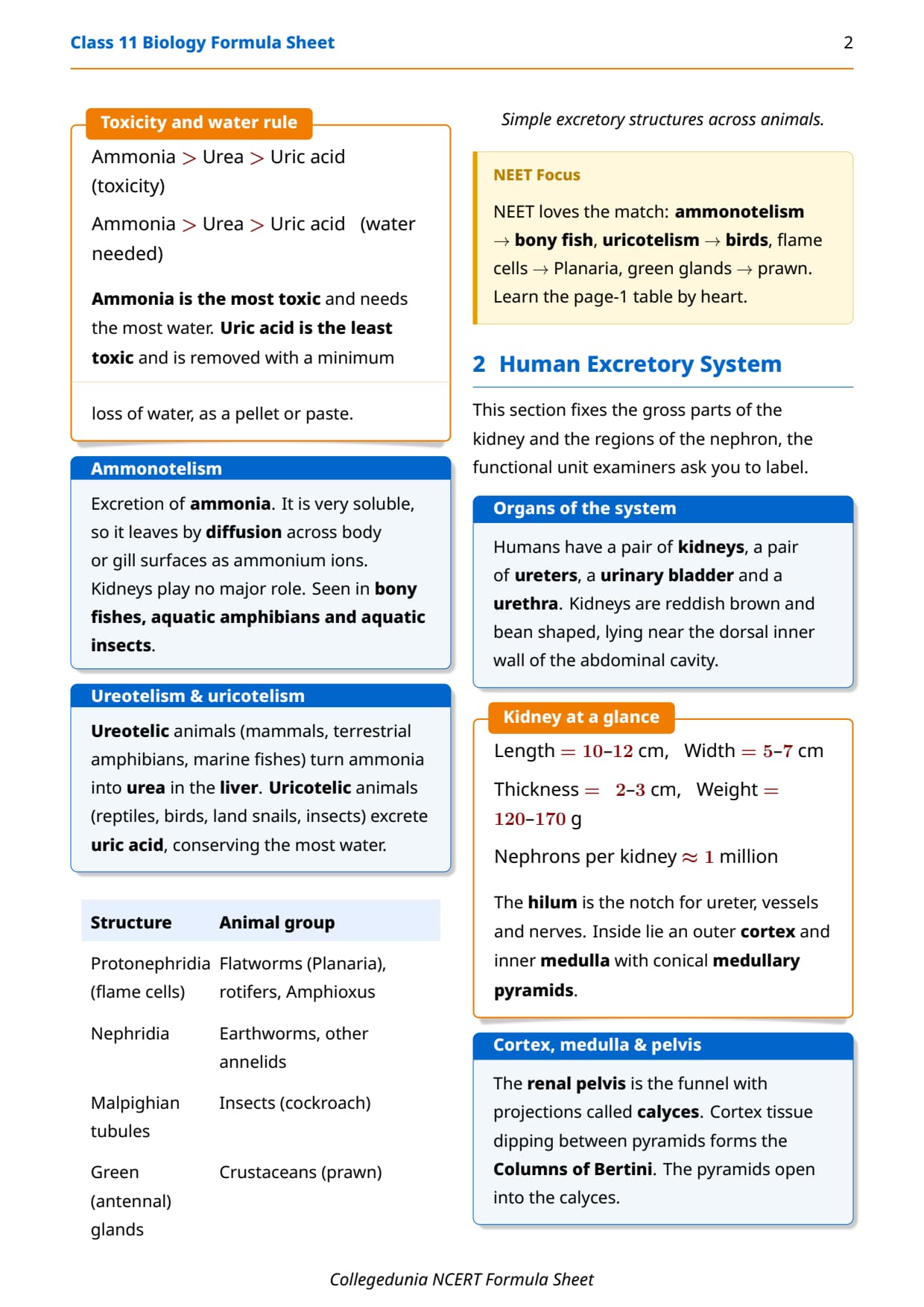
Toxicity and water need both fall in the order ammonia > urea > uric acid, so land animals that must save water excrete uric acid.
The Nephron and Urine Formation
The nephron is the functional unit of the kidney, and examiners ask you to label its regions and state what each one does. Urine forms in three steps that run across these regions.
| Nephron region | Role |
|---|---|
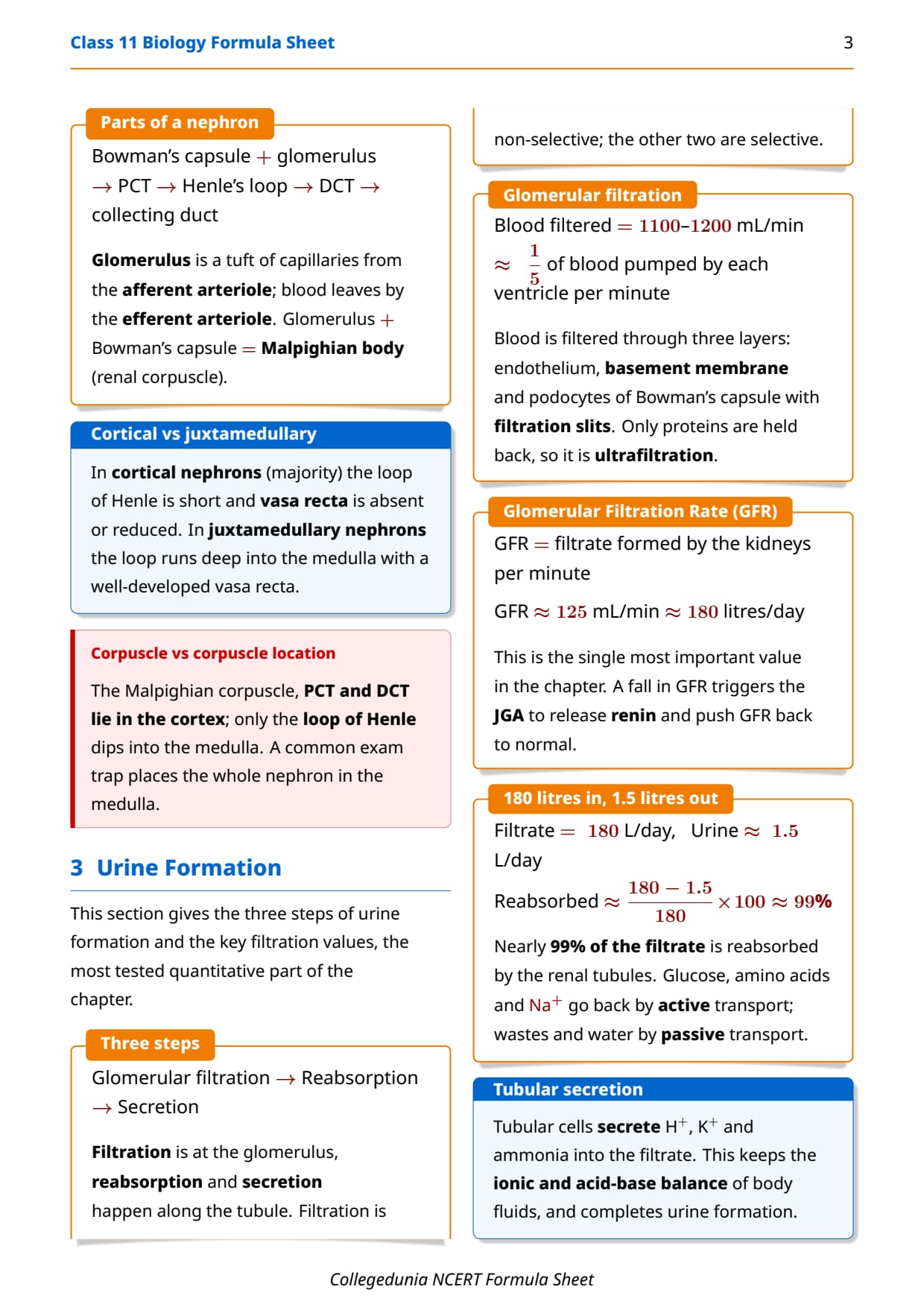
| Bowman's capsule + glomerulus | Site of ultrafiltration; glomerulus is a capillary tuft fed by the afferent arteriole and drained by the efferent arteriole |
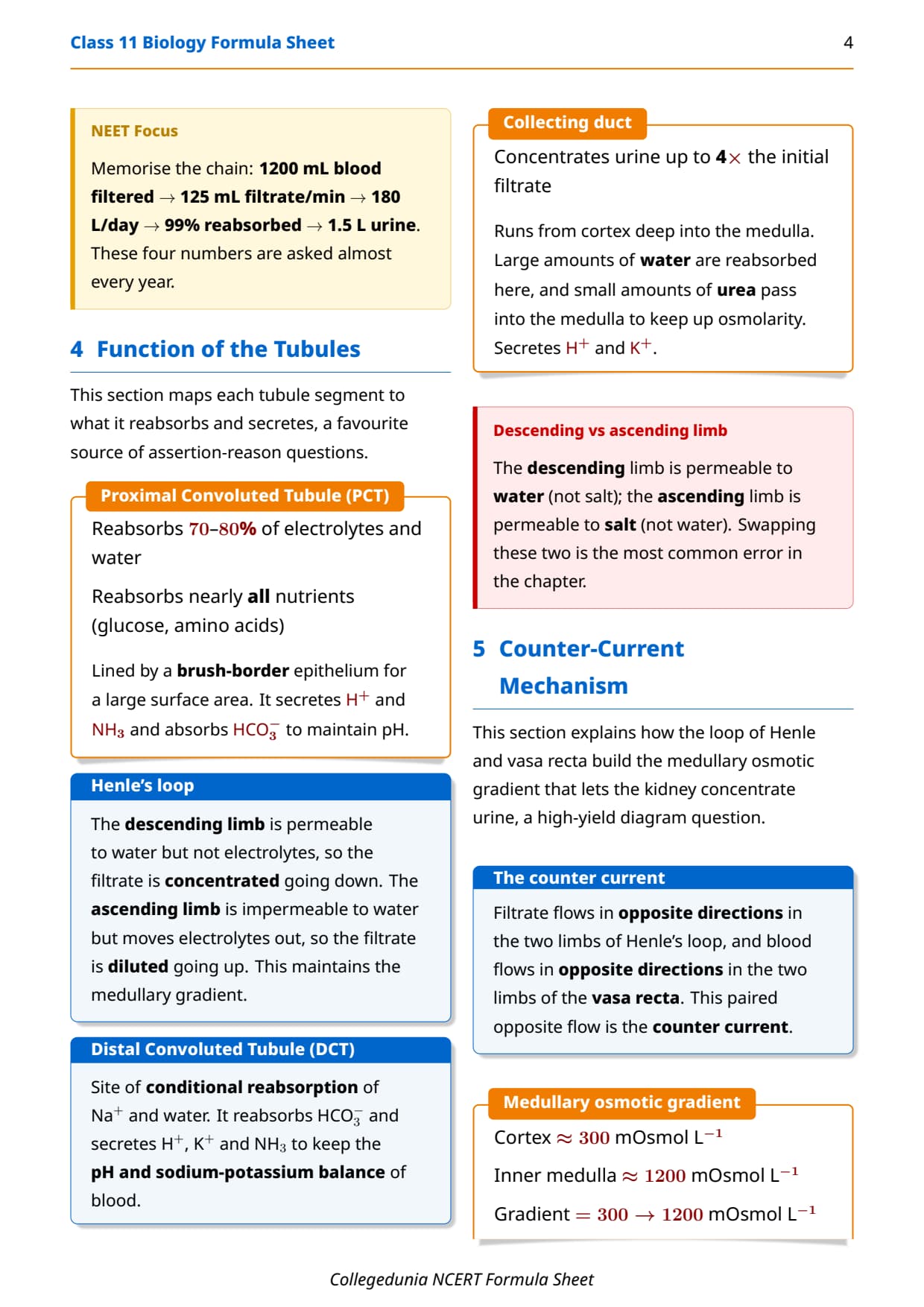
| Proximal convoluted tubule (PCT) | Reabsorbs 70 to 80% of water and electrolytes and nearly all glucose and amino acids; brush-border epithelium |
| Loop of Henle | Descending limb concentrates the filtrate, ascending limb dilutes it; maintains the medullary osmotic gradient |
| Distal convoluted tubule (DCT) | Conditional reabsorption of Na+ and water; secretes H+, K+ and NH3 to hold pH balance |
| Collecting duct | Reabsorbs large amounts of water, concentrating urine up to 4× the filtrate; lets some urea into the medulla |
| Step | What happens |
|---|---|
| Glomerular filtration | Non-selective ultrafiltration of blood at the glomerulus; only proteins are held back |
| Reabsorption | Selective return of nutrients, ions and water from the filtrate along the tubule |
| Secretion | Tubular cells add H+, K+ and ammonia to keep ionic and acid-base balance |
The Malpighian corpuscle, PCT and DCT lie in the cortex; only the loop of Henle dips into the medulla.
GFR and Key Kidney Values
The quantitative side of this chapter is the most tested. Memorise these numbers, because one-mark NEET questions come straight from them.
| Quantity | Key value |
|---|---|
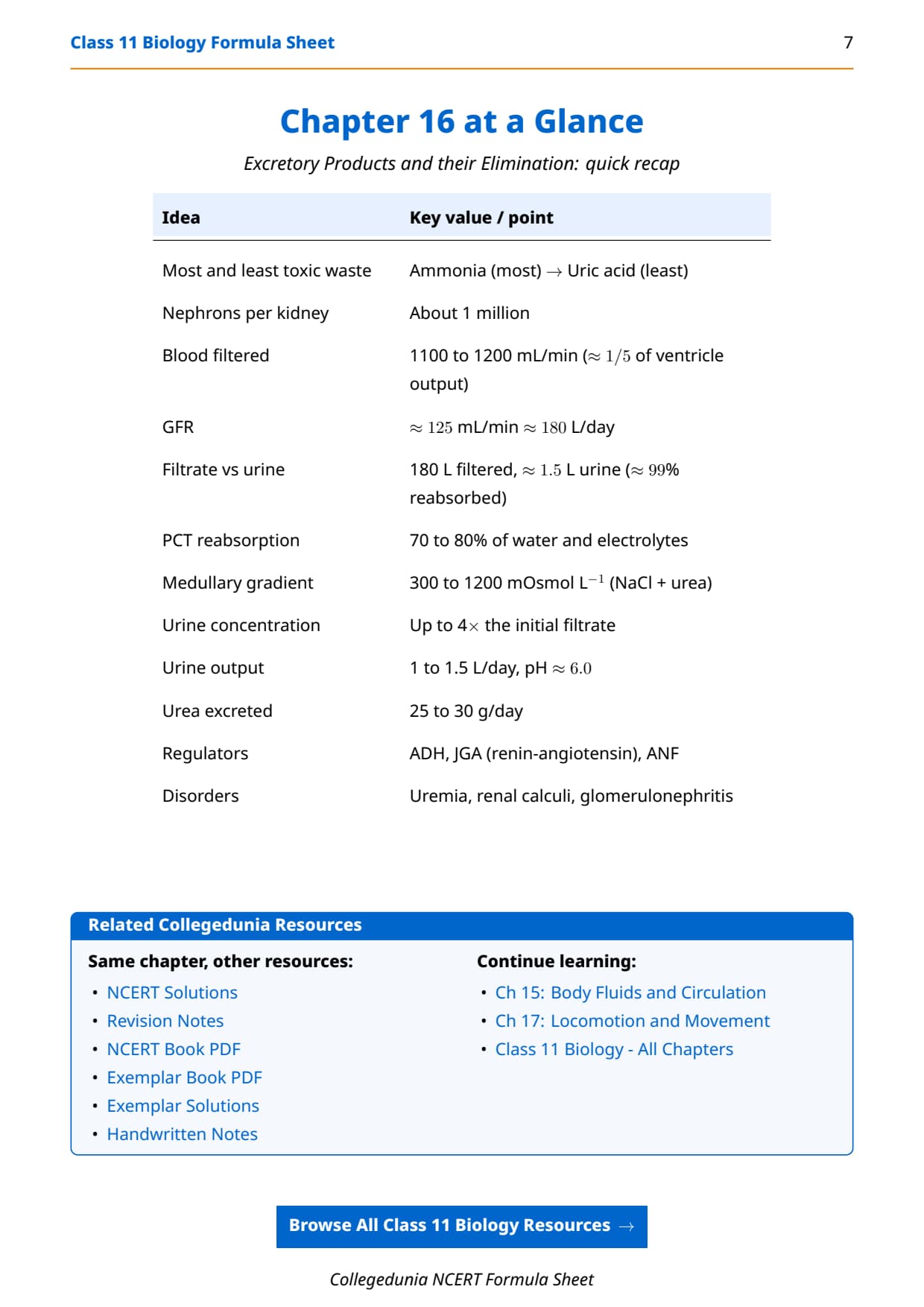
| Blood filtered | 1100 to 1200 mL/min (about one-fifth of ventricle output) |
| Glomerular Filtration Rate (GFR) | ~125 mL/min, that is ~180 L/day |
| Filtrate vs urine | 180 L filtered, ~1.5 L urine per day |
| Filtrate reabsorbed | ~99% of the filtrate returns to blood |
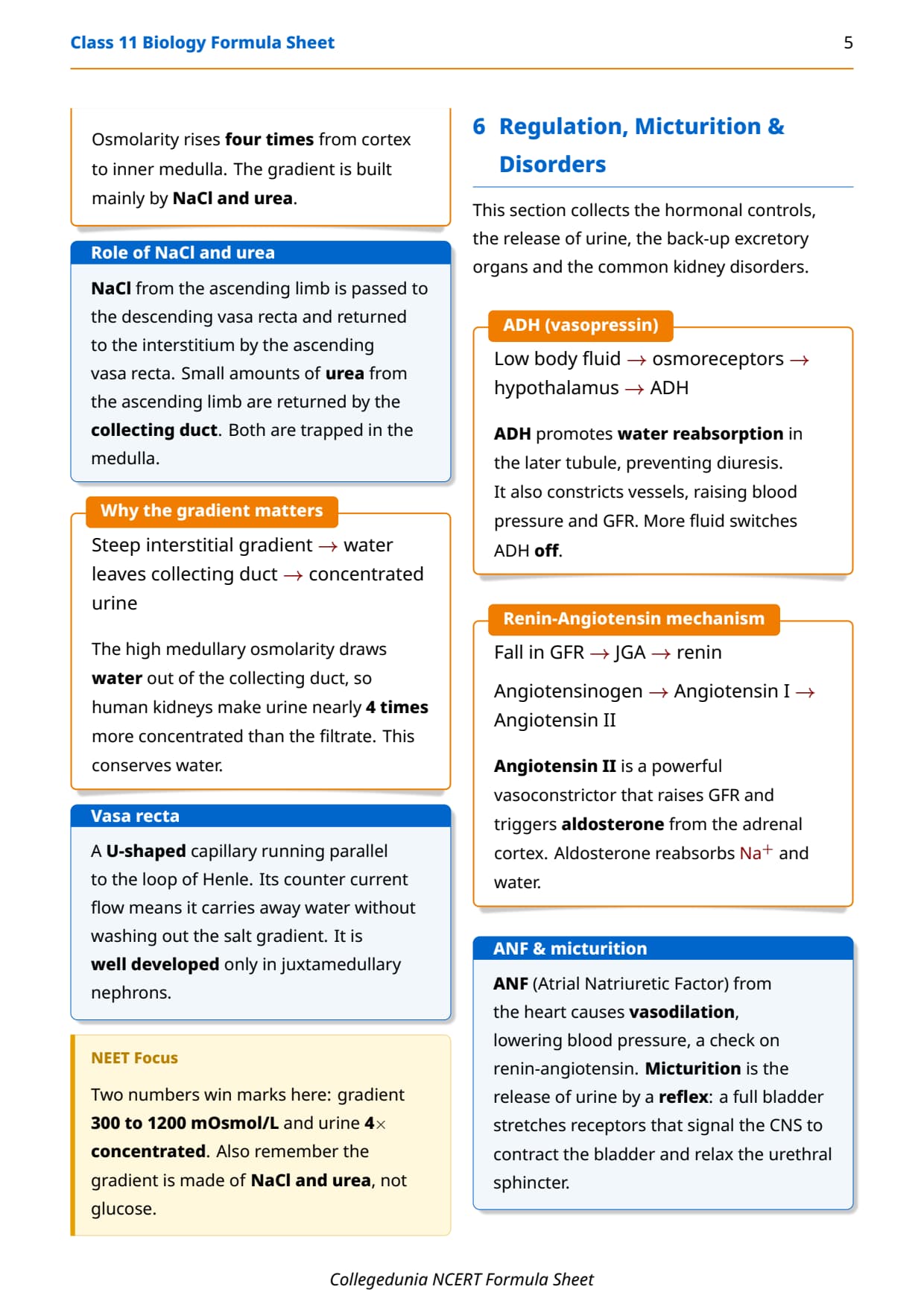
| Medullary osmolarity | Rises from 300 to 1200 mOsmol/L (built by NaCl and urea) |
| Regulators | ADH, JGA (renin-angiotensin) and ANF |
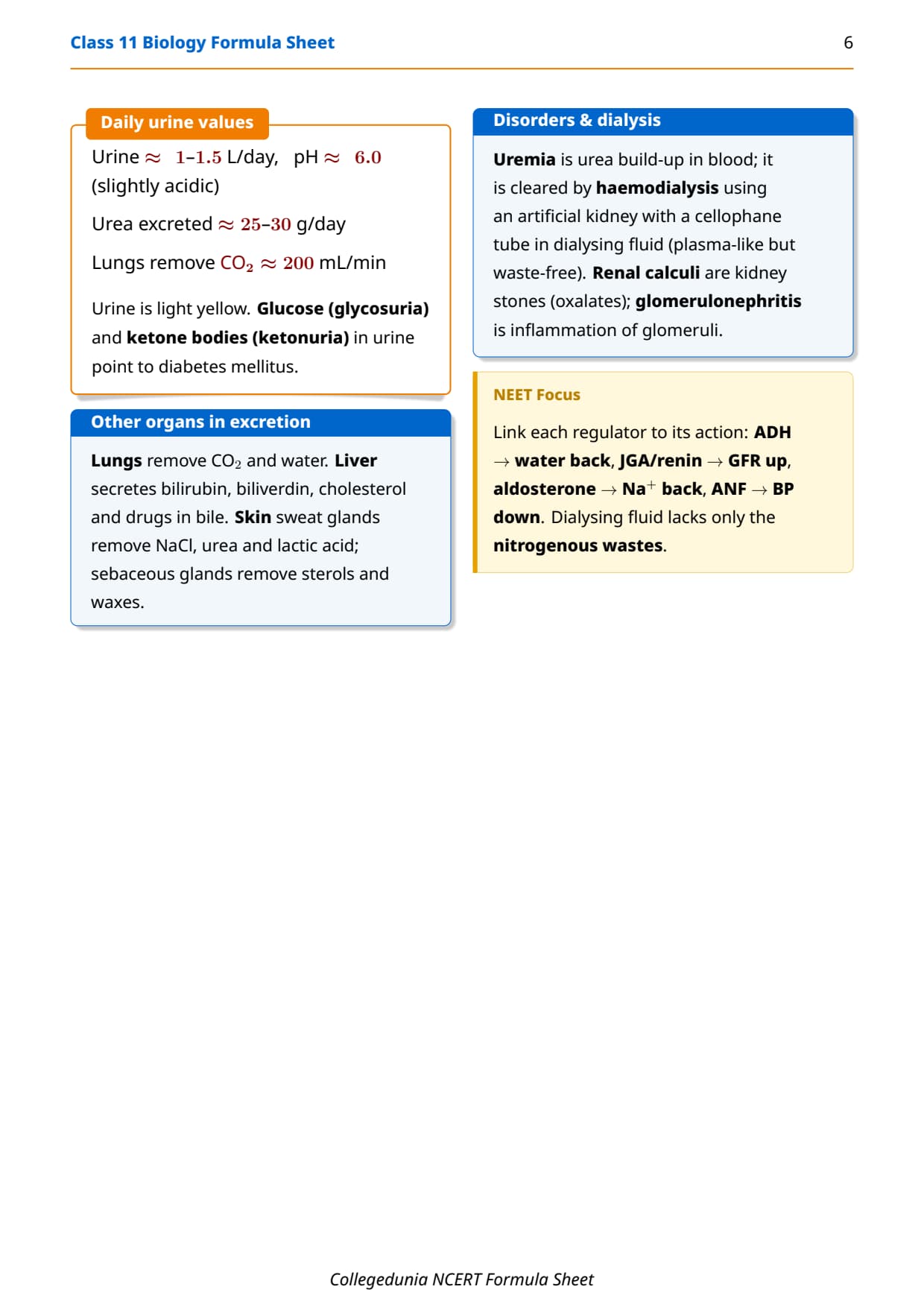
Regulation keeps these values steady. A fall in GFR makes the juxtaglomerular apparatus (JGA) release renin, driving the renin-angiotensin pathway to angiotensin II, which raises GFR and triggers aldosterone. ADH promotes water reabsorption in the later tubule, while ANF from the heart causes vasodilation and lowers blood pressure, acting as a check on renin-angiotensin.
The four numbers asked almost every year: 1200 mL blood filtered, 125 mL filtrate per minute, 180 L per day and 99% reabsorbed leaving 1.5 L urine.
How to Revise Excretory Products and their Elimination Before the Exam
This chapter rewards exact values and clean pathways more than long prose. A short, ordered revision locks the numbers in memory.
- Write the three modes of excretion with one example animal each, and note that water need follows toxicity.
- Draw the nephron and label every region, then state what each one reabsorbs or secretes.
- Memorise the key values: GFR ~125 mL/min, ~180 L/day filtrate, ~1.5 L urine and ~99% reabsorption.
- Link each regulator to its action: ADH returns water, JGA and renin raise GFR, aldosterone reabsorbs Na+ and ANF lowers blood pressure.
Student Feedback on the Excretory Products and their Elimination Formula Sheet
In a survey of 1,200 NEET aspirants who used this sheet, 84% said the single-page value table made the GFR and urine numbers easy to recall under exam pressure. Toppers reported that revising the nephron region table twice a week made labelling questions automatic before the exam.
Other Excretory Products and their Elimination Class 11 Biology Resources
Pair this formula sheet with the solved answers, notes and textbook PDF.
| Resource | Link |
|---|---|
| NCERT Solutions | Excretory Products and their Elimination Class 11 NCERT Solutions |
| Revision Notes | Excretory Products and their Elimination Class 11 Notes |
| NCERT Book PDF | Excretory Products and their Elimination Class 11 Book PDF |
NCERT Formula Sheet for Class 11 Biology: All Chapters
Revise every chapter from one place. Each link opens the formula sheet for that chapter.
| Chapter | Formula Sheet |
|---|---|
| Chapter 1 | The Living World |
| Chapter 2 | Biological Classification |
| Chapter 3 | Plant Kingdom |
| Chapter 4 | Animal Kingdom |
| Chapter 5 | Morphology of Flowering Plants |
| Chapter 6 | Anatomy of Flowering Plants |
| Chapter 7 | Structural Organisation in Animals |
| Chapter 8 | Cell: The Unit of Life |
| Chapter 9 | Biomolecules |
| Chapter 10 | Cell Cycle and Cell Division |
| Chapter 11 | Photosynthesis in Higher Plants |
| Chapter 12 | Respiration in Plants |
| Chapter 13 | Plant Growth and Development |
| Chapter 14 | Breathing and Exchange of Gases |
| Chapter 15 | Body Fluids and Circulation |
| Chapter 16 | Excretory Products and their Elimination |
| Chapter 17 | Locomotion and Movement |
| Chapter 18 | Neural Control and Coordination |
| Chapter 19 | Chemical Coordination and Integration |
FAQs on Excretory Products and their Elimination Class 11 Biology Formula Sheet
Excretory Products and Their Elimination Formula Sheet - Frequently Asked Questions
Ques. What does the class 11 biology formula sheet chapter 16 excretory products and their elimination cover?
Ans. This class 11 biology formula sheet chapter 16 excretory products and their elimination covers ammonotelism, ureotelism and uricotelism, the regions of the nephron, the three steps of urine formation, and the key values like GFR, filtrate volume, urine output and the regulators ADH, JGA and ANF.
Ques. What is the value of GFR in a healthy person?
Ans. The Glomerular Filtration Rate (GFR) is the amount of filtrate formed by the kidneys per minute, about 125 mL/min or ~180 L/day. Of this, nearly 99% is reabsorbed, so only about 1.5 L of urine is released each day.
Ques. What are the three modes of nitrogenous excretion?
Ans. Animals excrete nitrogen as ammonia (ammonotelism, in bony fishes), urea (ureotelism, in mammals) or uric acid (uricotelism, in birds and reptiles). Ammonia is the most toxic and needs the most water, while uric acid is the least toxic and is removed with minimum water loss.
Ques. Which hormones regulate kidney function?
Ans. ADH promotes water reabsorption in the later tubule, the JGA releases renin to drive the renin-angiotensin-aldosterone pathway that raises GFR and reabsorbs Na+, and ANF from the heart causes vasodilation to lower blood pressure. Together they keep the kidney's output balanced.



Comments