




The class 11 biology formula sheet chapter 15 body fluids and circulation gathers every key count, blood group rule and cardiac value tested in the CBSE Boards, NEET, CUET and other entrance exams. It lists the blood cell counts, the ABO compatibility chart and the cardiac output equation so students can revise the whole chapter fast.
Body Fluids and Circulation is one of the most number-heavy chapters of Class 11 Biology, and its values return in every human physiology question in NEET.
- Covers the counts of RBCs, WBCs and platelets, with their life spans and functions.
- Lists the ABO blood groups with antigens, antibodies and donor compatibility, including the universal donor and recipient.
- Gives the cardiac output equation, the 0.8 second cardiac cycle, the ECG waves and normal blood pressure.
This class 11 biology formula sheet chapter 15 body fluids and circulation is curated by subject experts and checked against the 2026-27 NCERT and recent CBSE and NEET papers.
Blood Cells at a Glance
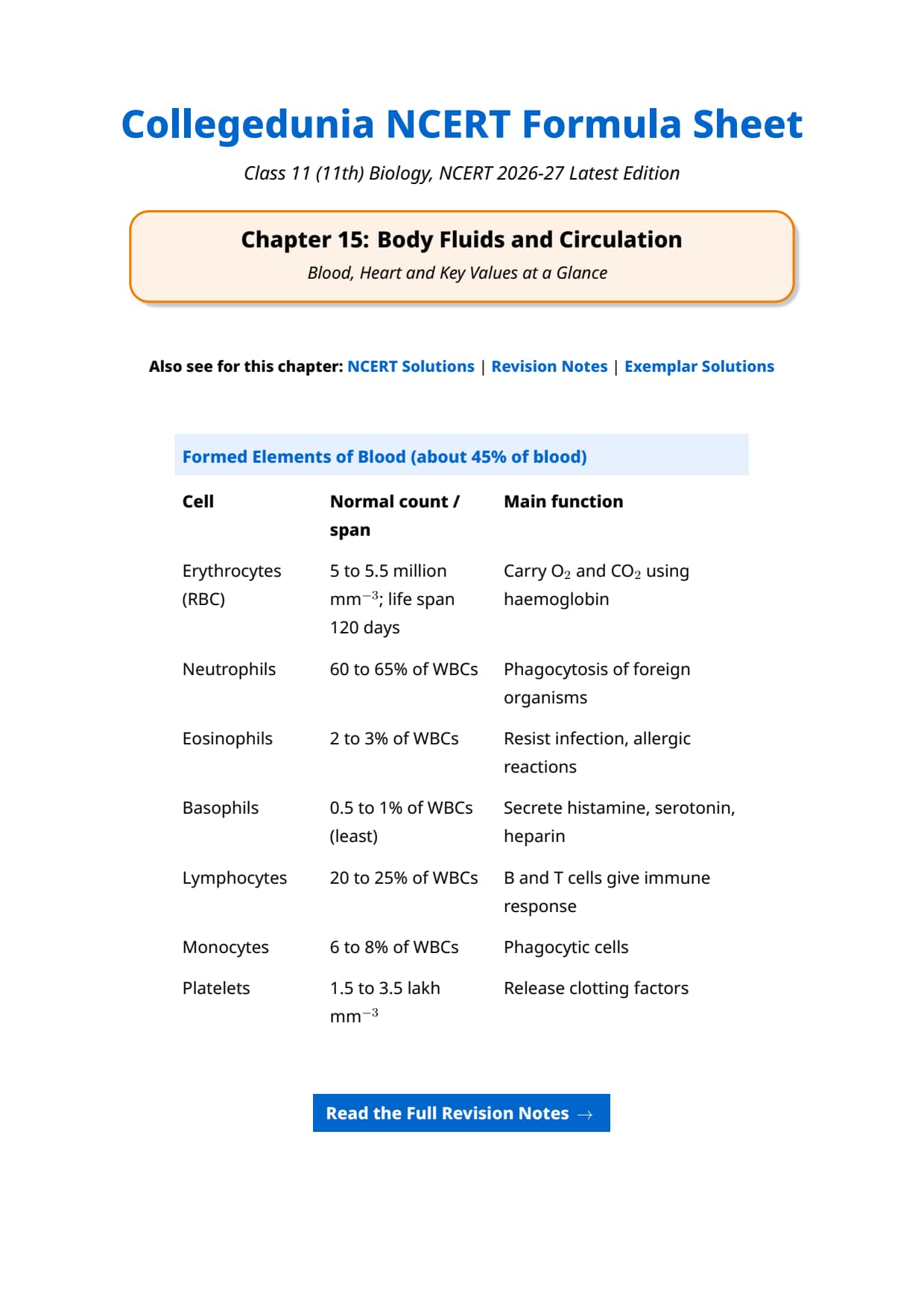
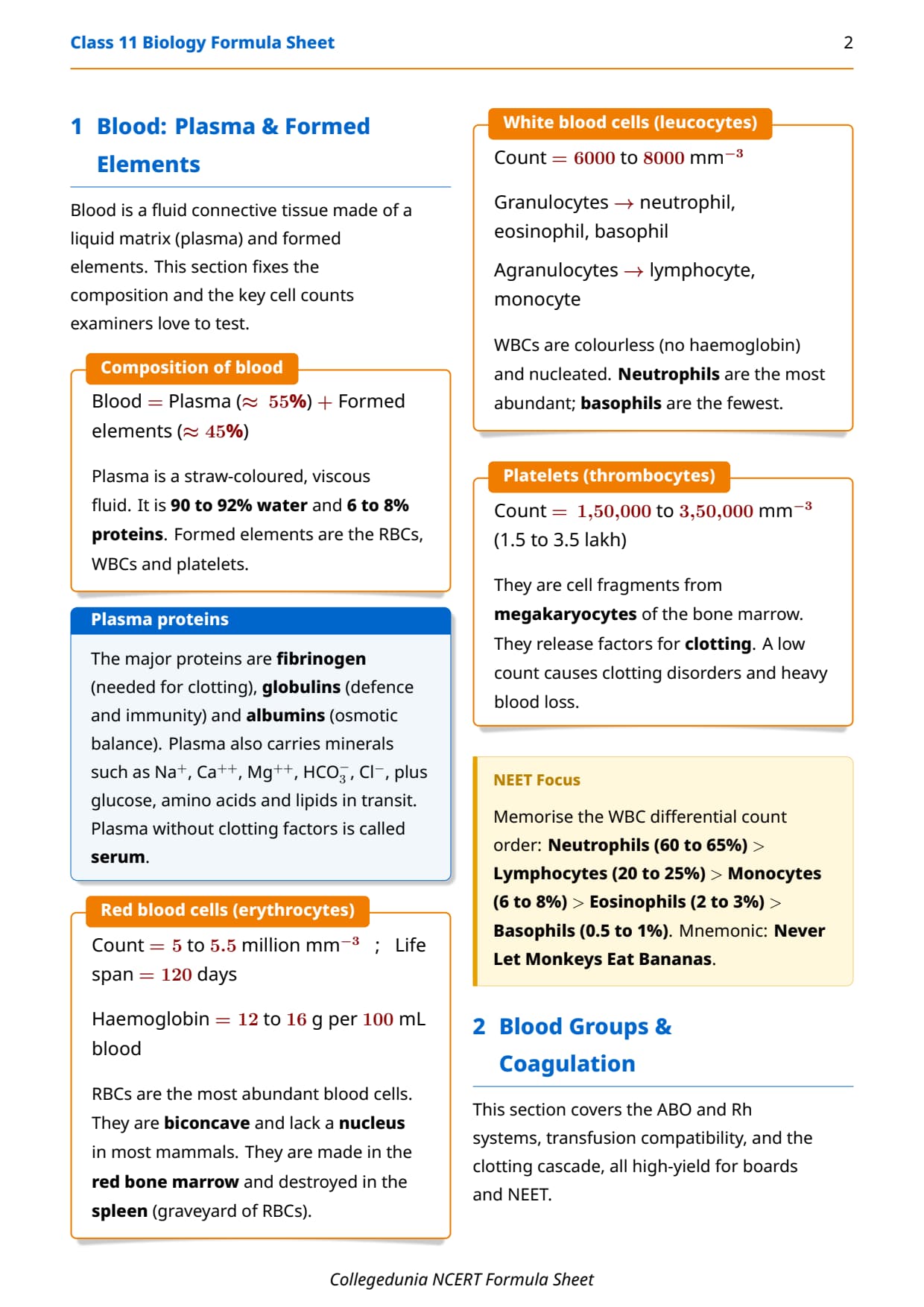
The formed elements make up about 45% of blood, and their counts are a favourite one-mark question. Learn the count and life span of each cell, since NEET often asks the value of a named cell type directly.
| Formed element | Normal count | Main function |
|---|---|---|
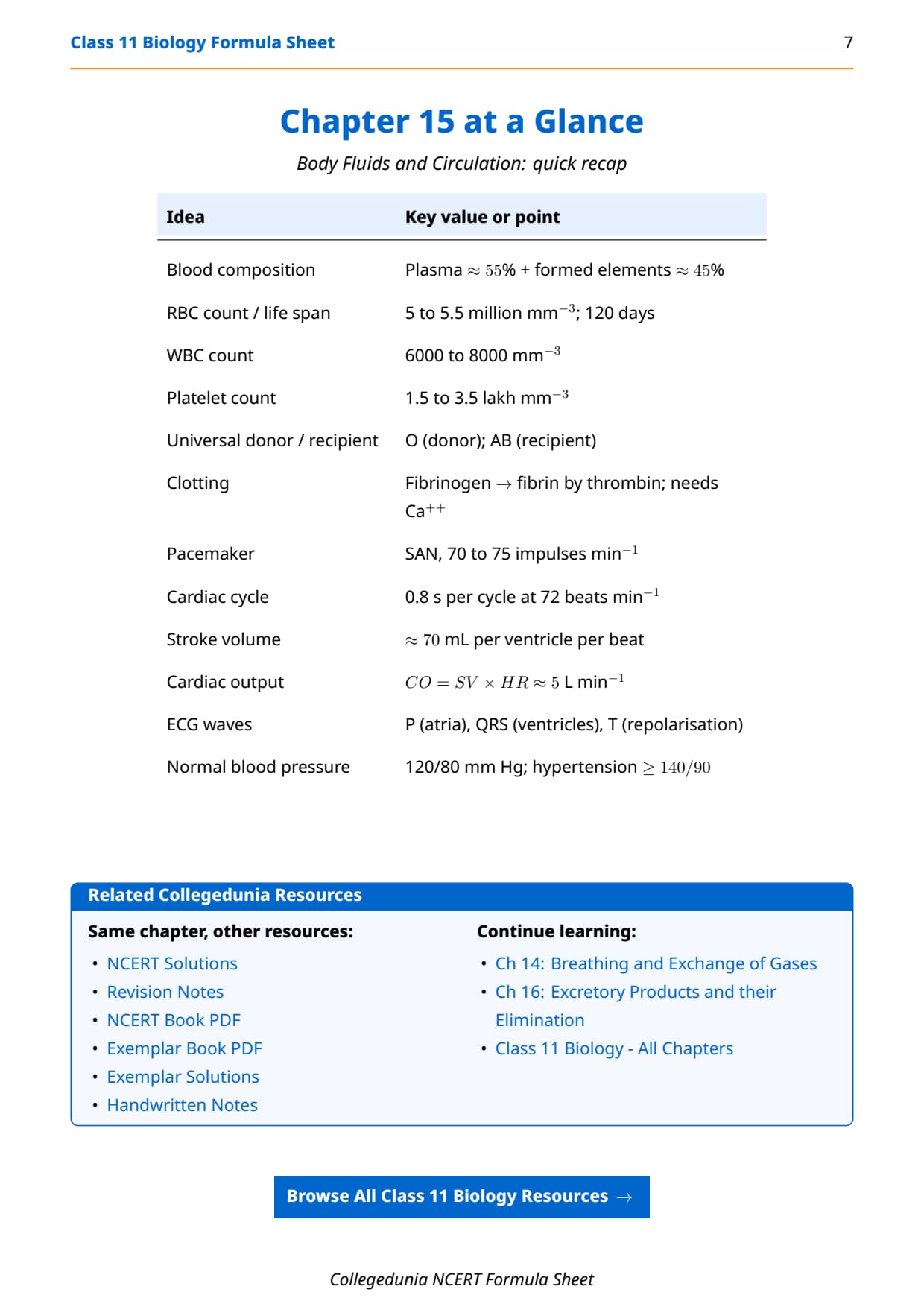
| Erythrocytes (RBC) | 5 to 5.5 million mm−3; life span 120 days | Carry O2 and CO2 using haemoglobin |
| Leucocytes (WBC) | 6000 to 8000 mm−3 | Granulocytes (neutrophil, eosinophil, basophil) and agranulocytes (lymphocyte, monocyte) fight infection |
| Platelets (thrombocytes) | 1.5 to 3.5 lakh mm−3 | Release clotting factors to stop bleeding |
RBCs are the most abundant blood cells, and among WBCs neutrophils are the most numerous while basophils are the fewest.
Blood Groups and Compatibility
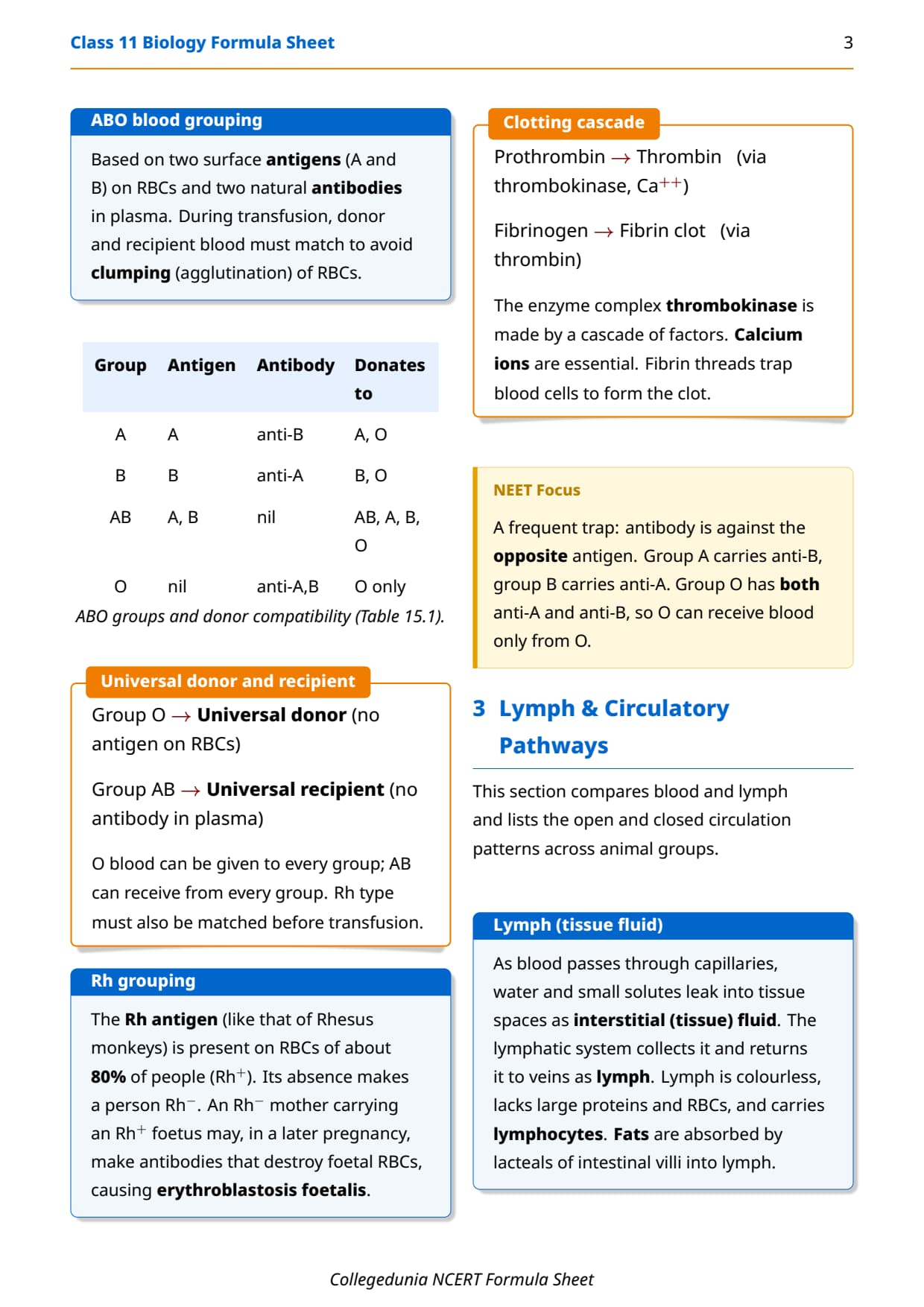
The ABO system is based on two antigens on the RBC surface and two natural antibodies in plasma. During transfusion the donor and recipient must match to avoid clumping (agglutination), so this chart is high-yield for the Boards and NEET.
| Blood group | Antigen on RBC | Antibody in plasma | Can donate to | Can receive from |
|---|---|---|---|---|
| A | A | anti-B | A, AB | A, O |
| B | B | anti-A | B, AB | B, O |
| AB | A and B | nil | AB only | A, B, AB, O (universal recipient) |
| O | nil | anti-A and anti-B | A, B, AB, O (universal donor) | O only |
Group O is the universal donor because its RBCs carry no antigen, while group AB is the universal recipient because its plasma carries no antibody. The Rh type must also be matched before any transfusion.
Cardiac Output, Cardiac Cycle and ECG
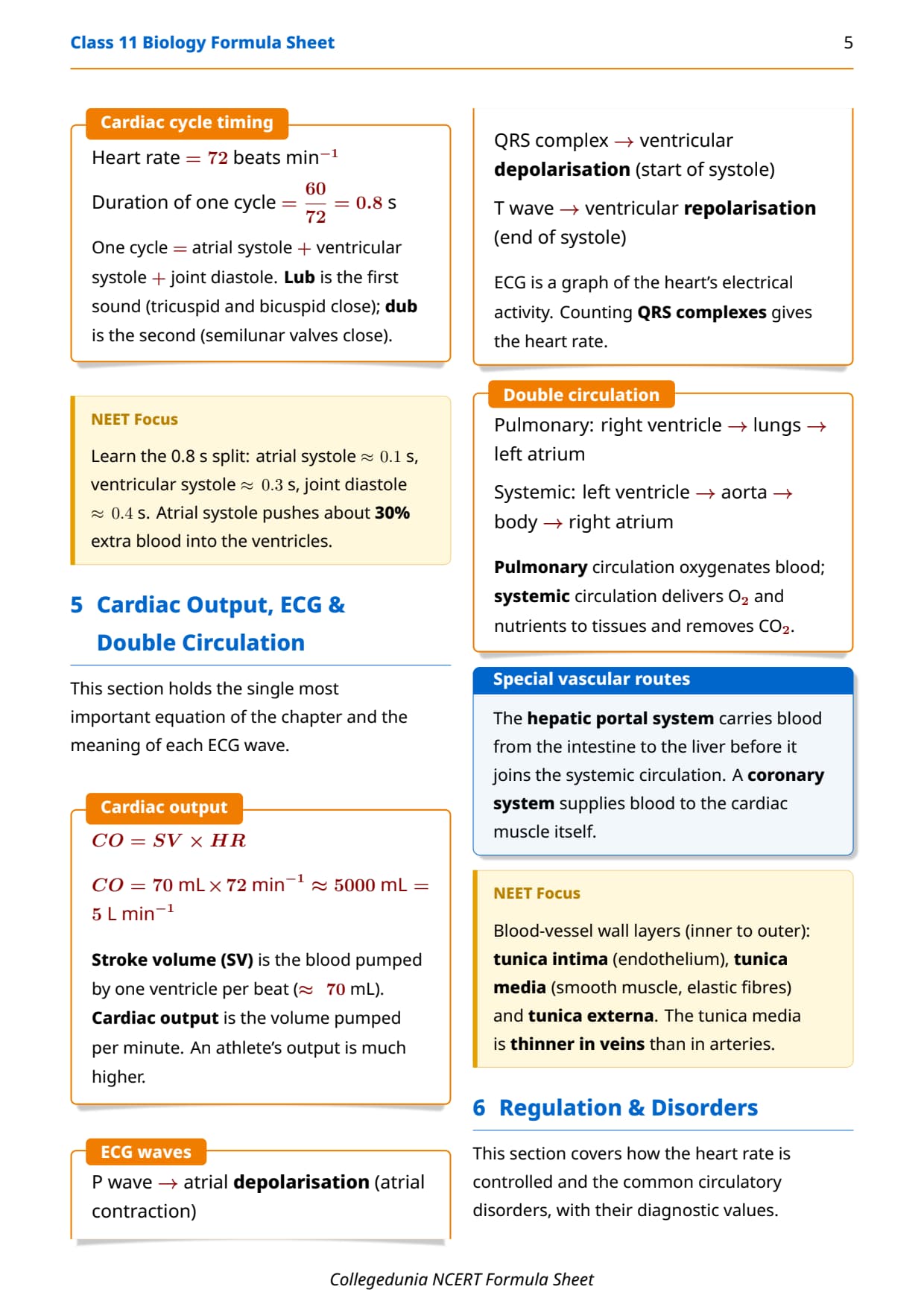
This section holds the single most important equation of the chapter along with the timing of one heartbeat and the meaning of each ECG wave. The cardiac output formula is almost guaranteed in NEET, so learn the substitution too.
| Quantity | Value |
|---|---|
| Cardiac output | CO = SV × HR = 70 mL × 72 ≈ 5000 mL = 5 L min−1 |
| Stroke volume (SV) | ≈ 70 mL of blood pumped by one ventricle per beat |
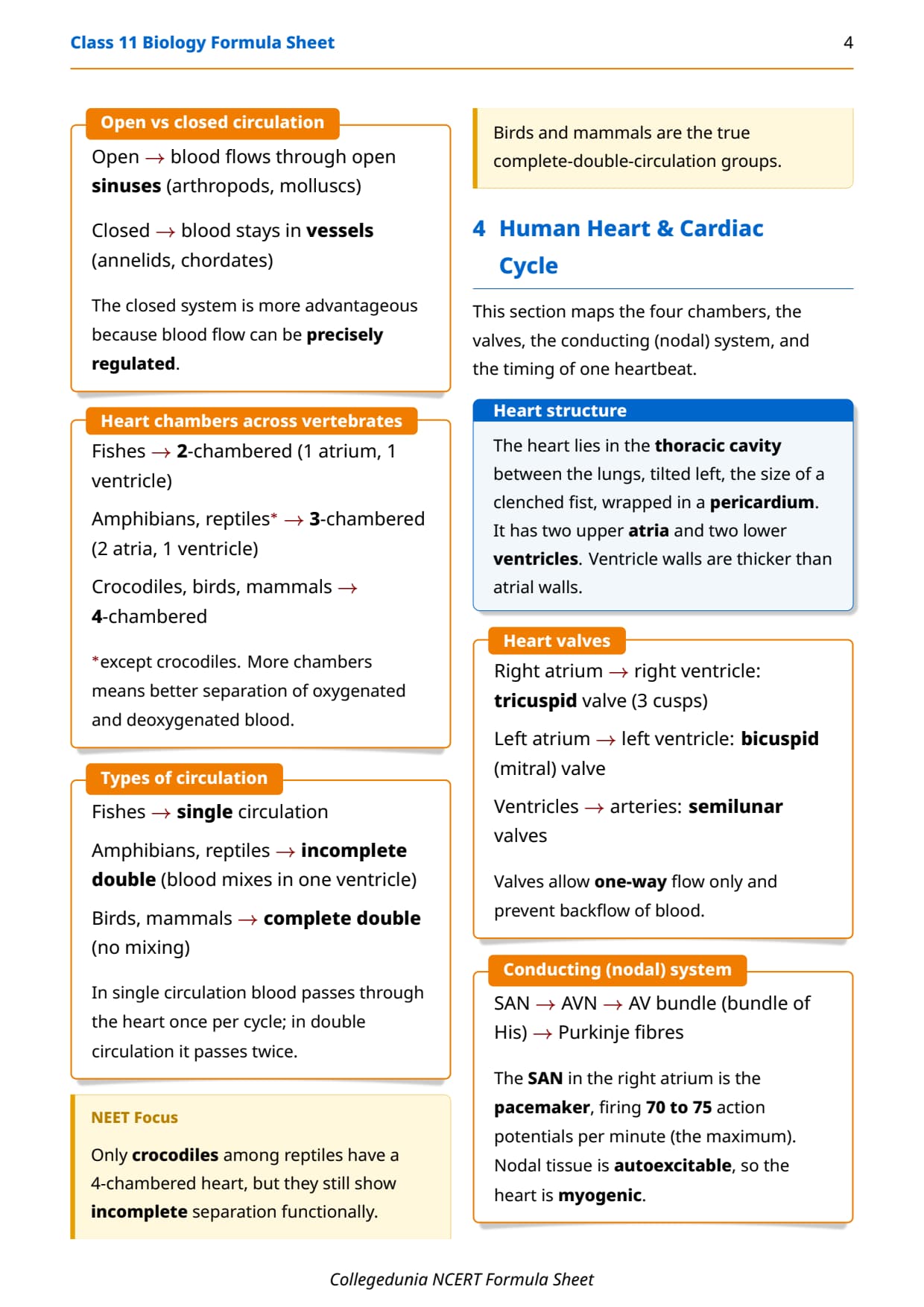
| Heart rate (HR) | 72 beats min−1, set by the SAN pacemaker |
| Cardiac cycle duration | 60 / 72 = 0.8 s per cycle (atrial systole 0.1 s, ventricular systole 0.3 s, joint diastole 0.4 s) |
| ECG waves | P wave = atrial depolarisation; QRS complex = ventricular depolarisation; T wave = ventricular repolarisation |
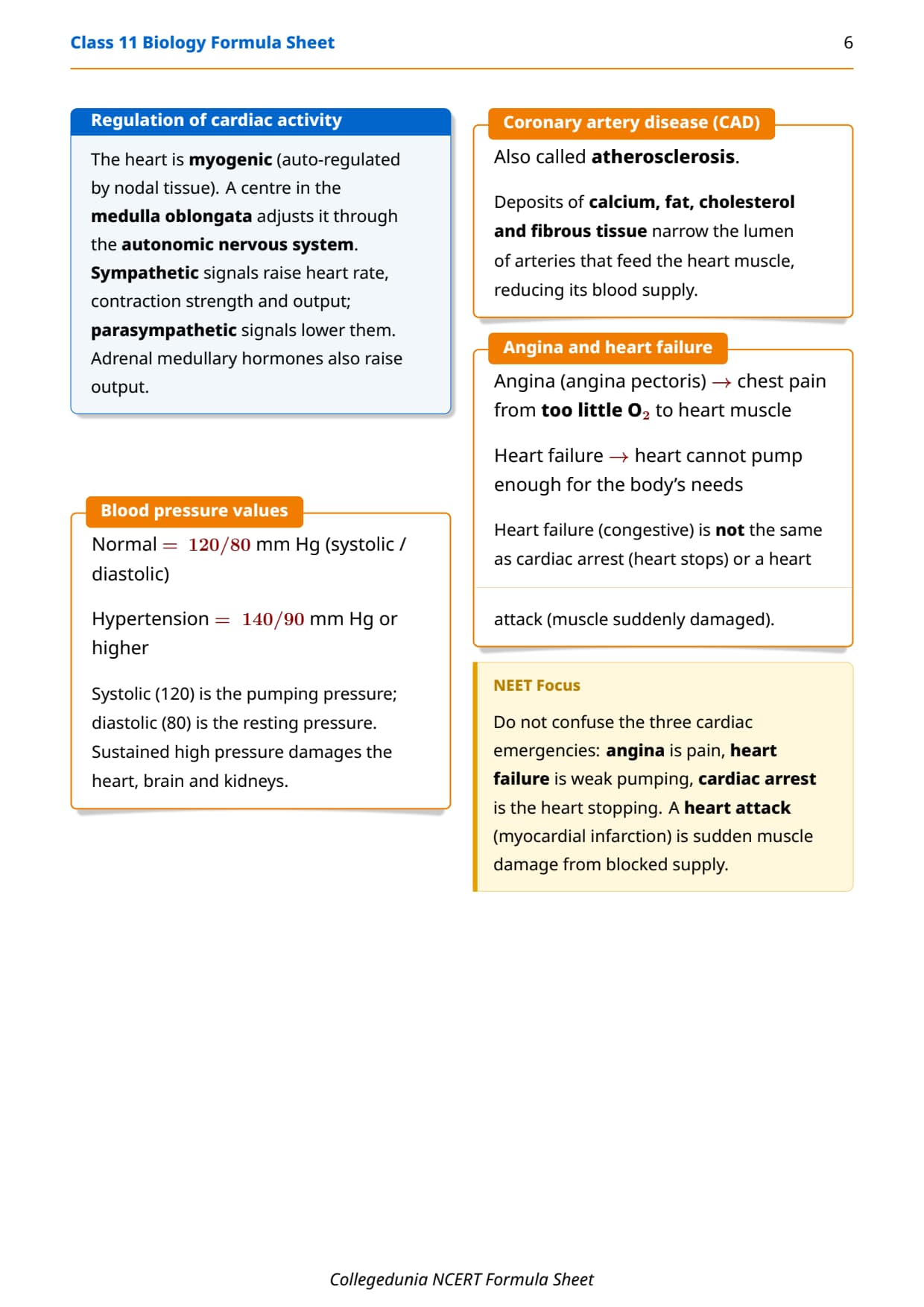
| Normal blood pressure | 120/80 mm Hg (systolic/diastolic); hypertension at 140/90 mm Hg or higher |
Counting the QRS complexes in an ECG over a minute gives the heart rate, and the heart sounds "lub" (bicuspid and tricuspid valves close) and "dub" (semilunar valves close) mark the cardiac cycle.
How to Revise Body Fluids and Circulation Before the Exam
This chapter rewards precise values more than long answers. A short, ordered revision fixes the counts and equations in memory.
- Write the counts of RBC, WBC and platelets with their life spans, then recall the WBC differential order.
- Memorise the ABO compatibility chart, and note that O is the universal donor and AB the universal recipient.
- Learn the cardiac output equation CO = SV x HR and the 0.8 second split of the cardiac cycle.
- Match each ECG wave to its event and revise the normal 120/80 mm Hg blood pressure value.
Student Feedback on the Body Fluids and Circulation Formula Sheet
In a survey of 1,200 NEET aspirants who used this sheet, 79% said the single-page cardiac output and blood group tables made the chapter's values easy to recall under exam pressure. Toppers reported that rewriting the ABO compatibility chart twice a week made the universal donor and recipient rules automatic before the exam.
Other Body Fluids and Circulation Class 11 Biology Resources
Pair this formula sheet with the solved answers, notes and textbook PDF.
| Resource | Link |
|---|---|
| NCERT Solutions | Body Fluids and Circulation Class 11 NCERT Solutions |
| Revision Notes | Body Fluids and Circulation Class 11 Notes |
| NCERT Book PDF | Body Fluids and Circulation Class 11 Book PDF |
NCERT Formula Sheet for Class 11 Biology: All Chapters
Revise every chapter from one place. Each link opens the formula sheet for that chapter.
| Chapter | Formula Sheet |
|---|---|
| Chapter 1 | The Living World |
| Chapter 2 | Biological Classification |
| Chapter 3 | Plant Kingdom |
| Chapter 4 | Animal Kingdom |
| Chapter 5 | Morphology of Flowering Plants |
| Chapter 6 | Anatomy of Flowering Plants |
| Chapter 7 | Structural Organisation in Animals |
| Chapter 8 | Cell: The Unit of Life |
| Chapter 9 | Biomolecules |
| Chapter 10 | Cell Cycle and Cell Division |
| Chapter 11 | Photosynthesis in Higher Plants |
| Chapter 12 | Respiration in Plants |
| Chapter 13 | Plant Growth and Development |
| Chapter 14 | Breathing and Exchange of Gases |
| Chapter 15 | Body Fluids and Circulation |
| Chapter 16 | Excretory Products and their Elimination |
| Chapter 17 | Locomotion and Movement |
| Chapter 18 | Neural Control and Coordination |
| Chapter 19 | Chemical Coordination and Integration |
FAQs on Body Fluids and Circulation Class 11 Biology Formula Sheet
Body Fluids and Circulation Formula Sheet - Frequently Asked Questions
Ques. What does the class 11 biology formula sheet chapter 15 body fluids and circulation cover?
Ans. This class 11 biology formula sheet chapter 15 body fluids and circulation covers the counts and functions of RBCs, WBCs and platelets, the ABO and Rh blood groups with donor compatibility, the cardiac output equation, the 0.8 second cardiac cycle, the ECG waves and normal blood pressure.
Ques. What is the formula for cardiac output in Class 11 Biology?
Ans. Cardiac output is given by CO = SV x HR. With a stroke volume of about 70 mL and a heart rate of 72 beats per minute, CO is about 70 x 72 = 5000 mL, or roughly 5 litres per minute in a healthy adult at rest.
Ques. Which blood group is the universal donor and which is the universal recipient?
Ans. Group O is the universal donor because its RBCs carry no A or B antigen, so its blood can be given to every group. Group AB is the universal recipient because its plasma has no anti-A or anti-B antibody, so it can receive from every group. The Rh type must still be matched.
Ques. What do the P, QRS and T waves of an ECG represent?
Ans. In an ECG the P wave marks atrial depolarisation (atrial contraction), the QRS complex marks ventricular depolarisation (start of ventricular contraction), and the T wave marks ventricular repolarisation (end of contraction). Counting the QRS complexes over a minute gives the heart rate.



Comments