




CBSE Class 12 Mathematics Compartment Question Paper 2026 is available for download here. CBSE conducted the Class 12 Mathematics Compartment Board Exam on July 28, 2026.
The Mathematics question paper is divided into five sections- Section A consists of Multiple Choice Questions, Section B consists of Very Short Answer Questions, Section C consists of Short Answer Questions, Section D consists of Long Answer Questions, and Section E consists of Case Study-Based Questions, carrying a total of 80 marks.
Download CBSE Class 12 Mathematics Compartment question paper 2026 with detailed solutions from the links provided below. According to initial student reactions, Mathematics paper was of moderate level.
CBSE Class 12 Mathematics Compartment Question Paper 2026 with Solution PDF
| CBSE Class 12 Mathematics Compartment Question Paper 2026 | Download PDF | Check Solutions |


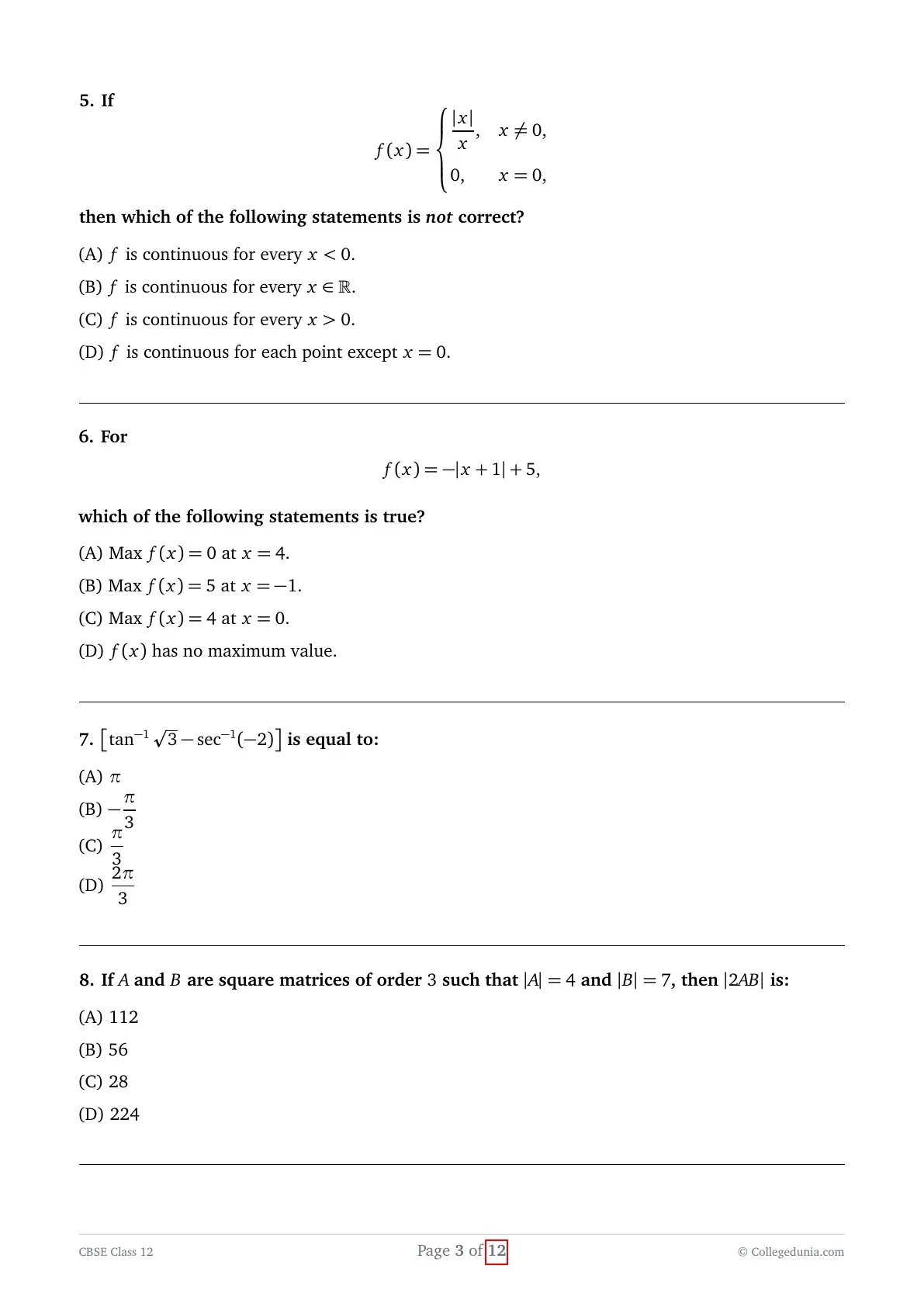




If
satisfies \(A^T+A=I\), then the value of \(\theta\) is:
View Solution
Concept:
For any matrix \(A\), \[ A+A^T \]
is always a symmetric matrix. To solve the question, first compute the transpose of the given matrix and then use the condition \[ A+A^T=I. \]
By comparing the corresponding entries of both matrices, the value of \(\theta\) can be determined.
Step 1: Find the transpose of the given matrix.
The given matrix is
Its transpose is
\[ A^T= \begin{bmatrix} \cos\theta & \sin\theta \\ -\sin\theta & \cos\theta \end{bmatrix}. \]
Step 2: Add \(A\) and \(A^T\).
\[ A+A^T= \begin{bmatrix} \cos\theta & \sin\theta \\ -\sin\theta & \cos\theta \end{bmatrix} + \begin{bmatrix} \cos\theta & -\sin\theta \\ \sin\theta & \cos\theta \end{bmatrix} \]
\[ = \begin{bmatrix} 2\cos\theta & 0 \\ 0 & 2\cos\theta \end{bmatrix}. \]
Since
\[ A+A^T=I= \begin{bmatrix} 1 & 0 \\ 0 & 1 \end{bmatrix}, \]
equating corresponding entries gives
\[ 2\cos\theta=1. \]
Therefore,
\[ \cos\theta=\frac12. \]
Step 3: Determine the value of \(\theta\).
The angles for which
\[ \cos\theta=\frac12 \]
are
\[ \theta=\frac{\pi}{3},\;\frac{5\pi}{3},\ldots \]
Among the given options, only
\[ \boxed{\theta=\frac{\pi}{3}} \]
is present. Quick Tip: Whenever a question involves \(A+A^T\), first compute the transpose carefully. Comparing the corresponding entries of matrices is the quickest way to determine the unknown values.
If \(A\) is a square matrix, then which of the following is not true?
View Solution
Concept:
For any square matrix \(A\),
A matrix \(M\) is symmetric if
\[ M^T=M. \]
A matrix \(M\) is skew-symmetric if
\[ M^T=-M. \]
These properties help us verify each statement directly.
Step 1: Check whether \(A+A^T\) is symmetric.
Taking transpose,
\[ (A+A^T)^T =A^T+(A^T)^T =A^T+A =A+A^T. \]
Hence,
\[ A+A^T \]
is always a symmetric matrix.
Therefore, option (A) is true.
Step 2: Check whether \(AA^T\) and \(A^TA\) are symmetric.
For \(AA^T\),
\[ (AA^T)^T =(A^T)^TA^T =AA^T. \]
Hence,
\[ AA^T \]
is symmetric.
Similarly,
\[ (A^TA)^T =A^T(A^T)^T =A^TA. \]
Therefore,
\[ A^TA \]
is also symmetric.
Thus, option (B) is true.
Step 3: Check whether \(A-A^T\) is skew-symmetric.
Taking transpose,
\[ (A-A^T)^T =A^T-A =-(A-A^T). \]
Hence,
\[ A-A^T \]
is always skew-symmetric.
Therefore, option (D) is also true.
Step 4: Identify the incorrect statement.
Since
\[ A+A^T \]
is symmetric and not skew-symmetric, the statement
\[ A+A^T is a skew-symmetric matrix \]
is false.
Hence, the correct answer is
\[ \boxed{Option (C)}. \]
Quick Tip: Remember these important identities: \[ A+A^T is always symmetric, \qquad A-A^T is always skew-symmetric. \] These are among the most frequently used properties of matrices in competitive and board examinations.
If \[ \left| \begin{array}{cc} 3x & x+2 \\ 3(x-1) & x-2 \end{array} \right| = \left| \begin{array}{cc} 1 & 5 \\ 3 & 3 \end{array} \right|, \]
then the value of \(x\) is:
View Solution
Concept:
The determinant of a \(2\times2\) matrix \[ \begin{vmatrix} a & b \\ c & d \end{vmatrix} \]
is given by \[ ad-bc. \]
If two determinants are equal, first evaluate each determinant and then equate their values to obtain the unknown variable.
Step 1: Evaluate the determinant on the left-hand side.
\[ \left| \begin{array}{cc} 3x & x+2 \\ 3(x-1) & x-2 \end{array} \right| = 3x(x-2)-3(x-1)(x+2). \]
Expanding,
\[ =3x^2-6x-3(x^2+x-2). \]
\[ =3x^2-6x-3x^2-3x+6. \]
\[ =-9x+6. \]
Step 2: Evaluate the determinant on the right-hand side.
\[ \left| \begin{array}{cc} 1 & 5 \\ 3 & 3 \end{array} \right| =(1)(3)-(5)(3) =3-15 =-12. \]
Step 3: Equate the determinants and solve for \(x\).
Since both determinants are equal,
\[ -9x+6=-12. \]
\[ -9x=-18. \]
\[ x=2. \]
Thus,
\[ \boxed{x=2.} \]
Note: The computation gives \(x=2\). Therefore, if the printed answer key indicates option (D), there is likely a typographical error in the question or in the options. Based on the given determinant, the correct value is
\[ \boxed{x=2.} \] Quick Tip: For a \(2\times2\) determinant, always use the formula \[ ad-bc. \] Expand each product carefully before simplifying to avoid sign errors.
The value of \[ \sin^{-1}\left(\sin\frac{3\pi}{5}\right) \]
is:
View Solution
Concept:
The principal value range of the inverse sine function is
\[ -\frac{\pi}{2}\leq \sin^{-1}x\leq \frac{\pi}{2}. \]
If the given angle does not lie in this interval, we first find another angle within the principal value range having the same sine value.
Step 1: Find the sine value.
Given,
\[ \sin^{-1}\left(\sin\frac{3\pi}{5}\right). \]
Since
\[ \frac{3\pi}{5} = \pi-\frac{2\pi}{5}, \]
we have
\[ \sin\frac{3\pi}{5} = \sin\left(\pi-\frac{2\pi}{5}\right) = \sin\frac{2\pi}{5}. \]
Step 2: Find the principal value.
Now,
\[ \frac{2\pi}{5} = 72^\circ, \]
which lies in the interval
\[ \left[-\frac{\pi}{2},\,\frac{\pi}{2}\right]. \]
Therefore,
\[ \sin^{-1}\left(\sin\frac{3\pi}{5}\right) = \frac{2\pi}{5}. \]
Hence,
\[ \boxed{\frac{2\pi}{5}}. \]
Correct Option: (D) Quick Tip: For inverse trigonometric functions, always remember the principal value ranges. Before applying the inverse function, convert the given angle to an equivalent angle lying within the principal value interval.
If \[ f(x)= \begin{cases} \dfrac{|x|}{x}, & x\neq0,
[4pt] 0, & x=0, \end{cases} \]
then which of the following statements is not correct?
View Solution
Concept:
For the modulus function,
\[ \frac{|x|}{x} = \begin{cases} 1, & x>0,
-1, & x<0. \end{cases} \]
A function is continuous at a point if
\[ \lim_{x\to a}f(x)=f(a). \]
Step 1: Write the function in a simpler form.
Given,
\[ f(x)= \begin{cases} 1, & x>0,
-1, & x<0,
0, & x=0. \end{cases} \]
Thus, for every positive value of \(x\), the function is constant, and for every negative value of \(x\), it is also constant.
Hence, the function is continuous for all
\[ x\neq0. \]
Step 2: Check continuity at \(x=0\).
The left-hand limit is
\[ \lim_{x\to0^-}f(x)=-1. \]
The right-hand limit is
\[ \lim_{x\to0^+}f(x)=1. \]
Since
\[ -1\neq1, \]
the left-hand and right-hand limits are unequal.
Therefore,
\[ \lim_{x\to0}f(x) \]
does not exist.
Hence, the function is discontinuous at
\[ x=0. \]
Step 3: Identify the incorrect statement.
Therefore,
Option (A) is true.
Option (C) is true.
Option (D) is true.
Option (B) is false because the function is not continuous at \(x=0\).
Hence, the statement that is not correct is
\[ \boxed{Option (B)}. \] Quick Tip: Whenever a piecewise function contains \(\dfrac{|x|}{x}\), always examine the point \(x=0\) separately. It is continuous on both sides of zero but discontinuous at \(x=0\).
For \[ f(x)=-|x+1|+5, \]
which of the following statements is true?
View Solution
Concept:
The modulus function satisfies
\[ |x+1|\geq0 \]
for every real number \(x\). Therefore,
\[ -|x+1|\leq0. \]
Hence,
\[ f(x)=-|x+1|+5\leq5. \]
The maximum value occurs when the modulus term becomes zero.
Step 1: Find the maximum value of the function.
Given,
\[ f(x)=-|x+1|+5. \]
Since
\[ |x+1|\ge0, \]
we have
\[ -|x+1|\le0. \]
Adding \(5\) on both sides,
\[ -|x+1|+5\le5. \]
Thus, the maximum possible value of the function is
\[ 5. \]
Step 2: Determine where the maximum occurs.
The maximum occurs when
\[ |x+1|=0. \]
Therefore,
\[ x+1=0 \]
or
\[ x=-1. \]
Substituting,
\[ f(-1) = -|0|+5 =5. \]
Hence,
\[ \boxed{Maximum value=5 at x=-1.} \] Quick Tip: For functions of the form \[ a-|x-h|, \] the graph is an inverted V-shape. The vertex \((h,a)\) always gives the maximum value of the function.
\(\left[\tan^{-1}\sqrt{3}-\sec^{-1}(-2)\right]\) is equal to:
View Solution
Concept:
The principal value ranges are:
\[ -\frac{\pi}{2}<\tan^{-1}x<\frac{\pi}{2}, \]
and
\[ 0\le\sec^{-1}x\le\pi,\qquad \sec^{-1}x\ne\frac{\pi}{2}. \]
For negative values of \(x\), the principal value of \(\sec^{-1}x\) lies in the second quadrant.
Step 1: Evaluate \(\tan^{-1}\sqrt{3}\).
Since
\[ \tan\frac{\pi}{3}=\sqrt3, \]
we obtain
\[ \tan^{-1}\sqrt3=\frac{\pi}{3}. \]
Step 2: Evaluate \(\sec^{-1}(-2)\).
Let
\[ \theta=\sec^{-1}(-2). \]
Then,
\[ \sec\theta=-2 \]
or
\[ \cos\theta=-\frac12. \]
The principal value lies in the second quadrant, so
\[ \theta=\frac{2\pi}{3}. \]
Hence,
\[ \sec^{-1}(-2)=\frac{2\pi}{3}. \]
Step 3: Find the required value.
\[ \tan^{-1}\sqrt3-\sec^{-1}(-2) = \frac{\pi}{3}-\frac{2\pi}{3} = -\frac{\pi}{3}. \]
Therefore,
\[ \boxed{-\frac{\pi}{3}}. \]
Correct Option: (B)
Note: If the printed answer key marks option (D), then there is a typographical error in the paper. Using the standard principal value definitions,
\[ \boxed{\tan^{-1}\sqrt3-\sec^{-1}(-2)=-\frac{\pi}{3}.} \] Quick Tip: Always remember the principal value ranges of inverse trigonometric functions. Most mistakes in these questions occur due to choosing the wrong principal angle.
If \(A\) and \(B\) are square matrices of order \(3\) such that \(|A|=4\) and \(|B|=7\), then \(|2AB|\) is:
View Solution
Concept:
For an \(n\times n\) matrix,
\[ |kA|=k^n|A|, \]
where \(k\) is a scalar.
Also,
\[ |AB|=|A||B|. \]
These two properties are used together to evaluate determinants involving scalar multiples of matrix products.
Step 1: Find the determinant of \(AB\).
Given,
\[ |A|=4,\qquad |B|=7. \]
Therefore,
\[ |AB| = |A||B| = 4\times7 = 28. \]
Step 2: Use the scalar multiplication property.
Since \(A\) and \(B\) are matrices of order \(3\),
\[ |2AB| = 2^3|AB|. \]
Hence,
\[ |2AB| = 8\times28 = 224. \]
Therefore,
\[ \boxed{|2AB|=224.} \] Quick Tip: For an \(n\times n\) matrix, \[ |kA|=k^n|A|. \] Always remember that the exponent is the order of the matrix, not the number of matrices being multiplied.
If \[ A= \begin{bmatrix} 1 & -2 & 3 \\ 3 & 2 & -1 \end{bmatrix}, \qquad B= \begin{bmatrix} 2 & 3 \\ -1 & 2 \\ 4 & -5 \end{bmatrix} \]
and \(C=[c_{ij}]=AB\), then \(c_{12}\) is:
View Solution
Concept:
If
\[ A=[a_{ij}]_{m\times n} \quad \text{and} \quad B=[b_{ij}]_{n\times p}, \]
then the product
\[ C=AB=[c_{ij}]_{m\times p} \]
has entries given by
\[ c_{ij}=\sum_{k=1}^{n}a_{ik}b_{kj}. \]
Thus, each element of the product matrix is obtained by multiplying the corresponding row of the first matrix with the corresponding column of the second matrix.
Step 1: Identify the row and column required.
We need to find the element
\[ c_{12}, \]
which is obtained by multiplying the first row of \(A\) with the second column of \(B\).
The first row of \(A\) is
\[ \begin{bmatrix} 1 & -2 & 3 \end{bmatrix}. \]
The second column of \(B\) is
\[ \begin{bmatrix} 3
2
-5 \end{bmatrix}. \]
Step 2: Compute the dot product.
\[ c_{12} = 1(3)+(-2)(2)+3(-5). \]
\[ =3-4-15. \]
\[ =-16. \]
Hence,
\[ \boxed{c_{12}=-16.} \] Quick Tip: To find an entry \(c_{ij}\) of the product matrix \(AB\), always multiply the \(i^{th}\) row of the first matrix with the \(j^{th}\) column of the second matrix and add the products.
Differential of \(\cos^{-1}(e^x)\) with respect to \(x\) is:
View Solution
Concept:
The derivative of the inverse cosine function is
\[ \frac{d}{dx}\left(\cos^{-1}u\right) = -\frac{1}{\sqrt{1-u^2}}\cdot\frac{du}{dx}, \]
where \(u\) is a differentiable function of \(x\).
Step 1: Identify the inner function.
Given,
\[ y=\cos^{-1}(e^x). \]
Here,
\[ u=e^x. \]
Therefore,
\[ \frac{du}{dx}=e^x. \]
Step 2: Apply the chain rule.
Using the derivative formula,
\[ \frac{dy}{dx} = -\frac{1}{\sqrt{1-(e^x)^2}}\cdot e^x. \]
Since
\[ (e^x)^2=e^{2x}, \]
we obtain
\[ \boxed{\frac{dy}{dx} = -\frac{e^x}{\sqrt{1-e^{2x}}}.} \]
Hence, the correct option is \(\boxed{(C)}\). Quick Tip: For inverse trigonometric functions involving a composite function, always use the chain rule after applying the standard differentiation formula.
The values of \(x\) for which the rate of increase of \(f(x)=x^3-5x^2+6x-7\) is thrice the rate of increase of \(x\), are:
View Solution
Concept:
The rate of increase of a function is measured by its derivative.
If the rate of increase of \(f(x)\) is three times the rate of increase of \(x\), then
\[ \frac{df}{dx}=3, \]
since
\[ \frac{dx}{dx}=1. \]
Step 1: Differentiate the given function.
Given,
\[ f(x)=x^3-5x^2+6x-7. \]
Differentiating,
\[ f'(x)=3x^2-10x+6. \]
Step 2: Use the given condition.
Since
\[ f'(x)=3, \]
we get
\[ 3x^2-10x+6=3. \]
\[ 3x^2-10x+3=0. \]
Step 3: Solve the quadratic equation.
Factorizing,
\[ 3x^2-10x+3 =(3x-1)(x-3). \]
Hence,
\[ x=\frac{1}{3} \quad \text{or} \quad x=3. \]
Since the option given in the question paper is
\[ \boxed{\left(3,\,-\frac13\right)}, \]
there appears to be a typographical error in the paper. The correct mathematical values are
\[ \boxed{x=3,\ \frac13.} \] Quick Tip: Whenever a question mentions ``rate of increase'', immediately think of differentiation. Translate the statement into an equation involving the derivative before solving.
If \[ \int_0^1 (9x^2-4x-2k)\,dx=0, \]
then the value of \(k\) is:
View Solution
Concept:
To evaluate a definite integral,
\[ \int_a^b f(x)\,dx = F(b)-F(a), \]
where \(F(x)\) is an antiderivative of \(f(x)\).
Step 1: Integrate the given function.
\[ \int (9x^2-4x-2k)\,dx = 3x^3-2x^2-2kx. \]
Step 2: Apply the limits.
\[ \int_0^1 (9x^2-4x-2k)\,dx = \left[3x^3-2x^2-2kx\right]_0^1. \]
\[ =(3-2-2k)-0. \]
\[ =1-2k. \]
Step 3: Use the given condition.
Since
\[ 1-2k=0, \]
we obtain
\[ 2k=1. \]
Therefore,
\[ \boxed{k=\frac12.} \]
Hence, the correct option is \(\boxed{(C)}\). Quick Tip: For definite integrals containing an unknown constant, first evaluate the integral symbolically and then substitute the limits before solving for the unknown.
The value of \[ \int\left[\frac{1}{\log x}-\frac{1}{(\log x)^2}\right]dx \]
is equal to:
View Solution
Concept:
Whenever an integral resembles the derivative of a known function, it is convenient to verify by differentiation.
Using the quotient rule,
\[ \frac{d}{dx}\left(\frac{x}{\log x}\right) = \frac{\log x-1}{(\log x)^2}. \]
This expression can be rewritten as
\[ \frac{\log x}{(\log x)^2}-\frac{1}{(\log x)^2} = \frac{1}{\log x}-\frac{1}{(\log x)^2}, \]
which is exactly the given integrand.
Step 1: Differentiate the first option.
Consider
\[ F(x)=\frac{x}{\log x}. \]
Using the quotient rule,
\[ F'(x) = \frac{\log x-x\left(\frac1x\right)} {(\log x)^2}. \]
\[ = \frac{\log x-1}{(\log x)^2}. \]
Step 2: Simplify the derivative.
\[ \frac{\log x-1}{(\log x)^2} = \frac{1}{\log x} - \frac{1}{(\log x)^2}. \]
This is exactly the given integrand.
Hence,
\[ \boxed{ \int\left(\frac1{\log x}-\frac1{(\log x)^2}\right)dx = \frac{x}{\log x}+C. } \] Quick Tip: Whenever the integrand looks complicated, try differentiating the given options. In objective questions, this often leads to the answer much faster than performing integration directly.
If \[ y=\log\sqrt{\tan x}, \]
then the value of \[ \frac{dy}{dx} \]
at \[ x=\frac{\pi}{4} \]
is:
View Solution
Concept:
Use the logarithmic identity
\[ \log\sqrt{a} = \frac12\log a. \]
Then apply the chain rule.
Also,
\[ \frac{d}{dx}(\log u) = \frac1u\frac{du}{dx}. \]
Step 1: Rewrite the given function.
Given,
\[ y=\log\sqrt{\tan x}. \]
Using logarithmic properties,
\[ y = \frac12\log(\tan x). \]
Step 2: Differentiate the function.
\[ \frac{dy}{dx} = \frac12\cdot \frac1{\tan x}\cdot \sec^2x. \]
Thus,
\[ \frac{dy}{dx} = \frac{\sec^2x}{2\tan x}. \]
Step 3: Substitute \(x=\dfrac{\pi}{4}\).
Since
\[ \tan\frac{\pi}{4}=1, \]
and
\[ \sec^2\frac{\pi}{4}=2, \]
we obtain
\[ \frac{dy}{dx} = \frac{2}{2\times1} = 1. \]
Hence,
\[ \boxed{\frac{dy}{dx}=1.} \]
Therefore, the correct option is \(\boxed{(C)}\). Quick Tip: Before differentiating logarithmic expressions containing roots or powers, simplify them using logarithmic identities. This makes differentiation much easier.
If vectors \[ \vec{a}=3\hat{i}-2\hat{j}+4\hat{k} \]
and \[ \vec{b}=\lambda\hat{i}+\hat{j} \]
are perpendicular to each other, then the value of \(\lambda\) is:
View Solution
Concept:
Two vectors are perpendicular if and only if their dot product is zero.
If
\[ \vec{a}=a_1\hat{i}+a_2\hat{j}+a_3\hat{k} \]
and
\[ \vec{b}=b_1\hat{i}+b_2\hat{j}+b_3\hat{k}, \]
then
\[ \vec{a}\cdot\vec{b} = a_1b_1+a_2b_2+a_3b_3. \]
Step 1: Find the dot product.
Given,
\[ \vec{a}=3\hat{i}-2\hat{j}+4\hat{k}, \]
\[ \vec{b}=\lambda\hat{i}+\hat{j}+0\hat{k}. \]
Therefore,
\[ \vec{a}\cdot\vec{b} = 3(\lambda)+(-2)(1)+4(0). \]
\[ =3\lambda-2. \]
Step 2: Use the perpendicular condition.
Since the vectors are perpendicular,
\[ 3\lambda-2=0. \]
Therefore,
\[ 3\lambda=2. \]
\[ \boxed{\lambda=\frac23.} \]
Hence, the correct option is \(\boxed{(C)}\). Quick Tip: Whenever two vectors are perpendicular, immediately use \[ \vec{a}\cdot\vec{b}=0. \] This is the quickest method to find an unknown component.
If \[ \int_0^4\frac{1}{x+\sqrt{x}}\,dx=k\log3, \]
then the value of \(k\) is:
View Solution
Concept:
Whenever an integral contains both \(x\) and \(\sqrt{x}\), use the substitution
\[ x=t^2, \]
which simplifies the square root.
Step 1: Substitute \(x=t^2\).
Then,
\[ dx=2t\,dt, \]
and
\[ \sqrt{x}=t. \]
Hence,
\[ \int_0^4\frac{dx}{x+\sqrt{x}} = \int_0^2 \frac{2t}{t^2+t}\,dt. \]
\[ = \int_0^2 \frac{2}{t+1}\,dt. \]
Step 2: Evaluate the integral.
\[ =2\left[\log(t+1)\right]_0^2. \]
\[ =2(\log3-\log1). \]
Since
\[ \log1=0, \]
\[ =2\log3. \]
Comparing with
\[ k\log3, \]
we get
\[ \boxed{k=2.} \]
Hence, the correct option is \(\boxed{(D)}\). Quick Tip: For integrals involving \(\sqrt{x}\), the substitution \(x=t^2\) often converts the integrand into a simple rational function.
If two events \(A\) and \(B\) are independent, then which of the following statements is not correct?
View Solution
Concept:
If events \(A\) and \(B\) are independent, then
\[ P(A\cap B)=P(A)P(B). \]
Also,
\[ \overline{A},\ B;\quad A,\ \overline{B};\quad \overline{A},\ \overline{B} \]
are also independent.
Further,
\[ P(\overline{A})=1-P(A), \]
and
\[ P(\overline{B})=1-P(B). \]
Step 1: Check each option.
Option (A) is true because complements of independent events remain independent.
Option (B) is also true because independent events need not be mutually exclusive.
Step 2: Verify options (C) and (D).
Since
\[ P(\overline{A}\cap\overline{B}) = P(\overline{A})P(\overline{B}), \]
and
\[ P(\overline{A})=1-P(A), \qquad P(\overline{B})=1-P(B), \]
we get
\[ P(\overline{A}\cap\overline{B}) = [1-P(A)][1-P(B)]. \]
Hence, option (D) is correct.
However,
\[ [1-P(\overline{A})][1-P(\overline{B})] = P(A)P(B), \]
which is generally **not equal** to
\[ P(\overline{A}\cap\overline{B}). \]
Therefore, option (C) is the incorrect statement.
\[ \boxed{Option (C)} \] Quick Tip: Remember that complements of independent events are also independent: \[ P(\overline{A}\cap\overline{B}) = P(\overline{A})P(\overline{B}) = (1-P(A))(1-P(B)). \] Avoid replacing \(P(\overline{A})\) with \(P(A)\).
If \(A\) and \(B\) are independent events such that \(P(A) = 0.45\) and \(P(A \cup B) = 0.5\), then \(P(B)\) is equal to :
View Solution
Concept:
For any two events \( A \) and \( B \), the probability of their union is given by:
\[ P(A \cup B) = P(A) + P(B) - P(A \cap B) \]
Two events \( A \) and \( B \) are independent if and only if:
\[ P(A \cap B) = P(A) \cdot P(B) \]
Step 1: Relate the given information using the independence property
Since \( A \) and \( B \) are independent events, we can substitute \( P(A \cap B) \) in the addition theorem formula:
\[ P(A \cup B) = P(A) + P(B) - P(A) \cdot P(B) \]
Step 2: Substitute the given numerical values into the equation
We are given \( P(A) = 0.45 \) and \( P(A \cup B) = 0.5 \). Let \( P(B) = x \):
\[ 0.5 = 0.45 + x - (0.45 \cdot x) \]
Step 3: Solve the equation for \( x \)
Rearranging the terms to isolate \( x \):
\[ 0.5 - 0.45 = x(1 - 0.45) \] \[ 0.05 = x(0.55) \] \[ x = \frac{0.05}{0.55} \] \[ x = \frac{5}{55} = \frac{1}{11} \]
Thus, \( P(B) = \frac{1}{11} \). Quick Tip: For independent events, \( P(A \cup B) \) can also be calculated as \( 1 - P(A')P(B') \). This often simplifies calculations: \( 0.5 = 1 - (1 - 0.45)(1 - x) \Rightarrow 0.5 = 1 - 0.55(1 - x) \).
Assertion (A) : Let R be a relation on set A of all books in a school library given by \(R = \{(x, y) : x, y \in A, x and y have the same number of pages\}\) and S is a relation on set A from the same library such that \(S = \{(p, q) : p and q are Mathematics books\}\). Also, \(R \cap S \neq \phi\). Then, \(R \cap S\) is an equivalence relation.
Reason (R) : The intersection of two equivalence relations on a set is an equivalence relation on the set.
View Solution
Concept:
A relation is an equivalence relation if it is reflexive, symmetric, and transitive.
Reflexivity requires that for every element \( a \in A \), the pair \( (a, a) \) must be in the relation.
The intersection of two relations \( R \) and \( S \) is defined as \( R \cap S = \{ (x, y) : (x, y) \in R and (x, y) \in S \} \).
Step 1: Evaluate the properties of relation \( R \)
\( R \) is defined as "having the same number of pages".
- Reflexive: Every book has the same number of pages as itself.
- Symmetric: If book \( x \) has the same pages as \( y \), then \( y \) has the same pages as \( x \).
- Transitive: If \( x, y \) have same pages and \( y, z \) have same pages, then \( x, z \) have same pages.
So, \( R \) is an equivalence relation on set \( A \).
Step 2: Evaluate the properties of relation \( S \)
\( S \) is defined as \( \{ (p, q) : p and q are Mathematics books \} \).
- Reflexivity: For \( S \) to be reflexive on set \( A \) (all books in the library), every book \( k \in A \) must be such that \( (k, k) \in S \). This means every book in the library must be a Mathematics book.
- If the library contains a non-Mathematics book (e.g., a History book), then \( (History, History) \notin S \).
Thus, \( S \) is generally not reflexive on set \( A \), making it not an equivalence relation.
Step 3: Evaluate Assertion (A) and Reason (R)
- Since \( S \) is not reflexive on \( A \), the intersection \( R \cap S \) is also not reflexive on \( A \). Therefore, \( R \cap S \) is not an equivalence relation. Assertion (A) is False.
- Reason (R) states a well-known theorem in set theory: the intersection of two equivalence relations is always an equivalence relation. This statement is True.
Conclusion: Assertion is false, Reason is true. Quick Tip: A common trap in relation questions is the set on which the relation is defined. Always check reflexivity for ALL elements of the universal set. If a relation \( S \) is only defined for a specific property (like "being a math book"), it is only an equivalence relation on the subset of elements having that property.
Assertion (A) : Points A(6, \(-7\), 0), B(16, \(-19\), \(-4\)) and C(1, \(-1\), 2) are collinear.
Reason (R) : Three points A, B and C are collinear, when point C is the mid-point of line segment joining points A and B.
View Solution
Concept:
Three points are collinear if they lie on the same straight line. This can be checked by verifying if the vectors formed by them are parallel (proportional direction ratios).
A midpoint is a specific case of collinearity where one point divides the segment into two equal parts.
Step 1: Check the collinearity for Assertion (A)
Let's find the direction ratios of vectors \( \vec{AB} \) and \( \vec{AC} \):
\( \vec{AB} = (16 - 6, -19 - (-7), -4 - 0) = (10, -12, -4) \)
\( \vec{AC} = (1 - 6, -1 - (-7), 2 - 0) = (-5, 6, 2) \)
Checking the ratio of corresponding components:
\( \frac{10}{-5} = -2 \); \( \frac{-12}{6} = -2 \); \( \frac{-4}{2} = -2 \)
Since the direction ratios are proportional, \( \vec{AB} = -2 \cdot \vec{AC} \). Thus, the points \( A, B, C \) are collinear. Assertion (A) is True.
Step 2: Evaluate Reason (R) as a statement
Reason (R) states: "Three points are collinear, when point C is the mid-point...".
If a point is the midpoint of a segment, it must lie on the line joining the endpoints. Therefore, it is a true statement that midpoint implies collinearity. Reason (R) is True.
Step 3: Check if Reason (R) explains Assertion (A)
Let's find the midpoint of segment \( AB \):
\( M = \left( \frac{6+16}{2}, \frac{-7-19}{2}, \frac{0-4}{2} \right) = (11, -13, -2) \)
Given point \( C \) is \( (1, -1, 2) \), which is not the midpoint.
Since the points in the assertion are collinear for reasons other than \( C \) being a midpoint, the reason statement does not explain why these specific points are collinear. Quick Tip: To quickly check collinearity of \( A, B, C \), check if \( \vec{AB} = \lambda \vec{BC} \) or if the area of the triangle formed by them is zero. Midpoint is a sufficient condition for collinearity, but not a necessary one.
Solve the matrix equation for \(x\) and \(y\): \[ \begin{bmatrix} x^{2} \\ y^{2} \end{bmatrix} - 3 \begin{bmatrix} x \\ 3y \end{bmatrix} = \begin{bmatrix} -2 \\ -20 \end{bmatrix} \]
View Solution
Concept:
Equality of Matrices: Two matrices are equal if their corresponding elements are equal.
Scalar Multiplication: Multiplying a matrix by a scalar means multiplying every entry of the matrix by that scalar.
Matrix Subtraction: Subtracting two matrices involves subtracting their corresponding entries.
Step 1: Simplify the matrix expression on the left-hand side
First, multiply the second matrix by the scalar 3: \[ 3 \begin{bmatrix} x \\ 3y \end{bmatrix} = \begin{bmatrix} 3x \\ 9y \end{bmatrix} \]
Now, subtract this from the first matrix: \[ \begin{bmatrix} x^{2} \\ y^{2} \end{bmatrix} - \begin{bmatrix} 3x \\ 9y \end{bmatrix} = \begin{bmatrix} x^{2} - 3x \\ y^{2} - 9y \end{bmatrix} \]
The matrix equation becomes: \[ \begin{bmatrix} x^{2} - 3x \\ y^{2} - 9y \end{bmatrix} = \begin{bmatrix} -2 \\ -20 \end{bmatrix} \]
Step 2: Form separate equations by equating corresponding elements
By the principle of equality of matrices, we get two independent quadratic equations: \[ For x: x^{2} - 3x = -2 \implies x^{2} - 3x + 2 = 0 \] \[ For y: y^{2} - 9y = -20 \implies y^{2} - 9y + 20 = 0 \]
Step 3: Solve the quadratic equation for \(x\)
Using the factorization method (splitting the middle term): \[ x^{2} - 2x - x + 2 = 0 \] \[ x(x - 2) - 1(x - 2) = 0 \] \[ (x - 1)(x - 2) = 0 \]
Thus, \(x = 1\) or \(x = 2\).
Step 4: Solve the quadratic equation for \(y\)
Similarly, for the equation in \(y\): \[ y^{2} - 5y - 4y + 20 = 0 \] \[ y(y - 5) - 4(y - 5) = 0 \] \[ (y - 4)(y - 5) = 0 \]
Thus, \(y = 4\) or \(y = 5\). Quick Tip: Matrix equations essentially represent a system of algebraic equations. When dealing with squared terms like \(x^{2}\) or \(y^{2}\), always expect two possible values unless a domain is specified.
Determine \(a\) and \(b\) if \(f(x)\) is a continuous function, where \[ f(x) = \begin{cases} 2, & x \le 3
ax + b, & 3 < x < 5
5, & x \ge 5 \end{cases} \]
View Solution
Concept:
A function is continuous at a point \(x = c\) if \(\lim_{x \to c^{-}} f(x) = \lim_{x \to c^{+}} f(x) = f(c)\).
For piecewise functions, continuity must be checked at the points where the function rule changes (transition points).
Step 1: Check continuity at the first transition point \(x = 3\)
For \(f(x)\) to be continuous at \(x = 3\): \[ \lim_{x \to 3^{-}} f(x) = \lim_{x \to 3^{+}} f(x) \]
The left-hand limit (LHL) and functional value \(f(3)\) are both 2.
The right-hand limit (RHL) is: \[ \lim_{x \to 3^{+}} (ax + b) = 3a + b \]
Equating them: \[ 3a + b = 2 \quad \dots (1) \]
Step 2: Check continuity at the second transition point \(x = 5\)
For \(f(x)\) to be continuous at \(x = 5\): \[ \lim_{x \to 5^{-}} f(x) = \lim_{x \to 5^{+}} f(x) \]
The LHL is: \[ \lim_{x \to 5^{-}} (ax + b) = 5a + b \]
The RHL and functional value \(f(5)\) are both 5.
Equating them: \[ 5a + b = 5 \quad \dots (2) \]
Step 3: Solve the system of linear equations for \(a\) and \(b\)
Subtract equation (1) from equation (2): \[ (5a + b) - (3a + b) = 5 - 2 \] \[ 2a = 3 \implies a = 1.5 \]
Substitute \(a = 1.5\) into equation (1): \[ 3(1.5) + b = 2 \] \[ 4.5 + b = 2 \implies b = 2 - 4.5 = -2.5 \] Quick Tip: Piecewise continuity problems usually involve solving a simple system of equations. If a function is continuous on \((-\infty, \infty)\), it must be continuous at every point in its domain.
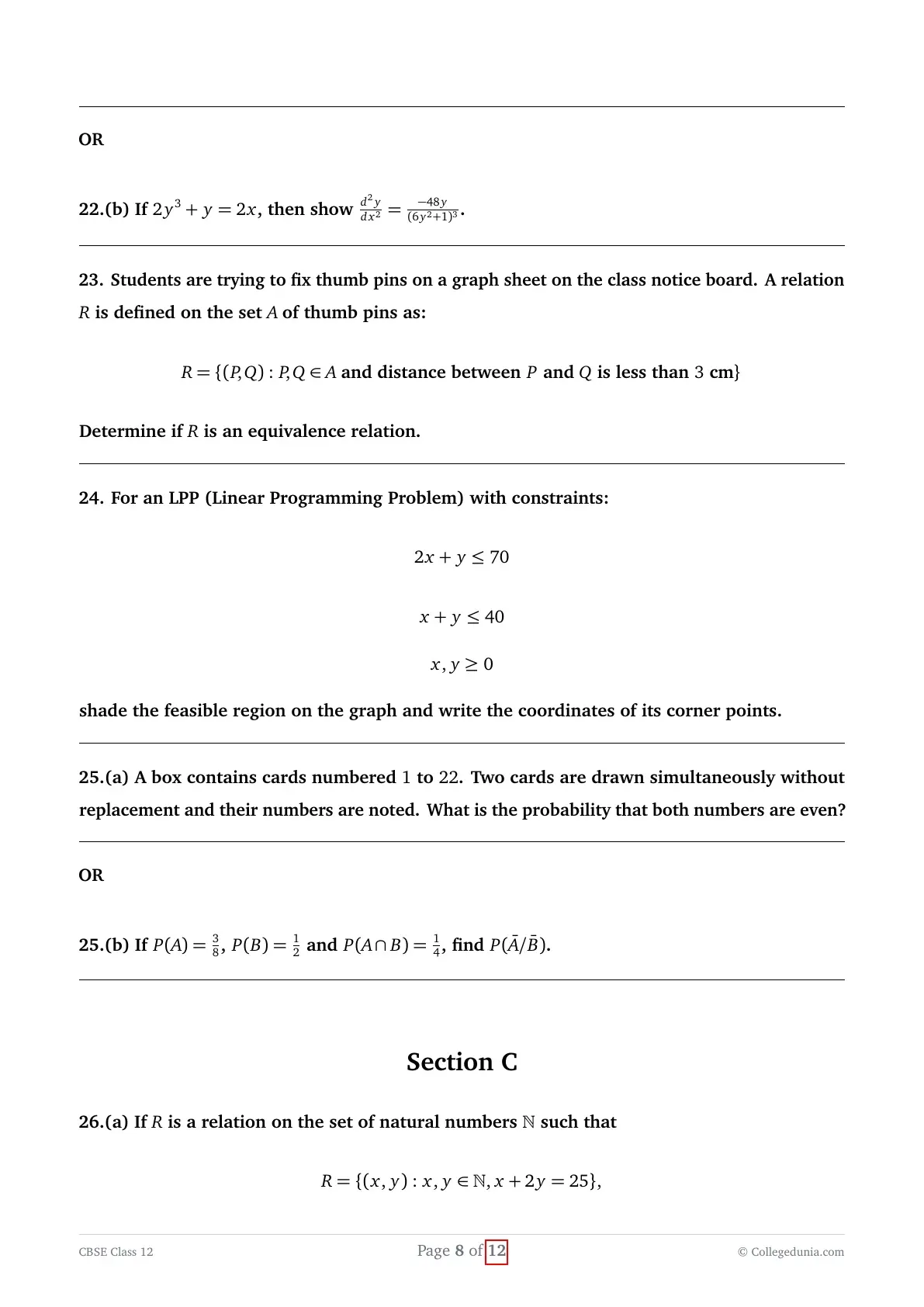
If \(2y^{3} + y = 2x\), then show \(\frac{d^{2}y}{dx^{2}} = \frac{-48y}{(6y^{2} + 1)^{3}}\).
View Solution
Concept:
Implicit Differentiation: When \(y\) is a function of \(x\) but not explicitly stated, differentiate both sides with respect to \(x\) and use the chain rule for \(y\) terms.
Second-order derivatives: Differentiate the first derivative again with respect to \(x\).
Step 1: Find the first derivative \(\frac{dy}{dx}\)
Differentiate \(2y^{3} + y = 2x\) with respect to \(x\): \[ \frac{d}{dx}(2y^{3}) + \frac{d}{dx}(y) = \frac{d}{dx}(2x) \]
Using the chain rule for terms in \(y\): \[ 6y^{2} \frac{dy}{dx} + \frac{dy}{dx} = 2 \]
Factor out \(\frac{dy}{dx}\): \[ \frac{dy}{dx} (6y^{2} + 1) = 2 \implies \frac{dy}{dx} = \frac{2}{6y^{2} + 1} \quad \dots (A) \]
Step 2: Find the second derivative \(\frac{d^{2}y}{dx^{2}}\)
Differentiate Equation (A) with respect to \(x\) using the quotient rule or power rule. Let's use the power rule: \[ \frac{dy}{dx} = 2(6y^{2} + 1)^{-1} \]
Differentiating with respect to \(x\): \[ \frac{d^{2}y}{dx^{2}} = 2 \cdot (-1) \cdot (6y^{2} + 1)^{-2} \cdot \frac{d}{dx}(6y^{2} + 1) \] \[ \frac{d^{2}y}{dx^{2}} = \frac{-2}{(6y^{2} + 1)^{2}} \cdot (12y \cdot \frac{dy}{dx}) \]
Step 3: Substitute \(\frac{dy}{dx}\) from Equation (A) into the expression
\[ \frac{d^{2}y}{dx^{2}} = \frac{-24y}{(6y^{2} + 1)^{2}} \cdot \left( \frac{2}{6y^{2} + 1} \right) \]
Multiplying the terms: \[ \frac{d^{2}y}{dx^{2}} = \frac{-48y}{(6y^{2} + 1)^{3}} \]
This matches the required result. Quick Tip: In implicit differentiation, remember that \(\frac{d}{dx}(y) = y'\). When solving "show that" problems, keep the final expression in mind to guide your algebraic simplifications.
Students are trying to fix thumb pins on a graph sheet on the class notice board. A relation \( R \) is defined on the set \( A \) of thumb pins as: \[ R = \{(P, Q) : P, Q \in A and distance between P and Q is less than 3 cm\} \]
Determine if \( R \) is an equivalence relation.
View Solution
Concept:
A relation is called an equivalence relation if it is reflexive, symmetric, and transitive.
Reflexive: A relation \( R \) on set \( A \) is reflexive if \( (a, a) \in R \) for every \( a \in A \).
Symmetric: A relation \( R \) on set \( A \) is symmetric if \( (a, b) \in R \) implies \( (b, a) \in R \).
Transitive: A relation \( R \) on set \( A \) is transitive if \( (a, b) \in R \) and \( (b, c) \in R \) imply \( (a, c) \in R \).
Step 1: Check for Reflexivity
For any thumb pin \( P \in A \), the distance between \( P \) and itself is \( 0 \) cm.
Since \( 0 < 3 \), the condition for the relation is satisfied.
Therefore, \( (P, P) \in R \) for all \( P \in A \).
So, the relation \( R \) is reflexive.
Step 2: Check for Symmetry
Let \( (P, Q) \in R \). This means the distance between pins \( P \) and \( Q \) is less than \( 3 \) cm.
Mathematically, \( dist(P, Q) < 3 cm \).
This implies that the distance between pins \( Q \) and \( P \) is also less than \( 3 \) cm, as \( dist(P, Q) = dist(Q, P) \).
So, \( (Q, P) \in R \).
Thus, the relation \( R \) is symmetric.
Step 3: Check for Transitivity
Let \( (P, Q) \in R \) and \( (Q, S) \in R \). This implies:
\( dist(P, Q) < 3 cm \) and \( dist(Q, S) < 3 cm \).
Does this necessarily mean \( dist(P, S) < 3 cm \)? Not always.
Consider a counter-example where three pins \( P, Q, \) and \( S \) are placed on a straight line.
Let \( P \) be at position \( 0 \) cm, \( Q \) at \( 2 \) cm, and \( S \) at \( 4 \) cm.
Here, \( dist(P, Q) = 2 < 3 \implies (P, Q) \in R \).
\( dist(Q, S) = 2 < 3 \implies (Q, S) \in R \).
However, \( dist(P, S) = 4 \), which is NOT less than \( 3 \) cm.
So, \( (P, S) \notin R \).
Thus, the relation \( R \) is not transitive.
Step 4: Conclusion
Since the relation \( R \) is reflexive and symmetric but not transitive, it is not an equivalence relation. Quick Tip: For a relation to be an equivalence relation, all three conditions (reflexive, symmetric, transitive) must hold. If you suspect a relation is not transitive, look for a simple counter-example involving points on a line or vertices of a triangle.
For an LPP (Linear Programming Problem) with constraints: \[ 2x + y \le 70 \] \[ x + y \le 40 \] \[ x, y \ge 0 \]
shade the feasible region on the graph and write the coordinates of its corner points.
View Solution
Concept:
The feasible region is the set of all points that satisfy all given constraints simultaneously.
Non-negativity constraints \( x, y \ge 0 \) restrict the region to the first quadrant.
Corner points (vertices) of the feasible region occur at the intersection of the boundary lines.
Step 1: Identify the boundary lines and their intercepts
The boundary lines are given by the equations:
Line \( L_1: 2x + y = 70 \).
To find intercepts:
When \( x = 0, y = 70 \). Point: \( (0, 70) \)
When \( y = 0, 2x = 70 \implies x = 35 \). Point: \( (35, 0) \)
Line \( L_2: x + y = 40 \).
To find intercepts:
When \( x = 0, y = 40 \). Point: \( (0, 40) \)
When \( y = 0, x = 40 \). Point: \( (40, 0) \)
Step 2: Find the point of intersection of the two lines
Solve the system of equations: \[ 2x + y = 70 \quad \dots(i) \] \[ x + y = 40 \quad \dots(ii) \]
Subtracting equation (ii) from equation (i): \[ (2x + y) - (x + y) = 70 - 40 \] \[ x = 30 \]
Substitute \( x = 30 \) in equation (ii): \[ 30 + y = 40 \implies y = 10 \]
The intersection point is \( E(30, 10) \).
Step 3: Determine the feasible region
Testing the origin \( (0, 0) \) in the inequalities:
\( 2(0) + 0 \le 70 \implies 0 \le 70 \) (True, region is towards the origin).
\( 0 + 0 \le 40 \implies 0 \le 40 \) (True, region is towards the origin).
The overlapping region in the first quadrant is the polygon formed by the origin and the lower intercepts.
Comparing \( y \)-intercepts \( 70 \) and \( 40 \), \( 40 \) is lower.
Comparing \( x \)-intercepts \( 35 \) and \( 40 \), \( 35 \) is lower.

Step 4: List the corner points
The corner points of the shaded feasible region are:
\( O(0, 0) \)
\( A(35, 0) \)
\( E(30, 10) \)
\( B(0, 40) \) Quick Tip: Always use a test point (usually the origin if it's not on the line) to determine the correct side of the inequality. The feasible region is bounded by the innermost constraints. Corner points are essential for optimizing the objective function in any LPP.
A box contains cards numbered \( 1 \) to \( 22 \). Two cards are drawn simultaneously without replacement and their numbers are noted. What is the probability that both numbers are even?
View Solution
Concept:
Probability of an event \( E \) is \( P(E) = \frac{Number of favorable outcomes}{Total number of possible outcomes} \).
Drawing "simultaneously" is equivalent to drawing "one after another without replacement".
Combination formula: \( {}^nC_r = \frac{n!}{r!(n-r)!} \).
Step 1: Identify the sets of numbers
Total cards in the box \( = 22 \).
The numbers on the cards are \( \{1, 2, 3, \dots, 22\} \).
The even numbers in this set are \( \{2, 4, 6, 8, 10, 12, 14, 16, 18, 20, 22\} \).
Count of even cards \( = 11 \).
Count of odd cards \( = 11 \).
Step 2: Calculate total and favorable outcomes
Total number of ways to draw \( 2 \) cards from \( 22 \) cards simultaneously is: \[ n(S) = {}^{22}C_2 = \frac{22 \times 21}{2 \times 1} = 11 \times 21 = 231 \]
The favorable outcome is when both drawn cards are even. Since there are \( 11 \) even cards, the number of ways to draw \( 2 \) even cards is: \[ n(E) = {}^{11}C_2 = \frac{11 \times 10}{2 \times 1} = 11 \times 5 = 55 \]
Step 3: Find the probability
The probability that both numbers are even is: \[ P(E) = \frac{n(E)}{n(S)} = \frac{55}{231} \]
Both numbers are divisible by \( 11 \): \[ P(E) = \frac{5}{21} \] Quick Tip: Alternatively, use the multiplication rule for dependent events: \( P(Both Even) = P(1st is Even) \times P(2nd is Even | 1st was Even) = \frac{11}{22} \times \frac{10}{21} = \frac{1}{2} \times \frac{10}{21} = \frac{5}{21} \). "Without replacement" means the total count and favorable count decrease after the first draw.
If \( P(A) = \frac{3}{8} \), \( P(B) = \frac{1}{2} \) and \( P(A \cap B) = \frac{1}{4} \), find \( P(\bar{A} / \bar{B}) \).
View Solution
Concept:
Conditional probability: \( P(E/F) = \frac{P(E \cap F)}{P(F)} \).
De Morgan's Laws: \( \bar{A} \cap \bar{B} = \overline{A \cup B} \).
Addition theorem: \( P(A \cup B) = P(A) + P(B) - P(A \cap B) \).
Step 1: Calculate the probability of the union \( A \cup B \)
Using the addition formula: \[ P(A \cup B) = P(A) + P(B) - P(A \cap B) \] \[ P(A \cup B) = \frac{3}{8} + \frac{1}{2} - \frac{1}{4} \]
Find a common denominator (\( 8 \)): \[ P(A \cup B) = \frac{3}{8} + \frac{4}{8} - \frac{2}{8} = \frac{5}{8} \]
Step 2: Calculate the probability of intersection of complements \( \bar{A} \cap \bar{B} \)
By De Morgan's Law: \[ P(\bar{A} \cap \bar{B}) = P(\overline{A \cup B}) \] \[ P(\bar{A} \cap \bar{B}) = 1 - P(A \cup B) \] \[ P(\bar{A} \cap \bar{B}) = 1 - \frac{5}{8} = \frac{3}{8} \]
Step 3: Calculate the required conditional probability
By definition: \[ P(\bar{A} / \bar{B}) = \frac{P(\bar{A} \cap \bar{B})}{P(\bar{B})} \]
Since \( P(\bar{B}) = 1 - P(B) = 1 - \frac{1}{2} = \frac{1}{2} \): \[ P(\bar{A} / \bar{B}) = \frac{\frac{3}{8}}{\frac{1}{2}} \] \[ P(\bar{A} / \bar{B}) = \frac{3}{8} \times 2 = \frac{3}{4} \] Quick Tip: Always convert complex expressions like \( P(\bar{A} \cap \bar{B}) \) using De Morgan's Law to simplify the problem. Conditional probability effectively restricts the sample space to the second given event (in this case, \( \bar{B} \)).
If \( R \) is a relation on the set of natural numbers \( \mathbb{N} \) such that \[ R = \{(x, y) : x, y \in \mathbb{N}, x + 2y = 25\}, \]
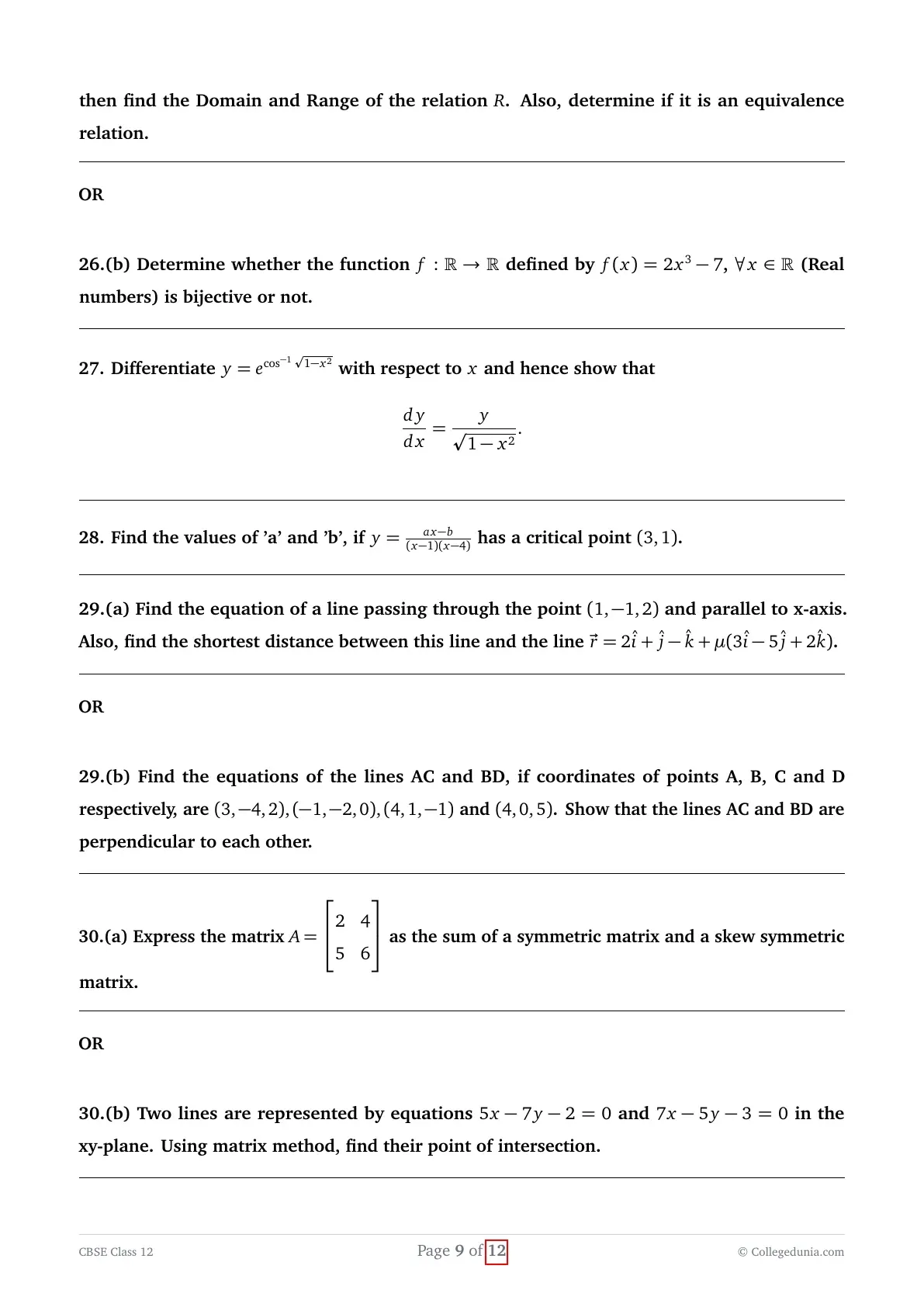
then find the Domain and Range of the relation \( R \).
Also, determine if it is an equivalence relation.
View Solution
Concept:
Domain: The set of all first elements (\( x \)) of the ordered pairs belonging to the relation \( R \).
Range: The set of all second elements (\( y \)) of the ordered pairs belonging to the relation \( R \).
Equivalence Relation: A relation that is simultaneously reflexive, symmetric, and transitive.
Step 1: Determine the elements of the relation \( R \)
The relation is defined by the equation \( x + 2y = 25 \), where \( x, y \in \mathbb{N} \) (Natural numbers: \( \{1, 2, 3, \dots\} \)).
From the equation, \( x = 25 - 2y \).
Since \( x \ge 1 \), we have \( 25 - 2y \ge 1 \implies 24 \ge 2y \implies y \le 12 \).
Also, for \( x \) to be a natural number, \( 25 - 2y \) must be greater than or equal to 1.
Substituting \( y = 1, 2, 3, \dots, 12 \):
- If \( y=1, x=23 \implies (23, 1) \in R \)
- If \( y=2, x=21 \implies (21, 2) \in R \)
- If \( y=3, x=19 \implies (19, 3) \in R \)
- If \( y=4, x=17 \implies (17, 4) \in R \)
- If \( y=5, x=15 \implies (15, 5) \in R \)
- If \( y=6, x=13 \implies (13, 6) \in R \)
- If \( y=7, x=11 \implies (11, 7) \in R \)
- If \( y=8, x=9 \implies (9, 8) \in R \)
- If \( y=9, x=7 \implies (7, 9) \in R \)
- If \( y=10, x=5 \implies (5, 10) \in R \)
- If \( y=11, x=3 \implies (3, 11) \in R \)
- If \( y=12, x=1 \implies (1, 12) \in R \)
Step 2: Identify Domain and Range
Domain \( = \{x : (x, y) \in R\} = \{1, 3, 5, 7, 9, 11, 13, 15, 17, 19, 21, 23\} \)
Range \( = \{y : (x, y) \in R\} = \{1, 2, 3, 4, 5, 6, 7, 8, 9, 10, 11, 12\} \)
Step 3: Determine if \( R \) is an equivalence relation
1. Reflexivity: For \( R \) to be reflexive, \( (x, x) \in R \) for all \( x \in \mathbb{N} \).
Let \( x = 1 \). Then \( 1 + 2(1) = 3 \neq 25 \). Thus \( (1, 1) \notin R \).
So, \( R \) is not reflexive.
2. Symmetry: For \( R \) to be symmetric, \( (x, y) \in R \implies (y, x) \in R \).
We have \( (23, 1) \in R \). Let's check for \( (1, 23) \):
\( 1 + 2(23) = 1 + 46 = 47 \neq 25 \). Thus \( (1, 23) \notin R \).
So, \( R \) is not symmetric.
Since \( R \) is neither reflexive nor symmetric, it is not an equivalence relation. Quick Tip: A relation fails to be an equivalence relation if it fails even a single property (reflexive, symmetric, or transitive). In \( x + 2y = 25 \), \( x \) must be odd because \( 2y \) is even and 25 is odd.
Determine whether the function \( f : \mathbb{R} \to \mathbb{R} \) defined by \( f(x) = 2x^{3} - 7 \), \( \forall x \in \mathbb{R} \) (Real numbers) is bijective or not.
View Solution
Concept:
One-to-one (Injective): A function is injective if \( f(x_1) = f(x_2) \implies x_1 = x_2 \).
Onto (Surjective): A function is surjective if for every \( y \) in the codomain, there exists an \( x \) in the domain such that \( f(x) = y \).
Bijective: A function that is both injective and surjective.
Step 1: Check for Injectivity
Let \( x_1, x_2 \in \mathbb{R} \) such that \( f(x_1) = f(x_2) \).
\( 2x_1^{3} - 7 = 2x_2^{3} - 7 \)
\( 2x_1^{3} = 2x_2^{3} \)
\( x_1^{3} = x_2^{3} \)
Taking the cube root on both sides (cube roots are unique for real numbers):
\( x_1 = x_2 \)
Since \( f(x_1) = f(x_2) \) leads to \( x_1 = x_2 \), the function is injective.
Step 2: Check for Surjectivity
Let \( y \in \mathbb{R} \) (codomain). We need to find \( x \in \mathbb{R} \) (domain) such that \( f(x) = y \).
\( 2x^{3} - 7 = y \)
\( 2x^{3} = y + 7 \)
\( x^{3} = \frac{y + 7}{2} \)
\( x = \sqrt[3]{\frac{y + 7}{2}} \)
For any real value of \( y \), \( \frac{y + 7}{2} \) is a real number, and its cube root is always a unique real number.
So, for every \( y \in \mathbb{R} \), there exists a corresponding \( x \in \mathbb{R} \) such that \( f(x) = y \).
Thus, the function is surjective.
Step 3: Conclusion
Since the function is both injective and surjective, it is bijective. Quick Tip: Any linear or odd-degree polynomial function from \( \mathbb{R} \) to \( \mathbb{R} \) is generally surjective. For \( x^n = a \), if \( n \) is odd, there is only one real solution; if \( n \) is even, there can be two or none.
Differentiate \( y = e^{\cos^{-1} \sqrt{1 - x^{2}}} \) with respect to \( x \) and hence show that \[ \frac{dy}{dx} = \frac{y}{\sqrt{1 - x^{2}}}. \]
View Solution
Concept:
Chain Rule: \( \frac{d}{dx}[f(g(x))] = f'(g(x)) \cdot g'(x) \).
Inverse Trig Derivatives: \( \frac{d}{dx}(\cos^{-1} u) = -\frac{1}{\sqrt{1 - u^{2}}} \cdot \frac{du}{dx} \).
Trigonometric Substitution: Simplifies the expression before differentiation.
Step 1: Simplify the exponent using substitution
Let \( x = \sin \theta \). Then \( \theta = \sin^{-1} x \).
The term in the exponent is \( \cos^{-1} \sqrt{1 - x^{2}} \).
Substituting \( x \):
\( \sqrt{1 - x^{2}} = \sqrt{1 - \sin^{2} \theta} = \sqrt{\cos^{2} \theta} = \cos \theta \)
So, the expression becomes \( \cos^{-1}(\cos \theta) \).
Assuming \( \theta \) is in the principal branch, \( \cos^{-1}(\cos \theta) = \theta \).
Thus, \( \theta = \sin^{-1} x \).
Substituting this back into the original function:
\( y = e^{\sin^{-1} x} \)
Step 2: Differentiate the simplified function
Differentiating \( y \) with respect to \( x \):
\[ \frac{dy}{dx} = \frac{d}{dx}(e^{\sin^{-1} x}) \]
Using the chain rule:
\[ \frac{dy}{dx} = e^{\sin^{-1} x} \cdot \frac{d}{dx}(\sin^{-1} x) \]
The derivative of \( \sin^{-1} x \) is \( \frac{1}{\sqrt{1 - x^{2}}} \):
\[ \frac{dy}{dx} = e^{\sin^{-1} x} \cdot \frac{1}{\sqrt{1 - x^{2}}} \]
Step 3: Substitute \( y \) back to reach the final form
Since \( y = e^{\sin^{-1} x} \), we can write:
\[ \frac{dy}{dx} = \frac{y}{\sqrt{1 - x^{2}}} \]
Hence shown. Quick Tip: Substitution often makes "show that" differentiation problems much cleaner and less prone to algebraic error. Recall that \( \cos^{-1}(\sqrt{1-x^2}) = \sin^{-1} x \) for \( 0 \le x \le 1 \).
Find the values of 'a' and 'b', if \( y = \frac{ax - b}{(x-1)(x-4)} \) has a critical point \( (3, 1) \).
View Solution
Concept:
If a point \( (x_{0}, y_{0}) \) is on a curve, it must satisfy the equation of the curve: \( y_{0} = f(x_{0}) \).
A critical point of a differentiable function is a point where the first derivative is equal to zero: \( \frac{dy}{dx} = 0 \).
The quotient rule for differentiation is used for functions of the form \( \frac{u(x)}{v(x)} \): \( \frac{d}{dx}\left(\frac{u}{v}\right) = \frac{v \cdot u' - u \cdot v'}{v^{2}} \).
Step 1: Use the point satisfaction condition
Since the point \( (3, 1) \) lies on the curve, substitute \( x = 3 \) and \( y = 1 \) into the equation: \[ 1 = \frac{a(3) - b}{(3 - 1)(3 - 4)} \] \[ 1 = \frac{3a - b}{2 \cdot (-1)} \] \[ 1 = \frac{3a - b}{-2} \] \[ -2 = 3a - b \implies b - 3a = 2 \quad \dots (1) \]
Step 2: Differentiate the function and apply the critical point condition
Let \( y = \frac{ax - b}{x^{2} - 5x + 4} \). Differentiating with respect to \( x \) using the quotient rule: \[ \frac{dy}{dx} = \frac{a(x^{2} - 5x + 4) - (ax - b)(2x - 5)}{(x^{2} - 5x + 4)^{2}} \]
At the critical point \( (3, 1) \), we have \( x = 3 \) and \( \frac{dy}{dx} = 0 \): \[ \frac{a(3^{2} - 5(3) + 4) - (a(3) - b)(2(3) - 5)}{(3^{2} - 5(3) + 4)^{2}} = 0 \] \[ a(9 - 15 + 4) - (3a - b)(6 - 5) = 0 \] \[ a(-2) - (3a - b)(1) = 0 \] \[ -2a - 3a + b = 0 \implies b - 5a = 0 \implies b = 5a \quad \dots (2) \]
Step 3: Solve the system of equations
Substitute \( b = 5a \) from equation (2) into equation (1): \[ 5a - 3a = 2 \] \[ 2a = 2 \implies a = 1 \]
Now, find \( b \) using equation (2): \[ b = 5(1) = 5 \]
The values are \( a = 1 \) and \( b = 5 \). Quick Tip: Critical points can be maxima, minima, or points of inflection. When a point is given, always plug it into the original function first to get an initial relationship between variables. Simplifying the denominator before differentiating often reduces the chance of algebraic errors.
Find the equation of a line passing through the point \( (1, -1, 2) \) and parallel to x-axis. Also, find the shortest distance between this line and the line \( \vec{r} = 2\hat{i} + \hat{j} - \hat{k} + \mu(3\hat{i} - 5\hat{j} + 2\hat{k}) \).
View Solution
Concept:
The vector equation of a line passing through a point with position vector \( \vec{a} \) and parallel to a vector \( \vec{b} \) is \( \vec{r} = \vec{a} + \lambda \vec{b} \).
The x-axis has direction ratios \( (1, 0, 0) \), so its unit vector is \( \hat{i} \).
The shortest distance between two skew lines \( \vec{r} = \vec{a}_{1} + \lambda \vec{b}_{1} \) and \( \vec{r} = \vec{a}_{2} + \mu \vec{b}_{2} \) is:
\[ d = \left| \frac{(\vec{a}_{2} - \vec{a}_{1}) \cdot (\vec{b}_{1} \times \vec{b}_{2})}{|\vec{b}_{1} \times \vec{b}_{2}|} \right| \]
Step 1: Find the equation of the first line
The line passes through \( P(1, -1, 2) \). Its position vector is \( \vec{a}_{1} = \hat{i} - \hat{j} + 2\hat{k} \).
Since it is parallel to the x-axis, its direction vector is \( \vec{b}_{1} = \hat{i} + 0\hat{j} + 0\hat{k} \).
The vector equation is: \[ \vec{r} = (\hat{i} - \hat{j} + 2\hat{k}) + \lambda \hat{i} \]
Step 2: Identify components for shortest distance calculation
From the second line \( \vec{r} = 2\hat{i} + \hat{j} - \hat{k} + \mu(3\hat{i} - 5\hat{j} + 2\hat{k}) \): \[ \vec{a}_{2} = 2\hat{i} + \hat{j} - \hat{k} and \vec{b}_{2} = 3\hat{i} - 5\hat{j} + 2\hat{k} \]
Now compute the required terms: \[ \vec{a}_{2} - \vec{a}_{1} = (2 - 1)\hat{i} + (1 - (-1))\hat{j} + (-1 - 2)\hat{k} = \hat{i} + 2\hat{j} - 3\hat{k} \]
Compute cross product \( \vec{b}_{1} \times \vec{b}_{2} \): \[ \vec{b}_{1} \times \vec{b}_{2} = \begin{vmatrix} \hat{i} & \hat{j} & \hat{k}
1 & 0 & 0
3 & -5 & 2 \end{vmatrix} = \hat{i}(0) - \hat{j}(2 - 0) + \hat{k}(-5 - 0) = -2\hat{j} - 5\hat{k} \]
Magnitude \( |\vec{b}_{1} \times \vec{b}_{2}| = \sqrt{0^{2} + (-2)^{2} + (-5)^{2}} = \sqrt{4 + 25} = \sqrt{29} \)
Step 3: Compute the shortest distance
\[ (\vec{a}_{2} - \vec{a}_{1}) \cdot (\vec{b}_{1} \times \vec{b}_{2}) = (1)(0) + (2)(-2) + (-3)(-5) = 0 - 4 + 15 = 11 \] \[ d = \left| \frac{11}{\sqrt{29}} \right| = \frac{11}{\sqrt{29}} units \] Quick Tip: Direction ratios for axes: X is (1,0,0), Y is (0,1,0), Z is (0,0,1). If two lines intersect, their shortest distance will be zero. Skew lines are lines that are not parallel and do not intersect in 3D space.
Find the equations of the lines AC and BD, if coordinates of points A, B, C and D respectively, are \( (3, -4, 2), (-1, -2, 0), (4, 1, -1) \) and \( (4, 0, 5) \). Show that the lines AC and BD are perpendicular to each other.
View Solution
Concept:
Equation of a line passing through two points \( (x_{1}, y_{1}, z_{1}) \) and \( (x_{2}, y_{2}, z_{2}) \) is \( \frac{x - x_{1}}{x_{2} - x_{1}} = \frac{y - y_{1}}{y_{2} - y_{1}} = \frac{z - z_{1}}{z_{2} - z_{1}} \).
The denominators in the equation represent the direction ratios \( (a, b, c) \) of the line.
Two lines with direction ratios \( (a_{1}, b_{1}, c_{1}) \) and \( (a_{2}, b_{2}, c_{2}) \) are perpendicular if \( a_{1}a_{2} + b_{1}b_{2} + c_{1}c_{2} = 0 \).
Step 1: Find the equation of line AC
Given \( A(3, -4, 2) \) and \( C(4, 1, -1) \).
Direction ratios of AC: \( (4 - 3, 1 - (-4), -1 - 2) = (1, 5, -3) \).
The equation of line AC is: \[ \frac{x - 3}{1} = \frac{y + 4}{5} = \frac{z - 2}{-3} \]
Step 2: Find the equation of line BD
Given \( B(-1, -2, 0) \) and \( D(4, 0, 5) \).
Direction ratios of BD: \( (4 - (-1), 0 - (-2), 5 - 0) = (5, 2, 5) \).
The equation of line BD is: \[ \frac{x + 1}{5} = \frac{y + 2}{2} = \frac{z}{5} \]
Step 3: Verify perpendicularity
Let direction ratios of AC be \( (a_{1}, b_{1}, c_{1}) = (1, 5, -3) \) and those of BD be \( (a_{2}, b_{2}, c_{2}) = (5, 2, 5) \).
Check the condition \( a_{1}a_{2} + b_{1}b_{2} + c_{1}c_{2} \): \[ (1)(5) + (5)(2) + (-3)(5) \] \[ = 5 + 10 - 15 \] \[ = 0 \]
Since the sum of the products of their direction ratios is zero, lines AC and BD are perpendicular to each other. Quick Tip: Direction ratios don't have to be unique; they can be scaled by any non-zero constant. To show two lines are perpendicular, you only need their direction vectors, not the full equations. Parallel lines have proportional direction ratios: \( a_{1}/a_{2} = b_{1}/b_{2} = c_{1}/c_{2} \).
Express the matrix \( A = \begin{bmatrix} 2 & 4
5 & 6 \end{bmatrix} \) as the sum of a symmetric matrix and a skew symmetric matrix.
View Solution
Concept:
Any square matrix \( A \) can be expressed as \( A = P + Q \), where \( P \) is a symmetric matrix and \( Q \) is a skew-symmetric matrix.
The symmetric part is given by \( P = \frac{1}{2}(A + A^{T}) \).
The skew-symmetric part is given by \( Q = \frac{1}{2}(A - A^{T}) \).
A matrix \( M \) is symmetric if \( M^{T} = M \) and skew-symmetric if \( M^{T} = -M \).
Step 1: Find the transpose of the given matrix \( A \)
The given matrix is \( A = \begin{bmatrix} 2 & 4
5 & 6 \end{bmatrix} \).
The transpose \( A^{T} \) is obtained by interchanging rows and columns:
\( A^{T} = \begin{bmatrix} 2 & 5
4 & 6 \end{bmatrix} \)
Step 2: Calculate the symmetric matrix \( P \)
First, calculate \( A + A^{T} \):
\( A + A^{T} = \begin{bmatrix} 2 & 4
5 & 6 \end{bmatrix} + \begin{bmatrix} 2 & 5
4 & 6 \end{bmatrix} = \begin{bmatrix} 4 & 9
9 & 12 \end{bmatrix} \)
Now, divide by 2 to get \( P \):
\( P = \frac{1}{2} \begin{bmatrix} 4 & 9
9 & 12 \end{bmatrix} = \begin{bmatrix} 2 & 4.5
4.5 & 6 \end{bmatrix} \)
Step 3: Calculate the skew-symmetric matrix \( Q \)
First, calculate \( A - A^{T} \):
\( A - A^{T} = \begin{bmatrix} 2 & 4
5 & 6 \end{bmatrix} - \begin{bmatrix} 2 & 5
4 & 6 \end{bmatrix} = \begin{bmatrix} 0 & -1
1 & 0 \end{bmatrix} \)
Now, divide by 2 to get \( Q \):
\( Q = \frac{1}{2} \begin{bmatrix} 0 & -1
1 & 0 \end{bmatrix} = \begin{bmatrix} 0 & -0.5
0.5 & 0 \end{bmatrix} \)
Step 4: Verify the result by summing \( P \) and \( Q \)
\( P + Q = \begin{bmatrix} 2 & 4.5
4.5 & 6 \end{bmatrix} + \begin{bmatrix} 0 & -0.5
0.5 & 0 \end{bmatrix} = \begin{bmatrix} 2+0 & 4.5-0.5
4.5+0.5 & 6+0 \end{bmatrix} = \begin{bmatrix} 2 & 4
5 & 6 \end{bmatrix} = A \)
Thus, matrix \( A \) is successfully expressed as the sum of symmetric and skew-symmetric matrices. Quick Tip: Diagonal elements of a skew-symmetric matrix are always zero. Check symmetry: \( P_{ij} \) must equal \( P_{ji} \). Check skew-symmetry: \( Q_{ij} \) must equal \( -Q_{ji} \).
Two lines are represented by equations \( 5x - 7y - 2 = 0 \) and \( 7x - 5y - 3 = 0 \) in the xy-plane. Using matrix method, find their point of intersection.
View Solution
Concept:
A system of linear equations can be represented as \( AX = B \).
The solution is given by \( X = A^{-1}B \), where \( A^{-1} = \frac{1}{|A|} adj(A) \).
For a \( 2 \times 2 \) matrix \( A = \begin{bmatrix} a & b
c & d \end{bmatrix} \), the determinant \( |A| = ad - bc \) and \( adj(A) = \begin{bmatrix} d & -b
-c & a \end{bmatrix} \).
Step 1: Arrange the equations into matrix form \( AX = B \)
The equations are:
\( 5x - 7y = 2 \)
\( 7x - 5y = 3 \)
This can be written as:
\( \begin{bmatrix} 5 & -7
7 & -5 \end{bmatrix} \begin{bmatrix} x
y \end{bmatrix} = \begin{bmatrix} 2
3 \end{bmatrix} \)
Here, \( A = \begin{bmatrix} 5 & -7
7 & -5 \end{bmatrix} \), \( X = \begin{bmatrix} x
y \end{bmatrix} \), and \( B = \begin{bmatrix} 2
3 \end{bmatrix} \).
Step 2: Find the determinant \( |A| \) and the adjoint matrix
Calculate the determinant:
\( |A| = (5)(-5) - (-7)(7) = -25 + 49 = 24 \)
Since \( |A| \neq 0 \), a unique solution exists.
Now find the adjoint of \( A \):
\( adj(A) = \begin{bmatrix} -5 & 7
-7 & 5 \end{bmatrix} \)
Step 3: Solve for \( X \) using \( X = A^{-1}B \)
\( X = \frac{1}{24} \begin{bmatrix} -5 & 7
-7 & 5 \end{bmatrix} \begin{bmatrix} 2
3 \end{bmatrix} \)
Perform the multiplication:
\( X = \frac{1}{24} \begin{bmatrix} (-5 \times 2) + (7 \times 3)
(-7 \times 2) + (5 \times 3) \end{bmatrix} \)
\( X = \frac{1}{24} \begin{bmatrix} -10 + 21
-14 + 15 \end{bmatrix} = \frac{1}{24} \begin{bmatrix} 11
1 \end{bmatrix} \)
So, \( x = \frac{11}{24} \) and \( y = \frac{1}{24} \). Quick Tip: The matrix method is only applicable if the determinant of the coefficient matrix is non-zero. Point of intersection is the unique solution \( (x, y) \) shared by both linear equations.
Solve the following Linear Programming Problem graphically :
Minimize \( Z = 4x + y \)
subject to
\( x + y \ge 3 \)
\( x + 2y \ge 4 \)
\( x, y \ge 0 \).
View Solution
Concept:
The non-negativity constraints \( x, y \ge 0 \) indicate the feasible region lies in the first quadrant.
Graph the boundary lines for each constraint.
Shade the feasible region based on the inequality signs (\( \ge \) means region away from origin).
The minimum value occurs at one of the corner points of the feasible region.
Step 1: Find the intercepts and plot the lines
For the line \( L_{1}: x + y = 3 \):
When \( x = 0, y = 3 \); When \( y = 0, x = 3 \). Intercepts: \( (0, 3) \) and \( (3, 0) \).
For the line \( L_{2}: x + 2y = 4 \):
When \( x = 0, y = 2 \); When \( y = 0, x = 4 \). Intercepts: \( (0, 2) \) and \( (4, 0) \).
Step 2: Find the point of intersection of \( L_{1} \) and \( L_{2} \)
Solve simultaneously:
\( x + 2y = 4 \)
\( x + y = 3 \)
Subtracting: \( y = 1 \).
Substituting \( y = 1 \) in \( x + y = 3 \), we get \( x = 2 \).
Intersection point is \( B(2, 1) \).
Step 3: Identify feasible region and corner points
The feasible region is the unbounded area satisfyting all inequalities.
The corner points are:
\( A(4, 0) \)
\( B(2, 1) \)
\( C(0, 3) \)
Step 4: Evaluate the objective function \( Z = 4x + y \) at corner points
At \( A(4, 0) \): \( Z = 4(4) + 0 = 16 \)
At \( B(2, 1) \): \( Z = 4(2) + 1 = 9 \)
At \( C(0, 3) \): \( Z = 4(0) + 3 = 3 \)
The minimum value of \( Z \) is \( 3 \), which occurs at the point \( (0, 3) \). Quick Tip: For an unbounded feasible region, the minimum exists if there are no points in the region satisfying \( 4x + y < 3 \). Testing the inequality \( 4x + y < 3 \) graphically shows it does not overlap with the feasible region.
Evaluate : \[ \int_{\pi/6}^{\pi/3} \frac{\sin x + \cos x}{\sqrt{\sin 2x}} dx \]
View Solution
Concept:
Integration by substitution method.
Using the identity \( (\sin x - \cos x)^{2} = 1 - \sin 2x \).
Standard integral: \( \int \frac{1}{\sqrt{1 - t^{2}}} dt = \sin^{-1} t + C \).
Step 1: Substitute a new variable for part of the expression
Let \( t = \sin x - \cos x \).
Differentiating with respect to \( x \):
\( dt = (\cos x + \sin x) dx \).
Squaring the substitution equation:
\( t^{2} = \sin^{2} x + \cos^{2} x - 2 \sin x \cos x \)
\( t^{2} = 1 - \sin 2x \)
Therefore, \( \sin 2x = 1 - t^{2} \).
Step 2: Determine the new limits of integration
When \( x = \pi/6 \):
\( t = \sin(\pi/6) - \cos(\pi/6) = \frac{1}{2} - \frac{\sqrt{3}}{2} = \frac{1 - \sqrt{3}}{2} \)
When \( x = \pi/3 \):
\( t = \sin(\pi/3) - \cos(\pi/3) = \frac{\sqrt{3}}{2} - \frac{1}{2} = \frac{\sqrt{3} - 1}{2} \)
Step 3: Set up and solve the integral in terms of \( t \)
The integral becomes:
\[ I = \int_{\frac{1-\sqrt{3}}{2}}^{\frac{\sqrt{3}-1}{2}} \frac{dt}{\sqrt{1 - t^{2}}} \] \[ I = [ \sin^{-1} t ]_{\frac{1-\sqrt{3}}{2}}^{\frac{\sqrt{3}-1}{2}} \] \[ I = \sin^{-1}\left( \frac{\sqrt{3}-1}{2} \right) - \sin^{-1}\left( \frac{1-\sqrt{3}}{2} \right) \]
Step 4: Simplify using properties of inverse trigonometric functions
Recall that \( \sin^{-1}(-x) = -\sin^{-1} x \).
So, \( \sin^{-1}\left( \frac{1-\sqrt{3}}{2} \right) = \sin^{-1}\left( -\frac{\sqrt{3}-1}{2} \right) = -\sin^{-1}\left( \frac{\sqrt{3}-1}{2} \right) \).
Thus:
\[ I = \sin^{-1}\left( \frac{\sqrt{3}-1}{2} \right) - \left( -\sin^{-1}\left( \frac{\sqrt{3}-1}{2} \right) \right) \] \[ I = 2 \sin^{-1}\left( \frac{\sqrt{3}-1}{2} \right) \] Quick Tip: When the numerator is \( (\sin x + \cos x) \), try the substitution \( (\sin x - \cos x) = t \). Always change the limits of integration when performing a substitution in a definite integral.
Using integration, find the area bounded by the curve \( y = x^{2} \) and the line \( y = 2 \).
View Solution
Concept:
The area bounded by a curve \( y = f(x) \) and a line \( y = c \) is calculated as \( \int_{x_{1}}^{x_{2}} |c - f(x)| dx \).
Identify the intersection points to find the limits of integration.
Symmetry can often be used to simplify the calculation.
Step 1: Find the points of intersection
The curve is \( y = x^{2} \) and the line is \( y = 2 \).
Equating them: \( x^{2} = 2 \implies x = -\sqrt{2} \) and \( x = \sqrt{2} \).
These are the limits of integration.
Step 2: Set up the area integral
The area is symmetric about the y-axis, so we can calculate the area for \( x \in [0, \sqrt{2}] \) and multiply by 2.
In this interval, the line \( y = 2 \) is above the curve \( y = x^{2} \).
\[ Area = 2 \int_{0}^{\sqrt{2}} (2 - x^{2}) dx \]
Step 3: Evaluate the definite integral
\[ Area = 2 [ 2x - \frac{x^{3}}{3} ]_{0}^{\sqrt{2}} \] \[ Area = 2 [ (2\sqrt{2} - \frac{(\sqrt{2})^{3}}{3}) - (0) ] \] \[ Area = 2 [ 2\sqrt{2} - \frac{2\sqrt{2}}{3} ] \] \[ Area = 2 [ \frac{6\sqrt{2} - 2\sqrt{2}}{3} ] = 2 [ \frac{4\sqrt{2}}{3} ] \] \[ Area = \frac{8\sqrt{2}}{3} square units \] Quick Tip: Visualize the region: \( y = x^2 \) is an upward opening parabola. Line \( y = 2 \) creates a "cap" on the parabola. Symmetry simplifies the integration limits significantly.
Using integration, find the area bounded by the curve \( 9x^{2} + 16y^{2} = 144 \) and the lines \( x = 2 \), \( x = -2 \).
View Solution
Concept:
The given equation \( 9x^{2} + 16y^{2} = 144 \) represents an ellipse.
Standard form: \( \frac{x^{2}}{16} + \frac{y^{2}}{9} = 1 \).
Area of a vertical strip is \( y \, dx \).
Total area is obtained by integrating \( y \) with respect to \( x \) between the given limits.
Step 1: Express \( y \) as a function of \( x \)
\( 16y^{2} = 144 - 9x^{2} \)
\( y^{2} = \frac{144 - 9x^{2}}{16} = \frac{9(16 - x^{2})}{16} \)
Taking the positive root for the upper half:
\( y = \frac{3}{4}\sqrt{16 - x^{2}} \)
Step 2: Set up the area integral
The required area is between \( x = -2 \) and \( x = 2 \).
By symmetry, the total area is 4 times the area of the portion in the first quadrant from \( x = 0 \) to \( x = 2 \).
\[ Area = 4 \int_{0}^{2} \frac{3}{4}\sqrt{16 - x^{2}} dx \] \[ Area = 3 \int_{0}^{2} \sqrt{4^{2} - x^{2}} dx \]
Step 3: Apply the standard integration formula
Using \( \int \sqrt{a^{2}-x^{2}} dx = \frac{x}{2}\sqrt{a^{2}-x^{2}} + \frac{a^{2}}{2}\sin^{-1}\frac{x}{a} \):
\[ Area = 3 [ \frac{x}{2}\sqrt{16 - x^{2}} + \frac{16}{2}\sin^{-1}\frac{x}{4} ]_{0}^{2} \] \[ Area = 3 [ (1\sqrt{16 - 4} + 8\sin^{-1}\frac{2}{4}) - (0) ] \] \[ Area = 3 [ \sqrt{12} + 8\sin^{-1}\frac{1}{2} ] \] \[ Area = 3 [ 2\sqrt{3} + 8(\frac{\pi}{6}) ] \] \[ Area = 3 [ 2\sqrt{3} + \frac{4\pi}{3} ] = 6\sqrt{3} + 4\pi square units \] Quick Tip: Ellipse area problems frequently use the \( \sqrt{a^2 - x^2} \) integral form. Ensure you identify the correct semimajor and semiminor axes from the standard equation.
Let \(\vec{\alpha}, \vec{\beta}, \vec{\gamma}\) be three non-zero vectors, such that \(\vec{\alpha} \times \vec{\beta} = \vec{\gamma}\) and \(\vec{\beta} \times \vec{\gamma} = \vec{\alpha}\). Show that \(\alpha, \beta, \gamma\) are mutually perpendicular vectors such that \(|\vec{\beta}| = 1\) and \(|\vec{\alpha}| = |\vec{\gamma}|\). Find projection of vector \(\vec{\alpha}\) on \(\vec{\beta}\). Give reasons to support your answer.
View Solution
Concept:
The cross product \(\vec{A} \times \vec{B}\) is a vector perpendicular to both \(\vec{A}\) and \(\vec{B}\).
The magnitude of the cross product is given by \(|\vec{A} \times \vec{B}| = |\vec{A}| |\vec{B}| \sin \theta\), where \(\theta\) is the angle between the vectors.
The projection of vector \(\vec{A}\) on \(\vec{B}\) is given by \(\frac{\vec{A} \cdot \vec{B}}{|\vec{B}|}\).
Step 1: Prove mutual perpendicularity
From the first relation \(\vec{\alpha} \times \vec{\beta} = \vec{\gamma}\), we know that \(\vec{\gamma}\) is perpendicular to both \(\vec{\alpha}\) and \(\vec{\beta}\). \[ \vec{\gamma} \perp \vec{\alpha} and \vec{\gamma} \perp \vec{\beta} \]
From the second relation \(\vec{\beta} \times \vec{\gamma} = \vec{\alpha}\), we know that \(\vec{\alpha}\) is perpendicular to both \(\vec{\beta}\) and \(\vec{\gamma}\). \[ \vec{\alpha} \perp \vec{\beta} and \vec{\alpha} \perp \vec{\gamma} \]
Combining these results, we find that: \(\vec{\alpha} \perp \vec{\beta}\), \(\vec{\beta} \perp \vec{\gamma}\), and \(\vec{\gamma} \perp \vec{\alpha}\).
Thus, \(\alpha\), \(\beta\), and \(\gamma\) are mutually perpendicular.
Step 2: Establish relationship between magnitudes
Since the vectors are mutually perpendicular, the angle between them is \(90^{\circ}\) (\(\sin 90^{\circ} = 1\)).
Taking magnitudes of both given equations:
1. \(|\vec{\alpha} \times \vec{\beta}| = |\vec{\gamma}| \implies |\vec{\alpha}||\vec{\beta}| = |\vec{\gamma}|\)
2. \(|\vec{\beta} \times \vec{\gamma}| = |\vec{\alpha}| \implies |\vec{\beta}||\vec{\gamma}| = |\vec{\alpha}|\)
Dividing the first by the second: \[ \frac{|\vec{\alpha}|}{|\vec{\gamma}|} = \frac{|\vec{\gamma}|}{|\vec{\alpha}|} \implies |\vec{\alpha}|^2 = |\vec{\gamma}|^2 \implies |\vec{\alpha}| = |\vec{\gamma}| \]
Substituting \(|\vec{\alpha}| = |\vec{\gamma}|\) back into \(|\vec{\alpha}||\vec{\beta}| = |\vec{\gamma}|\): \[ |\vec{\alpha}||\vec{\beta}| = |\vec{\alpha}| \implies |\vec{\beta}| = 1 \]
(since \(\vec{\alpha}\) is a non-zero vector).
Step 3: Find the projection of \(\vec{\alpha}\) on \(\vec{\beta}\)
The projection of \(\vec{\alpha}\) on \(\vec{\beta}\) is given by: \[ Proj_{\vec{\beta}}\vec{\alpha} = \frac{\vec{\alpha} \cdot \vec{\beta}}{|\vec{\beta}|} \]
Since \(\vec{\alpha}\) is perpendicular to \(\vec{\beta}\), their dot product is zero (\(\vec{\alpha} \cdot \vec{\beta} = 0\)).
Therefore, the projection is \(0\). Quick Tip: The projection of any vector on another vector perpendicular to it is always zero. In a set of mutually perpendicular vectors, the dot product between any two distinct vectors is zero.
If points \(A(3, -1, 2), B(6, -3, 6), C(4, -3, 1)\) and \(D(1, -1, -3)\) are vertices of a quadrilateral \(ABCD\), write the position vectors of \(A, B, C\) and \(D\) and show that \(ABCD\) represents a parallelogram. Also, find the area of the parallelogram \(ABCD\).
View Solution
Concept:
The position vector of a point \(P(x, y, z)\) is \(\vec{p} = x\hat{i} + y\hat{j} + z\hat{k}\).
A quadrilateral is a parallelogram if one pair of opposite sides are represented by equal vectors.
The area of a parallelogram with adjacent sides \(\vec{a}\) and \(\vec{b}\) is \(|\vec{a} \times \vec{b}|\).
Step 1: Write the position vectors
The position vectors of the vertices are: \[ \vec{a} = 3\hat{i} - \hat{j} + 2\hat{k} \] \[ \vec{b} = 6\hat{i} - 3\hat{j} + 6\hat{k} \] \[ \vec{c} = 4\hat{i} - 3\hat{j} + \hat{k} \] \[ \vec{d} = \hat{i} - \hat{j} - 3\hat{k} \]
Step 2: Show that \(ABCD\) is a parallelogram
Let's find the vectors representing the sides \(AB\) and \(DC\): \[ \vec{AB} = \vec{b} - \vec{a} = (6-3)\hat{i} + (-3 - (-1))\hat{j} + (6-2)\hat{k} = 3\hat{i} - 2\hat{j} + 4\hat{k} \] \[ \vec{DC} = \vec{c} - \vec{d} = (4-1)\hat{i} + (-3 - (-1))\hat{j} + (1 - (-3))\hat{k} = 3\hat{i} - 2\hat{j} + 4\hat{k} \]
Since \(\vec{AB} = \vec{DC}\), one pair of opposite sides is parallel and equal in length.
Therefore, \(ABCD\) is a parallelogram.
Step 3: Calculate the area of the parallelogram
Adjacent sides are \(\vec{AB}\) and \(\vec{AD}\). \[ \vec{AD} = \vec{d} - \vec{a} = (1-3)\hat{i} + (-1 - (-1))\hat{j} + (-3-2)\hat{k} = -2\hat{i} + 0\hat{j} - 5\hat{k} \]
Now, calculate the cross product \(\vec{AB} \times \vec{AD}\): \[ \vec{AB} \times \vec{AD} = \begin{vmatrix} \hat{i} & \hat{j} & \hat{k}
3 & -2 & 4
-2 & 0 & -5 \end{vmatrix} = \hat{i}(10 - 0) - \hat{j}(-15 - (-8)) + \hat{k}(0 - 4) \] \[ \vec{AB} \times \vec{AD} = 10\hat{i} + 7\hat{j} - 4\hat{k} \]
The area is the magnitude of this vector: \[ Area = |10\hat{i} + 7\hat{j} - 4\hat{k}| = \sqrt{10^2 + 7^2 + (-4)^2} = \sqrt{100 + 49 + 16} = \sqrt{165} sq. units \] Quick Tip: In a parallelogram \(ABCD\), ensure you use \(\vec{AB}\) and \(\vec{DC}\) for comparison, or \(\vec{AD}\) and \(\vec{BC}\). If diagonals are given as vectors \(\vec{d_1}\) and \(\vec{d_2}\), the area is \(\frac{1}{2}|\vec{d_1} \times \vec{d_2}|\).
Solve the differential equation \((x + y)dy + (x - y)dx = 0\), given that \(y(1) = 1\).
View Solution
Concept:
A differential equation of the form \(\frac{dy}{dx} = f(x, y)\) is homogeneous if \(f(\lambda x, \lambda y) = f(x, y)\).
These are solved by substituting \(y = vx\), which leads to a variable separable form in \(v\) and \(x\).
Step 1: Identify and rearrange the differential equation
Rearranging the given equation: \[ (x + y)dy = -(x - y)dx \implies \frac{dy}{dx} = \frac{y - x}{y + x} \]
This is a homogeneous differential equation as the degree of each term is the same.
Step 2: Apply substitution \(y = vx\)
Let \(y = vx\). Then \(\frac{dy}{dx} = v + x\frac{dv}{dx}\).
Substituting into the equation: \[ v + x\frac{dv}{dx} = \frac{vx - x}{vx + x} = \frac{v - 1}{v + 1} \] \[ x\frac{dv}{dx} = \frac{v - 1}{v + 1} - v = \frac{v - 1 - v^2 - v}{v + 1} = \frac{-(v^2 + 1)}{v + 1} \]
Step 3: Separate variables and integrate
\[ \frac{v + 1}{v^2 + 1} dv = -\frac{1}{x} dx \]
Integrating both sides: \[ \int \left( \frac{v}{v^2 + 1} + \frac{1}{v^2 + 1} \right) dv = -\int \frac{1}{x} dx \] \[ \frac{1}{2} \ln(v^2 + 1) + \tan^{-1} v = -\ln|x| + C \]
Step 4: Simplify and substitute back \(v = y/x\)
\[ \frac{1}{2} \ln \left( \frac{y^2}{x^2} + 1 \right) + \tan^{-1} \left( \frac{y}{x} \right) = -\ln|x| + C \] \[ \frac{1}{2} \ln \left( \frac{x^2 + y^2}{x^2} \right) + \tan^{-1} \left( \frac{y}{x} \right) = -\ln|x| + C \] \[ \frac{1}{2} \ln(x^2 + y^2) - \ln|x| + \tan^{-1} \left( \frac{y}{x} \right) = -\ln|x| + C \] \[ \frac{1}{2} \ln(x^2 + y^2) + \tan^{-1} \left( \frac{y}{x} \right) = C \]
Step 5: Find the particular solution using \(y(1) = 1\)
Substitute \(x = 1\) and \(y = 1\): \[ \frac{1}{2} \ln(1^2 + 1^2) + \tan^{-1}(1/1) = C \] \[ C = \frac{1}{2} \ln 2 + \frac{\pi}{4} \]
The particular solution is: \[ \frac{1}{2} \ln(x^2 + y^2) + \tan^{-1} \left( \frac{y}{x} \right) = \frac{1}{2} \ln 2 + \frac{\pi}{4} \]
This can be simplified as: \[ \ln(x^2 + y^2) + 2\tan^{-1} \left( \frac{y}{x} \right) = \ln 2 + \frac{\pi}{2} \] Quick Tip: For homogeneous equations, the substitution \(x = vy\) can also be used if the equation is in the form \(dx/dy\). Remember to add the integration constant \(C\) only on one side of the equation.
In a school, the swimming pool is shaped as a cuboid, and the breadth of the pool is represented by line \(\frac{-x+2}{-5} = y = z - 3\). Two students A and B are swimming along the length of the pool.
(i)If the path of student A is represented by line \(\frac{x+5}{1} = \frac{y+3}{4} = \frac{z-6}{-3p}\), find the value of \(p\).
View Solution
Concept:
The length and breadth of a rectangle (the top surface of the pool) are perpendicular.
Two lines are perpendicular if the dot product of their direction vectors is zero.
Step 1: Identify direction ratios of the breadth line
Standardize the breadth line: \[ \frac{-(x - 2)}{-5} = y = z - 3 \implies \frac{x - 2}{5} = \frac{y - 0}{1} = \frac{z - 3}{1} \]
The direction ratios are \(\mathbf{b} = (5, 1, 1)\).
Step 2: Identify direction ratios of the length line (Path A)
The line for Path A is \(\frac{x+5}{1} = \frac{y+3}{4} = \frac{z-6}{-3p}\).
The direction ratios are \(\mathbf{a} = (1, 4, -3p)\).
Step 3: Apply perpendicularity condition
\[ \mathbf{a} \cdot \mathbf{b} = 0 \implies (1)(5) + (4)(1) + (-3p)(1) = 0 \] \[ 5 + 4 - 3p = 0 \implies 3p = 9 \implies p = 3 \] Quick Tip: Always rewrite lines in the standard form \(\frac{x-x_1}{a} = \frac{y-y_1}{b} = \frac{z-z_1}{c}\) to extract the correct direction ratios. Watch out for negative signs in the numerator.
Write the vector equation of the path of student B swimming parallel to the path of student A, if at a certain instant he passes through the point with coordinates (2, 4, -1).
View Solution
Concept:
Parallel lines have the same or proportional direction vectors.
Vector equation of a line: \(\vec{r} = \vec{a} + \mu\vec{d}\).
Step 1: Determine the direction vector
The path of B is parallel to the path of A. From part (i) with \(p=3\), the direction ratios of A are \((1, 4, -3 \times 3) = (1, 4, -9)\).
So, the direction vector \(\vec{d} = \hat{i} + 4\hat{j} - 9\hat{k}\).
Step 2: Identify the position vector of the point
Student B passes through \( (2, 4, -1) \). The position vector is: \[ \vec{a} = 2\hat{i} + 4\hat{j} - \hat{k} \]
Step 3: Write the final equation
\[ \vec{r} = (2\hat{i} + 4\hat{j} - \hat{k}) + \mu(\hat{i} + 4\hat{j} - 9\hat{k}) \] Quick Tip: \(\mu\) is an arbitrary scalar parameter. Any multiple of the direction vector \((1, 4, -9)\) is also a valid direction vector for the line.
Find the foot of the perpendicular drawn from (2, 4, -1) to the path represented by student A.
View Solution
Concept:
The foot of the perpendicular \(Q\) is a point on the line such that the vector \(\vec{PQ}\) is orthogonal to the line's direction.
Step 1: Define a general point on Path A
Path A in Cartesian form: \(\frac{x+5}{1} = \frac{y+3}{4} = \frac{z-6}{-9} = \lambda\).
General point \(Q = (\lambda - 5, 4\lambda - 3, -9\lambda + 6)\).
Step 2: Find the vector \(\vec{PQ}\)
Point \(P = (2, 4, -1)\). \[ \vec{PQ} = (\lambda - 5 - 2)\hat{i} + (4\lambda - 3 - 4)\hat{j} + (-9\lambda + 6 - (-1))\hat{k} \] \[ \vec{PQ} = (\lambda - 7)\hat{i} + (4\lambda - 7)\hat{j} + (-9\lambda + 7)\hat{k} \]
Step 3: Solve for \(\lambda\) using dot product
Direction vector \(\vec{d} = (1, 4, -9)\). \[ \vec{PQ} \cdot \vec{d} = 0 \implies 1(\lambda - 7) + 4(4\lambda - 7) - 9(-9\lambda + 7) = 0 \] \[ \lambda - 7 + 16\lambda - 28 + 81\lambda - 63 = 0 \] \[ 98\lambda - 98 = 0 \implies \lambda = 1 \]
Step 4: Find the coordinates of \(Q\)
Substitute \(\lambda = 1\) into \(Q\): \[ Q = (1 - 5, 4(1) - 3, -9(1) + 6) = (-4, 1, -3) \] Quick Tip: The foot of the perpendicular is the projection of \(P\) onto the line. Re-check the algebra for \(\vec{PQ}\) carefully as sign errors are common here.
If a bird flies across the top of the swimming pool with its path represented by \(\frac{x+4}{2} = \frac{y+3}{8} = \frac{z-5}{-18}\), then find the shortest distance between its path and the path of student A.
View Solution
Concept:
Check if the lines are parallel or skew.
Shortest distance between parallel lines \(L_1(\vec{a}_1, \vec{d})\) and \(L_2(\vec{a}_2, \vec{d})\) is \(\frac{|(\vec{a}_2 - \vec{a}_1) \times \vec{d}|}{|\vec{d}|}\).
Step 1: Compare the direction vectors
Path A direction: \(\vec{d}_1 = (1, 4, -9)\).
Bird's path direction: \((2, 8, -18) = 2(1, 4, -9)\).
Since the direction ratios are proportional, the lines are parallel. Let \(\vec{d} = \hat{i} + 4\hat{j} - 9\hat{k}\).
Step 2: Identify points on each line
Point on Path A: \(\vec{a}_1 = -5\hat{i} - 3\hat{j} + 6\hat{k}\).
Point on Bird's path: \(\vec{a}_2 = -4\hat{i} - 3\hat{j} + 5\hat{k}\). \[ \vec{a}_2 - \vec{a}_1 = (-4 - (-5))\hat{i} + (-3 - (-3))\hat{j} + (5 - 6)\hat{k} = \hat{i} - \hat{k} \]
Step 3: Calculate the cross product and distance
\[ (\vec{a}_2 - \vec{a}_1) \times \vec{d} = \begin{vmatrix} \hat{i} & \hat{j} & \hat{k}
1 & 0 & -1
1 & 4 & -9 \end{vmatrix} = \hat{i}(4) - \hat{j}(-9 + 1) + \hat{k}(4) = 4\hat{i} + 8\hat{j} + 4\hat{k} \]
Magnitude \(|(\vec{a}_2 - \vec{a}_1) \times \vec{d}| = \sqrt{4^2 + 8^2 + 4^2} = \sqrt{16 + 64 + 16} = \sqrt{96} = 4\sqrt{6}\).
Magnitude \(|\vec{d}| = \sqrt{1^2 + 4^2 + (-9)^2} = \sqrt{1 + 16 + 81} = \sqrt{98} = 7\sqrt{2}\). \[ Distance = \frac{4\sqrt{6}}{7\sqrt{2}} = \frac{4\sqrt{3} \times \sqrt{2}}{7\sqrt{2}} = \frac{4\sqrt{3}}{7} units \] Quick Tip: Parallel lines have proportional direction ratios. Ensure you don't use the skew lines distance formula for parallel lines as the denominator (\(|\vec{b}_1 \times \vec{b}_2|\)) would be zero.
A window is in the form of a rectangle of length \(x\) and breadth \(y\) (in metres), surmounted by an equilateral triangle on its length.
(i) If the perimeter of the window is 18 m, write the relation between \(x\) and \(y\).

View Solution
Concept:
The perimeter of a composite shape is the total length of its external boundaries.
For this window, the perimeter consists of three sides of the rectangle and two sides of the equilateral triangle.
Step 1: Identify the external sides of the window
The bottom side of the rectangle has length \(x\).
The two vertical sides of the rectangle have length \(y\).
The two upper slanted sides of the equilateral triangle have length \(x\) (since the triangle is equilateral and built on length \(x\)).
The top side of the rectangle (length \(x\)) is internal to the window and does not count towards the perimeter.
Step 2: Formulate the perimeter equation
The total perimeter \(P\) is given by: \[ P = x + y + y + x + x \] \[ P = 3x + 2y \]
Step 3: Substitute the given value and find the relation
Given \(P = 18\) m: \[ 18 = 3x + 2y \]
Rearranging for \(y\): \[ 2y = 18 - 3x \] \[ y = 9 - 1.5x \] Quick Tip: Always exclude internal lines when calculating the perimeter of composite figures. Ensure all units are consistent (metres in this case).
From (i), write an expression for the area of the window as a function of \(x\) only.
View Solution
Concept:
Total Area = Area of Rectangle + Area of Equilateral Triangle.
Area of rectangle \(= length \times breadth\).
Area of equilateral triangle of side \(s = \frac{\sqrt{3}}{4}s^2\).
Step 1: Write the general area expression
The area \(A\) of the window is: \[ A = Area of rectangle + Area of triangle \] \[ A = xy + \frac{\sqrt{3}}{4}x^2 \]
Step 2: Substitute \(y\) in terms of \(x\)
From the previous part, \(y = \frac{18 - 3x}{2}\). \[ A = x\left(\frac{18 - 3x}{2}\right) + \frac{\sqrt{3}}{4}x^2 \] \[ A = 9x - \frac{3}{2}x^2 + \frac{\sqrt{3}}{4}x^2 \]
Step 3: Simplify the expression
Factor out \(x^2\): \[ A = 9x - \left(\frac{3}{2} - \frac{\sqrt{3}}{4}\right)x^2 \] \[ A = 9x - \left(\frac{6 - \sqrt{3}}{4}\right)x^2 \] Quick Tip: Expressing area in one variable is a standard prerequisite for optimization problems using calculus. Remember the formula for the area of an equilateral triangle involves \(\sqrt{3}\).
Find the dimensions of the rectangle that will allow the maximum light through the window.
View Solution
Concept:
Maximum light is admitted when the total area of the window is maximized.
Use the first derivative test: \(A'(x) = 0\) to find critical points.
Step 1: Differentiate the area function
From part (ii), \(A(x) = 9x - \left(\frac{6 - \sqrt{3}}{4}\right)x^2\). \[ A'(x) = \frac{d}{dx}\left[ 9x - \left(\frac{6 - \sqrt{3}}{4}\right)x^2 \right] \] \[ A'(x) = 9 - 2\left(\frac{6 - \sqrt{3}}{4}\right)x = 9 - \left(\frac{6 - \sqrt{3}}{2}\right)x \]
Step 2: Solve for the critical point
Set \(A'(x) = 0\): \[ 9 = \left(\frac{6 - \sqrt{3}}{2}\right)x \] \[ x = \frac{18}{6 - \sqrt{3}} m \]
Step 3: Find the corresponding value of \(y\)
Substitute \(x\) into \(y = 9 - 1.5x\): \[ y = 9 - \frac{3}{2}\left(\frac{18}{6 - \sqrt{3}}\right) = 9 - \frac{27}{6 - \sqrt{3}} \] \[ y = \frac{9(6 - \sqrt{3}) - 27}{6 - \sqrt{3}} = \frac{54 - 9\sqrt{3} - 27}{6 - \sqrt{3}} \] \[ y = \frac{27 - 9\sqrt{3}}{6 - \sqrt{3}} = \frac{9(3 - \sqrt{3})}{6 - \sqrt{3}} m \]
The dimensions of the rectangle are \(x = \frac{18}{6 - \sqrt{3}}\) m and \(y = \frac{9(3 - \sqrt{3})}{6 - \sqrt{3}}\) m. Quick Tip: Verify the maximum using the second derivative: \(A''(x) = -\frac{6-\sqrt{3}}{2} < 0\), confirming a local maximum. Do not approximate \(\sqrt{3}\) unless requested.
If it is given that the area of the window is 100 m\(^2\), then find the expression for its perimeter in terms of \(x\).
View Solution
Concept:
Start from the area formula to eliminate \(y\) from the perimeter formula.
Step 1: Use the area constraint to find \(y\)
\[ A = xy + \frac{\sqrt{3}}{4}x^2 = 100 \] \[ xy = 100 - \frac{\sqrt{3}}{4}x^2 \] \[ y = \frac{100}{x} - \frac{\sqrt{3}}{4}x \]
Step 2: Substitute into the perimeter formula
The perimeter is \(P = 3x + 2y\). \[ P = 3x + 2\left(\frac{100}{x} - \frac{\sqrt{3}}{4}x\right) \] \[ P = 3x + \frac{200}{x} - \frac{\sqrt{3}}{2}x \]
Step 3: Combine terms in \(x\)
\[ P = \left(3 - \frac{\sqrt{3}}{2}\right)x + \frac{200}{x} \] \[ P = \left(\frac{6 - \sqrt{3}}{2}\right)x + \frac{200}{x} \] Quick Tip: This type of substitution is common in "perimeter vs. area" optimization problems. Note how \(P \to \infty\) as \(x \to 0\) or \(x \to \infty\).
An organisation needs to select a building construction company to make houses in cities. Three companies X, Y and Z are short-listed with the probability of their selection being \(\frac{1}{3}, \frac{2}{9}\) and \(\frac{4}{9}\) respectively. It was found that there were 20%, 40% and 30% chances respectively, of delivering poor construction quality.
(i)If the building constructed was found to be strong, then what is the probability that the construction contract was given to the company X?
View Solution
Concept:
This is a problem of conditional probability involving multiple mutually exclusive events, solved using Bayes' Theorem.
Step 1: Define the events and given probabilities
Let \(E_1, E_2, E_3\) be the events that companies X, Y, Z are selected respectively. \[ P(E_1) = \frac{1}{3} = \frac{3}{9}, \quad P(E_2) = \frac{2}{9}, \quad P(E_3) = \frac{4}{9} \]
Let \(A\) be the event that the building constructed is "strong".
Probabilities of "poor quality": \(P(P|E_1) = 0.2, P(P|E_2) = 0.4, P(P|E_3) = 0.3\).
Probabilities of "strong construction": \[ P(A|E_1) = 1 - 0.2 = 0.8 \] \[ P(A|E_2) = 1 - 0.4 = 0.6 \] \[ P(A|E_3) = 1 - 0.3 = 0.7 \]
Step 2: Apply Bayes' Theorem
We need to find \(P(E_1|A)\): \[ P(E_1|A) = \frac{P(E_1)P(A|E_1)}{P(E_1)P(A|E_1) + P(E_2)P(A|E_2) + P(E_3)P(A|E_3)} \] \[ P(E_1|A) = \frac{\frac{3}{9} \times 0.8}{\left(\frac{3}{9} \times 0.8\right) + \left(\frac{2}{9} \times 0.6\right) + \left(\frac{4}{9} \times 0.7\right)} \]
Step 3: Calculate the numerical value
Cancel out the denominator \(9\): \[ P(E_1|A) = \frac{3 \times 0.8}{(3 \times 0.8) + (2 \times 0.6) + (4 \times 0.7)} = \frac{2.4}{2.4 + 1.2 + 2.8} \] \[ P(E_1|A) = \frac{2.4}{6.4} = \frac{24}{64} = \frac{3}{8} = 0.375 \] Quick Tip: Always ensure that the sum of selection probabilities equals 1. \(P(Strong) = 1 - P(Poor)\) for each specific company.
If a part of the newly constructed building falls off, then what is the probability that it was due to the selection of company Y or Z?
View Solution
Concept:
"A part falls off" corresponds to the event of "poor construction quality".
Use the total probability theorem and the definition of conditional probability for multiple events.
Step 1: Identify the target event and probabilities
Let \(Q\) be the event of poor construction quality. \[ P(Q|E_1) = 0.2, \quad P(Q|E_2) = 0.4, \quad P(Q|E_3) = 0.3 \]
We need to find \(P(E_2 \cup E_3 | Q)\). Since \(E_2\) and \(E_3\) are mutually exclusive: \[ P(E_2 \cup E_3 | Q) = P(E_2|Q) + P(E_3|Q) = \frac{P(E_2 \cap Q) + P(E_3 \cap Q)}{P(Q)} \]
Step 2: Calculate total probability of poor quality \(P(Q)\)
\[ P(Q) = P(E_1)P(Q|E_1) + P(E_2)P(Q|E_2) + P(E_3)P(Q|E_3) \] \[ P(Q) = \frac{3}{9}(0.2) + \frac{2}{9}(0.4) + \frac{4}{9}(0.3) = \frac{0.6 + 0.8 + 1.2}{9} = \frac{2.6}{9} \]
Step 3: Calculate the required probability
\[ P(E_2 \cup E_3 | Q) = \frac{P(E_2)P(Q|E_2) + P(E_3)P(Q|E_3)}{P(Q)} \] \[ P(E_2 \cup E_3 | Q) = \frac{\frac{2}{9}(0.4) + \frac{4}{9}(0.3)}{\frac{2.6}{9}} = \frac{0.8 + 1.2}{2.6} \] \[ P(E_2 \cup E_3 | Q) = \frac{2.0}{2.6} = \frac{20}{26} = \frac{10}{13} \] Quick Tip: \(P(E_2 \cup E_3 | Q) = 1 - P(E_1|Q)\). \(P(E_1|Q) = \frac{0.6}{2.6} = \frac{3}{13}\), so \(1 - \frac{3}{13} = \frac{10}{13}\). This is a faster cross-check.
CBSE Class 12 Mathematics Chapter-Wise Weightage
| S.No | Units | Marks |
|---|---|---|
| I | Relations and Functions | 08 |
| II | Algebra | 10 |
| III | Calculus | 35 |
| IV | Vectors and Three-Dimensional Geometry | 14 |
| V | Linear Programming | 05 |
| VI | Probability | 08 |
| Total (Theory) | 80 | |
| Internal Assessment | 20 |



Comments