CBSE Class 12 Mathematics Set 2- (65/5/2) Question Paper 2026 is available for download here. CBSE conducted Class 12 Mathematics exam on March 9, 2026 from 10:30 AM to 1:30 PM. The Mathematics theory paper is of 80 marks, and the internal assessment is of 20 marks.

Mathematics question paper includes MCQs (1 mark each), short-answer type questions (2 & 3 marks each), and long-answer type questions (4 & 6 marks each) which makes up the total of 80 marks.

Download CBSE Class 12 Mathematics Set 2- (65/5/2) Question Paper 2026 with detailed solutions from the links provided below.

CBSE Class 12 Mathematics Set 2- (65/5/2) Question Paper 2026 with Solution PDF

CBSE Class 12 Mathematics Question Paper 2026 Set 2- (65/5/2) Download PDF Check Solutions

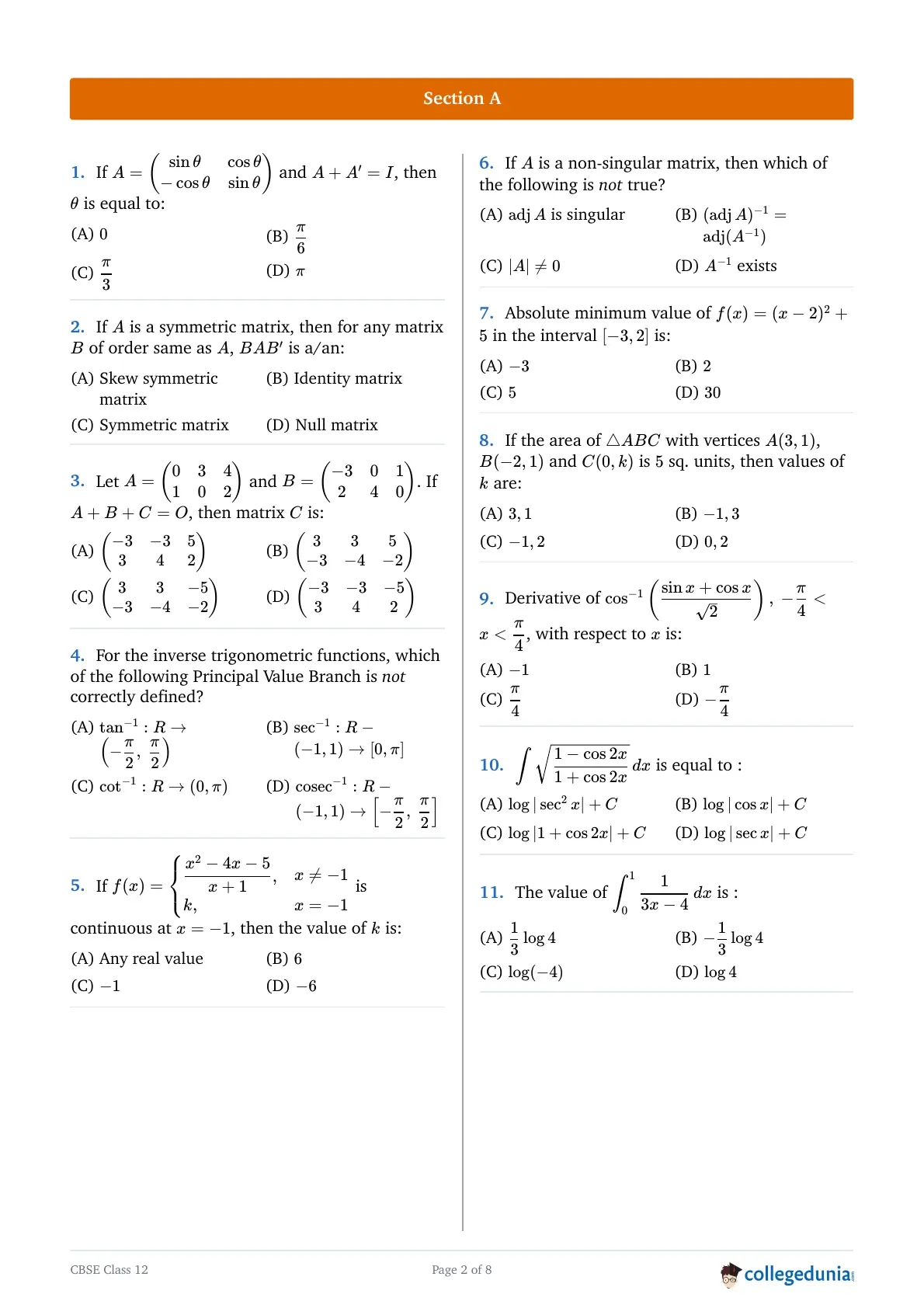
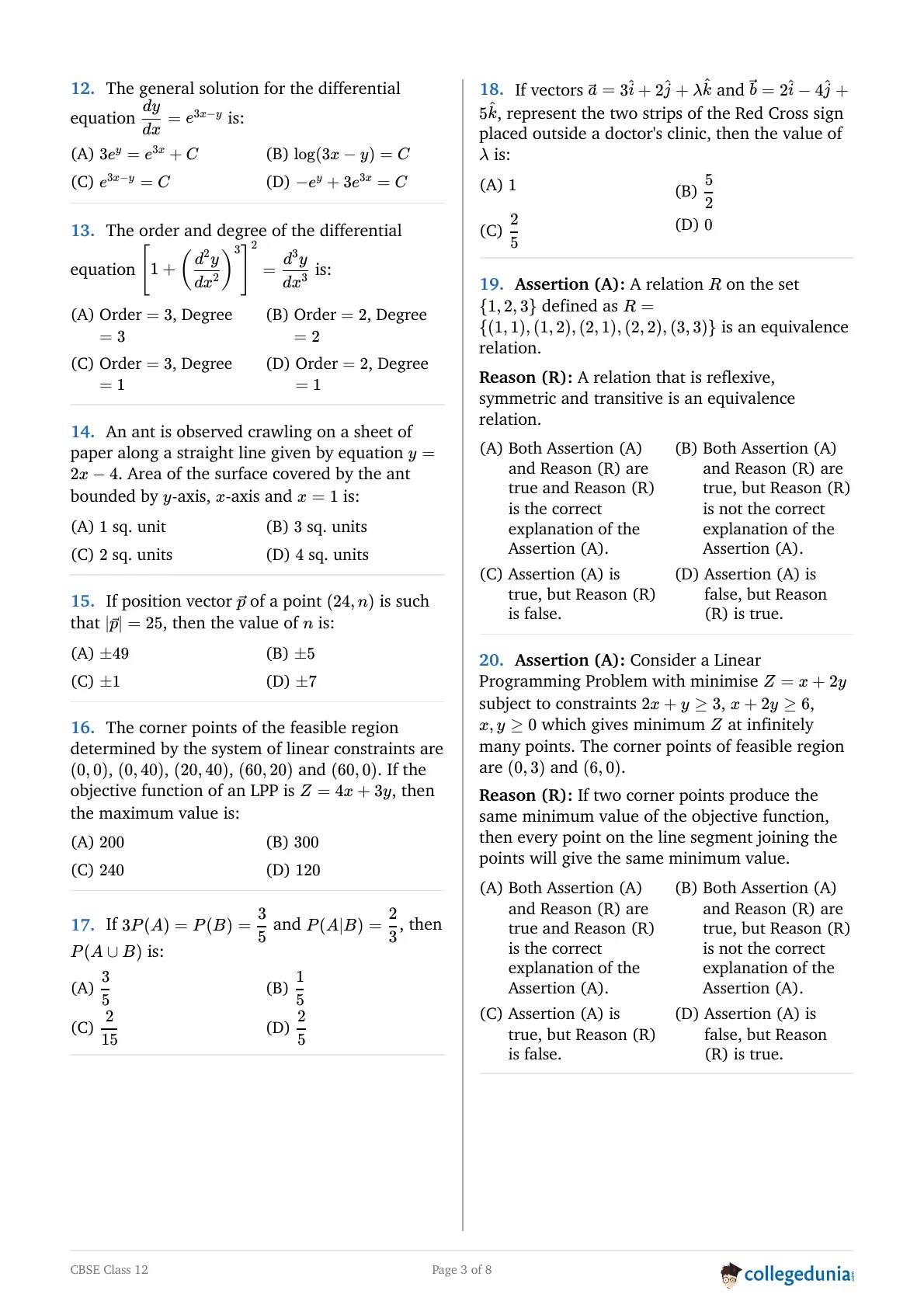
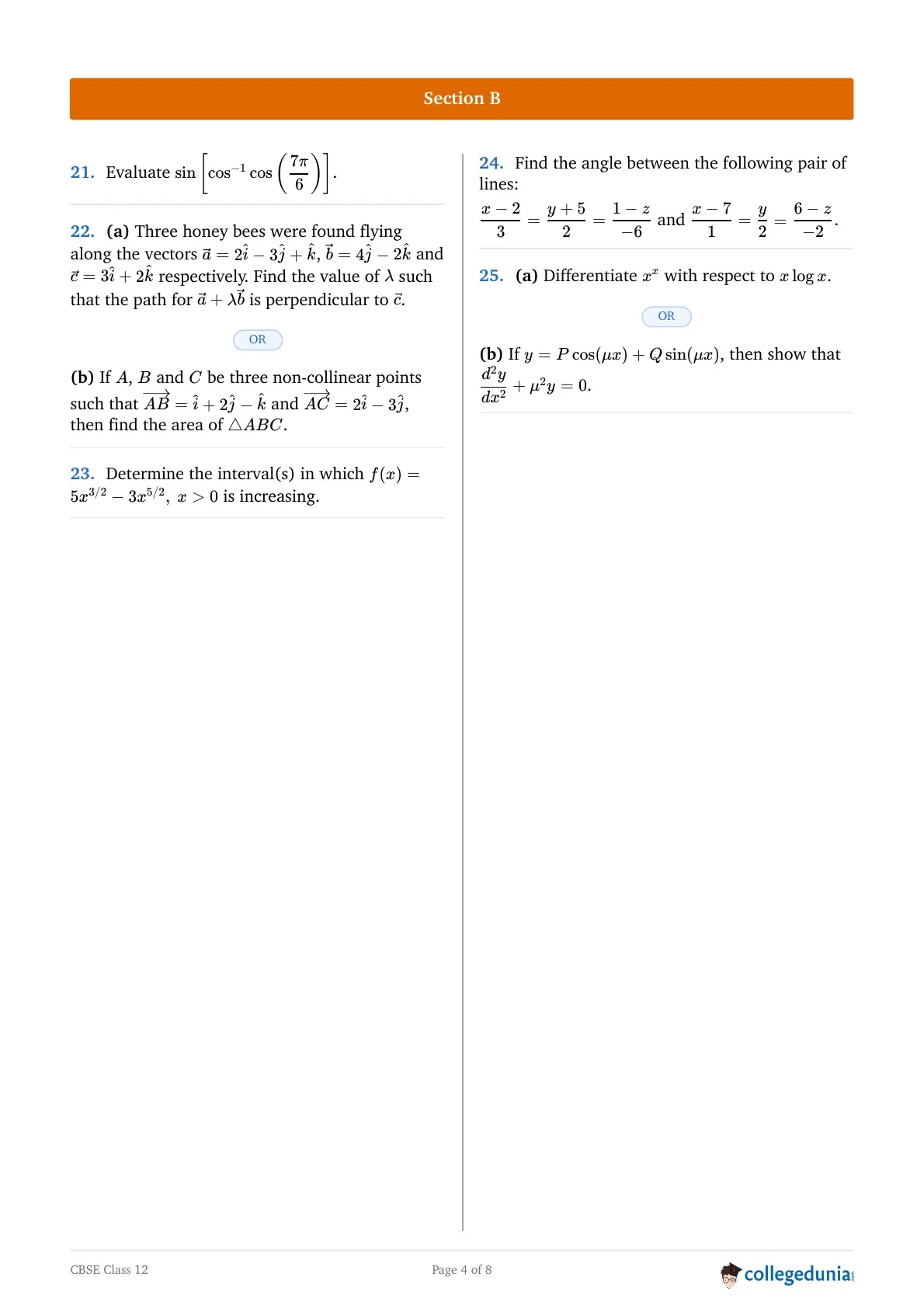
Question 1:

If \( A = \begin{bmatrix} \sin \theta & \cos \theta \\
-\cos \theta & \sin \theta \end{bmatrix} \) and \( A + A' = I \), then \( \theta \) is equal to :

  • (A) \( 0 \)
  • (B) \( \frac{\pi}{6} \)
  • (C) \( \frac{\pi}{3} \)
  • (D) \( \pi \)
Correct Answer: (B) \( \frac{\pi}{6} \)
View Solution


Concept:
A matrix transpose \( A' \) (or \( A^T \)) is obtained by swapping rows with columns. An identity matrix \( I \) of order \( 2 \times 2 \) is given by \( \begin{bmatrix} 1 & 0
0 & 1 \end{bmatrix} \). Setting up the matrix equation \( A + A' = I \) will allow us to equate corresponding elements and solve for the unknown parameter \( \theta \).


Step 1: Write down the given matrix and find its transpose.
The matrix \( A \) is given by: \[ A = \begin{bmatrix} \sin \theta & \cos \theta
-\cos \theta & \sin \theta \end{bmatrix} \]
The transpose \( A' \) is obtained by interchanging rows and columns: \[ A' = \begin{bmatrix} \sin \theta & -\cos \theta
\cos \theta & \sin \theta \end{bmatrix} \]


Step 2: Add matrix \( A \) and its transpose \( A' \).
Now, we calculate the sum matrix \( A + A' \): \[ A + A' = \begin{bmatrix} \sin \theta & \cos \theta
-\cos \theta & \sin \theta \end{bmatrix} + \begin{bmatrix} \sin \theta & -\cos \theta
\cos \theta & \sin \theta \end{bmatrix} \]
By adding corresponding entries of the two matrices, we get: \[ A + A' = \begin{bmatrix} \sin \theta + \sin \theta & \cos \theta + (-\cos \theta)
-\cos \theta + \cos \theta & \sin \theta + \sin \theta \end{bmatrix} \] \[ A + A' = \begin{bmatrix} 2\sin \theta & 0
0 & 2\sin \theta \end{bmatrix} \]


Step 3: Equate \( A + A' \) to the identity matrix \( I \).
According to the problem statement, \( A + A' = I \). Substituting the values, we have: \[ \begin{bmatrix} 2\sin \theta & 0
0 & 2\sin \theta \end{bmatrix} = \begin{bmatrix} 1 & 0
0 & 1 \end{bmatrix} \]
By comparing the corresponding non-zero elements from both sides of the matrix equation, we obtain: \[ 2\sin \theta = 1 \implies \sin \theta = \frac{1}{1} = \frac{1}{2} \]


Step 4: Solve for \( \theta \).
\( \sin\theta = 1/2 \implies \theta = \frac{\pi}{6} \). Quick Tip: When adding a matrix to its transpose, the diagonal elements always double (\( 2a_{ii} \)), while the off-diagonal elements become \( a_{ij} + a_{ji} \). If the matrix is skew-symmetric, the off-diagonal sum cancels out completely to zero.


Question 2:

If \( A \) is a symmetric matrix, then for any matrix \( B \) of order same as \( A \), \( BAB' \) is a/an :

  • (A) Skew symmetric matrix
  • (B) Identity matrix
  • (C) Symmetric matrix
  • (D) Null matrix
Correct Answer: (C) Symmetric matrix
View Solution


Concept:
A matrix \( M \) is said to be symmetric if it equals its own transpose, meaning \( M' = M \). Conversely, it is skew-symmetric if \( M' = -M \). An essential property of matrix transposes is the reversal rule for products: \( (XYZ)' = Z'Y'X' \).


Step 1: State the given mathematical properties.
We are given that \( A \) is a symmetric matrix. By definition: \[ A' = A \]
We want to determine the nature of the expression matrix \( X = BAB' \).


Step 2: Take the transpose of the matrix expression \( BAB' \).
Let \( X = BAB' \). To find whether it is symmetric or skew-symmetric, let us evaluate its transpose \( X' \): \[ X' = (BAB')' \]
Applying the reversal law of transpose operation for multiple matrices, \( (PQR)' = R'Q'P' \), we get: \[ X' = (B')' \cdot A' \cdot B' \]


Step 3: Simplify the expression using transpose rules.
We know that the double transpose of any matrix returns the original matrix itself, i.e., \( (B')' = B \). Substituting this and \( A' = A \) back into the expression: \[ X' = B \cdot A \cdot B' \]
Notice that this resulting expression is exactly the matrix \( X \) we started with: \[ X' = BAB' = X \]


Step 4: Draw conclusion.
Since taking the transpose of \( BAB' \) gives back the original matrix \( BAB' \) unaltered, the matrix \( BAB' \) is conclusively a symmetric matrix. Quick Tip: The expression \( B M B' \) always inherits the symmetry characteristics of the central matrix \( M \). If \( M \) is symmetric, \( B M B' \) is symmetric. If \( M \) is skew-symmetric, \( B M B' \) becomes skew-symmetric.


Question 3:

Let \( A = \begin{bmatrix} 0 & -3 & 4 \\
1 & 0 & 2 \end{bmatrix} \) and \( B = \begin{bmatrix} -3 & 0 & 1 \\ 
2 & 4 & 0 \end{bmatrix} \). If \( A + B + C = O \), then matrix \( C \) is :

  • (A) \( \begin{bmatrix} -3 & -3 & 5 \\
    3 & 4 & 2 \end{bmatrix} \)
  • (B) \( \begin{bmatrix} 3 & 3 & 5 \\
    -3 & -4 & -2 \end{bmatrix} \)
  • (C) \( \begin{bmatrix} 3 & 3 & -5 \\
    -3 & -4 & -2 \end{bmatrix} \)
  • (D) \( \begin{bmatrix} -3 & -3 & -5 \\
    3 & 4 & 2 \end{bmatrix} \)
Correct Answer: (C) \( \begin{bmatrix} 3 & 3 & -5 \\
-3 & -4 & -2 \end{bmatrix} \)
View Solution


Concept:
Matrix addition is performed entry-wise for matrices of identical dimensions. The zero matrix \( O \) represents a matrix where every individual entry is equal to \( 0 \). The equation \( A + B + C = O \) implies that the matrix \( C \) can be calculated directly via subtraction: \( C = -(A + B) \).


Step 1: Compute the sum matrix \( A + B \).
Let's add the corresponding individual elements of matrix \( A \) and matrix \( B \): \[ A + B = \begin{bmatrix} 0 & -3 & 4
1 & 0 & 2 \end{bmatrix} + \begin{bmatrix} -3 & 0 & 1
2 & 4 & 0 \end{bmatrix} \] \[ A + B = \begin{bmatrix} 0 + (-3) & -3 + 0 & 4 + 1
1 + 2 & 0 + 4 & 2 + 0 \end{bmatrix} \] \[ A + B = \begin{bmatrix} -3 & -3 & 5
3 & 4 & 2 \end{bmatrix} \]


Step 2: Solve for matrix \( C \).
From the given equation condition: \[ A + B + C = O \implies C = O - (A + B) = -(A + B) \]
We now apply scalar multiplication by multiplying each entry of the matrix \( A+B \) by \( -1 \): \[ C = -\begin{bmatrix} -3 & -3 & 5
3 & 4 & 2 \end{bmatrix} = \begin{bmatrix} -(-3) & -(-3) & -(5)
-(3) & -(4) & -(2) \end{bmatrix} \] \[ C = \begin{bmatrix} 3 & 3 & -5
-3 & -4 & -2 \end{bmatrix} \] Quick Tip: To avoid sign mistakes when solving algebra with matrices like \( A+B+C=O \), compute the sum element-by-element first, then flip the sign of every single component to reveal \( C \).


Question 4:

For the inverse trigonometric functions, which of the following Principal Value Branch is not correctly defined ?

  • (A) \( \tan^{-1} : \mathbb{R} \rightarrow \left( -\frac{\pi}{2}, \frac{\pi}{2} \right) \)
  • (B) \( \sec^{-1} : \mathbb{R} - (-1, 1) \rightarrow [0, \pi] - \left\{ \frac{\pi}{2} \right\} \)
  • (C) \( \cot^{-1} : \mathbb{R} \rightarrow (0, \pi) \)
  • (D) \( cosec^{-1} : \mathbb{R} - (-1, 1) \rightarrow \left[ -\frac{\pi}{2}, \frac{\pi}{2} \right] \)
Correct Answer: (D) \( \text{cosec}^{-1} : \mathbb{R} - (-1, 1) \rightarrow \left[ -\frac{\pi}{2}, \frac{\pi}{2} \right] \)
View Solution


Concept:
The principal value branches for inverse trigonometric functions define specific restricted codomains to make the original trigonometric functions bijective. Let's recall the standard, universally established principal value branches:

\( \tan^{-1}x \): Domain is \( \mathbb{R} \), Range is \( \left(-\frac{\pi}{2}, \frac{\pi}{2}\right) \)
\( \sec^{-1}x \): Domain is \( \mathbb{R} - (-1, 1) \), Range is \( [0, \pi] - \left\{\frac{\pi}{2}\right\} \)
\( \cot^{-1}x \): Domain is \( \mathbb{R} \), Range is \( (0, \pi) \)
\( cosec^{-1}x \): Domain is \( \mathbb{R} - (-1, 1) \), Range must exclude \( 0 \) because \( cosec(0) \) is undefined. Thus, its true range is \( \left[-\frac{\pi}{2}, \frac{\pi}{2}\right] - \{0\} \).


Step 1: Check option (A).
The given branch is \( \tan^{-1} : \mathbb{R} \rightarrow \left( -\frac{\pi}{2}, \frac{\pi}{2} \right) \). This matches the standard definition precisely, so it is correct.


Step 2: Check option (B).
The given branch is \( \sec^{-1} : \mathbb{R} - (-1, 1) \rightarrow [0, \pi] - \left\{ \frac{\pi}{2} \right\} \). This matches the mathematical standard definitions exactly because \( \cos(\pi/2) = 0 \), hence secant is undefined there. This is correct.


Step 3: Check option (C).
The given branch is \( \cot^{-1} : \mathbb{R} \rightarrow (0, \pi) \). This is correct according to modern standard conventions.


Step 4: Check option (D).
The given branch is listed as \( cosec^{-1} : \mathbb{R} - (-1, 1) \rightarrow \left[ -\frac{\pi}{2}, \frac{\pi}{2} \right] \). However, the value \( 0 \) lies within the interval \( \left[ -\frac{\pi}{2}, \frac{\pi}{2} \right] \). Since \( \sin(0) = 0 \), \( cosec(0) = \frac{1}{0} \) is totally undefined. Therefore, \( 0 \) cannot belong to the codomain of the principal branch of \( cosec^{-1} \). The true branch must be written as \( \left[-\frac{\pi}{2}, \frac{\pi}{2}\right] - \{0\} \). Consequently, option (D) is not correctly defined. Quick Tip: Always look out for points where the original base functions are undefined. For example, \( cosec(\theta) \) is undefined at \( \theta = 0 \), so \( 0 \) must always be excluded from the principal range of \( cosec^{-1}x \).


Question 5:

If \( f(x) = \begin{cases} \frac{x^2 - 4x - 5}{x + 1}, & x \neq -1
k, & x = -1 \end{cases} \) is continuous at \( x = -1 \), then the value of \( k \) is :

  • (A) Any real value
  • (B) \( 6 \)
  • (C) \( -1 \)
  • (D) \( -6 \)
Correct Answer: (D) \( -6 \)
View Solution


Concept:
For a function \( f(x) \) to be continuous at a specific point \( x = c \), the limiting value of the function as \( x \) approaches \( c \) must exist and be exactly equal to the value of the function evaluated at \( c \): \[ \lim_{x \rightarrow c} f(x) = f(c) \]


Step 1: Calculate the limit of \( f(x) \) as \( x \rightarrow -1 \).
We evaluate the limit using the branch defined for \( x \neq -1 \): \[ \lim_{x \rightarrow -1} f(x) = \lim_{x \rightarrow -1} \frac{x^2 - 4x - 5}{x + 1} \]
Direct substitution of \( x = -1 \) leads to an indeterminate form of type \( \frac{0}{0} \): \[ \frac{(-1)^2 - 4(-1) - 5}{-1 + 1} = \frac{1 + 4 - 5}{0} = \frac{0}{0} \]


Step 2: Factorize the numerator expression to simplify.
Let us factorize the quadratic polynomial expression in the numerator: \[ x^2 - 4x - 5 = x^2 - 5x + x - 5 = x(x - 5) + 1(x - 5) = (x + 1)(x - 5) \]
Substitute this back into our limit calculation: \[ \lim_{x \rightarrow -1} \frac{(x + 1)(x - 5)}{x + 1} \]
Since \( x \rightarrow -1 \), \( x \neq -1 \), meaning \( x + 1 \neq 0 \). Thus, we can safely cancel the common factor \( (x + 1) \) from both the numerator and the denominator: \[ \lim_{x \rightarrow -1} (x - 5) \]


Step 3: Evaluate the simplified limit expression.
Now substitute \( x = -1 \) into the remaining reduced factor expression: \[ \lim_{x \rightarrow -1} (x - 5) = -1 - 5 = -6 \]


Step 4: Use the continuity condition to find \( k \).
For continuity at the point \( x = -1 \), we must have: \[ \lim_{x \rightarrow -1} f(x) = f(-1) \]
From the piece-wise definition, \( f(-1) = k \). Therefore: \[ -6 = k \implies k = -6 \] Quick Tip: When resolving \( \frac{0}{0} \) limits involving quadratic equations, factoring out the problematic term \( (x - c) \) is highly reliable and prevents direct substitution errors.


Question 6:

If \( A \) is a non-singular matrix, then which of the following is \textit{not true ?

  • (A) \( adj A \) is singular
  • (B) \( (adj A)^{-1} = (adj A^{-1}) \)
  • (C) \( |A| \neq 0 \)
  • (D) \( A^{-1} \) exists
Correct Answer: (A) \( \text{adj } A \) is singular
View Solution


Concept:
A square matrix \( A \) of order \( n \) is classified as non-singular if its determinant value is non-zero, i.e., \( |A| \neq 0 \). For any non-singular matrix, its inverse exists and is explicitly given by \( A^{-1} = \frac{adj A}{|A|} \). Additionally, a known property for determinants of adjoint matrices states that \( |adj A| = |A|^{n-1} \).


Step 1: Analyze statements (C) and (D).
By direct definition, a non-singular matrix satisfies \( |A| \neq 0 \). Therefore, statement (C) is completely true. Furthermore, because \( |A| \neq 0 \), the inverse matrix \( A^{-1} \) exists. This renders statement (D) entirely true as well.


Step 2: Analyze statement (B).
Using classical algebraic properties of matrices, taking the inverse of an adjoint yields the exact same result as finding the adjoint of the inverse matrix, meaning \( (adj A)^{-1} = adj(A^{-1}) \). This statement is also true.


Step 3: Analyze statement (A).
Let's find the determinant value of the adjoint matrix \( adj A \): \[ |adj A| = |A|^{n-1} \]
Since \( A \) is given to be non-singular, we know that \( |A| \neq 0 \). Consequently, \( |A|^{n-1} \neq 0 \), which implies that \( |adj A| \neq 0 \). By definition, a matrix with a non-zero determinant is non-singular. Therefore, \( adj A \) must be non-singular. Statement (A) claims that \( adj A \) is singular, making it false. Quick Tip: If a matrix \( A \) is invertible (non-singular), all related structural matrices such as \( A^{-1} \), \( adj A \), and \( A^T \) are also fully invertible (non-singular).


Question 7:

Absolute minimum value of \( f(x) = (x - 2)^2 + 5 \) in the interval \( [-3, 2] \) is :

  • (A) \( -3 \)
  • (B) \( 2 \)
  • (C) \( 5 \)
  • (D) \( 30 \)
Correct Answer: (C) \( 5 \)
View Solution


Concept:
To determine the absolute maximum or absolute minimum value of a continuous function on a closed interval \( [a, b] \), we must find the values of the function at all its critical points located inside the interval, as well as evaluate it directly at the endpoints \( x = a \) and \( x = b \).


Step 1: Locate critical points by differentiating \( f(x) \).
The function given is: \[ f(x) = (x - 2)^2 + 5 \]
Differentiating with respect to \( x \): \[ f'(x) = 2(x - 2) \cdot \frac{d}{dx}(x - 2) = 2(x - 2)(1) = 2(x - 2) \]
To find the critical points, set the first derivative equal to zero: \[ 2(x - 2) = 0 \implies x - 2 = 0 \implies x = 2 \]
Notice that \( x = 2 \) is a critical point that serves simultaneously as the right endpoint of our given interval \( [-3, 2] \).


Step 2: Evaluate the function at the boundary endpoints.
We need to test the function's values at \( x = -3 \) and at \( x = 2 \):

At \( x = -3 \):
\[ f(-3) = (-3 - 2)^2 + 5 = (-5)^2 + 5 = 25 + 5 = 30 \]
At \( x = 2 \):
\[ f(2) = (2 - 2)^2 + 5 = (0)^2 + 5 = 0 + 5 = 5 \]


Step 3: Compare values to find the absolute minimum.
Comparing the computed values: \[ f(-3) = 30, \quad f(2) = 5 \]
The smallest value among these is \( 5 \). Hence, the absolute minimum value of the function over the closed interval is \( 5 \). Quick Tip: Since a squared expression \( (x - 2)^2 \) is always non-negative (\( \ge 0 \)), its minimum possible value is \( 0 \), which occurs at \( x = 2 \). Thus, the absolute minimum value is simply \( 0 + 5 = 5 \).


Question 8:

If the area of \( \Delta ABC \) with vertices \( A(3, 1) \), \( B(-2, 1) \) and \( C(0, k) \) is \( 5 \) sq. units, then values of \( k \) are :

  • (A) \( 3, 1 \)
  • (B) \( -1, 3 \)
  • (C) \( -1, 2 \)
  • (D) \( 0, 2 \)
Correct Answer: (B) \( -1, 3 \)
View Solution


Concept:
The area of a triangle with coordinate vertices \( (x_1, y_1) \), \( (x_2, y_2) \), and \( (x_3, y_3) \) can be evaluated using determinants: \[ Area = \frac{1}{2} \left| \det \begin{bmatrix} x_1 & y_1 & 1
x_2 & y_2 & 1
x_3 & y_3 & 1 \end{bmatrix} \right| \]
Because area is always a positive scalar, we must use an absolute value sign, which produces two possibilities (\( \pm \)) when solving for an unknown coordinate.


Step 1: Set up the determinant formula with given points.
Substitute the vertices \( A(3, 1) \), \( B(-2, 1) \), and \( C(0, k) \) into the triangle formula: \[ \pm 5 = \frac{1}{2} \det \begin{bmatrix} 3 & 1 & 1
-2 & 1 & 1
0 & k & 1 \end{bmatrix} \]
Multiply both sides by \( 2 \) to clear the fraction: \[ \det \begin{bmatrix} 3 & 1 & 1
-2 & 1 & 1
0 & k & 1 \end{bmatrix} = \pm 10 \]


Step 2: Expand the matrix determinant.
Let us expand along the first column to simplify calculations: \[ 3 \cdot \det \begin{bmatrix} 1 & 1
k & 1 \end{bmatrix} - (-2) \cdot \det \begin{bmatrix} 1 & 1
k & 1 \end{bmatrix} + 0 = \pm 10 \] \[ 3(1 - k) + 2(1 - k) = \pm 10 \]
Combine the like terms together: \[ 5(1 - k) = \pm 10 \implies 1 - k = \frac{\pm 10}{5} \implies 1 - k = \pm 2 \]


Step 3: Solve the two separate equations for \( k \).

Case 1 (Positive sign):
\[ 1 - k = 2 \implies -k = 2 - 1 \implies -k = 1 \implies k = -1 \]
Case 2 (Negative sign):
\[ 1 - k = -2 \implies -k = -2 - 1 \implies -k = -3 \implies k = 3 \]

Thus, the possible values for the coordinate parameter are \( k = -1 \) and \( k = 3 \). Quick Tip: Don't forget to include the \( \pm \) sign when removing the area modulus context. Omitting the negative case will cause you to miss one of the valid solution coordinates.


Question 9:

Derivative of \( \cos^{-1}\left( \frac{\sin x + \cos x}{\sqrt{2}} \right) \), \( -\frac{\pi}{4} < x < \frac{\pi}{4} \) with respect to \( x \) is :

  • (A) \( -1 \)
  • (B) \( 1 \)
  • (C) \( \frac{\pi}{4} \)
  • (D) \( -\frac{\pi}{4} \)
Correct Answer: (A) \( -1 \)
View Solution


Concept:
To differentiate complex expressions involving inverse trigonometric functions, simplify the inner argument using standard trigonometric identities before computing the derivative.


Step 1: Simplify the inner expression.
Let \( y = \cos^{-1}\left( \frac{\sin x + \cos x}{\sqrt{2}} \right) \). We can distribute the denominator: \[ \frac{\sin x + \cos x}{\sqrt{2}} = \frac{1}{\sqrt{2}}\cos x + \frac{1}{\sqrt{2}}\sin x \]
Recall the standard trigonometric values: \( \cos\left(\frac{\pi}{4}\right) = \frac{1}{\sqrt{2}} \) and \( \sin\left(\frac{\pi}{4}\right) = \frac{1}{\sqrt{2}} \). Substituting these into the formula: \[ \frac{\sin x + \cos x}{\sqrt{2}} = \cos x \cos\left(\frac{\pi}{4}\right) + \sin x \sin\left(\frac{\pi}{4}\right) \]
Using the cosine subtraction identity, \( \cos(A - B) = \cos A \cos B + \sin A \sin B \), we rewrite it as: \[ \cos\left(x - \frac{\pi}{4}\right) \]


Step 2: Substitute back into the inverse function. \[ y = \cos^{-1}\left( \cos\left(x - \frac{\pi}{4}\right) \right) \]
We are given the domain restriction: \( -\frac{\pi}{4} < x < \frac{\pi}{4} \). Subtracting \( \frac{\pi}{4} \) across the inequality: \[ -\frac{\pi}{4} - \frac{\pi}{4} < x - \frac{\pi}{4} < \frac{\pi}{4} - \frac{\pi}{4} \implies -\frac{\pi}{2} < x - \frac{\pi}{4} < 0 \]
Since cosine is an even function, \( \cos\left(x - \frac{\pi}{4}\right) = \cos\left(\frac{\pi}{4} - x\right) \). Under our domain, the angle \( \left(\frac{\pi}{4} - x\right) \) lies in \( \left(0, \frac{\pi}{2}\right) \), which is well within the principal value branch of \( \cos^{-1} \) (i.e., \( [0, \pi] \)). Thus: \[ y = \cos^{-1}\left( \cos\left(\frac{\pi}{4} - x\right) \right) = \frac{\pi}{4} - x \]


Step 3: Differentiate with respect to \( x \).
Now, we take the derivative of our simplified equation: \[ \frac{dy}{dx} = \frac{d}{dx}\left( \frac{\pi}{4} - x \right) = 0 - 1 = -1 \] Quick Tip: Always double-check interval ranges. Since \( \cos(- \theta) = \cos(\theta) \), adapting the sign of the inside angle ensures compliance with the principal range of \( \cos^{-1} \).


Question 10:

The integral \( \int \sqrt{\frac{1 - \cos 2x}{1 + \cos 2x}} \, dx \) is equal to :

  • (A) \( \log |\sec^2 x| + C \)
  • (B) \( \log |\cos x| + C \)
  • (C) \( \log |1 + \cos 2x| + C \)
  • (D) \( \log |\sec x| + C \)
Correct Answer: (D) \( \log |\sec x| + C \)
View Solution


Concept:
We utilize trigonometric double-angle identities to simplify the integrand: \[ 1 - \cos 2x = 2\sin^2 x \quad and \quad 1 + \cos 2x = 2\cos^2 x \]
The standard integral of the tangent function is given by \( \int \tan x \, dx = \log |\sec x| + C \).


Step 1: Substitute double-angle identities into the integrand.
Let's simplify the inner fraction: \[ \sqrt{\frac{1 - \cos 2x}{1 + \cos 2x}} = \sqrt{\frac{2\sin^2 x}{2\cos^2 x}} = \sqrt{\frac{\sin^2 x}{\cos^2 x}} = \sqrt{\tan^2 x} = \tan x \]
(Assuming standard principal domains where \( \tan x > 0 \)).


Step 2: Integrate the simplified function.
The original integral now reduces directly to: \[ I = \int \tan x \, dx \]
We solve this using substitution by rewriting \( \tan x = \frac{\sin x}{\cos x} \): \[ I = \int \frac{\sin x}{\cos x} \, dx \]
Let \( u = \cos x \), then \( du = -\sin x \, dx \implies \sin x \, dx = -du \): \[ I = \int \frac{-du}{u} = -\log|u| + C = -\log|\cos x| + C \]
Using logarithmic power rules, \( -\log|\cos x| = \log|(\cos x)^{-1}| = \log\left|\frac{1}{\cos x}\right| = \log|\sec x| + C \). Quick Tip: The double angle identities \( 1-\cos 2x = 2\sin^2 x \) and \( 1+\cos 2x = 2\cos^2 x \) are highly frequent in calculus. Memorize them to simplify trigonometric roots quickly.


Question 11:

The value of \( \int_{0}^{1} \frac{1}{3x - 4} \, dx \) is :

  • (A) \( \frac{1}{3} \log 4 \)
  • (B) \( -\frac{1}{3} \log 4 \)
  • (C) \( \log (-4) \)
  • (D) \( \log 4 \)
Correct Answer: (B) \( -\frac{1}{3} \log 4 \)
View Solution


Concept:
The standard integration formula for a linear fractional form is \( \int \frac{1}{ax + b} \, dx = \frac{1}{a} \log |ax + b| \). When dealing with definite integration, evaluate this anti-derivative at the upper limit and subtract its value at the lower limit.


Step 1: Compute the indefinite integral.
Let us find the antiderivative of the function: \[ \int \frac{1}{3x - 4} \, dx = \frac{1}{3} \log |3x - 4| \]


Step 2: Apply the limits of integration from \( 0 \) to \( 1 \).
Using the Fundamental Theorem of Calculus: \[ I = \left[ \frac{1}{3} \log |3x - 4| \right]_{0}^{1} \]
Substitute the upper limit \( x = 1 \): \[ I_{upper} = \frac{1}{3} \log |3(1) - 4| = \frac{1}{3} \log |3 - 4| = \frac{1}{3} \log |-1| = \frac{1}{3} \log(1) = 0 \]
Substitute the lower limit \( x = 0 \): \[ I_{lower} = \frac{1}{3} \log |3(0) - 4| = \frac{1}{3} \log |0 - 4| = \frac{1}{3} \log |-4| = \frac{1}{3} \log 4 \]


Step 3: Subtract lower limit value from upper limit value. \[ I = I_{upper} - I_{lower} = 0 - \frac{1}{3} \log 4 = -\frac{1}{3} \log 4 \] Quick Tip: Always use absolute value signs within the logarithm argument during integration, because \( \log(x) \) is undefined for negative real numbers. This ensures that terms like \( |-4| \) correctly simplify to \( 4 \).


Question 12:

The general solution for the differential equation \( \frac{dy}{dx} = e^{3x - y} \) is :

  • (A) \( 3e^y = e^{3x} + C \)
  • (B) \( \log(3x - y) = C \)
  • (C) \( e^{3x - y} = C \)
  • (D) \( -e^y + 3e^{3x} = C \)
Correct Answer: (A) \( 3e^y = e^{3x} + C \)
View Solution


Concept:
This differential equation can be solved using the method of separation of variables. We transform the equation into the form \( g(y) \, dy = f(x) \, dx \), and then integrate both sides independently.


Step 1: Separate the variables \( x \) and \( y \).
The given differential equation is: \[ \frac{dy}{dx} = e^{3x - y} \]
Using exponential laws, we split the right-hand side: \[ \frac{dy}{dx} = \frac{e^{3x}}{e^y} \]
Now, cross-multiply to separate variables on opposite sides: \[ e^y \, dy = e^{3x} \, dx \]


Step 2: Integrate both sides.
Set up the integrals: \[ \int e^y \, dy = \int e^{3x} \, dx \]
Evaluating the basic exponential integrals yields: \[ e^y = \frac{e^{3x}}{3} + C_1 \]


Step 3: Clear fractions to match option formatting.
Multiply the entire equation by \( 3 \): \[ 3e^y = e^{3x} + 3C_1 \]
Let \( 3C_1 = C \) be a new arbitrary constant: \[ 3e^y = e^{3x} + C \] Quick Tip: When exponents contain sums or differences like \( e^{a-b} \), separating them into products or quotients \( \frac{e^a}{e^b} \) is the standard first step to isolate variables.


Question 13:

The order and degree of differential equation \( \frac{d^2y}{dx^2} = 1 - \left( \frac{d^3y}{dx^3} \right)^2 \) is :

  • (A) Order = 3, Degree = 3
  • (B) Order = 2, Degree = 2
  • (C) Order = 3, Degree = 2
  • (D) Order = 2, Degree = 1
Correct Answer: (C) Order = 3, Degree = 2
View Solution


Concept:

Order: The order of a differential equation is defined as the highest derivative order present anywhere inside the equation.
Degree: The degree is the power of the highest order derivative term, provided the differential equation is written as a polynomial expression in terms of its derivatives.


Step 1: Determine the order.
Look at the derivative components present in the given equation: \[ \frac{d^2y}{dx^2} \quad (Second derivative) \] \[ \frac{d^3y}{dx^3} \quad (Third derivative) \]
The highest derivative order appearing in the expression is \( 3 \). Thus, Order = 3.


Step 2: Determine the degree.
Identify the term containing this highest derivative, which is \( \left( \frac{d^3y}{dx^3} \right)^2 \). The exponent power of this term is \( 2 \). Since the entire equation is a polynomial in derivatives, the degree is simply this exponent. Thus, Degree = 2. Quick Tip: Always locate the highest derivative first to find the order. The degree belongs exclusively to that specific term's exponent, regardless of how high other lower-derivative powers are.


Question 14:

An ant is observed crawling on a sheet of paper along a straight line given by equation \( y = 2x - 4 \). Area of the surface covered by the ant bounded by y-axis, x-axis and \( x = 1 \) is :

  • (A) \( 1 \) sq. unit
  • (B) \( 3 \) sq. units
  • (C) \( 2 \) sq. units
  • (D) \( 4 \) sq. units
Correct Answer: (B) \( 3 \) sq. units
View Solution


Concept:
The area bounded by a curve \( y = f(x) \), the x-axis, and vertical lines \( x = a \), \( x = b \) is evaluated using definite integration: \( Area = \int_{a}^{b} |y| \, dx \). If the curve falls below the x-axis within the region, the integral will yield a negative value, so we take its absolute magnitude.


Step 1: Identify bounds and find critical intercepts.
The boundaries are the y-axis (\( x = 0 \)), the vertical line \( x = 1 \), and the x-axis (\( y = 0 \)).
Let's check where the line \( y = 2x - 4 \) intersects the x-axis by setting \( y = 0 \): \[ 2x - 4 = 0 \implies 2x = 4 \implies x = 2 \]
Since our region lies strictly within the interval \( x \in [0, 1] \), the line does not cross the x-axis inside the integration window. For any value in \( [0, 1] \), \( y = 2x - 4 \) is negative.


Step 2: Set up the area definite integral. \[ Area = \int_{0}^{1} |2x - 4| \, dx = \int_{0}^{1} -(2x - 4) \, dx = \int_{0}^{1} (4 - 2x) \, dx \]


Step 3: Compute the integral value. \[ Area = \left[ 4x - \frac{2x^2}{2} \right]_{0}^{1} = \left[ 4x - x^2 \right]_{0}^{1} \]
Substitute the upper boundary \( x = 1 \): \[ Area_{upper} = 4(1) - (1)^2 = 4 - 1 = 3 \]
Substitute the lower boundary \( x = 0 \): \[ Area_{lower} = 4(0) - (0)^2 = 0 \]
Subtract to find total area: \[ Area = 3 - 0 = 3 sq. units \] Quick Tip: Areas represent real physical regions and can never be negative. If your integral yields a negative value, take its absolute value.


Question 15:

If position vector \( \vec{p} \) of a point \( (24, n) \) is such that \( |\vec{p}| = 25 \), then the value of \( n \) is :

  • (A) \( \pm 49 \)
  • (B) \( \pm 5 \)
  • (C) \( \pm 1 \)
  • (D) \( \pm 7 \)
Correct Answer: (D) \( \pm 7 \)
View Solution


Concept:
The magnitude of a 2D position vector \( \vec{p} = x\hat{i} + y\hat{j} \) corresponding to a coordinate point \( (x, y) \) is calculated using the Pythagorean-based distance formula: \[ |\vec{p}| = \sqrt{x^2 + y^2} \]


Step 1: Write the position vector format and vector magnitude.
The coordinate point is given as \( (24, n) \), so its vector representation is: \[ \vec{p} = 24\hat{i} + n\hat{j} \]
The magnitude formula yields: \[ |\vec{p}| = \sqrt{24^2 + n^2} \]


Step 2: Form an equation with the given magnitude.
We are given that \( |\vec{p}| = 25 \), so: \[ \sqrt{24^2 + n^2} = 25 \]
Square both sides of the equation to eliminate the radical sign: \[ 24^2 + n^2 = 25^2 \]


Step 3: Solve for parameter \( n \).
Compute the known squares: \[ 576 + n^2 = 625 \]
Isolate \( n^2 \): \[ n^2 = 625 - 576 \implies n^2 = 49 \]
Taking square roots on both sides gives both positive and negative options: \[ n = \pm\sqrt{49} = \pm 7 \] Quick Tip: This problem uses the well-known Pythagorean triple \( (7, 24, 25) \). Remembering basic right-triangle integer triples allows you to verify vector components instantly.


Question 16:

The corner points of the feasible region determined by the system of linear constraints are \( (0, 0), (0, 40), (20, 40), (60, 20) \) and \( (60, 0) \). If the objective function of an LPP is \( Z = 4x + 3y \), then the maximum value is :

  • (A) \( 200 \)
  • (B) \( 300 \)
  • (C) \( 240 \)
  • (D) \( 120 \)
Correct Answer: (B) \( 300 \)
View Solution


Concept:
According to the Corner Point Theorem in Linear Programming, the optimal value (maximum or minimum) of an objective function always occurs at one of the vertices (corner points) of the bounded feasible region. We calculate the value of \( Z \) at each vertex to find the largest one.


Step 1: Evaluate \( Z = 4x + 3y \) at each corner point systematically.
Let's compute the value of the objective function for all five points:

At point \( (0, 0) \):
\[ Z = 4(0) + 3(0) = 0 + 0 = 0 \]
At point \( (0, 40) \):
\[ Z = 4(0) + 3(40) = 0 + 120 = 120 \]
At point \( (20, 40) \):
\[ Z = 4(20) + 3(40) = 80 + 120 = 200 \]
At point \( (60, 20) \):
\[ Z = 4(60) + 3(20) = 240 + 60 = 300 \]
At point \( (60, 0) \):
\[ Z = 4(60) + 3(0) = 240 + 0 = 240 \]


Step 2: Identify the maximum value.
Comparing all the calculated objective values: \[ 0, \, 120, \, 200, \, 300, \, 240 \]
The maximum value among these options is \( 300 \), which occurs at the coordinate point vertex \( (60, 20) \). Quick Tip: To avoid calculation errors, organize your vertex evaluations inside a small table mapping points directly to calculated values.


Question 17:

If \( 3P(A) = P(B) = \frac{3}{5} \) and \( P(A|B) = \frac{2}{3} \), then \( P(A \cup B) \) is :

  • (A) \( \frac{3}{5} \)
  • (B) \( \frac{1}{5} \)
  • (C) \( \frac{2}{15} \)
  • (D) \( \frac{2}{5} \)
Correct Answer: (D) \( \frac{2}{5} \)
View Solution


Concept:
We use key equations from conditional probability and basic set operations:

Multiplication rule: \( P(A \cap B) = P(B) \cdot P(A|B) \)
Addition rule: \( P(A \cup B) = P(A) + P(B) - P(A \cap B) \)


Step 1: Extract individual probabilities.
From the compound equality statement: \[ 3P(A) = \frac{3}{5} \implies P(A) = \frac{3}{5 \times 3} = \frac{1}{5} \] \[ P(B) = \frac{3}{5} \]


Step 2: Find the intersection probability \( P(A \cap B) \).
Using the conditional probability values provided: \[ P(A|B) = \frac{P(A \cap B)}{P(B)} \implies P(A \cap B) = P(B) \cdot P(A|B) \]
Substitute our values into this formula: \[ P(A \cap B) = \frac{3}{5} \times \frac{2}{3} = \frac{2}{5} \]


Step 3: Calculate the union probability \( P(A \cup B) \).
Now apply the general probability addition rule: \[ P(A \cup B) = P(A) + P(B) - P(A \cap B) \]
Substitute the calculated values into the formula: \[ P(A \cup B) = \frac{1}{5} + \frac{3}{5} - \frac{2}{5} = \frac{1 + 3 - 2}{5} = \frac{2}{5} \] Quick Tip: Always decouple compound equalities like \( 3P(A) = P(B) = value \) into isolated algebraic equations first to prevent coefficient mistakes later.


Question 18:

If vectors \( \vec{a} = 3\hat{i} + 2\hat{j} + \lambda\hat{k} \) and \( \vec{b} = 2\hat{i} - 4\hat{j} + 5\hat{k} \) represent the two strips of the Red Cross sign placed outside a doctor's clinic, then the value of \( \lambda \) is :

  • (A) \( 1 \)
  • (B) \( \frac{5}{2} \)
  • (C) \( \frac{2}{5} \)
  • (D) \( 0 \)
Correct Answer: (C) \( \frac{2}{5} \)
View Solution


Concept:
The geometry of a standard Red Cross sign consists of two perpendicular straight strips that intersect at right angles (\( 90^\circ \)). For any two vectors that are perpendicular, their dot product equals zero: \[ \vec{a} \cdot \vec{b} = 0 \]


Step 1: Express the condition for perpendicular vectors.
Since the strips represent the Red Cross sign, the vectors \( \vec{a} \) and \( \vec{b} \) must be orthogonal to one another: \[ \vec{a} \cdot \vec{b} = 0 \]


Step 2: Expand the dot product using components.
The vectors are given as: \[ \vec{a} = 3\hat{i} + 2\hat{j} + \lambda\hat{k} \] \[ \vec{b} = 2\hat{i} - 4\hat{j} + 5\hat{k} \]
Compute the dot product by multiplying corresponding component parts: \[ (3)(2) + (2)(-4) + (\lambda)(5) = 0 \] \[ 6 - 8 + 5\lambda = 0 \]


Step 3: Solve for the unknown variable \( \lambda \).
Combine the constants: \[ -2 + 5\lambda = 0 \]
Isolate the term containing \( \lambda \): \[ 5\lambda = 2 \implies \lambda = \frac{2}{5} \] Quick Tip: Real-world application word cues like "Red Cross sign" or "orthogonal axes" indicate that the underlying angle is exactly \( 90^\circ \), meaning you should set the dot product equal to zero.


Question 19:

Assertion (A): A relation \(R\) on the set \(\{1, 2, 3\}\) defined as \(R = \{(1, 1), (1, 2), (2, 1), (2, 2), (3, 3)\}\) is an equivalence relation.

Reason (R): A relation that is reflexive, symmetric and transitive is an equivalence relation.

  • (A) Both Assertion (A) and Reason (R) are true and Reason (R) is the correct explanation of the Assertion (A).
  • (B) Both Assertion (A) and Reason (R) are true, but Reason (R) is \textbf{not} the correct explanation of the Assertion (A).
  • (C) Assertion (A) is true, but Reason (R) is false.
  • (D) Assertion (A) is false, but Reason (R) is true.
Correct Answer: (A) Both Assertion (A) and Reason (R) are true and Reason (R) is the correct explanation of the Assertion (A).
View Solution


Concept:
An equivalence relation is a fundamental concept in set theory that groups elements sharing a common property. For a relation \(R\) defined on a non-empty set \(A\) to qualify as an equivalence relation, it must simultaneously satisfy three independent foundational mathematical criteria:

Reflexivity: Every element in the set must be related to itself. Mathematically, \(\forall x \in A, \, (x, x) \in R\).
Symmetry: If an element is related to another element, then the second element must also be related back to the first. Mathematically, if \((x, y) \in R\), then \((y, x) \in R\) for all \(x, y \in A\).
Transitivity: If a first element relates to a second, and that second element relates to a third, then the first element must relate directly to the third. Mathematically, if \((x, y) \in R\) and \((y, z) \in R\), then \((x, z) \in R\) for all \(x, y, z \in A\).


Step 1: {\color{redAnalysis of the fundamental definition given in Reason (R).

The statement given in Reason (R) states: "A relation that is reflexive, symmetric and transitive is an equivalence relation." This statement is directly extracted from the core axiomatic definitions of set theory. By definition, a relation earns the designation of an "equivalence relation" if and only if it possesses all three properties: reflexivity, symmetry, and transitivity. Thus, the statement in Reason (R) is undeniably True.


Step 2: {\color{redVerifying the Reflexive property for Assertion (A).

The given underlying set is \(A = \{1, 2, 3\}\). For the relation \(R\) to be reflexive on set \(A\), every individual element belonging to \(A\) must map to itself within the relation. This means the ordered pairs \((1, 1)\), \((2, 2)\), and \((3, 3)\) must all be explicitly present as elements inside the set \(R\).
Let us verify the elements of the given relation: \[ R = \{(1, 1), (1, 2), (2, 1), (2, 2), (3, 3)\} \]
Checking the elements one by one:

For \(1 \in A\), we observe that \((1, 1) \in R\).
For \(2 \in A\), we observe that \((2, 2) \in R\).
For \(3 \in A\), we observe that \((3, 3) \in R\).

Since all required reflexive pairs exist within \(R\), the relation is successfully verified to be Reflexive.


Step 3: {\color{redVerifying the Symmetric property for Assertion (A).

For the relation \(R\) to be symmetric, for any ordered pair \((x, y)\) that exists inside \(R\), its inverse pair \((y, x)\) must also exist inside \(R\). Let us systematically test every distinct non-diagonal ordered pair present in \(R\):

Consider the ordered pair \((1, 2)\). We check if its reverse pair \((2, 1)\) exists. Looking at \(R\), we see that \((2, 1) \in R\).
Consider the ordered pair \((2, 1)\). We check if its reverse pair \((1, 2)\) exists. Looking at \(R\), we see that \((1, 2) \in R\).
For the diagonal elements \((1, 1)\), \((2, 2)\), and \((3, 3)\), their respective reversals are identical to themselves, which naturally belong to \(R\).

Since every element satisfies the condition of having its corresponding symmetric pair present, the relation is verified to be Symmetric.


Step 4: {\color{redVerifying the Transitive property for Assertion (A).

For the relation \(R\) to be transitive, whenever two pairs of the form \((x, y)\) and \((y, z)\) belong to \(R\), the resulting terminal pair \((x, z)\) must also belong to \(R\). Let us scrutinize the non-trivial combinations where the second coordinate of the first pair matches the first coordinate of the second pair:

Combination 1: Take \((1, 2) \in R\) and \((2, 1) \in R\). Here, \(x=1, y=2, z=1\). The required transitivity pair is \((x, z) = (1, 1)\). Checking the relation, we find that \((1, 1) \in R\).
Combination 2: Take \((2, 1) \in R\) and \((1, 2) \in R\). Here, \(x=2, y=1, z=2\). The required transitivity pair is \((x, z) = (2, 2)\). Checking the relation, we find that \((2, 2) \in R\).
Checking with diagonal components like \((1,1)\) combined with \((1,2)\) yields \((1,2)\), which is trivially in \(R\). Similarly, \((2,1)\) combined with \((1,1)\) yields \((2,1)\), which is in \(R\).

Since all possible chain combinations yield valid ordered pairs within \(R\), the relation is verified to be Transitive.


Step 5: {\color{redSynthesizing the final logic conclusion.

Because the relation \(R\) has been proven to be completely Reflexive, Symmetric, and Transitive, it satisfies all criteria needed to be classified as an equivalence relation. Therefore, Assertion (A) is True. Furthermore, the reason why Assertion (A) is true is precisely because it fulfills the core definition outlined in Reason (R). Hence, Reason (R) is the exact and correct explanation for Assertion (A). Quick Tip: To test equivalence relations efficiently on a small finite set: - First, check if all identity components \((x,x)\) are fully present for the set elements. - Second, ignore identity pairs while checking for symmetry and transitivity to save computation time, as identity pairs \((x,x)\) always satisfy symmetry and transitivity automatically.


Question 20:

Assertion (A): Consider a Linear Programming Problem with minimise \(Z = x + 2y\) subject to constraints \(2x + y \geq 3\), \(x + 2y \geq 6\), \(x, y \geq 0\) which gives minimum \(Z\) at infinitely many points. The corner points of feasible region are \((0, 3)\) and \((6, 0)\).

Reason (R): If two corner points produce the same minimum value of the objective function, then every point on the line segment joining the points will give the same minimum value.

  • (A) Both Assertion (A) and Reason (R) are true and Reason (R) is the correct explanation of the Assertion (A).
  • (B) Both Assertion (A) and Reason (R) are true, but Reason (R) is \textbf{not} the correct explanation of the Assertion (A).
  • (C) Assertion (A) is true, but Reason (R) is false.
  • (D) Assertion (A) is false, but Reason (R) is true.
Correct Answer: (A) Both Assertion (A) and Reason (R) are true and Reason (R) is the correct explanation of the Assertion (A).
View Solution


Concept:
In Linear Programming Problems (LPP), the feasible region is determined by the intersection of all given linear constraints, including non-negativity restrictions. According to the Fundamental Theorem of Linear Programming, if an optimal value (maximum or minimum) of an objective function exists, it must occur at one of the extreme boundary points, known as the corner points or vertices of the feasible region. Furthermore, if the optimal value is attained at two distinct corner points, then the objective function will yield that identical optimal value at any and every point lying along the line segment connecting those two specific corner points, creating infinitely many optimal solutions.

Step 1: {\color{redDetermining the boundary lines and finding the exact corner points of the feasible region.

To locate the corner points of the region defined by the system of linear inequalities, let us convert the inequality constraints into standard linear equations to locate their geometric intercepts:

Constraint 1: \(2x + y \geq 3\). The corresponding boundary line equation is \(2x + y = 3\).

To find the \(y\)-intercept, set \(x = 0\): \(2(0) + y = 3 \implies y = 3\). Point is \(A(0, 3)\).
To find the \(x\)-intercept, set \(y = 0\): \(2x + 0 = 3 \implies x = \frac{3}{2} = 1.5\). Point is \(B(1.5, 0)\).

Constraint 2: \(x + 2y \geq 6\). The corresponding boundary line equation is \(x + 2y = 6\).

To find the \(y\)-intercept, set \(x = 0\): \(0 + 2y = 6 \implies y = 3\). Point is \(A(0, 3)\).
To find the \(x\)-intercept, set \(y = 0\): \(x + 2(0) = 6 \implies x = 6\). Point is \(C(6, 0)\).


Now, let us consider the inequalities \(2x + y \geq 3\) and \(x + 2y \geq 6\) along with the non-negativity constraints \(x \geq 0, y \geq 0\). Testing the origin \((0,0)\) in both inequalities gives \(0 \geq 3\) (False) and \(0 \geq 6\) (False), indicating the feasible region lies away from the origin in the first quadrant.
The boundary vertices that bound this open, unbounded region on the low side are exactly the points \((0, 3)\) and \((6, 0)\). The point \((1.5, 0)\) is inside the non-feasible zone since it does not satisfy \(x + 2y \geq 6\) (\(1.5 + 0 = 1.5 \nsim \geq 6\)). Thus, the actual corner points of the feasible region are indeed \((0, 3)\) and \((6, 0)\).


Step 2: {\color{redEvaluating the objective function \(Z = x + 2y\) at each valid corner point.

Let us calculate the exact quantitative value of our objective function \(Z\) at the two identified vertices:

At the first corner point \((0, 3)\):
\[ Z_{(0,3)} = 0 + 2(3) = 6 \]
At the second corner point \((6, 0)\):
\[ Z_{(6,0)} = 6 + 2(0) = 6 \]

We observe that the objective function values at both independent boundary coordinates are precisely equal to \(6\).


Step 3: {\color{redAssessing the validity of Assertion (A) and Reason (R).

Since both distinct corner points yield the exact same minimum value (\(Z = 6\)), any linear convex combination of these two points will yield the exact same value. Since a line segment contains an infinite number of points, the LPP possesses infinitely many points that minimize \(Z\). Thus, Assertion (A) is completely True.

Now looking at Reason (R): It states that if two corner points produce the same minimum value, then every point on the line segment connecting them will also give that minimum value. This statement is a standard, mathematically sound theorem of optimization theory. Therefore, Reason (R) is True.

Moreover, Assertion (A) concludes that there are infinitely many minimizing points precisely because the two corner points yield identical values, which is the exact behavior described by Reason (R). Hence, Reason (R) is the direct and correct explanation for Assertion (A). Quick Tip: When the coefficients of the variables in the objective function \(Z = ax + by\) are perfectly proportional to the coefficients of a bounding constraint line \(ax + by = c\), the optimal solution will always occur along the entire corresponding line segment, generating infinitely many solutions.


Question 21:

Evaluate \(\sin\left[\cos^{-1} \cos\left(\frac{7\pi}{6}\right)\right]\).

Correct Answer:
View Solution


Concept:
To accurately evaluate composite functions involving trigonometric and inverse trigonometric operations, we must strictly respect the principal value branches. The principal value branch of the inverse cosine function, \(y = \cos^{-1}(x)\), is strictly restricted to the closed domain interval \([0, \pi]\). Therefore, the simplification identity \(\cos^{-1}(\cos \theta) = \theta\) holds true if and only if \(\theta\) lies within \([0, \pi]\). If the angle \(\theta\) lies outside this range, we must first utilize trigonometric reduction identities to map the angle into the principal interval without changing its fundamental cosine evaluation.

Step 1: {\color{redAnalyzing and reducing the inner angle \(\frac{7\pi}{6}\) to fit within the principal value branch.

The given internal angle is \(\theta = \frac{7\pi}{6}\). Let us check if this angle falls inside the principal value range \([0, \pi]\): \[ \frac{7\pi}{6} = 1.166\pi > \pi \]
Since \(\frac{7\pi}{6} \notin [0, \pi]\), we cannot directly simplify \(\cos^{-1}\left(\cos\frac{7\pi}{6}\right) = \frac{7\pi}{6}\). We must rewrite the angle using the periodic and symmetric properties of the cosine function. We know that \(\cos(2\pi - \alpha) = \cos(\alpha)\). Let us apply this identity: \[ \cos\left(\frac{7\pi}{6}\right) = \cos\left(2\pi - \frac{7\pi}{6}\right) = \cos\left(\frac{12\pi - 7\pi}{6}\right) = \cos\left(\frac{5\pi}{6}\right) \]
Now, let us verify if the new angle \(\frac{5\pi}{6}\) lies inside our principal branch interval \([0, \pi]\): \[ 0 \leq \frac{5\pi}{6} \leq \pi \]
This is true. Thus, \(\frac{5\pi}{6}\) is the correct principal angle representation.


Step 2: {\color{redEvaluating the inverse cosine component.

Now we can substitute our simplified, valid principal angle expression back into the composition: \[ \cos^{-1}\left[\cos\left(\frac{7\pi}{6}\right)\right] = \cos^{-1}\left[\cos\left(\frac{5\pi}{6}\right)\right] \]
Applying the direct inversion property \(\cos^{-1}(\cos \alpha) = \alpha\) since \(\alpha = \frac{5\pi}{6} \in [0, \pi]\): \[ \cos^{-1}\left[\cos\left(\frac{5\pi}{6}\right)\right] = \frac{5\pi}{6} \]


Step 3: {\color{redCalculating the final outermost sine evaluation.

The final expression requires us to take the sine of the value calculated in Step 2: \[ Value = \sin\left(\frac{5\pi}{6}\right) \]
To compute this without a calculator, we expand the angle using the standard second-quadrant identity \(\sin(\pi - \alpha) = \sin(\alpha)\): \[ \sin\left(\frac{5\pi}{6}\right) = \sin\left(\pi - \frac{\pi}{6}\right) = \sin\left(\frac{\pi}{6}\right) \]
We know from standard exact trigonometric values that \(\sin\left(\frac{\pi}{6}\right) = \frac{1}{2}\).
Thus, the final evaluated result of the entire expression is exactly \(\frac{1}{2}\). Quick Tip: Always remember the principal value ranges: - \(\sin^{-1}(x) \in [-\frac{\pi}{2}, \frac{\pi}{2}]\) - \(\cos^{-1}(x) \in [0, \pi]\) Never blindly cancel an inverse function with its regular function without verifying the angle range first!


Question 22:

Three honey bees were found flying along the vectors \(\vec{a} = 2\hat{i} - 3\hat{j} + \hat{k}\), \(\vec{b} = 4\hat{j} - 2\hat{k}\) and \(\vec{c} = 3\hat{i} + 2\hat{k}\) respectively. Find the scalar value of \(\lambda\) such that the path represented by the vector \(\vec{a} + \lambda \vec{b}\) is perfectly perpendicular to the vector \(\vec{c}\).

Correct Answer:
View Solution


Concept:
In vector algebra, two non-zero vectors \(\vec{u}\) and \(\vec{v}\) are mathematically defined to be perpendicular (orthogonal) to each other if and only if their vector dot product (scalar product) is exactly equal to zero. That is: \[ \vec{u} \cdot \vec{v} = 0 \]
The dot product of two vectors represented in Cartesian component form \(\vec{u} = u_1\hat{i} + u_2\hat{j} + u_3\hat{k}\) and \(\vec{v} = v_1\hat{i} + v_2\hat{j} + v_3\hat{k}\) is computed as: \[ \vec{u} \cdot \vec{v} = u_1v_1 + u_2v_2 + u_3v_3 \]
We will form a linear equation in terms of \(\lambda\) using this condition and solve for it.

Step 1: {\color{redConstructing the composite vector \(\vec{a} + \lambda \vec{b}\) in component form.

Let us write out the full component expressions for vectors \(\vec{a}\) and \(\vec{b}\): \[ \vec{a} = 2\hat{i} - 3\hat{j} + \hat{k} \] \[ \vec{b} = 0\hat{i} + 4\hat{j} - 2\hat{k} \]
Now, let us perform scalar multiplication of \(\lambda\) with vector \(\vec{b}\): \[ \lambda\vec{b} = \lambda(4\hat{j} - 2\hat{k}) = 0\hat{i} + 4\lambda\hat{j} - 2\lambda\hat{k} \]
Next, add vector \(\vec{a}\) and vector \(\lambda\vec{b}\) together by grouping their respective \(\hat{i}\), \(\hat{j}\), and \(\hat{k}\) directional unit components: \[ \vec{a} + \lambda\vec{b} = (2 + 0)\hat{i} + (-3 + 4\lambda)\hat{j} + (1 - 2\lambda)\hat{k} \] \[ \vec{a} + \lambda\vec{b} = 2\hat{i} + (4\lambda - 3)\hat{j} + (1 - 2\lambda)\hat{k} \]


Step 2: {\color{redApplying the orthogonality condition with vector \(\vec{c}\).

The vector representing the third path is given as: \[ \vec{c} = 3\hat{i} + 0\hat{j} + 2\hat{k} \]
Since the question states that \((\vec{a} + \lambda\vec{b})\) is perpendicular to \(\vec{c}\), their scalar dot product must be equal to zero: \[ (\vec{a} + \lambda\vec{b}) \cdot \vec{c} = 0 \]
Substitute the derived component values into this dot product equation: \[ \left[ 2\hat{i} + (4\lambda - 3)\hat{j} + (1 - 2\lambda)\hat{k} \right] \cdot \left[ 3\hat{i} + 0\hat{j} + 2\hat{k} \right] = 0 \]
Multiply corresponding directional coefficients together: \[ (2)(3) + (4\lambda - 3)(0) + (1 - 2\lambda)(2) = 0 \]


Step 3: {\color{redSolving the resulting algebraic equation to determine \(\lambda\).

Let us expand and simplify the expression: \[ 6 + 0 + 2(1) - 2(2\lambda) = 0 \] \[ 6 + 2 - 4\lambda = 0 \] \[ 8 - 4\lambda = 0 \]
Isolating the variable term containing \(\lambda\): \[ 4\lambda = 8 \implies \lambda = \frac{8}{4} \implies \lambda = 2 \]
Thus, the value of the scalar parameter \(\lambda\) must be exactly \(2\). Quick Tip: When computing dot products where one component is missing (like \(\hat{j}\) in vector \(\vec{c}\)), that entire middle term becomes zero automatically. Pay close attention to missing components to avoid calculation errors!


Question 23:

If \(A\), \(B\) and \(C\) are three non-collinear points in a plane such that their relative position vectors form the directed sides \(\vec{AB} = \hat{i} + 2\hat{j} - \hat{k}\) and \(\vec{AC} = 2\hat{i} - 3\hat{j}\), then compute the exact geometric area of the triangle \(\Delta ABC\).

Correct Answer:
View Solution


Concept:
In vector geometry, the area of a triangle formed by three vertices \(A\), \(B\), and \(C\) can be evaluated using the cross product of any two adjacent directed vectors originating from a shared vertex. If we select vertex \(A\) as our base origin point, the two adjacent vector sides are \(\vec{AB}\) and \(\vec{AC}\). The mathematical formula for the area of triangle \(\Delta ABC\) is given by: \[ Area = \frac{1}{2} \left| \vec{AB} \times \vec{AC} \right| \]
where \(\vec{AB} \times \vec{AC}\) denotes the vector cross product, and \(\left| \cdot \right| \) represents the spatial magnitude of the resulting cross product vector.

Step 1: {\color{redFormulating and computing the vector cross product \(\vec{AB} \times \vec{AC}\) using a matrix determinant.

Let us express the vectors with all three Cartesian components explicitly visible: \[ \vec{AB} = 1\hat{i} + 2\hat{j} - 1\hat{k} \] \[ \vec{AC} = 2\hat{i} - 3\hat{j} + 0\hat{k} \]
The cross product is computed by expanding a \(3 \times 3\) matrix determinant layout: \[ \vec{AB} \times \vec{AC} = \begin{vmatrix} \hat{i} & \hat{j} & \hat{k}
1 & 2 & -1
2 & -3 & 0 \end{vmatrix} \]
Expanding this determinant along the first row: \[ \vec{AB} \times \vec{AC} = \hat{i} \begin{vmatrix} 2 & -1
-3 & 0 \end{vmatrix} - \hat{j} \begin{vmatrix} 1 & -1
2 & 0 \end{vmatrix} + \hat{k} \begin{vmatrix} 1 & 2
2 & -3 \end{vmatrix} \]
Now, compute the values of individual \(2 \times 2\) determinants:

For \(\hat{i}\): \((2)(0) - (-1)(-3) = 0 - 3 = -3\)
For \(-\hat{j}\): \((1)(0) - (-1)(2) = 0 - (-2) = 2\)
For \(\hat{k}\): \((1)(-3) - (2)(2) = -3 - 4 = -7\)

Combining these components gives: \[ \vec{AB} \times \vec{AC} = -3\hat{i} - 2\hat{j} - 7\hat{k} \]


Step 2: {\color{redCalculating the absolute spatial magnitude of the cross product vector.

The magnitude of our cross product vector is determined using the standard three-dimensional Pythagorean distance formula: \[ \left| \vec{AB} \times \vec{AC} \right| = \sqrt{(-3)^2 + (-2)^2 + (-7)^2} \]
Squaring each real coefficient component: \[ \left| \vec{AB} \times \vec{AC} \right| = \sqrt{9 + 4 + 49} \]
Summing the values under the square root: \[ \left| \vec{AB} \times \vec{AC} \right| = \sqrt{62} \]


Step 3: {\color{redSubstituting the magnitude value into the triangle area formula.

Now, apply the triangle area formula: \[ Area = \frac{1}{2} \left| \vec{AB} \times \vec{AC} \right| = \frac{1}{2} \cdot \sqrt{62} = \frac{\sqrt{62}}{2} square units \]
Thus, the final exact area of the triangle is \(\frac{\sqrt{62}}{2}\) square units. Quick Tip: When expanding the cross product determinant, remember that the middle term (\(\hat{j}\)) always carries a negative sign by default from matrix cofactor rules: \(+\hat{i}, -\hat{j}, +\hat{k}\).


Question 24:

Determine the interval(s) in which \(f(x) = 5x^{3/2} - 3x^{5/2}\) for all \(x > 0\) is increasing.

Correct Answer:
View Solution


Concept:
According to the principles of differential calculus, a continuous function \(f(x)\) is defined to be increasing on an open interval if its first derivative with respect to \(x\), denoted as \(f'(x)\), is greater than or equal to zero (\(f'(x) \geq 0\)) for every point contained within that interval. To find these specific intervals, we find the derivative, locate critical points where \(f'(x) = 0\), and perform a sign analysis across the domain.

Step 1: {\color{redDifferentiating the function \(f(x)\) with respect to \(x\) using the power rule.

The given function is: \[ f(x) = 5x^{3/2} - 3x^{5/2} \quad for x > 0 \]
Let us differentiate this term-by-term using the standard power rule of differentiation, \(\frac{d}{dx}(x^n) = n x^{n-1}\): \[ f'(x) = \frac{d}{dx}\left(5x^{3/2}\right) - \frac{d}{dx}\left(3x^{5/2}\right) \] \[ f'(x) = 5 \cdot \left(\frac{3}{2}x^{\frac{3}{2} - 1}\right) - 3 \cdot \left(\frac{5}{2}x^{\frac{5}{2} - 1}\right) \]
Simplify the exponents and fractions: \[ f'(x) = \frac{15}{2}x^{1/2} - \frac{15}{2}x^{3/2} \]


Step 2: {\color{redFactoring the first derivative expression for sign analysis.

To make it easier to analyze the sign of \(f'(x)\), let us factor out the greatest common algebraic expression from both terms. The common term is \(\frac{15}{2}x^{1/2}\): \[ f'(x) = \frac{15}{2}x^{1/2} \left(1 - x^{3/2 - 1/2}\right) \] \[ f'(x) = \frac{15}{2}\sqrt{x}(1 - x) \]


Step 3: {\color{redApplying the increasing function condition (\(f'(x) \geq 0\)).

For the function to be increasing, we must find where: \[ f'(x) \geq 0 \implies \frac{15}{2}\sqrt{x}(1 - x) \geq 0 \]
Let us carefully evaluate each factor given the initial domain condition \(x > 0\):

Since \(x > 0\), the square root term \(\sqrt{x}\) is guaranteed to be a positive real number.
The constant scalar fraction \(\frac{15}{2}\) is also positive.

Since the product of positive terms is positive, the overall sign of \(f'(x)\) depends entirely on the remaining linear factor \((1 - x)\). Therefore: \[ 1 - x \geq 0 \]
Isolating the variable \(x\): \[ 1 \geq x \implies x \leq 1 \]


Step 4: {\color{redCombining the result with the original domain restriction.

The problem states that the function is only defined for \(x > 0\). Combining our derived condition \(x \leq 1\) with this domain restriction yields: \[ 0 < x \leq 1 \]
Expressed in standard interval notation, the function is increasing on the interval **\((0, 1]\)**. Quick Tip: Always check the initial domain constraints given in the problem statement. Omitting \(x > 0\) might lead to incorrectly including negative values or choosing a closed interval like \((-\infty, 1]\).


Question 25:

Find the angle between the following pair of lines : \[ \frac{x-2}{3} = \frac{y+5}{2} = \frac{1-z}{-6} \quad and \quad \frac{x-7}{1} = \frac{y}{2} = \frac{6-z}{-2} \]

Correct Answer:
View Solution


Concept:
The angle \(\theta\) between two lines in a three-dimensional coordinate system is equivalent to the angle between their respective direction vectors, \(\vec{b_1}\) and \(\vec{b_2}\). Before extracting these directional components, both equations must be written in the standard symmetrical form: \[ \frac{x - x_0}{a} = \frac{y - y_0}{b} = \frac{z - z_0}{c} \]
where the variables \(x, y, z\) must have a positive coefficient of \(+1\). Once the direction vectors \(\vec{b_1} = a_1\hat{i} + b_1\hat{j} + c_1\hat{k}\) and \(\vec{b_2} = a_2\hat{i} + b_2\hat{j} + c_2\hat{k}\) are determined, the angle is computed using the formula: \[ \cos\theta = \frac{|\vec{b_1} \cdot \vec{b_2}|}{|\vec{b_1}| |\vec{b_2}|} \]

Step 1: {\color{redConverting Line 1 into standard form and extracting its direction vector.

The given equation for Line 1 is: \[ \frac{x-2}{3} = \frac{y+5}{2} = \frac{1-z}{-6} \]
Notice that the third term, \(\frac{1-z}{-6}\), is not in standard form because the variable \(z\) has a negative sign. Let us multiply both the numerator and the denominator of this term by \(-1\): \[ \frac{1-z}{-6} = \frac{-(z-1)}{-6} = \frac{z-1}{6} \]
Now, rewriting Line 1 in standard form: \[ \frac{x-2}{3} = \frac{y+5}{2} = \frac{z-1}{6} \]
The direction vector \(\vec{b_1}\) is formed from the denominators: \[ \vec{b_1} = 3\hat{i} + 2\hat{j} + 6\hat{k} \]


Step 2: {\color{redConverting Line 2 into standard form and extracting its direction vector.

The given equation for Line 2 is: \[ \frac{x-7}{1} = \frac{y}{2} = \frac{6-z}{-2} \]
Similarly, the third term \(\frac{6-z}{-2}\) has a negative \(z\) variable. Multiplying its numerator and denominator by \(-1\): \[ \frac{6-z}{-2} = \frac{-(z-6)}{-2} = \frac{z-6}{2} \]
Rewriting Line 2 in standard form: \[ \frac{x-7}{1} = \frac{y}{2} = \frac{z-6}{2} \]
The direction vector \(\vec{b_2}\) is formed from the denominators: \[ \vec{b_2} = 1\hat{i} + 2\hat{j} + 2\hat{k} \]


Step 3: {\color{redComputing the dot product and the magnitudes of the direction vectors.

Let us calculate the vector dot product \(\vec{b_1} \cdot \vec{b_2}\): \[ \vec{b_1} \cdot \vec{b_2} = (3)(1) + (2)(2) + (6)(2) = 3 + 4 + 12 = 19 \]
Next, calculate the absolute magnitudes of each direction vector: \[ |\vec{b_1}| = \sqrt{3^2 + 2^2 + 6^2} = \sqrt{9 + 4 + 36} = \sqrt{49} = 7 \] \[ |\vec{b_2}| = \sqrt{1^2 + 2^2 + 2^2} = \sqrt{1 + 4 + 4 = } \sqrt{9} = 3 \]


Step 4: {\color{redSubstituting values into the cosine formula to solve for \(\theta\).

Substitute the derived values into the angle formula: \[ \cos\theta = \frac{19}{7 \times 3} = \frac{19}{21} \]
Taking the inverse cosine on both sides to isolate \(\theta\): \[ \theta = \cos^{-1}\left(\frac{19}{21}\right) \] Quick Tip: Always look out for terms like \(1-z\) or \(3-x\) in line equations. Forgetting to rearrange them to standard form will change the sign of your direction numbers and result in an incorrect angle calculation.


Question 26:

Differentiate \(x^x\) with respect to \(x \log x\).

Correct Answer:
View Solution


Concept:
When differentiating a function \(u\) with respect to another function \(v\), we utilize a variation of the chain rule. Instead of finding \(\frac{du}{dx}\) directly, we compute the individual derivatives of both functions with respect to their shared underlying independent variable \(x\), and then divide them: \[ \frac{du}{dv} = \frac{\left(\frac{du}{dx}\right)}{\left(\frac{dv}{dx}\right)} \]
Since \(u = x^x\) features a variable in both the base and the exponent, we must apply logarithmic differentiation to find its derivative.

Step 1: {\color{redDifferentiating \(u = x^x\) with respect to \(x\) using logarithmic differentiation.

Let: \[ u = x^x \]
Taking the natural logarithm (\(\log_e\) or \(\ln\)) on both sides: \[ \log u = \log\left(x^x\right) \]
Using the logarithm power rule property \(\log(a^b) = b \log a\): \[ \log u = x \log x \]
Now, differentiate both sides with respect to \(x\). Apply the chain rule on the left side and the product rule (\(\frac{d}{dx}(f \cdot g) = f'g + fg'\)) on the right side: \[ \frac{1}{u} \cdot \frac{du}{dx} = \frac{d}{dx}(x) \cdot \log x + x \cdot \frac{d}{dx}(\log x) \] \[ \frac{1}{u} \cdot \frac{du}{dx} = 1 \cdot \log x + x \cdot \left(\frac{1}{x}\right) \] \[ \frac{1}{u} \cdot \frac{du}{dx} = \log x + 1 \]
Multiply both sides by \(u\) to isolate \(\frac{du}{dx}\): \[ \frac{du}{dx} = u(1 + \log x) \]
Substitute the original expression \(u = x^x\) back into the equation: \[ \frac{du}{dx} = x^x(1 + \log x) \]


Step 2: {\color{redDifferentiating \(v = x \log x\) with respect to \(x\).

Let: \[ v = x \log x \]
Differentiate \(v\) with respect to \(x\) using the standard product rule: \[ \frac{dv}{dx} = \frac{d}{dx}(x) \cdot \log x + x \cdot \frac{d}{dx}(\log x) \] \[ \frac{dv}{dx} = 1 \cdot \log x + x \cdot \left(\frac{1}{x}\right) \] \[ \frac{dv}{dx} = \log x + 1 \]


Step 3: {\color{redCombining the derivatives using the function-by-function derivative formula.

Now, substitute the two individual derivatives from Step 1 and Step 2 into our core formula: \[ \frac{du}{dv} = \frac{\frac{du}{dx}}{\frac{dv}{dx}} = \frac{x^x(1 + \log x)}{1 + \log x} \]
Since \((1 + \log x)\) is common to both the numerator and the denominator, we can cancel them out: \[ \frac{du}{dv} = x^x \]
Thus, the derivative of \(x^x\) with respect to \(x \log x\) is exactly \(x^x\). Quick Tip: Notice during calculation that \(\log u = v\). Differentiating both sides of \(\log u = v\) with respect to \(v\) gives \(\frac{1}{u}\frac{du}{dv} = 1 \implies \frac{du}{dv} = u = x^x\). This alternative method is much faster!


Question 27:

If \(y = P \cos(ux) + Q \sin(ux)\), show that \(\frac{d^2y}{dx^2} + u^2y = 0\).

Correct Answer:
View Solution


Concept:
This problem requires verifying a second-order linear homogeneous differential equation. We will find the first derivative (\(\frac{dy}{dx}\)) and the second derivative (\(\frac{d^2y}{dx^2}\)) of the given function with respect to \(x\). We will then substitute these derivatives back into the differential expression to verify that it simplifies to zero.

Step 1: {\color{redFinding the first derivative \(\frac{dy}{dx}\).

The given function is: \[ y = P \cos(ux) + Q \sin(ux) \]
Differentiating both sides with respect to \(x\) using the chain rule (\(\frac{d}{dx}[\cos(ux)] = -u\sin(ux)\) and \(\frac{d}{dx}[\sin(ux)] = u\cos(ux)\)): \[ \frac{dy}{dx} = P \cdot \left(-u \sin(ux)\right) + Q \cdot \left(u \cos(ux)\right) \] \[ \frac{dy}{dx} = -Pu \sin(ux) + Qu \cos(ux) \]


Step 2: {\color{redFinding the second derivative \(\frac{d^2y}{dx^2}\).

Now, differentiate the first derivative expression with respect to \(x\) once more to find the second derivative: \[ \frac{d^2y}{dx^2} = \frac{d}{dx}\left[-Pu \sin(ux) + Qu \cos(ux)\right] \]
Apply the chain rule again to both terms: \[ \frac{d^2y}{dx^2} = -Pu \cdot \left(u \cos(ux)\right) + Qu \cdot \left(-u \sin(ux)\right) \]
Multiply the constant parameters together: \[ \frac{d^2y}{dx^2} = -Pu^2 \cos(ux) - Qu^2 \sin(ux) \]


Step 3: {\color{redFactoring out the common constant parameter and substituting \(y\).

Let us factor out the common term \(-u^2\) from both expressions on the right side: \[ \frac{d^2y}{dx^2} = -u^2 \left[ P \cos(ux) + Q \sin(ux) \right] \]
Notice that the expression inside the brackets, \(\left[ P \cos(ux) + Q \sin(ux) \right]\), is exactly equal to our original function \(y\). Substituting \(y\) back into the equation gives: \[ \frac{d^2y}{dx^2} = -u^2y \]


Step 4: {\color{redRearranging the terms into the final requested format.

Move the term \(-u^2y\) from the right side of the equation to the left side by adding \(u^2y\) to both sides: \[ \frac{d^2y}{dx^2} + u^2y = 0 \]
This completes the required mathematical proof. *(Hence Proved)* Quick Tip: When differentiating sine and cosine functions repeatedly, remember that the signs alternate in pairs: sine becomes cosine, cosine becomes negative sine, negative sine becomes negative cosine, and negative cosine returns to positive sine.


Question 28:

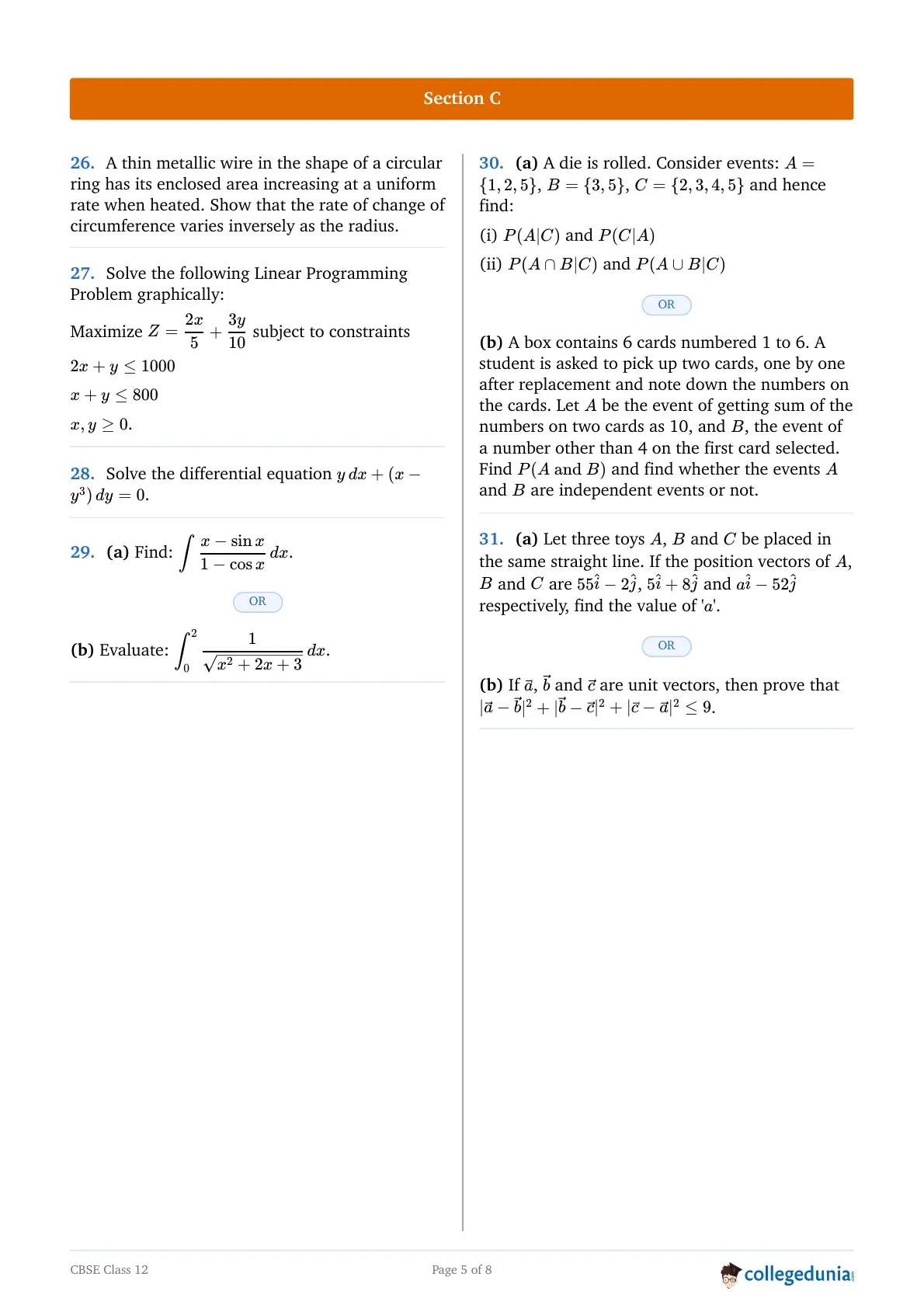
A thin metallic wire in the shape of a circular ring has its enclosed area increasing at a uniform rate when heated. Show that the rate of change of circumference varies inversely as the radius.

Correct Answer:
View Solution


Concept:
This problem deals with the application of derivatives in determining the rates of change of geometric quantities. Consider a circular ring whose radius at any arbitrary instant of time \(t\) is denoted by \(r\).

The total area \(A\) enclosed by a circle of radius \(r\) is given by the standard geometric formula:
\[ A = \pi r^2 \]
The perimeter or circumference \(C\) of the circular ring is given by the formula:
\[ C = 2\pi r \]

When the metallic ring is heated, it undergoes thermal expansion, causing its radius \(r\), area \(A\), and circumference \(C\) to become functions of time \(t\). We can use the chain rule of differentiation to relate their rates of change with respect to time \(t\), namely \(\frac{dA}{dt}\) and \(\frac{dC}{dt}\).

Step 1: Expressing the rate of change of area

Let \(A\) be the area enclosed by the circular ring at any instant \(t\). The area formula is: \[ A = \pi r^2 \]
Differentiating both sides of this equation with respect to time \(t\) using the chain rule, we obtain: \[ \frac{dA}{dt} = \frac{d}{dt}(\pi r^2) = \pi \cdot \frac{d}{dr}(r^2) \cdot \frac{dr}{dt} \]
Applying the power rule \(\frac{d}{dr}(r^2) = 2r\), we get: \[ \frac{dA}{dt} = 2\pi r \frac{dr}{dt} \quad \cdots (1) \]

Step 2: Incorporating the given uniform rate constraint

According to the problem statement, the enclosed area is increasing at a uniform (constant) rate. Let this constant rate of increase be denoted by \(k\), where \(k > 0\). Therefore, we can write: \[ \frac{dA}{dt} = k \]
Substituting this into Equation (1), we establish a relationship for the rate of change of the radius: \[ k = 2\pi r \frac{dr}{dt} \]
Isolating the term \(\frac{dr}{dt}\) by dividing both sides by \(2\pi r\), we get: \[ \frac{dr}{dt} = \frac{k}{2\pi r} \quad \cdots (2) \]

Step 3: Finding the rate of change of circumference

Let \(C\) be the circumference of the circular ring at any instant \(t\). The formula for the circumference is: \[ C = 2\pi r \]
Now, differentiate both sides of this equation with respect to time \(t\): \[ \frac{dC}{dt} = \frac{d}{dt}(2\pi r) = 2\pi \frac{dr}{dt} \quad \cdots (3) \]

Step 4: Substituting \(\frac{dr}{dt}\) into the circumference rate equation

We can now substitute the expression for \(\frac{dr}{dt}\) from Equation (2) into Equation (3): \[ \frac{dC}{dt} = 2\pi \left( \frac{k}{2\pi r} \right) \]
Canceling out the common factor of \(2\pi\) from both the numerator and the denominator, the expression simplifies to: \[ \frac{dC}{dt} = \frac{k}{r} \]

Step 5: Concluding the inverse variation property

Since \(k\) is a uniform constant value, the equation \(\frac{dC}{dt} = \frac{k}{r}\) can be rewritten in terms of a proportionality relationship: \[ \frac{dC}{dt} \propto \frac{1}{r} \]
This mathematically proves that the rate of change of the circumference of the circular ring varies inversely as its radius \(r\). Quick Tip: Whenever a question asks to show that a quantity \(Y\) varies inversely as \(X\), always look to find an equation of the form \(Y = \frac{Constant}{X}\). Here, since the area rate is constant, the expansion speed of the boundary slows down as the circle grows wider because the same amount of added area must be spread over a larger perimeter.


Question 29:

Solve the following Linear Programming Problem graphically:

Maximize \(Z = \frac{2x}{5} + \frac{3y}{10}\)

subject to constraints:
\(2x + y \le 1000\)
\(x + y \le 800\)
\(x, y \ge 0\).

Correct Answer:
View Solution


Concept:
To solve a Linear Programming Problem (LPP) graphically, we execute the following systematic process:

Treat inequalities as equations to determine boundary lines.
Identify the half-planes determined by inequalities to locate the feasible region.
Determine the corner points (vertices) of the bounded feasible region by finding intersection points.
Apply the Corner Point Theorem by evaluating the objective function \(Z\) at each vertex to find the maximum value.


Step 1: Finding points for the line \(2x + y = 1000\)

To plot the boundary line corresponding to the first constraint \(2x + y \le 1000\):

Set \(x = 0\): \(2(0) + y = 1000 \implies y = 1000\). This gives the y-intercept point \(A(0, 1000)\).
Set \(y = 0\): \(2x + 0 = 1000 \implies x = 500\). This gives the x-intercept point \(B(500, 0)\).

Testing the origin \((0,0)\) in the inequality \(2(0) + 0 \le 1000 \implies 0 \le 1000\), which is true. Hence, the region containing the origin is part of the solution space for this constraint.

Step 2: Finding points for the line \(x + y = 800\)

To plot the boundary line corresponding to the second constraint \(x + y \le 800\):

Set \(x = 0\): \(0 + y = 800 \implies y = 800\). This gives the y-intercept point \(C(0, 800)\).
Set \(y = 0\): \(x + 0 = 800 \implies x = 800\). This gives the x-intercept point \(D(800, 0)\).

Testing the origin \((0,0)\) in the inequality \(0 + 0 \le 800 \implies 0 \le 800\), which is true. Hence, the region containing the origin is also part of the solution space for this constraint.

Step 3: Finding the intersection point of the two boundary lines

Let the intersection point of the two lines be denoted by \(E\). We solve the simultaneous linear system: \[ 2x + y = 1000 \quad \cdots (Eq. 1) \] \[ x + y = 800 \quad \cdots (Eq. 2) \]
Subtracting Eq. 2 from Eq. 1: \[ (2x + y) - (x + y) = 1000 - 800 \] \[ x = 200 \]
Substituting \(x = 200\) back into Eq. 2: \[ 200 + y = 800 \implies y = 600 \]
Thus, the intersection point of the two lines is \(E(200, 600)\).

Step 4: Identifying the corner points of the bounded feasible region

The non-negativity constraints \(x \ge 0, y \ge 0\) restrict our feasible region entirely to the first quadrant. By combining the regions bounded by both lines towards the origin, we find that the closed feasible region is a quadrilateral defined by the following corner points:

\(O(0, 0)\) — The origin
\(B(500, 0)\) — On the x-axis
\(E(200, 600)\) — The intersection point
\(C(0, 800)\) — On the y-axis


Step 5: Evaluating the Objective Function \(Z\)

To make calculations easier, let's rewrite the objective function \(Z\) with a common denominator: \[ Z = \frac{2x}{5} + \frac{3y}{10} = \frac{4x + 3y}{10} \]
Let's compute the value of \(Z\) systematically at each of the four corner points:

At point \(O(0,0)\):
\[ Z = \frac{4(0) + 3(0)}{10} = 0 \]

At point \(B(500, 0)\):
\[ Z = \frac{4(500) + 3(0)}{10} = \frac{2000}{10} = 200 \]

At point \(E(200, 600)\):
\[ Z = \frac{4(200) + 3(600)}{10} = \frac{800 + 1800}{10} = \frac{2600}{10} = 260 \]

At point \(C(0, 800)\):
\[ Z = \frac{4(0) + 3(800)}{10} = \frac{2400}{10} = 240 \]


Comparing all calculated values of \(Z\) (\(0, 200, 260, 240\)), the maximum value obtained is \(260\), which occurs precisely at the coordinates \((200, 600)\). Quick Tip: When evaluating fractions in objective functions, avoid calculating decimal equivalents immediately. Convert the entire function to a common denominator first, like \(\frac{4x+3y}{10}\). This makes substituting whole coordinates much quicker and reduces basic calculation errors!


Question 30:

Solve the differential equation \(y \, dx + (x - y^3) \, dy = 0\).

Correct Answer:
View Solution


Concept:
The given differential equation can be tested for standard structures (separable variables, homogeneous, or linear forms). Let us rearrange the expression to see its mathematical form: \[ y \, dx + (x - y^3) \, dy = 0 \]
If we try to isolate \(\frac{dy}{dx}\), we get: \[ (x - y^3) \, dy = -y \, dx \implies \frac{dy}{dx} = \frac{-y}{x - y^3} \]
This form is non-separable and non-linear in terms of \(y\) because of the \(y^3\) term in the denominator. Let us instead invert the derivative to find \(\frac{dx}{dy}\): \[ y \, dx = (y^3 - x) \, dy \implies \frac{dx}{dy} = \frac{y^3 - x}{y} \]
Splitting the fraction on the right-hand side gives: \[ \frac{dx}{dy} = \frac{y^3}{y} - \frac{x}{y} \implies \frac{dx}{dy} = y^2 - \frac{x}{y} \]
Rearranging terms yields: \[ \frac{dx}{dy} + \frac{1}{y} \cdot x = y^2 \]
This matches the standard mathematical structure of a **First-Order Linear Differential Equation in \(x\)**, which is expressed generally as: \[ \frac{dx}{dy} + P(y)x = Q(y) \]
Here, by matching components, we find: \[ P(y) = \frac{1}{y} \quad and \quad Q(y) = y^2 \]

Step 1: Calculating the Integrating Factor (I.F.)

The integrating factor for a linear differential equation of this type is computed using the formula: \[ I.F. = e^{\int P(y) \, dy} \]
Substituting our value \(P(y) = \frac{1}{y}\): \[ I.F. = e^{\int \frac{1}{y} \, dy} \]
Since the antiderivative \(\int \frac{1}{y} \, dy = \ln|y|\), we can substitute this back: \[ I.F. = e^{\ln|y|} = y \]

Step 2: Formulating the general solution equation

The standard general solution formula for a linear differential equation in \(x\) is given by: \[ x \times (I.F.) = \int Q(y) \times (I.F.) \, dy + C \]
Substituting our expressions for \(I.F. = y\) and \(Q(y) = y^2\) into this equation, we obtain: \[ x \cdot y = \int (y^2 \cdot y) \, dy + C \]
Simplifying the integrand: \[ xy = \int y^3 \, dy + C \]

Step 3: Performing the integration

Using the basic power rule of integration \(\int y^n \, dy = \frac{y^{n+1}}{n+1}\) for \(n=3\): \[ xy = \frac{y^4}{4} + C \]

Step 4: Expressing \(x\) explicitly

To completely isolate \(x\) and match the standard choices, we divide both sides of the solution equation by \(y\) (assuming \(y \ne 0\)): \[ x = \frac{\frac{y^4}{4} + C}{y} \] \[ x = \frac{y^3}{4} + \frac{C}{y} \] Quick Tip: If a differential equation looks complicated and has an expression like \((x \pm y^n)dy\), it is almost always a linear differential equation of the form \(\frac{dx}{dy} + Px = Q\). Inverting the derivative from \(\frac{dy}{dx}\) to \(\frac{dx}{dy}\) simplifies the algebra instantly!


Question 31:

Find the indefinite integral:
\[ \int \frac{x - \sin x}{1 - \cos x} \, dx \]

Correct Answer:
View Solution


Concept:
To evaluate this trigonometric integral, we split the given fraction into two manageable parts and then apply half-angle trigonometric identities:

\(1 - \cos x = 2\sin^2\left(\frac{x}{2}\right)\)
\(\sin x = 2\sin\left(\frac{x}{2}\right)\cos\left(\frac{x}{2}\right)\)

After simplification, we can use the technique of **Integration by Parts**, which is defined as: \[ \int u \, dv = u v - \int v \, du \]

Step 1: Splitting and simplifying the integrand

Let \(I = \int \frac{x - \sin x}{1 - \cos x} \, dx\). Splitting the numerator gives: \[ I = \int \frac{x}{1 - \cos x} \, dx - \int \frac{\sin x}{1 - \cos x} \, dx \]
Now, apply the half-angle identities to both terms separately: \[ I = \int \frac{x}{2\sin^2\left(\frac{x}{2}\right)} \, dx - \int \frac{2\sin\left(\frac{x}{2}\right)\cos\left(\frac{x}{2}\right)}{2\sin^2\left(\frac{x}{2}\right)} \, dx \]
Using the trigonometric definitions \(\frac{1}{\sin^2\theta} = \csc^2\theta\) and \(\frac{\cos\theta}{\sin\theta} = \cot\theta\): \[ I = \frac{1}{2}\int x \csc^2\left(\frac{x}{2}\right) \, dx - \int \cot\left(\frac{x}{2}\right) \, dx \quad \cdots (1) \]

Step 2: Integrating the first term using Integration by Parts

Let us focus on the first integral: \(I_1 = \int x \csc^2\left(\frac{x}{2}\right) \, dx\).
Using the ILATE rule, we choose:

First function (algebraic): \(u = x \implies du = dx\)
Second function (trigonometric): \(dv = \csc^2\left(\frac{x}{2}\right) \, dx \implies v = \frac{-\cot\left(\frac{x}{2}\right)}{1/2} = -2\cot\left(\frac{x}{2}\right)\)

Applying the integration by parts formula: \[ I_1 = x \left[-2\cot\left(\frac{x}{2}\right)\right] - \int \left[-2\cot\left(\frac{x}{2}\right)\right] \, dx \] \[ I_1 = -2x\cot\left(\frac{x}{2}\right) + 2\int \cot\left(\frac{x}{2}\right) \, dx \]

Step 3: Combining the terms back into the main equation

Now substitute this result for \(I_1\) back into Equation (1): \[ I = \frac{1}{2} \left[ -2x\cot\left(\frac{x}{2}\right) + 2\int \cot\left(\frac{x}{2}\right) \, dx \right] - \int \cot\left(\frac{x}{2}\right) \, dx \]
Distributing the factor of \(\frac{1}{2}\) across the brackets: \[ I = -x\cot\left(\frac{x}{2}\right) + \int \cot\left(\frac{x}{2}\right) \, dx - \int \cot\left(\frac{x}{2}\right) \, dx \]
Notice that the two remaining integrals cancel each other out completely: \[ I = -x\cot\left(\frac{x}{2}\right) + C \] Quick Tip: Keep an eye out for integrals structured like \(\int [f(x) + f'(x)] dx\). In many cases, performing integration by parts on one term creates a second term that cancels out the other half of the expression, saving you from having to compute both integrals!


Question 32:

Evaluate the definite integral:
\[ \int_{0}^{1} \frac{1}{x^2 + 2x + 3} \, dx \]

Correct Answer:
View Solution


Concept:
This problem requires integrating a rational function with a quadratic denominator. Since the denominator cannot be factored easily into linear components over the real numbers, we use the method of **completing the square** to transform it into the standard form: \[ \int \frac{1}{u^2 + a^2} \, du = \frac{1}{a} \tan^{-1}\left(\frac{u}{a}\right) + C \]

Step 1: Completing the square for the denominator expression

Consider the quadratic function in the denominator: \(x^2 + 2x + 3\).
To rewrite this as a perfect square plus a constant, take half of the coefficient of \(x\) (which is \(\frac{2}{2} = 1\)), square it (\(1^2 = 1\)), and then add and subtract it: \[ x^2 + 2x + 3 = (x^2 + 2x + 1) - 1 + 3 \] \[ x^2 + 2x + 3 = (x + 1)^2 + 2 \]
We can express the constant 2 as a square: \(2 = (\sqrt{2})^2\). Thus, the quadratic terms become: \[ x^2 + 2x + 3 = (x + 1)^2 + (\sqrt{2})^2 \]

Step 2: Rewriting the definite integral with new limits

Let us substitute our rewritten expression into the integral \(I\): \[ I = \int_{0}^{1} \frac{1}{(x + 1)^2 + (\sqrt{2})^2} \, dx \]
Let us apply a variable substitution to simplify the expression: \[ Let u = x + 1 \implies du = dx \]
Now, we must update the limits of integration according to this substitution:

Lower limit: When \(x = 0 \implies u = 0 + 1 = 1\)
Upper limit: When \(x = 1 \implies u = 1 + 1 = 2\)

Substituting these values gives: \[ I = \int_{1}^{2} \frac{1}{u^2 + (\sqrt{2})^2} \, du \]

Step 3: Evaluating the antiderivative

Using the standard integration formula with \(a = \sqrt{2}\): \[ I = \left[ \frac{1}{\sqrt{2}} \tan^{-1}\left(\frac{u}{\sqrt{2}}\right) \right]_{1}^{2} \]
We can factor out the constant scalar value \(\frac{1}{\sqrt{2}}\): \[ I = \frac{1}{\sqrt{2}} \left[ \tan^{-1}\left(\frac{u}{\sqrt{2}}\right) \right]_{1}^{2} \]

Step 4: Substituting the limits of integration

Applying the Fundamental Theorem of Calculus by evaluating at the upper limit (2) and subtracting the value at the lower limit (1): \[ I = \frac{1}{\sqrt{2}} \left[ \tan^{-1}\left(\frac{2}{\sqrt{2}}\right) - \tan^{-1}\left(\frac{1}{\sqrt{2}}\right) \right] \]
Simplifying the fraction inside the first inverse tangent term (\(\frac{2}{\sqrt{2}} = \sqrt{2}\)), we get our final exact value: \[ I = \frac{1}{\sqrt{2}} \left[ \tan^{-1}(\sqrt{2}) - \tan^{-1}\left(\frac{1}{\sqrt{2}}\right) \right] \] Quick Tip: When completing the square for \(x^2 + bx + c\), always rewrite it as \(\left(x + \frac{b}{2}\right)^2 + \left(c - \frac{b^2}{4}\right)\). Keeping this mental shortcut handy makes working through algebraic steps much faster during exams.


Question 33:

A die is rolled. Consider the following events:
\(A = \{1, 2, 5\}\), \(B = \{3, 5\}\), \(C = \{2, 3, 4, 5\}\)

Find the following conditional probabilities:

(i) \(P(A|C)\) and \(P(C|A)\)

(ii) \(P(A \cap B|C)\) and \(P(A \cup B|C)\)

Correct Answer:
View Solution


Concept:
This problem deals with conditional probability within a finite sample space. When a fair six-sided die is rolled, the complete sample space \(S\) is: \[ S = \{1, 2, 3, 4, 5, 6\} \implies n(S) = 6 \]
The formula for the conditional probability of an event \(X\) given that event \(Y\) has occurred is defined as: \[ P(X|Y) = \frac{P(X \cap Y)}{P(Y)} = \frac{n(X \cap Y)}{n(Y)} \]
Let us list the elements and counts for each given event set:

\(A = \{1, 2, 5\} \implies n(A) = 3\)
\(B = \{3, 5\} \implies n(B) = 2\)
\(C = \{2, 3, 4, 5\} \implies n(C) = 4\)


Step 1: Finding intersections needed for part (i)

To compute \(P(A|C)\) and \(P(C|A)\), we first identify the elements common to sets \(A\) and \(C\): \[ A \cap C = \{1, 2, 5\} \cap \{2, 3, 4, 5\} = \{2, 5\} \implies n(A \cap C) = 2 \]

Step 2: Calculating \(P(A|C)\) and \(P(C|A)\)

Using the conditional probability formulas: \[ P(A|C) = \frac{n(A \cap C)}{n(C)} = \frac{2}{4} = \frac{1}{2} \] \[ P(C|A) = \frac{n(A \cap C)}{n(A)} = \frac{2}{3} \]

Step 3: Finding operations for part (ii)

For the second part, let us determine the compound sets \((A \cap B)\) and \((A \cup B)\) first: \[ A \cap B = \{1, 2, 5\} \cap \{3, 5\} = \{5\} \] \[ A \cup B = \{1, 2, 5\} \cup \{3, 5\} = \{1, 2, 3, 5\} \]
Next, find the intersections of these compound sets with condition set \(C\):

For the first case:
\[ (A \cap B) \cap C = \{5\} \cap \{2, 3, 4, 5\} = \{5\} \implies n((A \cap B) \cap C) = 1 \]
For the second case:
\[ (A \cup B) \cap C = \{1, 2, 3, 5\} \cap \{2, 3, 4, 5\} = \{2, 3, 5\} \implies n((A \cup B) \cap C) = 3 \]


Step 4: Calculating \(P(A \cap B|C)\) and \(P(A \cup B|C)\)

Using the definition of conditional probability with respect to the reduced sample space of \(C\) (\(n(C) = 4\)): \[ P(A \cap B|C) = \frac{n((A \cap B) \cap C)}{n(C)} = \frac{1}{4} \] \[ P(A \cup B|C) = \frac{n((A \cup B) \cap C)}{n(C)} = \frac{3}{4} \]

Step 5: Summary of Results

Gathering all our calculated values:

(i) \(P(A|C) = \frac{1}{2}\) and \(P(C|A) = \frac{2}{3}\)
(ii) \(P(A \cap B|C) = \frac{1}{4}\) and \(P(A \cup B|C) = \frac{3}{4}\)

These values line up with Option (A). Quick Tip: For discrete sample spaces, you can find conditional probability \(P(X|Y)\) quickly by ignoring the main sample space \(S\) entirely. Treat set \(Y\) as your new universe, and count how many elements of \(X\) live inside it!


Question 34:

A box contains 6 cards numbered 1 to 6. A student is asked to pick up two cards, one by one after replacement and note down the numbers on the cards. Let \(A\) be the event of getting the sum of the numbers on the two cards as 10, and \(B\) be the event of a number other than 4 on the first card selected. Find \(P(A and B)\) and find whether the events \(A\) and \(B\) are independent events or not.

Correct Answer:
View Solution


Concept:
Two events \(A\) and \(B\) associated with a random experiment are defined to be mathematically independent if and only if the probability of their simultaneous occurrence satisfies the product rule: \[ P(A \cap B) = P(A) \cdot P(B) \]
If this multiplicative equation does not hold true, the events are classified as dependent. Here, two cards are drawn sequentially with replacement from a set of 6 unique cards, meaning each draw has 6 independent outcomes.

Step 1: {\color{redDetermining the total sample space and listing outcomes for Event \(A\).

Since two cards are drawn one by one with replacement from a box containing cards numbered \(\{1, 2, 3, 4, 5, 6\}\), the total number of elementary outcomes in the sample space \(S\) is: \[ n(S) = 6 \times 6 = 36 \]
Event \(A\) is defined as getting a sum equal to 10 on the two drawn cards. Let us systematically list all ordered pairs \((x, y)\) such that \(x + y = 10\), where \(1 \leq x, y \leq 6\):

If \(x = 4\), then \(y = 6 \implies (4, 6)\)
If \(x = 5\), then \(y = 5 \implies (5, 5)\)
If \(x = 6\), then \(y = 4 \implies (6, 4)\)

Thus, \(A = \{(4, 6), (5, 5), (6, 4)\}\), and the number of favorable outcomes is \(n(A) = 3\).
The probability of event \(A\) is: \[ P(A) = \frac{n(A)}{n(S)} = \frac{3}{36} = \frac{1}{12} \]


Step 2: {\color{redListing outcomes and finding the probability for Event \(B\).

Event \(B\) is defined as getting a number other than 4 on the first card selected.
This means the first card can be any number from the set \(\{1, 2, 3, 5, 6\}\) (5 possibilities), and the second card can be any number from \(\{1, 2, 3, 4, 5, 6\}\) (6 possibilities).
The total number of favorable outcomes for event \(B\) is: \[ n(B) = 5 \times 6 = 30 \]
The probability of event \(B\) is: \[ P(B) = \frac{n(B)}{n(S)} = \frac{30}{36} = \frac{5}{6} \]


Step 3: {\color{redFinding the intersection set \((A \cap B)\) and computing \(P(A and B)\).

The intersection event \((A \cap B)\) represents the outcomes where the sum of the numbers is 10 AND the first card is not equal to 4. Let us filter the elements of set \(A\) to remove any pair where the first coordinate is 4:

\((4, 6)\) has 4 as the first card \(\implies\) excluded.
\((5, 5)\) does not have 4 as the first card \(\implies\) included.
\((6, 4)\) does not have 4 as the first card \(\implies\) included.

Therefore, \(A \cap B = \{(5, 5), (6, 4)\}\), which gives \(n(A \cap B) = 2\).
The probability of their simultaneous occurrence is: \[ P(A \cap B) = \frac{n(A \cap B)}{n(S)} = \frac{2}{36} = \frac{1}{18} \]


Step 4: {\color{redTesting for mathematical independence.

Let us check if the product of individual probabilities equals the joint intersection probability: \[ P(A) \cdot P(B) = \frac{1}{12} \times \frac{5}{6} = \frac{5}{72} \]
Comparing this with our calculated value of \(P(A \cap B)\): \[ P(A \cap B) = \frac{1}{18} = \frac{4}{72} \neq \frac{5}{72} \]
Since \(P(A \cap B) \neq P(A) \cdot P(B)\), the events \(A\) and \(B\) are verified to be Dependent. Quick Tip: When computing sample spaces with replacement, the denominator is always \(n^k\). Always look out for words like "with replacement" or "without replacement" as they entirely alter the conditional probabilities of subsequent events!


Question 35:

Let three toys A, B and C be placed in the same straight line. If the position vectors of A, B and C are \(55\hat{i} - 2\hat{j}\), \(5\hat{i} + 8\hat{j}\) and \(a\hat{i} - 52\hat{j}\) respectively, find the value of '\(a\)'.

Correct Answer:
View Solution


Concept:
Three points are collinear if the vectors joining any two pairs of points are parallel. Thus, for points \(A\), \(B\), and \(C\) to lie on the same straight line, \(\vec{AB}\) and \(\vec{BC}\) must be parallel.


Step 1: {\color{redFinding \(\vec{AB}\).

The position vectors of \(A\) and \(B\) are \[ \vec{OA} = 55\hat{i} - 2\hat{j} \]
and \[ \vec{OB} = 5\hat{i} + 8\hat{j}. \]

Therefore, \[ \vec{AB} = \vec{OB} - \vec{OA} \] \[ = (5-55)\hat{i} + \left(8-(-2)\right)\hat{j} \] \[ = -50\hat{i} + 10\hat{j}. \]


Step 2: {\color{redFinding \(\vec{BC}\).

The position vector of \(C\) is \[ \vec{OC} = a\hat{i} - 52\hat{j}. \]

Therefore, \[ \vec{BC} = \vec{OC} - \vec{OB} \] \[ = (a-5)\hat{i} + (-52-8)\hat{j} \] \[ = (a-5)\hat{i} - 60\hat{j}. \]


Step 3: {\color{redApplying the collinearity condition.

Since \(A\), \(B\), and \(C\) are collinear, \(\vec{AB}\) and \(\vec{BC}\) are parallel.

Hence, their corresponding components are proportional: \[ \frac{-50}{a-5} = \frac{10}{-60}. \]

Simplifying, \[ \frac{-50}{a-5} = -\frac{1}{6}. \]

Cross-multiplying, \[ -50(-6) = a-5 \] \[ 300 = a-5. \]

Therefore, \[ \boxed{a=305}. \] Quick Tip: For three points to be collinear, the vectors joining consecutive points must be parallel. Thus, if \(\vec{AB}=p\hat{i}+q\hat{j}\) and \(\vec{BC}=r\hat{i}+s\hat{j}\), then \(\frac{p}{r}=\frac{q}{s}\), provided the denominators are non-zero.


Question 36:

If \(\vec{a}\), \(\vec{b}\) and \(\vec{c}\) are three unit vectors, then prove that: \[ |\vec{a} - \vec{b}|^2 + |\vec{b} - \vec{c}|^2 + |\vec{c} - \vec{a}|^2 \leq 9 \]

Correct Answer:
View Solution


Concept:
A unit vector has an absolute scalar length or magnitude of exactly 1. Therefore, if \(\vec{a}, \vec{b}, \vec{c}\) are unit vectors, we have \(|\vec{a}| = |\vec{b}| = |\vec{c}| = 1\). We will use the fundamental vector identity relating the magnitude squared of a vector sum or difference to its dot product: \[ |\vec{u}|^2 = \vec{u} \cdot \vec{u} \]
Additionally, we rely on the property that the magnitude squared of any vector sum, such as \(|\vec{a} + \vec{b} + \vec{c}|^2\), must always be greater than or equal to zero.

Step 1: {\color{redExpanding the individual squared magnitude terms using dot products.

Let us expand each of the three terms in the given expression using the identity \(|\vec{u} - \vec{v}|^2 = |\vec{u}|^2 + |\vec{v}|^2 - 2(\vec{u} \cdot \vec{v})\): \[ |\vec{a} - \vec{b}|^2 = |\vec{a}|^2 + |\vec{b}|^2 - 2(\vec{a} \cdot \vec{b}) \] \[ |\vec{b} - \vec{c}|^2 = |\vec{b}|^2 + |\vec{c}|^2 - 2(\vec{b} \cdot \vec{c}) \] \[ |\vec{c} - \vec{a}|^2 = |\vec{c}|^2 + |\vec{a}|^2 - 2(\vec{c} \cdot \vec{a}) \]


Step 2: {\color{redSumming the three expanded expressions and substituting the unit values.

Let us add all three equations together: \[ Sum = \left(|\vec{a}|^2 + |\vec{b}|^2 - 2\vec{a}\cdot\vec{b}\right) + \left(|\vec{b}|^2 + |\vec{c}|^2 - 2\vec{b}\cdot\vec{c}\right) + \left(|\vec{c}|^2 + |\vec{a}|^2 - 2\vec{c}\cdot\vec{a}\right) \]
Combine identical magnitude terms: \[ Sum = 2|\vec{a}|^2 + 2|\vec{b}|^2 + 2|\vec{c}|^2 - 2(\vec{a}\cdot\vec{b} + \vec{b}\cdot\vec{c} + \vec{c}\cdot\vec{a}) \]
Since \(\vec{a}, \vec{b}, \vec{c}\) are unit vectors, substitute \(|\vec{a}|^2 = 1\), \(|\vec{b}|^2 = 1\), and \(|\vec{c}|^2 = 1\): \[ Sum = 2(1) + 2(1) + 2(1) - 2(\vec{a}\cdot\vec{b} + \vec{b}\cdot\vec{c} + \vec{c}\cdot\vec{a}) \] \[ Sum = 6 - 2(\vec{a}\cdot\vec{b} + \vec{b}\cdot\vec{c} + \vec{c}\cdot\vec{a}) \quad \cdots (1) \]


Step 3: {\color{redUsing the semi-positive definite property of vector sums to establish an inequality boundary.

Consider the vector sum \((\vec{a} + \vec{b} + \vec{c})\). The square of its magnitude must be non-negative: \[ |\vec{a} + \vec{b} + \vec{c}|^2 \geq 0 \]
Expanding this expression gives: \[ |\vec{a}|^2 + |\vec{b}|^2 + |\vec{c}|^2 + 2(\vec{a}\cdot\vec{b} + \vec{b}\cdot\vec{c} + \vec{c}\cdot\vec{a}) \geq 0 \]
Substitute the unit values (\(1+1+1 = 3\)): \[ 3 + 2(\vec{a}\cdot\vec{b} + \vec{b}\cdot\vec{c} + \vec{c}\cdot\vec{a}) \geq 0 \]
Rearranging to isolate the dot product sum: \[ 2(\vec{a}\cdot\vec{b} + \vec{b}\cdot\vec{c} + \vec{c}\cdot\vec{a}) \geq -3 \implies -2(\vec{a}\cdot\vec{b} + \vec{b}\cdot\vec{c} + \vec{c}\cdot\vec{a}) \leq 3 \quad \cdots (2) \]


Step 4: {\color{redCombining the inequality with equation (1).

Now, substitute the maximum upper bound from equation (2) into our original sum from equation (1): \[ Sum = 6 - 2(\vec{a}\cdot\vec{b} + \vec{b}\cdot\vec{c} + \vec{c}\cdot\vec{a}) \leq 6 + 3 \] \[ |\vec{a} - \vec{b}|^2 + |\vec{b} - \vec{c}|^2 + |\vec{c} - \vec{a}|^2 \leq 9 \]
This completes the formal mathematical proof. *(Hence Proved)* Quick Tip: This expression achieves its absolute maximum value of 9 when the three vectors point in symmetrically opposing directions in a plane (\(120^\circ\) angles from each other), causing their mutual dot products to equal \(-\frac{1}{2}\).


Question 37:

Find the cost (per kg) of each fertilizer A, B and C that a farmer needs to buy, such that 1 kg each of fertilizer A and C added to 2 kg of B costs him Rs 400. Also, the cost of each kg of fertilizer B and C added together is equal to the cost of 1 kg of fertilizer A. However, the cost of 3 kg of fertilizer B added to Rs 200 is the same as the cost of 1 kg of fertilizer A and C together. Use the matrix method to find the solution.

Correct Answer:
View Solution


Concept:
To solve a system of three linear equations using the matrix inversion method, we express the system in the matrix form: \[ AX = B \implies X = A^{-1}B \]
where \(A\) is the \(3 \times 3\) coefficient matrix, \(X\) is the column matrix of unknown variables, and \(B\) is the column matrix of constants. The inverse matrix is computed using the formula \(A^{-1} = \frac{1}{|A|} adj(A)\), where \(|A|\) is the matrix determinant and \(adj(A)\) is the transpose of the cofactor matrix.

Step 1: {\color{redTranslating the word problem into a system of linear equations.

Let the cost per kg of fertilizer \(A\), \(B\), and \(C\) be represented by the variables \(x\), \(y\), and \(z\) respectively (in Rs).

From the first condition: "1 kg each of fertilizer A and C added to 2 kg of B costs Rs 400":
\[ 1x + 2y + 1z = 400 \implies x + 2y + z = 400 \]
From the second condition: "the cost of each kg of fertilizer B and C added together is equal to the cost of 1 kg of fertilizer A":
\[ y + z = x \implies x - y - z = 0 \]
From the third condition: "the cost of 3 kg of fertilizer B added to Rs 200 is the same as the cost of 1 kg of fertilizer A and C together":
\[ 3y + 200 = x + z \implies x - 3y + z = 200 \]

Our system of linear equations is: \[ \begin{aligned} x + 2y + z &= 400
x - y - z &= 0
x - 3y + z &= 200 \end{aligned} \]


Step 2: {\color{redWriting the system in matrix form \(AX = B\) and evaluating determinant \(|A|\).

Define matrices \(A\), \(X\), and \(B\): \[ A = \begin{bmatrix} 1 & 2 & 1
1 & -1 & -1
1 & -3 & 1 \end{bmatrix}, \quad X = \begin{bmatrix} x
y
z \end{bmatrix}, \quad B = \begin{bmatrix} 400
0
200 \end{bmatrix} \]
Let us compute the determinant of matrix \(A\) by expanding along the first row: \[ |A| = 1\begin{bmatrix} -1 & -1
-3 & 1 \end{bmatrix} - 2\begin{bmatrix} 1 & -1
1 & 1 \end{bmatrix} + 1\begin{bmatrix} 1 & -1
1 & -3 \end{bmatrix} \] \[ |A| = 1((-1)(1) - (-1)(-3)) - 2((1)(1) - (-1)(1)) + 1((1)(-3) - (-1)(1)) \] \[ |A| = 1(-1 - 3) - 2(1 + 1) + 1(-3 + 1) = 1(-4) - 2(2) + 1(-2) \] \[ |A| = -4 - 4 - 2 = -10 \]
Since \(|A| = -10 \neq 0\), the matrix inverse \(A^{-1}\) exists, and the system has a unique solution.


Step 3: {\color{redFinding the cofactor matrix and the adjugate matrix \(adj(A)\).

Let us calculate the cofactors \(C_{ij}\) for all nine elements of matrix \(A\): \[ \begin{aligned} C_{11} &= +(-1 - 3) = -4, & C_{12} &= -(1 - (-1)) = -2, & C_{13} &= +(-3 - (-1)) = -2
C_{21} &= -(2 - (-3)) = -5, & C_{22} &= +(1 - 1) = 0, & C_{23} &= -(-3 - 2) = 5
C_{31} &= +(-2 - (-1)) = -1, & C_{32} &= -(-1 - 1) = 2, & C_{33} &= +(-1 - 2) = -3 \end{aligned} \]
Form the cofactor matrix and transpose it to obtain the adjugate matrix \(adj(A)\): \[ Cofactor Matrix = \begin{bmatrix} -4 & -2 & -2
-5 & 0 & 5
-1 & 2 & -3 \end{bmatrix} \implies adj(A) = \begin{bmatrix} -4 & -5 & -1
-2 & 0 & 2
-2 & 5 & -3 \end{bmatrix} \]


Step 4: {\color{redComputing the inverse \(A^{-1}\) and solving for \(X\).

Using the matrix equation \(X = A^{-1}B = \frac{1}{|A|} adj(A)B\): \[ \begin{bmatrix} x
y
z \end{bmatrix} = \frac{1}{-10} \begin{bmatrix} -4 & -5 & -1
-2 & 0 & 2
-2 & 5 & -3 \end{bmatrix} \begin{bmatrix} 400
0
200 \end{bmatrix} \]
Perform row-by-column multiplication: \[ \begin{bmatrix} -4(400) + (-5)(0) + (-1)(200)
-2(400) + (0)(0) + (2)(200)
-2(400) + (5)(0) + (-3)(200) \end{bmatrix} = \begin{bmatrix} -1600 + 0 - 200
-800 + 0 + 400
-800 + 0 - 600 \end{bmatrix} = \begin{bmatrix} -1800
-400
-1400 \end{bmatrix} \]
Now divide each component by the determinant value \(-10\): \[ x = \frac{-1800}{-10} = 150, \quad y = \frac{-400}{-10} = 50, \quad z = \frac{-1400}{-10} = 100 \]
Thus, the individual prices are: Fertilizer A = Rs 150/kg, Fertilizer B = Rs 50/kg, and Fertilizer C = Rs 100/kg. Quick Tip: To verify your solution quickly in a competitive exam, plug the calculated variables back into the simplest equation: \(x - y - z = 150 - 50 - 100 = 0\). Since it satisfies the condition, your matrix inverse steps are guaranteed to be correct!


Question 38:

Find the coordinates of the foot of the perpendicular drawn from the point \((0, 2, 3)\) onto the spatial line given by: \[ \frac{-x-3}{-5} = \frac{1-y}{-2} = \frac{3z+12}{9} \]
And hence, find the length of the perpendicular.

Correct Answer:
View Solution


Concept:
The given line is first converted into parametric form. If \(P\) is the given point and \(Q\) is the foot of the perpendicular on the line, then \(\overrightarrow{PQ}\) must be perpendicular to the direction vector of the line. Therefore, \[ \overrightarrow{PQ}\cdot\vec{d}=0. \]


Step 1: {\color{redWriting the given line in parametric form.

Let \[ \frac{-x-3}{-5} = \frac{1-y}{-2} = \frac{3z+12}{9} = \lambda. \]

Then, \[ -x-3=-5\lambda \] \[ x=5\lambda-3. \]

Similarly, \[ 1-y=-2\lambda \] \[ y=2\lambda+1. \]

Also, \[ 3z+12=9\lambda \] \[ 3z=9\lambda-12 \] \[ z=3\lambda-4. \]

Hence, the line can be written as \[ x=5\lambda-3,\qquad y=2\lambda+1,\qquad z=3\lambda-4. \]

Thus, a general point \(Q\) on the line is \[ Q=(5\lambda-3,\;2\lambda+1,\;3\lambda-4), \]
and the direction vector of the line is \[ \vec{d}=5\hat{i}+2\hat{j}+3\hat{k}. \]


Step 2: {\color{redFinding the foot of the perpendicular.

Let \[ P=(0,2,3) \]
be the given point.

If \(Q=(5\lambda-3,2\lambda+1,3\lambda-4)\) is the foot of the perpendicular, then \[ \overrightarrow{PQ} = (5\lambda-3)\hat{i} +(2\lambda-1)\hat{j} +(3\lambda-7)\hat{k}. \]

Since \(PQ\) is perpendicular to the given line, \[ \overrightarrow{PQ}\cdot\vec{d}=0. \]

Therefore, \[ (5\lambda-3)(5)+(2\lambda-1)(2)+(3\lambda-7)(3)=0. \]

Simplifying, \[ 25\lambda-15+4\lambda-2+9\lambda-21=0 \] \[ 38\lambda-38=0. \]

Hence, \[ \lambda=1. \]

Substituting \(\lambda=1\) in the coordinates of \(Q\), \[ x=5(1)-3=2, \] \[ y=2(1)+1=3, \] \[ z=3(1)-4=-1. \]

Therefore, the coordinates of the foot of the perpendicular are \[ \boxed{Q=(2,3,-1)}. \]


Step 3: {\color{redFinding the length of the perpendicular.

The length of the perpendicular is the distance between \(P=(0,2,3)\) and \(Q=(2,3,-1)\).

Using the distance formula in three dimensions, \[ PQ=\sqrt{(2-0)^2+(3-2)^2+(-1-3)^2}. \]

Thus, \[ PQ=\sqrt{4+1+16} \] \[ PQ=\sqrt{21}. \]

Hence, the length of the perpendicular is \[ \boxed{\sqrt{21}}. \] Quick Tip: To find the foot of the perpendicular from a point to a line in three dimensions, write a general point on the line using a parameter and impose the condition that the vector joining the given point to this general point is perpendicular to the direction vector of the line.


Question 39:

Find the value of \(p\) if the shortest distance between the lines \[ \vec{r} = (\hat{i} + 2\hat{j} + \hat{k}) + \lambda(\hat{i} - \hat{j} + \hat{k}) \quad and \quad \vec{r} = (p\hat{i} - \hat{j} - \hat{k}) + \mu(2\hat{i} + \hat{j} + 2\hat{k}) \]
is exactly \(\frac{3}{\sqrt{2}}\) units.

Correct Answer:
View Solution


Concept:
This problem requires using the shortest distance formula for skew lines in vector form to solve for an unknown coordinate parameter \(p\). The formula is: \[ d = \frac{\left| (\vec{a_2} - \vec{a_1}) \cdot (\vec{b_1} \times \vec{b_2}) \right|}{\left| \vec{b_1} \times \vec{b_2} \right|} \]
We extract the constant and direction vectors, find their cross and dot products as functions of \(p\), and set the expression equal to the given distance value \(\frac{3}{\sqrt{2}}\) to solve for \(p\).

Step 1: {\color{redExtracting vectors and computing the cross product \((\vec{b_1} \times \vec{b_2})\).

From the given equations, let us identify the component vectors: \[ \vec{a_1} = \hat{i} + 2\hat{j} + \hat{k}, \quad \vec{b_1} = \hat{i} - \hat{j} + \hat{k} \] \[ \vec{a_2} = p\hat{i} - \hat{j} - \hat{k}, \quad \vec{b_2} = 2\hat{i} + \hat{j} + 2\hat{k} \]
The cross product of the direction vectors is calculated using the matrix determinant method: \[ \vec{b_1} \times \vec{b_2} = \begin{vmatrix} \hat{i} & \hat{j} & \hat{k}
1 & -1 & 1
2 & 1 & 2 \end{vmatrix} \]
Expanding along the first row: \[ \vec{b_1} \times \vec{b_2} = \hat{i}(-2 - 1) - \hat{j}(2 - 2) + \hat{k}(1 - (-2)) = -3\hat{i} + 3\hat{k} \]
The magnitude of this cross product vector is: \[ \left| \vec{b_1} \times \vec{b_2} \right| = \sqrt{(-3)^2 + 0^2 + 3^2} = \sqrt{18} = 3\sqrt{2} \]


Step 2: {\color{redComputing the displacement vector \((\vec{a_2} - \vec{a_1})\) as a function of \(p\).

Subtract vector \(\vec{a_1}\) from \(\vec{a_2}\): \[ \vec{a_2} - \vec{a_1} = (p - 1)\hat{i} + (-1 - 2)\hat{j} + (-1 - 1)\hat{k} \] \[ \vec{a_2} - \vec{a_1} = (p - 1)\hat{i} - 3\hat{j} - 2\hat{k} \]


Step 3: {\color{redSetting up the dot product equation for the numerator.

Compute the scalar dot product of the displacement vector and the cross product vector: \[ (\vec{a_2} - \vec{a_1}) \cdot (\vec{b_1} \times \vec{b_2}) = \left[ (p - 1)\hat{i} - 3\hat{j} - 2\hat{k} \right] \cdot \left[ -3\hat{i} + 0\hat{j} + 3\hat{k} \right] \]
Multiply the corresponding components together: \[ = -3(p - 1) + (-3)(0) + (-2)(3) = -3p + 3 + 0 - 6 = -3p - 3 \]


Step 4: {\color{redSubstituting terms into the distance formula to solve for \(p\).

Substitute the expressions into the shortest distance formula and set it equal to \(\frac{3}{\sqrt{2}}\): \[ \frac{|-3p - 3|}{3\sqrt{2}} = \frac{3}{\sqrt{2}} \]
Cancel out the common denominator term \(\sqrt{2}\) from both sides: \[ \frac{|-3p - 3|}{3} = 3 \implies |-3p - 3| = 9 \]
Factor out the constant magnitude 3: \[ 3|p + 1| = 9 \implies |p + 1| = 3 \]
This absolute value equation yields two separate linear equations: \[ p + 1 = 3 \implies p = 2 \] \[ p + 1 = -3 \implies p = -4 \]
Thus, the valid values for parameter \(p\) are **\(2\) or \(-4\)**. Quick Tip: An absolute value equation \(|x| = c\) always splits into two cases: \(x = c\) and \(x = -c\). Forgetting the negative case means losing half of the valid solutions!


Question 40:

Sketch the curve described by the equation \(\{(x, y) : 9x^2 + 16y^2 = 144\}\) and find the area of the region enclosed by it, using definite integration.

Correct Answer:
View Solution


Concept:
The equation \(9x^2 + 16y^2 = 144\) represents a standard horizontal ellipse centered at the origin. To analyze it, we rewrite it in standard form: \[ \frac{x^2}{a^2} + \frac{y^2}{b^2} = 1 \]
The total enclosed geometric area can be calculated by integrating a thin vertical area strip \(y \, dx\) across a bounding interval. Since an ellipse is perfectly symmetrical across both the \(x\)-axis and \(y\)-axis, the total area is equal to 4 times the area of the region contained within the first quadrant: \[ Total Area = 4 \int_{0}^{a} y \, dx \]

Step 1: {\color{redConverting the equation to standard form to find the semi-axes.

The given equation is: \[ 9x^2 + 16y^2 = 144 \]
Divide both sides of the equation by 144 to make the right side equal to 1: \[ \frac{9x^2}{144} + \frac{16y^2}{144} = 1 \implies \frac{x^2}{16} + \frac{y^2}{9} = 1 \]
Rewriting this with squared denominators: \[ \frac{x^2}{4^2} + \frac{y^2}{3^2} = 1 \]
Comparing this to the standard form shows that the curve is an ellipse with:

Semi-major axis length \(a = 4\) along the \(x\)-axis.
Semi-minor axis length \(b = 3\) along the \(y\)-axis.

The ellipse intersects the coordinate axes at the vertices \((\pm 4, 0)\) and \((0, \pm 3)\).


Step 2: {\color{redIsolating the variable \(y\) as an explicit function of \(x\).

Let us solve for \(y\) from our standard form equation: \[ \frac{y^2}{9} = 1 - \frac{x^2}{16} \implies \frac{y^2}{9} = \frac{16 - x^2}{16} \]
Multiply both sides by 9: \[ y^2 = \frac{9}{16}(16 - x^2) \]
Taking the positive square root for our first-quadrant calculation analysis (\(y \geq 0\)): \[ y = \frac{3}{4}\sqrt{16 - x^2} \]


Step 3: {\color{redSetting up the definite integral for the area.

Using the symmetry property, integrate from \(x = 0\) to \(x = 4\) and multiply the result by 4: \[ Area = 4 \int_{0}^{4} y \, dx = 4 \int_{0}^{4} \frac{3}{4}\sqrt{16 - x^2} \, dx \]
Cancel out the constant coefficient fraction 4: \[ Area = 3 \int_{0}^{4} \sqrt{4^2 - x^2} \, dx \]


Step 4: {\color{redEvaluating the integral using standard integration formulas.

Apply the standard trigonometric radical integration formula \(\int \sqrt{a^2 - x^2} \, dx = \frac{x}{2}\sqrt{a^2 - x^2} + \frac{a^2}{2}\sin^{-1}\left(\frac{x}{a}\right)\): \[ Area = 3 \left[ \frac{x}{2}\sqrt{16 - x^2} + \frac{16}{2}\sin^{-1}\left(\frac{x}{4}\right) \right]_{0}^{4} \] \[ Area = 3 \left[ \frac{x}{2}\sqrt{16 - x^2} + 8\sin^{-1}\left(\frac{x}{4}\right) \right]_{0}^{4} \]
Now substitute the upper boundary limit (\(x = 4\)) and lower boundary limit (\(x = 0\)):

Substituting \(x = 4\): \(\frac{4}{2}\sqrt{16 - 16} + 8\sin^{-1}\left(\frac{4}{4}\right) = 0 + 8\sin^{-1}(1) = 8 \left(\frac{\pi}{2}\right) = 4\pi\)
Substituting \(x = 0\): \(\frac{0}{2}\sqrt{16 - 0} + 8\sin^{-1}(0) = 0 + 0 = 0\)

Multiply the result by our constant factor 3: \[ Area = 3 \times (4\pi - 0) = 12\pi square units \]
Thus, the total area enclosed by the ellipse curve is exactly \(12\pi\) square units. Quick Tip: The total area of any standard ellipse \(\frac{x^2}{a^2} + \frac{y^2}{b^2} = 1\) can be calculated directly using the formula \(Area = \pi a b\). For this problem, \(Area = \pi \times 4 \times 3 = 12\pi\). Use this formula to check your answer instantly!


Question 41:

If \(y\sqrt{x^2 + 1} = \log\left(\sqrt{x^2 + 1} - x\right)\), show that: \[ (x^2 + 1)\frac{dy}{dx} + xy + 1 = 0 \]

Correct Answer:
View Solution


Concept:
This problem requires verifying an explicit first-order differential equation using implicit differentiation. We will differentiate both sides of the given equation with respect to \(x\). This requires applying the product rule on the left side and the chain rule on the right side. We will then simplify the terms to match the requested equation format.

Step 1: {\color{redDifferentiating the right-hand side logarithmic function using the chain rule.

Let us find the derivative of the right side expression, \(u = \log\left(\sqrt{x^2 + 1} - x\right)\), with respect to \(x\): \[ \frac{du}{dx} = \frac{1}{\sqrt{x^2 + 1} - x} \cdot \frac{d}{dx}\left(\sqrt{x^2 + 1} - x\right) \]
Apply the chain rule to the terms inside the parentheses: \[ \frac{d}{dx}\left(\sqrt{x^2 + 1} - x\right) = \frac{1}{2\sqrt{x^2 + 1}} \cdot (2x) - 1 = \frac{x}{\sqrt{x^2 + 1}} - 1 \]
Find a common denominator for this derivative expression: \[ = \frac{x - \sqrt{x^2 + 1}}{\sqrt{x^2 + 1}} = -\frac{\sqrt{x^2 + 1} - x}{\sqrt{x^2 + 1}} \]
Substitute this back into our calculation for \(\frac{du}{dx}\): \[ \frac{du}{dx} = \frac{1}{\sqrt{x^2 + 1} - x} \cdot \left( -\frac{\sqrt{x^2 + 1} - x}{\sqrt{x^2 + 1}} \right) \]
Cancel out the common term \(\left(\sqrt{x^2 + 1} - x\right)\) from the numerator and denominator: \[ \frac{du}{dx} = -\frac{1}{\sqrt{x^2 + 1}} \]


Step 2: {\color{redDifferentiating the left-hand side expression using the product rule.

The left side of the equation is \(y\sqrt{x^2 + 1}\). Differentiating this with respect to \(x\) using the product rule gives: \[ \frac{d}{dx}\left(y\sqrt{x^2 + 1}\right) = \frac{dy}{dx}\sqrt{x^2 + 1} + y \cdot \left(\frac{1}{2\sqrt{x^2 + 1}} \cdot 2x\right) \] \[ = \sqrt{x^2 + 1}\frac{dy}{dx} + \frac{xy}{\sqrt{x^2 + 1}} \]


Step 3: {\color{redEquating both sides and simplifying the fractions.

Set the derivatives from Step 1 and Step 2 equal to each other: \[ \sqrt{x^2 + 1}\frac{dy}{dx} + \frac{xy}{\sqrt{x^2 + 1}} = -\frac{1}{\sqrt{x^2 + 1}} \]
To clear the fractions, multiply the entire equation by \(\sqrt{x^2 + 1}\): \[ \left(\sqrt{x^2 + 1} \cdot \sqrt{x^2 + 1}\right)\frac{dy}{dx} + \left(\frac{xy}{\sqrt{x^2 + 1}} \cdot \sqrt{x^2 + 1}\right) = -\frac{1}{\sqrt{x^2 + 1}} \cdot \sqrt{x^2 + 1} \]
Simplifying the expressions gives: \[ (x^2 + 1)\frac{dy}{dx} + xy = -1 \]


Step 4: {\color{redRearranging the terms into the final requested form.

Move the constant \(-1\) from the right side of the equation to the left side by adding 1 to both sides: \[ (x^2 + 1)\frac{dy}{dx} + xy + 1 = 0 \]
This completes the required mathematical proof. *(Hence Proved)* Quick Tip: Recognizing that \(\frac{d}{dx}\left[\log(\sqrt{x^2+1}-x)\right] = -\frac{1}{\sqrt{x^2+1}}\) is a standard identity saves time. This expression is closely related to the derivative of the inverse hyperbolic sine function!


Question 42:

Find the derivative of the composite algebraic-trigonometric function expression with respect to \(x\): \[ f(x) = x^{\cot x} + \frac{2x^2 - 3}{2x^2 - x + 2} \]

Correct Answer:
View Solution


Concept:
The given function is a sum of two distinct mathematical terms: a variable base raised to a variable exponent (\(u = x^{\cot x}\)), and a rational algebraic fraction (\(v = \frac{2x^2 - 3}{2x^2 - x + 2}\)). We compute their derivatives independently and then sum them together: \[ \frac{df}{dx} = \frac{du}{dx} + \frac{dv}{dx} \]
We use logarithmic differentiation to evaluate \(\frac{du}{dx}\), and the quotient rule (\(\frac{d}{dx}\left[\frac{p}{q}\right] = \frac{p'q - pq'}{q^2}\)) to evaluate \(\frac{dv}{dx}\).

Step 1: {\color{redDifferentiating the variable exponent component \(u = x^{\cot x}\) using logarithms.

Let: \[ u = x^{\cot x} \]
Taking the natural logarithm on both sides: \[ \log u = \cot x \cdot \log x \]
Differentiating both sides with respect to \(x\) using the product rule: \[ \frac{1}{u}\frac{du}{dx} = \frac{d}{dx}(\cot x) \cdot \log x + \cot x \cdot \frac{d}{dx}(\log x) \]
We know that \(\frac{d}{dx}(\cot x) = -\csc^2 x\) and \(\frac{d}{dx}(\log x) = \frac{1}{x}\): \[ \frac{1}{u}\frac{du}{dx} = -\csc^2 x \cdot \log x + \frac{\cot x}{x} \]
Multiply by \(u\) to isolate \(\frac{du}{dx}\), then substitute back \(u = x^{\cot x}\): \[ \frac{du}{dx} = x^{\cot x} \left[ \frac{\cot x}{x} - \csc^2 x \log x \right] \quad \cdots (1) \]


Step 2: {\color{redDifferentiating the rational expression \(v = \frac{2x^2 - 3}{2x^2 - x + 2}\) using the quotient rule.

Let: \[ v = \frac{2x^2 - 3}{2x^2 - x + 2} \]
Apply the quotient rule formula: \[ \frac{dv}{dx} = \frac{(4x)(2x^2 - x + 2) - (2x^2 - 3)(4x - 1)}{(2x^2 - x + 2)^2} \]
Let us expand both polynomial products in the numerator:

First product: \(4x(2x^2 - x + 2) = 8x^3 - 4x^2 + 8x\)
Second product: \((2x^2 - 3)(4x - 1) = 8x^3 - 2x^2 - 12x + 3\)

Subtract the second product from the first: \[ Numerator = (8x^3 - 4x^2 + 8x) - (8x^3 - 2x^2 - 12x + 3) \] \[ = 8x^3 - 4x^2 + 8x - 8x^3 + 2x^2 + 12x - 3 \]
Group and combine like terms: \[ = (-4x^2 + 2x^2) + (8x + 12x) - 3 = -2x^2 + 20x - 3 \]
Thus, the derivative of the second component is: \[ \frac{dv}{dx} = \frac{-2x^2 + 20x - 3}{(2x^2 - x + 2)^2} \quad \cdots (2) \]


Step 3: {\color{redCombining the results into the final derivative expression.

Sum the two independent derivatives from equations (1) and (2): \[ \frac{df}{dx} = x^{\cot x} \left[ \frac{\cot x}{x} - \csc^2 x \log x \right] + \frac{-2x^2 + 20x - 3}{(2x^2 - x + 2)^2} \]
This expression represents the complete derivative of the original function. Quick Tip: When applying the quotient rule, be extra careful with negative signs when expanding polynomial terms in the numerator. A single sign error during expansion will change the final quadratic coefficients!


Question 43:

There are three types of vaccines \( A_1, A_2, A_3 \), available in the market to protect the population of the country from spread of certain infection. According to a survey conducted, it was found that 25% of the population was given Vaccine \( A_1 \), 35% of the population was given Vaccine \( A_2 \) and 40% of the population was given Vaccine \( A_3 \). The survey also stated that the probabilities that Vaccines \( A_1, A_2 \) and \( A_3 \) would protect against the infection were 60%, 55% and 50% respectively. Based on the above information, find the probability that:

The person taking vaccine \( A_2 \) will get infected.

Correct Answer:
View Solution


Concept:

Probability of an event and its complement: \( P(E') = 1 - P(E) \).
Given a conditional probability of success (protection), the probability of failure (infection) is its complement.


Step 1: {\color{redIdentify the given probabilities for Vaccine \( A_2 \)

From the case study, for a person taking Vaccine \( A_2 \):
Probability of being protected, \( P(Protected | A_2) = 55% = 0.55 \).


Step 2: {\color{redCalculate the probability of being infected

Getting infected is the complementary event of being protected. \[ P(Infected | A_2) = 1 - P(Protected | A_2) \] \[ P(Infected | A_2) = 1 - 0.55 \] \[ P(Infected | A_2) = 0.45 \]


Step 3: {\color{redFinal Result

The probability that a person taking Vaccine \( A_2 \) will get infected is \( 0.45 \) or \( 45% \). Quick Tip: Conditional probability for a single branch is simply the complement.
Always convert percentages to decimals for easier calculation in probability problems.


Question 44:

If a person is chosen randomly, he/she will be protected from the
infection.

Correct Answer:
View Solution


Concept:

Theorem of Total Probability: For mutually exclusive events \( E_1, E_2, E_3 \), the total probability of an event \( A \) is \( P(A) = \sum P(E_i)P(A|E_i) \).


Step 1: {\color{redDefine the events and their probabilities

Let \( E_1, E_2, E_3 \) be the events that a person takes Vaccine \( A_1, A_2, A_3 \) respectively. \[ P(E_1) = 25% = 0.25 \] \[ P(E_2) = 35% = 0.35 \] \[ P(E_3) = 40% = 0.40 \]
Let \( A \) be the event that the person is protected. \[ P(A|E_1) = 0.60 \] \[ P(A|E_2) = 0.55 \] \[ P(A|E_3) = 0.50 \]


Step 2: {\color{redApply the Total Probability Formula
\[ P(A) = P(E_1)P(A|E_1) + P(E_2)P(A|E_2) + P(E_3)P(A|E_3) \] \[ P(A) = (0.25 \times 0.60) + (0.35 \times 0.55) + (0.40 \times 0.50) \]


Step 3: {\color{redCalculate the final numerical value
\[ P(A) = 0.1500 + 0.1925 + 0.2000 \] \[ P(A) = 0.5425 \]
The probability that a randomly chosen person is protected is \( 0.5425 \). Quick Tip: Total probability sums the 'weighted' probabilities of each vaccine branch.
Multiply carefully and keep as many decimal places as needed until the final step.


Question 45:

The person was given Vaccine \(A_1\), given that the randomly chosen person is infected.

Correct Answer:
View Solution


Concept:

Bayes' Theorem: \( P(E_k|I) = \frac{P(E_k)P(I|E_k)}{P(I)} \).
\( P(I) = 1 - P(Protected) \).


Step 1: {\color{redCalculate the total probability of being infected

From question 37(ii), total probability of protection \( P(A) = 0.5425 \).
Total probability of infection \( P(I) = 1 - 0.5425 = 0.4575 \).


Step 2: {\color{redCalculate the numerator for Bayes' Theorem

We need the probability of being infected given Vaccine \( A_1 \). \[ P(I|E_1) = 1 - 0.60 = 0.40 \]
Numerator: \( P(E_1)P(I|E_1) = 0.25 \times 0.40 = 0.10 \).


Step 3: {\color{redApply Bayes' Theorem
\[ P(E_1|I) = \frac{P(E_1)P(I|E_1)}{P(I)} \] \[ P(E_1|I) = \frac{0.10}{0.4575} \]
Converting to fraction: \[ P(E_1|I) = \frac{1000}{4575} = \frac{40}{183} \] Quick Tip: Always simplify your final fraction if possible.
Bayes' Theorem answers "given the result, what was the cause?".


Question 46:

The person was given Vaccine \(A_3\), given that the randomly chosen person is not infected.

Correct Answer:
View Solution


Concept:


Bayes' Theorem for protected individuals (not infected): \( P(E_3|A) = \frac{P(E_3)P(A|E_3)}{P(A)} \).


Step 1: {\color{redIdentify the required values from previous steps

\( P(A) = 0.5425 \) (Total Probability of protection).

\( P(E_3) = 0.40 \).

\( P(A|E_3) = 0.50 \).


Step 2: {\color{redCalculate the numerator

\[ P(E_3)P(A|E_3) = 0.40 \times 0.50 = 0.20 \]


Step 3: {\color{redApply Bayes' Theorem

\[ P(E_3|A) = \frac{0.20}{0.5425} \]


Converting to fraction:

\[ P(E_3|A) = \frac{2000}{5425} = \frac{80}{217} \] Quick Tip: "Not infected" is the same as "Protected" in this context.
Double check your division when converting decimals to fractions.


Question 47:

A company produces cylindrical tumblers, open from the top. Since they want uniformity in the product, they fix the surface area of the tumblers produced. If for a tumbler, \( V \) is its volume, \( h \) the height and \( r \) the radius of the circular base, then:


Differentiate its volume with respect to radius of the base, where
the surface area is constant.

Correct Answer:
View Solution


Concept:

Volume of cylinder: \( V = \pi r^2 h \).
Surface area of an open cylinder: \( S = \pi r^2 + 2\pi r h \).
To differentiate \( V \) wrt \( r \), express \( V \) as a function of \( r \) alone by eliminating \( h \).


Step 1: {\color{redExpress \( h \) in terms of \( S \) and \( r \)

From the surface area formula (where \( S \) is constant): \[ 2\pi r h = S - \pi r^2 \] \[ h = \frac{S - \pi r^2}{2\pi r} \]


Step 2: {\color{redSubstitute \( h \) into the volume formula
\[ V = \pi r^2 \left( \frac{S - \pi r^2}{2\pi r} \right) \] \[ V = \frac{r(S - \pi r^2)}{2} \] \[ V = \frac{Sr}{2} - \frac{\pi r^3}{2} \]


Step 3: {\color{redDifferentiate \( V \) with respect to \( r \)

Treating \( S \) and \( \pi \) as constants: \[ \frac{dV}{dr} = \frac{d}{dr} \left( \frac{Sr}{2} - \frac{\pi r^3}{2} \right) \] \[ \frac{dV}{dr} = \frac{S}{2} - \frac{3\pi r^2}{2} \] Quick Tip: For an open cylinder, only one base (\( \pi r^2 \)) is included in the surface area.
Ensure you simplify the volume expression before differentiating to avoid the product rule.


Question 48:

If the company wants to maximize the volume of each tumbler,
then establish a relation between its height and the radius of the
base.

Correct Answer:
View Solution


Concept:

For maximum volume, the derivative \( dV/dr \) must be zero.
Use the result from the previous part to find the optimal dimensions.


Step 1: {\color{redSet the derivative to zero

From part (i): \( \frac{dV}{dr} = \frac{S}{2} - \frac{3\pi r^2}{2} \).
For maximum volume: \[ \frac{S}{2} - \frac{3\pi r^2}{2} = 0 \] \[ S = 3\pi r^2 \]


Step 2: {\color{redSubstitute the original formula for \( S \)

We know \( S = \pi r^2 + 2\pi r h \).
Substituting this into our optimality condition: \[ \pi r^2 + 2\pi r h = 3\pi r^2 \]


Step 3: {\color{redSimplify the relation
\[ 2\pi r h = 3\pi r^2 - \pi r^2 \] \[ 2\pi r h = 2\pi r^2 \]
Dividing by \( 2\pi r \) (since \( r \neq 0 \)): \[ h = r \]


Step 4: {\color{redConclusion

To maximize the volume of an open cylindrical tumbler for a fixed surface area, the height must be equal to the radius of the base. Quick Tip: In many optimization problems involving shapes, the dimensions often turn out to be equal or proportional to each other.
Always verify with the second derivative test if required; here \( d^2V/dr^2 = -3\pi r < 0 \), confirming a maximum.


Question 49:

A school wants the students of class XII to do a project on ‘Sustainability’ keeping the world environment in mind. They select the student participants on the basis of an essay writing competition.

7 students out of 80 are selected for the project and are categorized into
two sets such that :

Girl students belong to Set A = \( A = \{G_1, G_2, G_3, G_4\} \) and

Boy students belong to Set B = \( B = \{B_1, B_2, B_3\} \) .

How many relations are possible from Set \( A \to \) Set \( B \)?

Correct Answer:
View Solution


Concept:

A relation from set \( A \) to set \( B \) is any subset of the Cartesian product \( A \times B \).
If \( n(A) = p \) and \( n(B) = q \), then the number of elements in \( A \times B \) is \( p \times q \).
The total number of subsets of a set with \( m \) elements is \( 2^m \).


Step 1: {\color{redFind the number of elements in each set

Set \( A \) contains 4 elements: \( n(A) = 4 \).

Set \( B \) contains 3 elements: \( n(B) = 3 \).


Step 2: {\color{redCalculate the number of elements in the Cartesian product \( A \times B \)
\[ n(A \times B) = n(A) \times n(B) \] \[ n(A \times B) = 4 \times 3 = 12 \]


Step 3: {\color{redDetermine the total number of relations

The total number of possible relations is the total number of subsets of \( A \times B \). \[ Total Relations = 2^{n(A \times B)} \] \[ Total Relations = 2^{12} \] \[ Total Relations = 4096 \] Quick Tip: A relation is simply a set of ordered pairs; it doesn't have the "one output per input" restriction of a function.
Remember: The number of relations from \( A \to B \) is the same as from \( B \to A \).


Question 50:

Let \( R \) be a relation from \( A \to B \) such that \( R = \{(G_1, B_1), (G_2, B_2), (G_3, B_2), (G_4, B_3), (G_1, B_2)\} \). Is \( R \) an injective function? Justify your answer.

Correct Answer:
View Solution


Concept:

A relation is a function if every element in the domain has exactly one image in the codomain.
A function is injective (one-to-one) if distinct elements in the domain have distinct images in the codomain.


Step 1: {\color{redCheck if the relation \( R \) qualifies as a function

In the given relation \( R \):
The element \( G_1 \in A \) is associated with two different elements in \( B \), namely \( B_1 \) and \( B_2 \). \[ (G_1, B_1) \in R \quad and \quad (G_1, B_2) \in R \]
By the definition of a function, an element in the domain cannot have more than one image.
Therefore, \( R \) is not a function.


Step 2: {\color{redCheck the condition for injectivity

Even if we ignore the first step, let's examine the mapping of other elements:
We see that \( (G_2, B_2) \in R \) and \( (G_3, B_2) \in R \).
Two distinct elements \( G_2 \) and \( G_3 \) have the same image \( B_2 \).
This violates the condition for a function to be injective.


Step 3: {\color{redConclusion and Justification
\( R \) is not an injective function because:

It is not a function (since \( G_1 \) has multiple images).
It is not one-to-one (since \( G_2 \) and \( G_3 \) share the same image \( B_2 \)). Quick Tip: To be a function, check if any first element in the pairs is repeated with a different second element.
Injectivity is about the 'uniqueness' of the second elements in the pairs.


Question 51:

Let the relation \(R\) from \(A \to A\) be such that \[ R = \{(x,y) : x,y \in A,\ x and y are students from the same colony in the city\}. \]
Verify if \(R\) is an equivalence relation.

Correct Answer:
View Solution


Concept:

Reflexive: \((x, x) \in R\) for all \(x \in A\).
Symmetric: If \((x, y) \in R\), then \((y, x) \in R\).
Transitive: If \((x, y) \in R\) and \((y, z) \in R\), then \((x, z) \in R\).
A relation is an equivalence relation if it is reflexive, symmetric, and transitive.


Step 1: {\color{redVerify Reflexivity

For any student \( x \in A \), \( x \) and \( x \) are obviously from the same colony.
So, \( (x, x) \in R \) for all \( x \in A \).
Therefore, \( R \) is reflexive.


Step 2: {\color{redVerify Symmetry

Let \( (x, y) \in R \). This means student \( x \) and student \( y \) are from the same colony.
If \( x \) and \( y \) are in the same colony, then \( y \) and \( x \) are also in the same colony.
So, \( (y, x) \in R \).
Therefore, \( R \) is symmetric.


Step 3: {\color{redVerify Transitivity

Let \( (x, y) \in R \) and \( (y, z) \in R \).
This means \( x \) and \( y \) are in the same colony, and \( y \) and \( z \) are in the same colony.
This logically implies that \( x \) and \( z \) must also be in the same colony.
So, \( (x, z) \in R \).
Therefore, \( R \) is transitive.


Step 4: {\color{redConclusion

Since the relation \( R \) is reflexive, symmetric, and transitive, it is verified that \( R \) is an equivalence relation. Quick Tip: Any relation defined by the property of "belonging to the same category" (colony, school, age, etc.) is always an equivalence relation.
Use clear logical statements for symmetry and transitivity to earn full marks.


Question 52:

Verify if any function \( f : B \to A \) is bijective. Give reason to support your answer.

Correct Answer:
View Solution


Concept:


A function is bijective if it is both injective (one-to-one) and surjective (onto).
For a function \( f : X \to Y \) to be bijective, the number of elements in the domain and codomain must be equal: \( n(X) = n(Y) \).


Step 1: {\color{redCompare the number of elements in both sets


Set \( B \) (Domain) contains 3 elements: \( n(B) = 3 \).


Set \( A \) (Codomain) contains 4 elements: \( n(A) = 4 \).


Step 2: {\color{redAnalyze the condition for Surjectivity (Onto)


For a function to be surjective, every element in the codomain \( A \) must have at least one pre-image in the domain \( B \).


Since there are only 3 elements in the domain \( B \), they can map to at most 3 distinct elements in the codomain \( A \).


Because the codomain \( A \) has 4 elements, at least one element in \( A \) will always be left without a pre-image.


Thus, no function from \( B \) to \( A \) can be surjective.


Step 3: {\color{redConclusion


A function must be both injective and surjective to be bijective.
Since no function from \( B \) to \( A \) can be surjective (due to \( n(B) < n(A) \)), it follows that no such function can be bijective. Quick Tip: If \( n(Domain) \neq n(Codomain) \), a bijection is impossible.
If \( n(D) < n(C) \), it cannot be onto. If \( n(D) > n(C) \), it cannot be one-to-one.

CBSE Class 12 Mathematics Chapter-Wise Weightage

S.No Units Marks
I Relations and Functions 08
II Algebra 10
III Calculus 35
IV Vectors and Three-Dimensional Geometry 14
V Linear Programming 05
VI Probability 08
Total (Theory) 80
Internal Assessment 20

CBSE Class 12 Mathematics Paper Analysis 2026