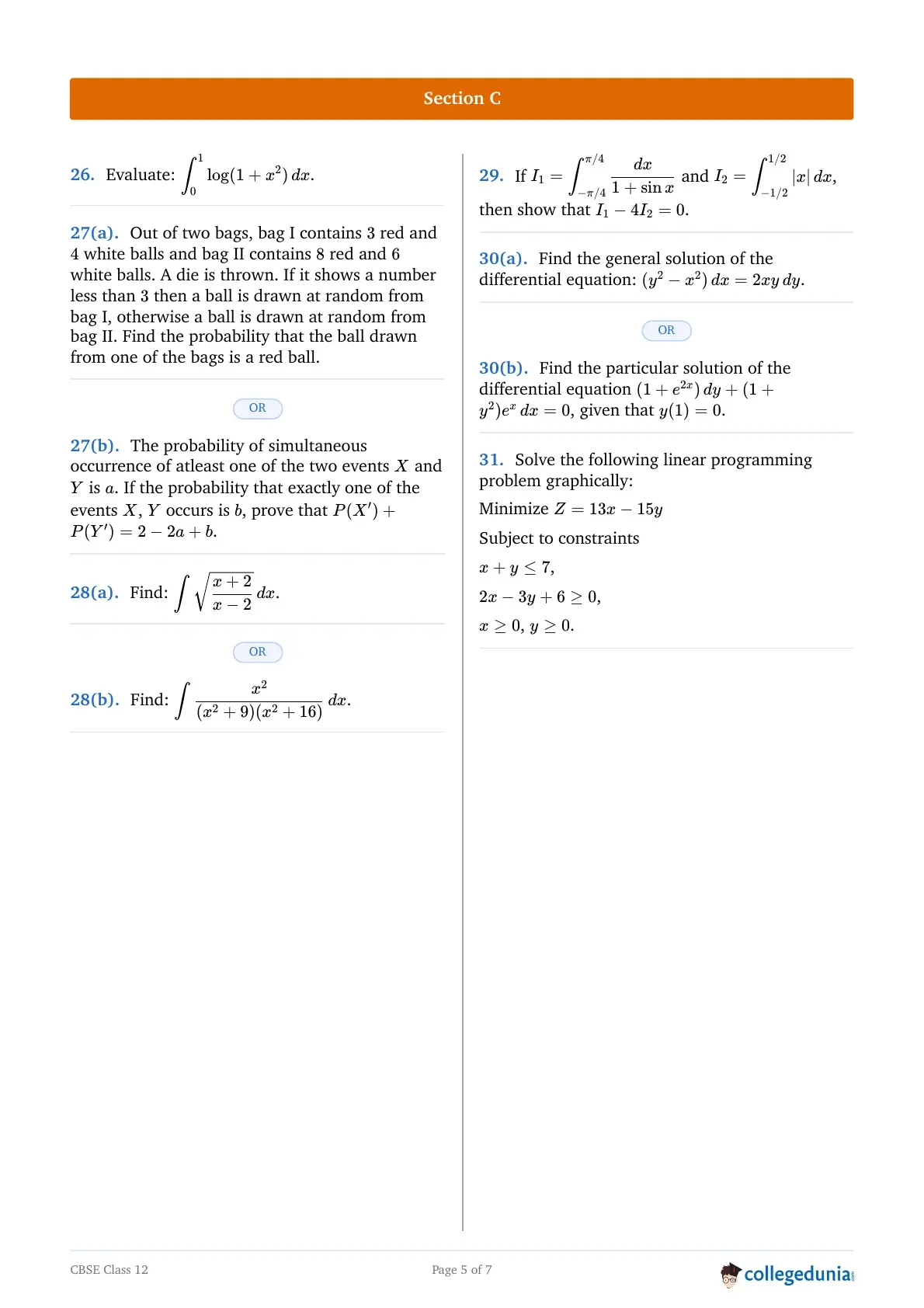
CBSE Class 12 Mathematics Set 3- (65/1/3) Question Paper 2026 is available for download here. CBSE has conducted the Class 12 Mathematics exam on March 9, 2026 from 10:30 AM to 1:30 PM. The Mathematics theory paper is of 80 marks, and the internal assessment is of 20 marks.
Mathematics question paper includes MCQs (1 mark each), short-answer type questions (2 & 3 marks each), and long-answer type questions (4 & 6 marks each) which makes up the total of 80 marks. Download CBSE Class 12 Mathematics Set 3- (65/1/3) Question Paper 2026 with detailed solutions from the links provided below.
CBSE Class 12 Mathematics Set 3- (65/1/3) Question Paper 2026 with Solution PDF
| CBSE Class 12 Mathematics Question Paper 2026 Set 3- (65/1/3) | Download PDF | Check Solutions |
If \( |\vec{a}| = 8 \), \( |\vec{b}| = 3 \) and \( |\vec{a} \times \vec{b}| = 12 \), then the value of \( |\vec{a} \cdot \vec{b}| \) is
View Solution
Concept:
Lagrange's Identity: For any two vectors \( \vec{a} \) and \( \vec{b} \), the relationship between their cross product and dot product is given by:
\[ |\vec{a} \times \vec{b}|^2 + (\vec{a} \cdot \vec{b})^2 = |\vec{a}|^2 |\vec{b}|^2 \]
Alternatively, using the definitions:
\[ |\vec{a} \times \vec{b}| = |\vec{a}| |\vec{b}| \sin \theta \quad and \quad \vec{a} \cdot \vec{b} = |\vec{a}| |\vec{b}| \cos \theta \]
Step 1: List the given magnitudes
We are provided with the following values: \[ |\vec{a}| = 8 \] \[ |\vec{b}| = 3 \] \[ |\vec{a} \times \vec{b}| = 12 \]
Step 2: Apply Lagrange's Identity to relate the products
Using the identity: \[ (12)^2 + (\vec{a} \cdot \vec{b})^2 = (8)^2 \times (3)^2 \] \[ 144 + (\vec{a} \cdot \vec{b})^2 = 64 \times 9 \]
Step 3: Calculate the square of the dot product
\[ 144 + (\vec{a} \cdot \vec{b})^2 = 576 \]
Subtract 144 from both sides: \[ (\vec{a} \cdot \vec{b})^2 = 576 - 144 \] \[ (\vec{a} \cdot \vec{b})^2 = 432 \]
Step 4: Find the magnitude of the dot product
To find \( |\vec{a} \cdot \vec{b}| \), take the square root of 432: \[ |\vec{a} \cdot \vec{b}| = \sqrt{432} \]
Factorize 432 to simplify the radical: \[ |\vec{a} \cdot \vec{b}| = \sqrt{144 \times 3} \] \[ |\vec{a} \cdot \vec{b}| = 12\sqrt{3} \] Quick Tip: Tip 1: Lagrange's Identity is the most efficient way to solve problems involving both dot and cross products.
Tip 2: Always look for perfect square factors like 144 when simplifying square roots in competitive exams.
The length of perpendicular drawn from the point \( (3, 4, 2) \) on the line \( \frac{x}{0} = \frac{y}{0} = \frac{z}{1} \) is
View Solution
Concept:
The equation of the line is \( \frac{x}{0} = \frac{y}{0} = \frac{z}{1} \).
This line passes through the origin \( (0, 0, 0) \) and has direction ratios \( (0, 0, 1) \), which identifies it as the \( z \)-axis.
The perpendicular distance from a point \( (x, y, z) \) to the \( z \)-axis is \( \sqrt{x^2 + y^2} \).
Step 1: Identify the target line
The denominators of the symmetric form are \( 0, 0, 1 \).
This indicates the line is parallel to the vector \( \hat{k} \).
Since it passes through \( (0, 0, 0) \), the line is exactly the \( z \)-axis.
Step 2: Determine the foot of the perpendicular
Let the given point be \( P(3, 4, 2) \).
The foot of the perpendicular \( M \) from \( P \) onto the \( z \)-axis will have coordinates \( (0, 0, z_P) \).
Therefore, \( M = (0, 0, 2) \).
Step 3: Calculate the distance between the point and the foot
Using the distance formula: \[ Length = \sqrt{(3 - 0)^2 + (4 - 0)^2 + (2 - 2)^2} \] \[ Length = \sqrt{3^2 + 4^2 + 0^2} \]
Step 4: Final computation
\[ Length = \sqrt{9 + 16} \] \[ Length = \sqrt{25} = 5 \] Quick Tip: Tip 1: Distance from \( z \)-axis is \( \sqrt{x^2 + y^2} \).
Tip 2: Distance from \( y \)-axis is \( \sqrt{x^2 + z^2} \).
Tip 3:Distance from \( x \)-axis is \( \sqrt{y^2 + z^2} \).
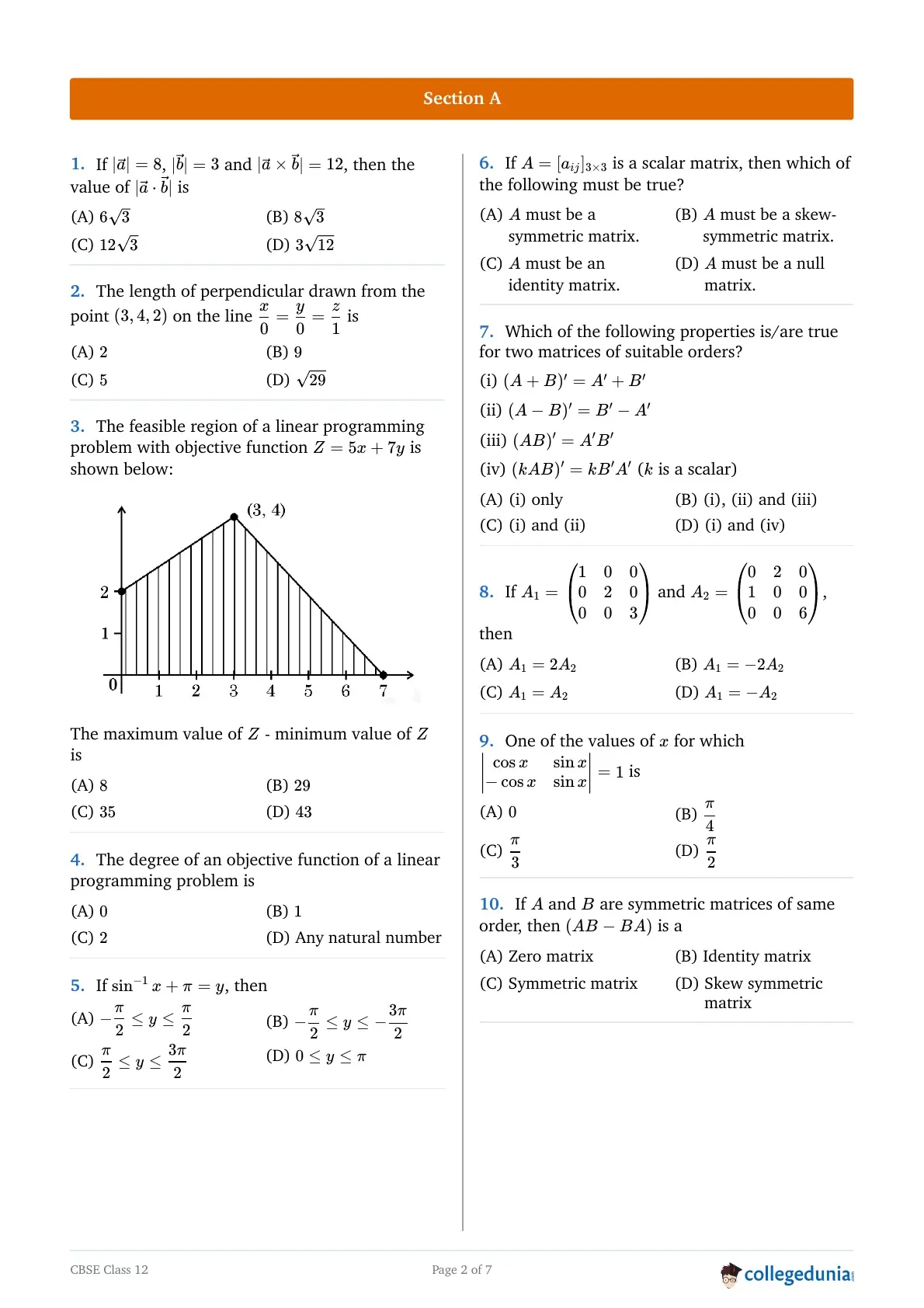
The feasible region of a linear programming problem with objective function \( Z = 5x + 7y \) is shown below :
The maximum value of \( Z \) – minimum value of \( Z \) is
View Solution
Concept:
Corner Point Theorem: The optimal (maximum or minimum) value of an objective function in an LPP occurs at the vertices (corner points) of the feasible region.
Step 1: Identify the corner points of the shaded region
From the provided graph, the vertices are:
\( (0, 0) \)
\( (0, 2) \)
\( (3, 4) \)
\( (7, 0) \)
Step 2: Evaluate \( Z = 5x + 7y \) at each corner point
At \( (0, 0) \): \( Z = 5(0) + 7(0) = 0 \)
At \( (0, 2) \): \( Z = 5(0) + 7(2) = 14 \)
At \( (3, 4) \): \( Z = 5(3) + 7(4) = 15 + 28 = 43 \)
At \( (7, 0) \): \( Z = 5(7) + 7(0) = 35 \)
Step 3: Identify the maximum and minimum values
From the calculated values: \[ Z_{max} = 43 \quad at (3, 4) \] \[ Z_{min} = 0 \quad at (0, 0) \]
Step 4: Calculate the difference
\[ Difference = Z_{max} - Z_{min} \] \[ Difference = 43 - 0 = 43 \] Quick Tip: Tip 1: Always check the origin first for minimization problems if it's part of the feasible region.
Tip 2: Linear objective functions change most rapidly in the direction of their coefficients.
The degree of an objective function of a linear programming problem is
View Solution
Concept:
Linear Programming (LP) is a method to achieve the best outcome in a mathematical model whose requirements are represented by linear relationships.
A linear relationship or function is a polynomial of degree 1.
Step 1: Define the objective function form
In any standard LPP, the objective function \( Z \) is typically written as: \[ Z = ax + by \]
where \( a \) and \( b \) are constants and \( x, y \) are decision variables.
Step 2: Determine the degree of the expression
The degree of a term is the sum of the exponents of the variables in that term.
In \( ax \), the exponent of \( x \) is 1.
In \( by \), the exponent of \( y \) is 1.
Since the highest power of the variables is 1, the degree is 1. Quick Tip: Tip 1: The word 'Linear' in Linear Programming itself specifies that the degree of the function and constraints must be 1.
Tip 2: If the degree were higher, it would fall under Non-Linear Programming.
If \( \sin^{-1}x + \pi = y \), then
View Solution
Concept:
The Range (Principal Value Branch) of \( f(x) = \sin^{-1}x \) is \( [-\frac{\pi}{2}, \frac{\pi}{2}] \).
This means for any defined \( x \), \( -\frac{\pi}{2} \leq \sin^{-1}x \leq \frac{\pi}{2} \).
Step 1: Isolate the inverse trigonometric term
Given the equation: \[ \sin^{-1}x + \pi = y \]
Subtract \( \pi \) from both sides to get: \[ \sin^{-1}x = y - \pi \]
Step 2: Apply the standard range constraint
We know the bounds for the arcsine function: \[ -\frac{\pi}{2} \leq \sin^{-1}x \leq \frac{\pi}{2} \]
Step 3: Substitute and solve the inequality for \( y \)
Replace \( \sin^{-1}x \) with \( y - \pi \): \[ -\frac{\pi}{2} \leq y - \pi \leq \frac{\pi}{2} \]
Step 4: Add \( \pi \) to all parts of the inequality
\[ \pi - \frac{\pi}{2} \leq y \leq \pi + \frac{\pi}{2} \] \[ \frac{\pi}{2} \leq y \leq \frac{3\pi}{2} \] Quick Tip: Tip 1: Always memorize the principal value branches of all six inverse trigonometric functions.
Tip 2: When an equation involves an inverse function, the bounds of that function dictate the bounds of the other side of the equation.
If \( A = [a_{ij}]_{3 \times 3} \) is a scalar matrix then which of the following must be true ?
View Solution
Concept:
A scalar matrix is a diagonal matrix in which all the diagonal elements are equal.
For a matrix \( A = [a_{ij}] \), it is a scalar matrix if \( a_{ij} = 0 \) for \( i \neq j \) and \( a_{ii} = k \) for some constant \( k \).
A matrix is symmetric if \( A = A^T \), i.e., \( a_{ij} = a_{ji} \) for all \( i, j \).
Step 1: Write the general form of a \( 3 \times 3 \) scalar matrix
Let \( A \) be a scalar matrix with diagonal elements \( k \): \[ A = \begin{bmatrix} k & 0 & 0 \\ 0 & k & 0 \\ 0 & 0 & k \end{bmatrix} \]
Step 2: Find the transpose of the matrix
The transpose \( A^T \) is obtained by interchanging rows and columns: \[ A^T = \begin{bmatrix} k & 0 & 0 \\ 0 & k & 0 \\ 0 & 0 & k \end{bmatrix} \]
Step 3: Compare the matrix with its transpose
Since \( A = A^T \), the matrix is symmetric.
Note that it is not necessarily an identity matrix (unless \( k=1 \)) or a null matrix (unless \( k=0 \)).
It is not skew-symmetric because diagonal elements of a skew-symmetric matrix must be zero. Quick Tip:Tip 1: Every diagonal matrix (and thus every scalar and identity matrix) is always a symmetric matrix.
Tip 2: The only scalar matrix that is also skew-symmetric is the Zero matrix.
Which of the following properties is/are true for two matrices of suitable orders ?
(i) \( (A + B)' = A' + B' \)
(ii) \( (A - B)' = B' - A' \)
(iii) \( (AB)' = A'B' \)
(iv) \( (kAB)' = kB'A' \) (k is a scalar)
View Solution
Concept:
Properties of Transpose of a Matrix:
\( (A^T)^T = A \)
\( (kA)^T = k A^T \)
\( (A \pm B)^T = A^T \pm B^T \)
\( (AB)^T = B^T A^T \) (Reversal Law)
Step 1: Evaluate property (i)
By the addition property of transposes, \( (A + B)' = A' + B' \).
This is True.
Step 2: Evaluate property (ii)
By property, \( (A - B)' = A' - B' \).
The given expression \( B' - A' \) is only true if \( A' = B' \).
This is False in general.
Step 3: Evaluate property (iii)
By the reversal law of transposes, \( (AB)' = B'A' \).
The given expression \( A'B' \) is only true if the matrices commute under transpose.
This is False in general.
Step 4: Evaluate property (iv)
Using the constant property and the reversal law:
\[ (k AB)' = k (AB)' = k (B'A') \]
This matches the given property.
This is True. Quick Tip:Tip 1: Always remember the reversal law: the transpose of a product is the product of the transposes in reverse order.
Tip 2: Transpose is distributive over addition and subtraction but not over multiplication.
If \( \Delta_1 = \begin{vmatrix} 1 & 0 & 0 \\ 0 & 2 & 0 \\ 0 & 0 & 3 \end{vmatrix} \) and \( \Delta_2 = \begin{vmatrix} 0 & 2 & 0 \\ 1 & 0 & 0 \\ 0 & 0 & 6 \end{vmatrix} \), then
View Solution
Concept:
The determinant of a diagonal matrix is the product of its diagonal elements.
Interchanging any two rows (or columns) of a determinant changes its sign.
If a scalar is multiplied to a row, the determinant value is multiplied by that scalar.
Step 1: Calculate the value of \( \Delta_1 \)
\( \Delta_1 \) is a diagonal matrix: \[ \Delta_1 = 1 \times 2 \times 3 = 6 \]
Step 2: Calculate the value of \( \Delta_2 \)
Expand \( \Delta_2 \) along the first row: \[ \Delta_2 = 0 - 2(1 \times 6 - 0) + 0 \] \[ \Delta_2 = -2(6) = -12 \]
Step 3: Relate the two values
We have \( \Delta_1 = 6 \) and \( \Delta_2 = -12 \).
To find the relation, divide \( \Delta_2 \) by \( \Delta_1 \): \[ \frac{\Delta_2}{\Delta_1} = \frac{-12}{6} = -2 \] \[ \Delta_2 = -2\Delta_1 \] Quick Tip: Tip 1: For diagonal or triangular matrices, don't waste time expanding; just multiply the diagonal.
Tip 2: In \( \Delta_2 \), observe it's almost \( \Delta_1 \) with \( R_1, R_2 \) swapped and one element doubled.
One of the values of \( x \) for which \( \begin{vmatrix} \cos x & \sin x \\ -\cos x & \sin x \end{vmatrix} = 1 \) is
View Solution
Concept:
The determinant of a \( 2 \times 2 \) matrix \( \begin{vmatrix} a & b
c & d \end{vmatrix} \) is \( ad - bc \).
Trigonometric Identity: \( 2 \sin \theta \cos \theta = \sin 2\theta \).
Step 1: Expand the given determinant
\[ \begin{vmatrix} \cos x & \sin x \\ -\cos x & \sin x \end{vmatrix} = (\cos x)(\sin x) - (\sin x)(-\cos x) \] \[ = \cos x \sin x + \sin x \cos x \] \[ = 2 \sin x \cos x \]
Step 2: Equate to the given value
Using the identity \( 2 \sin x \cos x = \sin 2x \): \[ \sin 2x = 1 \]
Step 3: Solve for \( x \)
For \( \sin \theta = 1 \), the general solution is \( \theta = n\pi + (-1)^n \frac{\pi}{2} \).
For the principal value: \[ 2x = \frac{\pi}{2} \] \[ x = \frac{\pi}{4} \] Quick Tip: Tip 1: If you forget the \( \sin 2x \) identity, just substitute the options into the expanded expression \( 2\sin x \cos x \).
Tip 2: At \( x = \pi/4 \), \( \sin x = \cos x = 1/\sqrt{2} \), so \( 2(1/\sqrt{2})(1/\sqrt{2}) = 1 \).
If A and B are symmetric matrics of same order, then \( (AB - BA) \) is a
View Solution
Concept:
Since \( A \) and \( B \) are symmetric, \( A^T = A \) and \( B^T = B \).
A matrix \( C \) is symmetric if \( C^T = C \).
A matrix \( C \) is skew-symmetric if \( C^T = -C \).
Step 1: Let the resulting matrix be \( C \)
Define \( C = AB - BA \).
To check its property, we must find its transpose \( C^T \).
Step 2: Find the transpose using properties
\[ C^T = (AB - BA)^T \] \[ C^T = (AB)^T - (BA)^T \]
Apply the reversal law \( (XY)^T = Y^T X^T \): \[ C^T = B^T A^T - A^T B^T \]
Step 3: Substitute the given conditions
Since \( A^T = A \) and \( B^T = B \): \[ C^T = BA - AB \]
Step 4: Compare \( C^T \) with \( C \)
Factor out a negative sign: \[ C^T = -(AB - BA) \] \[ C^T = -C \]
Since \( C^T = -C \), the matrix is skew-symmetric. Quick Tip: Tip 1: For any symmetric matrices \( A, B \):
Tip 2: \( AB + BA \) is always symmetric.
Tip 3: \( AB - BA \) is always skew-symmetric.
The least value of \( f(x) = e^{-x} \) in \( [0, 3] \) is
View Solution
Concept:
For a continuous and monotonic function, the absolute maximum and minimum values in a closed interval \( [a, b] \) occur at the endpoints or at critical points.
An exponential function \( e^{kx} \) is strictly monotonic.
If \( k < 0 \), the function is strictly decreasing.
Step 1: Determine the nature of the function by finding its derivative
The given function is: \[ f(x) = e^{-x} \]
Differentiating with respect to \( x \): \[ f'(x) = \frac{d}{dx}(e^{-x}) = -e^{-x} \]
Since \( e^{-x} > 0 \) for all real \( x \), we have: \[ f'(x) = -e^{-x} < 0 for all x \in [0, 3] \]
Step 2: Evaluate the function at the boundary points of the interval
Because \( f'(x) < 0 \), the function \( f(x) \) is strictly decreasing on the interval \( [0, 3] \).
This implies the maximum value is at the left endpoint and the minimum value is at the right endpoint.
Value at the left endpoint \( x = 0 \): \[ f(0) = e^{-(0)} = 1 \]
Value at the right endpoint \( x = 3 \): \[ f(3) = e^{-3} \]
Step 3: Identify the least value
Since the function is strictly decreasing: \[ f(3) < f(0) \implies e^{-3} < 1 \]
Thus, the least value of the function in the interval \( [0, 3] \) is \( e^{-3} \). Quick Tip: For any strictly decreasing function in \( [a, b] \), the least value is always \( f(b) \).
For any strictly increasing function in \( [a, b] \), the least value is always \( f(a) \).
If \( \int \frac{3ax}{b^2 + c^2x^2} dx = A \log |b^2 + c^2x^2| + K \), then the value of \( A \) is
View Solution
Concept:
Integration by substitution: If an integral has the form \( \int f(g(x))g'(x) dx \), we substitute \( u = g(x) \).
The derivative of the denominator often appears in the numerator of log-type integrals.
Step 1: Choose an appropriate substitution for the integral
Let the integral be \( I \): \[ I = \int \frac{3ax}{b^2 + c^2x^2} dx \]
Put \( t = b^2 + c^2x^2 \).
Differentiating with respect to \( x \): \[ \frac{dt}{dx} = 0 + c^2(2x) = 2c^2x \] \[ dt = 2c^2x dx \implies x dx = \frac{1}{2c^2} dt \]
Step 2: Perform the substitution and integrate
Substitute \( t \) and \( x dx \) back into the integral: \[ I = \int \frac{3a}{t} \cdot \left( \frac{1}{2c^2} \right) dt \]
Take the constants outside the integral: \[ I = \frac{3a}{2c^2} \int \frac{1}{t} dt \] \[ I = \frac{3a}{2c^2} \log |t| + K \]
Step 3: Substitute back the original variable and compare coefficients
Replacing \( t \) with its expression in \( x \): \[ I = \frac{3a}{2c^2} \log |b^2 + c^2x^2| + K \]
Comparing this result with the given form \( A \log |b^2 + c^2x^2| + K \): \[ A = \frac{3a}{2c^2} \] Quick Tip: Use the shortcut: \( \int \frac{f'(x)}{f(x)} dx = \log |f(x)| + C \).
Adjust the constant factor in the numerator to match the derivative of the denominator exactly.
The value of \( \int_{-1}^{1} \frac{x^3}{x^2 + 2|x| + 1} dx \) is
View Solution
Concept:
Property of Definite Integrals: \( \int_{-a}^{a} f(x) dx = 0 \) if \( f(x) \) is an odd function.
A function is odd if \( f(-x) = -f(x) \).
A function is even if \( f(-x) = f(x) \).
Step 1: Define the integrand function and test for symmetry
Let the integrand be \( f(x) \):
\[ f(x) = \frac{x^3}{x^2 + 2|x| + 1} \]
To check if the function is odd or even, replace \( x \) with \( -x \):
\[ f(-x) = \frac{(-x)^3}{(-x)^2 + 2|-x| + 1} \]
Step 2: Simplify the expression for \( f(-x) \)
Using the properties \( (-x)^3 = -x^3 \), \( (-x)^2 = x^2 \), and \( |-x| = |x| \):
\[ f(-x) = \frac{-x^3}{x^2 + 2|x| + 1} \] \[ f(-x) = - \left( \frac{x^3}{x^2 + 2|x| + 1} \right) \] \[ f(-x) = -f(x) \]
This proves that \( f(x) \) is an odd function.
Step 3: Apply the definite integral property
Since the function is odd and the limits of integration are symmetric about the origin (\( -1 \) to \( 1 \)):
\[ \int_{-1}^{1} f(x) dx = 0 \]
Therefore:
\[ \int_{-1}^{1} \frac{x^3}{x^2 + 2|x| + 1} dx = 0 \] Quick Tip: Always check for odd functions when the integration limits are of the form \( [-a, a] \).
Odd function times even function is always an odd function. Here, \( x^3 \) is odd and the denominator is even.
The area bounded by the curve \( y = x|x| \), x-axis and the ordinates \( x = -1 \) and \( x = 1 \) is given by
View Solution
Concept:
The area bounded by a curve \( y = f(x) \), the x-axis, and lines \( x=a, x=b \) is given by \( \int_{a}^{b} |y| dx \).
Absolute value function definition: \( |x| = x \) for \( x \geq 0 \) and \( |x| = -x \) for \( x < 0 \).
Step 1: Redefine the function to handle the absolute value
The given curve is \( y = x|x| \).
For \( x \geq 0 \), \( y = x(x) = x^2 \).
For \( x < 0 \), \( y = x(-x) = -x^2 \).
Thus: \[ y = \begin{cases} -x^2 & if x < 0
x^2 & if x \geq 0 \end{cases} \]
Step 2: Set up the integral for area
The area required is the integral of the absolute value of \( y \) from \( -1 \) to \( 1 \): \[ Area = \int_{-1}^{1} |x|x|| dx \]
Since \( |x|x|| = x^2 \) for all real \( x \) (because \( x^2 \) is always non-negative): \[ Area = \int_{-1}^{1} x^2 dx \]
Step 3: Evaluate the definite integral
Since \( x^2 \) is an even function, we can simplify the integral: \[ Area = 2 \int_{0}^{1} x^2 dx \] \[ Area = 2 \left[ \frac{x^3}{3} \right]_{0}^{1} \] \[ Area = 2 \left( \frac{1^3}{3} - \frac{0^3}{3} \right) \] \[ Area = 2 \left( \frac{1}{3} \right) = \frac{2}{3} \] Quick Tip: Area is a physical quantity and can never be zero or negative.
In area problems, if you get zero, you likely forgot to take the absolute value of the function before integrating.
The integrating factor of differential equation \( R \frac{dx}{dy} + Px = Q \) where \( P, Q, R \) are functions of \( y \) is
View Solution
Concept:
A first-order linear differential equation in \( x \) has the standard form:
\[ \frac{dx}{dy} + P_1(y)x = Q_1(y) \]
The Integrating Factor (I.F.) for such an equation is defined as:
\[ I.F. = e^{\int P_1(y) dy} \]
Step 1: Convert the given equation to standard form
The given equation is: \[ R \frac{dx}{dy} + Px = Q \]
To get it into standard form, we divide the entire equation by \( R \) (assuming \( R \neq 0 \)): \[ \frac{dx}{dy} + \left( \frac{P}{R} \right) x = \frac{Q}{R} \]
Step 2: Identify the coefficient of \( x \)
Comparing with the standard form \( \frac{dx}{dy} + P_1 x = Q_1 \), we find: \[ P_1 = \frac{P}{R} \]
Note that \( P \) and \( R \) are given as functions of \( y \), so \( P_1 \) is also a function of \( y \).
Step 3: Calculate the Integrating Factor
Using the formula for I.F.: \[ I.F. = e^{\int P_1 dy} \] \[ I.F. = e^{\int \frac{P}{R} dy} \]
This matches option (C). Quick Tip: Always ensure the coefficient of the derivative term (\( \frac{dx}{dy} \) or \( \frac{dy}{dx} \)) is 1 before identifying \( P \).
The integral in the exponent must be with respect to the independent variable (\( y \) in this case).
The order and degree of the differential equation : \( \frac{d}{dx}(y')^3 + (y')^3 = 1 \) respectively are where \( y' = \frac{dy}{dx} \)
View Solution
Concept:
Order: The order of a differential equation is the order of the highest derivative present in the equation.
Degree: The degree is the power of the highest order derivative, provided the equation is a polynomial in its derivatives.
Step 1: Expand the given differential equation
The given equation is: \[ \frac{d}{dx}(y')^3 + (y')^3 = 1 \]
We need to perform the differentiation in the first term with respect to \( x \).
Using the chain rule: \[ \frac{d}{dx} \left( \frac{dy}{dx} \right)^3 = 3 \left( \frac{dy}{dx} \right)^2 \cdot \frac{d}{dx} \left( \frac{dy}{dx} \right) \] \[ = 3(y')^2 \cdot y'' \]
Step 2: Rewrite the full equation
Substituting the derivative back into the original equation: \[ 3(y')^2 y'' + (y')^3 = 1 \]
Or in standard notation: \[ 3 \left( \frac{dy}{dx} \right)^2 \left( \frac{d^2y}{dx^2} \right) + \left( \frac{dy}{dx} \right)^3 = 1 \]
Step 3: Identify the order and degree
The highest derivative present in the equation is the second derivative, \( y'' \) or \( \frac{d^2y}{dx^2} \).
Therefore, the order is 2.
The highest order derivative term is \( 3(y')^2 y'' \).
The exponent (power) of this term \( (y'') \) is 1.
Therefore, the degree is 1. Quick Tip: Always perform indicated operations like \( \frac{d}{dx} \) before determining the order and degree.
Ensure all derivatives are free from radicals or fractional exponents to correctly identify the degree.
The value of \( p \) for which vectors \( \hat{i} + 2\hat{j} + 3\hat{k} \) and \( 2\hat{i} - p\hat{j} + \hat{k} \) are perpendicular to each other is
View Solution
Concept:
Two non-zero vectors \( \vec{a} \) and \( \vec{b} \) are perpendicular if and only if their dot product (scalar product) is zero.
If \( \vec{a} = a_1\hat{i} + a_2\hat{j} + a_3\hat{k} \) and \( \vec{b} = b_1\hat{i} + b_2\hat{j} + b_3\hat{k} \), then \( \vec{a} \cdot \vec{b} = a_1b_1 + a_2b_2 + a_3b_3 \).
Step 1: Set up the dot product equation
Let \( \vec{a} = \hat{i} + 2\hat{j} + 3\hat{k} \) and \( \vec{b} = 2\hat{i} - p\hat{j} + \hat{k} \).
Since the vectors are perpendicular: \[ \vec{a} \cdot \vec{b} = 0 \]
Step 2: Calculate the dot product
Multiply the corresponding components of the vectors: \[ (1)(2) + (2)(-p) + (3)(1) = 0 \] \[ 2 - 2p + 3 = 0 \]
Step 3: Solve for \( p \)
Combine the numerical terms: \[ 5 - 2p = 0 \]
Isolate \( p \): \[ 2p = 5 \] \[ p = \frac{5}{2} \] Quick Tip: Perpendicularity check: \( \vec{a} \cdot \vec{b} = 0 \).
Parallelism check: \( \vec{a} \times \vec{b} = 0 \) or components are proportional.
The value of \( m \) for which the points with position vectors \( -\hat{i} - \hat{j} + 2\hat{k} \), \( 2\hat{i} + m\hat{j} + 5\hat{k} \) and \( 3\hat{i} + 11\hat{j} + 6\hat{k} \) are collinear, is
View Solution
Concept:
Three points \( A, B, C \) are collinear if the vectors \( \vec{AB} \) and \( \vec{BC} \) (or \( \vec{AC} \)) are parallel.
Parallel vectors have proportional components: if \( \vec{u} = x_1\hat{i} + y_1\hat{j} + z_1\hat{k} \) and \( \vec{v} = x_2\hat{i} + y_2\hat{j} + z_2\hat{k} \), then \( \frac{x_1}{x_2} = \frac{y_1}{y_2} = \frac{z_1}{z_2} \).
Step 1: Find the vectors connecting the points
Let the points be \( A(-\hat{i} - \hat{j} + 2\hat{k}) \), \( B(2\hat{i} + m\hat{j} + 5\hat{k}) \), and \( C(3\hat{i} + 11\hat{j} + 6\hat{k}) \).
Vector \( \vec{AB} = \vec{OB} - \vec{OA} \): \[ \vec{AB} = (2 - (-1))\hat{i} + (m - (-1))\hat{j} + (5 - 2)\hat{k} \] \[ \vec{AB} = 3\hat{i} + (m + 1)\hat{j} + 3\hat{k} \]
Vector \( \vec{BC} = \vec{OC} - \vec{OB} \): \[ \vec{BC} = (3 - 2)\hat{i} + (11 - m)\hat{j} + (6 - 5)\hat{k} \] \[ \vec{BC} = 1\hat{i} + (11 - m)\hat{j} + 1\hat{k} \]
Step 2: Apply the condition for collinearity
Since the points are collinear, \( \vec{AB} = \lambda \vec{BC} \).
Equating the ratios of the components: \[ \frac{3}{1} = \frac{m + 1}{11 - m} = \frac{3}{1} \]
Step 3: Solve for \( m \)
From the first equality: \[ 3 = \frac{m + 1}{11 - m} \]
Cross-multiply: \[ 3(11 - m) = m + 1 \] \[ 33 - 3m = m + 1 \]
Group the terms: \[ 33 - 1 = m + 3m \] \[ 32 = 4m \] \[ m = 8 \] Quick Tip: For collinearity of \( A, B, C \), the area of triangle \( ABC \) must be zero.
Alternatively, checking the ratio of the change in components is often the fastest method.
Assertion (A) : In an experiment of throwing an unbiased die, the probability of getting a prime number given that number appearing on the die being odd is \( \frac{2}{3} \).
Reason (R) : For any two events \( A \) and \( B \), \( P(A|B) = \frac{P(A \cup B)}{P(B)} \).
View Solution
Concept:
Conditional Probability: The probability of an event \( A \) given that event \( B \) has occurred is \( P(A|B) = \frac{P(A \cap B)}{P(B)} \), where \( P(B) > 0 \).
For an unbiased die, the sample space is \( S = \{1, 2, 3, 4, 5, 6\} \).
Step 1: Verify the Assertion (A)
Let \( A \) be the event of getting a prime number. \[ A = \{2, 3, 5\} \implies n(A) = 3 \]
Let \( B \) be the event that the number appearing on the die is odd. \[ B = \{1, 3, 5\} \implies n(B) = 3 \]
The intersection \( A \cap B \) is the set of numbers that are both prime and odd: \[ A \cap B = \{3, 5\} \implies n(A \cap B) = 2 \]
Calculating the conditional probability: \[ P(A|B) = \frac{n(A \cap B)}{n(B)} = \frac{2}{3} \]
Thus, Assertion (A) is True.
Step 2: Verify the Reason (R)
The formula provided in the Reason is: \[ P(A|B) = \frac{P(A \cup B)}{P(B)} \]
This formula is incorrect. The correct formula for conditional probability is: \[ P(A|B) = \frac{P(A \cap B)}{P(B)}, \quad P(B) > 0 \]
Therefore, Reason (R) is False.
Step 3: Check the relationship between A and R
Assertion (A) is True, as \[ P(A|B) = \frac{2}{3}. \]
However, Reason (R) is False because conditional probability is calculated using the intersection \( A \cap B \), not the union \( A \cup B \).
Therefore, Assertion (A) is true and Reason (R) is false. Quick Tip: Tip 1: In conditional probability, the given condition reduces the size of the sample space. Tip 2: Remember that \( P(A|B) \) involves the intersection \( A \cap B \), not the union \( A \cup B \).
Assertion (A) : Lines given by \( x = py + q, z = ry + s \) and \( x = p'y + q', z = r'y + s' \) are perpendicular to each other when \( pp' + rr' + 1 = 0 \).
Reason (R) : Two lines \( \vec{r} = \vec{a}_1 + \lambda\vec{b}_1 \) and \( \vec{r} = \vec{a}_2 + \mu\vec{b}_2 \) are perpendicular to each other if \( \vec{b}_1 \cdot \vec{b}_2 = 0 \).
View Solution
Concept:
The direction of a line is determined by the vector \( \vec{b} \) in the form \( \vec{r} = \vec{a} + \lambda\vec{b} \).
Two lines are perpendicular if the dot product of their direction vectors is zero.
Step 1: Find the direction vectors of the lines in Assertion (A)
For the first line: \( x = py + q \implies \frac{x - q}{p} = y \) and \( z = ry + s \implies \frac{z - s}{r} = y \).
The symmetric form is: \[ \frac{x - q}{p} = \frac{y - 0}{1} = \frac{z - s}{r} \]
The direction vector is \( \vec{b}_1 = p\hat{i} + 1\hat{j} + r\hat{k} \).
For the second line: \( x = p'y + q' \implies \frac{x - q'}{p'} = y \) and \( z = r'y + s' \implies \frac{z - s'}{r'} = y \).
The symmetric form is: \[ \frac{x - q'}{p'} = \frac{y - 0}{1} = \frac{z - s'}{r'} \]
The direction vector is \( \vec{b}_2 = p'\hat{i} + 1\hat{j} + r'\hat{k} \).
Step 2: Apply the perpendicularity condition
The lines are perpendicular if \( \vec{b}_1 \cdot \vec{b}_2 = 0 \). \[ (p\hat{i} + \hat{j} + r\hat{k}) \cdot (p'\hat{i} + \hat{j} + r'\hat{k}) = 0 \] \[ (p)(p') + (1)(1) + (r)(r') = 0 \] \[ pp' + rr' + 1 = 0 \]
Thus, Assertion (A) is True.
Step 3: Evaluate the Reason (R) and the link
Reason (R) states the general vector condition for perpendicularity, \( \vec{b}_1 \cdot \vec{b}_2 = 0 \).
This is True.
Since we derived the result in Step 2 directly from this principle, the Reason correctly explains the Assertion. Quick Tip: When a line is given as \( x = ay+b, z = cy+d \), the direction ratios are \( (a, 1, c) \).
If denominators in symmetric form are \( l, m, n \), the direction vector is \( l\hat{i} + m\hat{j} + n\hat{k} \).
Simplify : \( \tan^{-1} \left( \frac{\cos 2x - \sin 2x}{\cos 2x + \sin 2x} \right) \), \( 0 < x < \frac{\pi}{4} \).
View Solution
Concept:
Conversion to tangent form: To simplify an expression involving \( \tan^{-1} \), we try to express the inner term as \( \tan \theta \).
Trigonometric Identity: \( \tan \left( \frac{\pi}{4} - \theta \right) = \frac{1 - \tan \theta}{1 + \tan \theta} \).
Step 1: Divide numerator and denominator by \( \cos 2x \)
Divide both the numerator and the denominator inside the brackets by \( \cos 2x \): \[ \frac{\frac{\cos 2x}{\cos 2x} - \frac{\sin 2x}{\cos 2x}}{\frac{\cos 2x}{\cos 2x} + \frac{\sin 2x}{\cos 2x}} = \frac{1 - \tan 2x}{1 + \tan 2x} \]
Step 2: Rewrite the expression using tangent identity
We know that \( \tan \frac{\pi}{4} = 1 \). The expression can be written as: \[ \frac{\tan \frac{\pi}{4} - \tan 2x}{1 + \tan \frac{\pi}{4} \tan 2x} \]
Using the formula \( \tan(A - B) = \frac{\tan A - \tan B}{1 + \tan A \tan B} \), we get: \[ = \tan \left( \frac{\pi}{4} - 2x \right) \]
Step 3: Simplify the inverse tangent function
Substitute the result back into the original expression: \[ \tan^{-1} \left[ \tan \left( \frac{\pi}{4} - 2x \right) \right] \]
Check the range: Given \( 0 < x < \frac{\pi}{4} \), then \( 0 < 2x < \frac{\pi}{2} \).
Subtracting from \( \frac{\pi}{4} \): \[ \frac{\pi}{4} - \frac{\pi}{2} < \frac{\pi}{4} - 2x < \frac{\pi}{4} - 0 \] \[ -\frac{\pi}{4} < \frac{\pi}{4} - 2x < \frac{\pi}{4} \]
Since this is within the principal value branch \( (-\frac{\pi}{2}, \frac{\pi}{2}) \): \[ = \frac{\pi}{4} - 2x \] Quick Tip: When you see \( \cos \theta \pm \sin \theta \), dividing by \( \cos \theta \) is almost always the first step to convert it to a tangent form.
Always verify the range of the argument for inverse functions to ensure the result is correct.
Evaluate : \( \tan \left( \sin^{-1} 1 - \cos^{-1} \left( -\frac{1}{2} \right) \right) \).
View Solution
Concept:
Principal values:
\( \sin^{-1}(1) = \frac{\pi}{2} \) since \( \sin \frac{\pi}{2} = 1 \).
\( \cos^{-1}(-x) = \pi - \cos^{-1}(x) \).
Step 1: Determine the principal values of inverse terms
For the first term: \[ \sin^{-1}(1) = \frac{\pi}{2} \]
For the second term: \[ \cos^{-1} \left( -\frac{1}{2} \right) = \pi - \cos^{-1} \left( \frac{1}{2} \right) \]
Since \( \cos \frac{\pi}{3} = \frac{1}{2} \): \[ \cos^{-1} \left( -\frac{1}{2} \right) = \pi - \frac{\pi}{3} = \frac{2\pi}{3} \]
Step 2: Substitute values into the expression
The expression becomes: \[ \tan \left( \frac{\pi}{2} - \frac{2\pi}{3} \right) \]
Step 3: Simplify and calculate the final value
Find the common denominator for the angle: \[ \frac{\pi}{2} - \frac{2\pi}{3} = \frac{3\pi - 4\pi}{6} = -\frac{\pi}{6} \]
Now find the tangent: \[ \tan \left( -\frac{\pi}{6} \right) = -\tan \left( \frac{\pi}{6} \right) \] \[ = -\frac{1}{\sqrt{3}} \] Quick Tip: Remember that \( \cos^{-1} \) of a negative value always lies in the second quadrant \( (\frac{\pi}{2}, \pi] \).
\( \tan(-\theta) = -\tan \theta \), a property of odd functions.
Check whether function \( f(x) \) defined as \( f(x) = \begin{cases} \frac{|x - 3|}{2(x - 3)} & , x < 3
\frac{x - 6}{6} & , x \geq 3 \end{cases} \) is continuous at \( x = 3 \) or not ?
View Solution
Concept:
Continuity Check: A function \( f(x) \) is continuous at \( x = a \) if \( LHL = RHL = f(a) \).
Modulus property: \( |x - 3| = -(x - 3) \) when \( x < 3 \).
Step 1: Calculate the Left Hand Limit (LHL) at \( x = 3 \)
For \( x < 3 \), \( |x - 3| = -(x - 3) \). \[ LHL = \lim_{x \to 3^-} f(x) = \lim_{x \to 3^-} \frac{-(x - 3)}{2(x - 3)} \]
Cancelling the common term \( (x - 3) \): \[ LHL = \lim_{x \to 3^-} \left( -\frac{1}{2} \right) = -\frac{1}{2} \]
Step 2: Calculate the Right Hand Limit (RHL) at \( x = 3 \)
For \( x \geq 3 \), the function is defined as \( \frac{x - 6}{6} \). \[ RHL = \lim_{x \to 3^+} f(x) = \lim_{x \to 3^+} \frac{x - 6}{6} \] \[ RHL = \frac{3 - 6}{6} = \frac{-3}{6} = -\frac{1}{2} \]
Step 3: Compare LHL, RHL, and the function value \( f(3) \)
From the definition, \( f(3) \) is calculated using the \( x \geq 3 \) case: \[ f(3) = \frac{3 - 6}{6} = -\frac{1}{2} \]
Since: \[ LHL = RHL = f(3) = -\frac{1}{2} \]
The function \( f(x) \) is continuous at \( x = 3 \). Quick Tip: Modulus functions create corners in graphs but don't always create discontinuities.
When a function involves a fraction like \( \frac{|x-a|}{x-a} \), it's essentially a jump function with values \( \pm 1 \) (or scaled versions thereof).
If \( \sqrt{3}(x^2 + y^2) = 4xy \), then find \( \frac{dy}{dx} \) at \( \left( \frac{1}{2}, \frac{\sqrt{3}}{2} \right) \).
View Solution
Concept:
Implicit Differentiation: Differentiate every term with respect to \( x \), treating \( y \) as a function of \( x \) (using the chain rule).
Product Rule: \( \frac{d}{dx}(uv) = u \frac{dv}{dx} + v \frac{du}{dx} \).
Step 1: Differentiate the equation with respect to \( x \)
Given: \( \sqrt{3}x^2 + \sqrt{3}y^2 = 4xy \)
Differentiating both sides: \[ \sqrt{3}(2x) + \sqrt{3}\left( 2y \frac{dy}{dx} \right) = 4 \left[ x \frac{dy}{dx} + y(1) \right] \] \[ 2\sqrt{3}x + 2\sqrt{3}y \frac{dy}{dx} = 4x \frac{dy}{dx} + 4y \]
Step 2: Rearrange to solve for \( \frac{dy}{dx} \)
Gather all \( \frac{dy}{dx} \) terms on one side: \[ 2\sqrt{3}y \frac{dy}{dx} - 4x \frac{dy}{dx} = 4y - 2\sqrt{3}x \]
Factor out the derivative: \[ \frac{dy}{dx} (2\sqrt{3}y - 4x) = 4y - 2\sqrt{3}x \] \[ \frac{dy}{dx} = \frac{4y - 2\sqrt{3}x}{2\sqrt{3}y - 4x} \]
Step 3: Substitute the coordinates \( \left( \frac{1}{2}, \frac{\sqrt{3}}{2} \right) \)
\[ \frac{dy}{dx} = \frac{4(\frac{\sqrt{3}}{2}) - 2\sqrt{3}(\frac{1}{2})}{2\sqrt{3}(\frac{\sqrt{3}}{2}) - 4(\frac{1}{2})} \]
Simplify numerator: \( 2\sqrt{3} - \sqrt{3} = \sqrt{3} \)
Simplify denominator: \( 3 - 2 = 1 \)
\[ \frac{dy}{dx} = \frac{\sqrt{3}}{1} = \sqrt{3} \] Quick Tip: You can often plug in the coordinates right after differentiation instead of rearranging to save time.
Ensure you apply the chain rule correctly to every term containing \( y \).
Simplify : \( \sin^{-1} \sqrt{\frac{1 + \cos 2x}{2}} \), \( 0 < x < \frac{\pi}{2} \).
View Solution
Concept:
Double Angle Formulas: \( 1 + \cos 2x = 2 \cos^2 x \).
Relation between Sine and Cosine: \( \cos x = \sin \left( \frac{\pi}{2} - x \right) \).
Step 1: Substitute the identity for \( 1 + \cos 2x \)
\[ \sqrt{\frac{1 + \cos 2x}{2}} = \sqrt{\frac{2 \cos^2 x}{2}} \] \[ = \sqrt{\cos^2 x} = |\cos x| \]
Step 2: Determine the sign based on the given interval
Given \( 0 < x < \frac{\pi}{2} \), \( x \) is in the first quadrant.
In the first quadrant, \( \cos x \) is positive. \[ |\cos x| = \cos x \]
Step 3: Apply the inverse sine transformation
The expression becomes: \[ \sin^{-1}(\cos x) \]
Convert cosine to sine to match the inverse function: \[ \sin^{-1} \left[ \sin \left( \frac{\pi}{2} - x \right) \right] \]
Check the range: Since \( 0 < x < \frac{\pi}{2} \), then \( 0 < \frac{\pi}{2} - x < \frac{\pi}{2} \).
This is within the principal range of \( \sin^{-1} \).
\[ = \frac{\pi}{2} - x \] Quick Tip: Memorizing \( \sin^{-1}(\cos x) = \frac{\pi}{2} - x \) for small \( x \) saves time in calculus.
Always pay attention to the interval to correctly resolve square roots of squares.
Evaluate : \( \cos[\sin^{-1}(-1) - \tan^{-1}(-\sqrt{3})] \).
View Solution
Concept:
Inverse function values:
\( \sin^{-1}(-1) = -\frac{\pi}{2} \).
\( \tan^{-1}(-\sqrt{3}) = -\frac{\pi}{3} \).
Step 1: Find the values of inverse functions
Let \( \alpha = \sin^{-1}(-1) \). Since \( \sin(-\frac{\pi}{2}) = -1 \): \[ \alpha = -\frac{\pi}{2} \]
Let \( \beta = \tan^{-1}(-\sqrt{3}) \). Since \( \tan(-\frac{\pi}{3}) = -\sqrt{3} \): \[ \beta = -\frac{\pi}{3} \]
Step 2: Substitute values into the expression
\[ \cos [ \alpha - \beta ] = \cos \left[ -\frac{\pi}{2} - \left( -\frac{\pi}{3} \right) \right] \] \[ = \cos \left( -\frac{\pi}{2} + \frac{\pi}{3} \right) \]
Step 3: Simplify and calculate the result
\[ \cos \left( \frac{-3\pi + 2\pi}{6} \right) = \cos \left( -\frac{\pi}{6} \right) \]
Since \( \cos(-\theta) = \cos \theta \): \[ = \cos \frac{\pi}{6} \] \[ = \frac{\sqrt{3}}{2} \] Quick Tip: Note the signs carefully when subtracting negative angles. \( \sin^{-1} \) and \( \tan^{-1} \) of negative values result in negative angles in the fourth quadrant \( (-\frac{\pi}{2}, 0) \).
Using vectors, find the area of \( \Delta ABC \) with vertices \( A(1, 2, 3) \), \( B(2, -1, 4) \) and \( C(4, 5, -1) \).
View Solution
Concept:
Vector area of a triangle: The area of a triangle with vertices \( A, B, C \) is given by:
\[ Area = \frac{1}{2} | \vec{AB} \times \vec{AC} | \]
Position vectors: \( \vec{AB} = P.V. of B - P.V. of A \).
Step 1: Determine the vectors \( \vec{AB} \) and \( \vec{AC} \)
\[ \vec{AB} = (2 - 1)\hat{i} + (-1 - 2)\hat{j} + (4 - 3)\hat{k} = \hat{i} - 3\hat{j} + \hat{k} \] \[ \vec{AC} = (4 - 1)\hat{i} + (5 - 2)\hat{j} + (-1 - 3)\hat{k} = 3\hat{i} + 3\hat{j} - 4\hat{k} \]
Step 2: Calculate the cross product \( \vec{AB} \times \vec{AC} \)
\[ \vec{AB} \times \vec{AC} = \begin{vmatrix} \hat{i} & \hat{j} & \hat{k} \\ 1 & -3 & 1 \\ 3 & 3 & -4 \end{vmatrix} \] \[ = \hat{i} [(-3)(-4) - (3)(1)] - \hat{j} [(1)(-4) - (3)(1)] + \hat{k} [(1)(3) - (3)(-3)] \] \[ = \hat{i} [12 - 3] - \hat{j} [-4 - 3] + \hat{k} [3 + 9] \] \[ = 9\hat{i} + 7\hat{j} + 12\hat{k} \]
Step 3: Find the magnitude and calculate area
\[ | \vec{AB} \times \vec{AC} | = \sqrt{9^2 + 7^2 + 12^2} \] \[ = \sqrt{81 + 49 + 144} = \sqrt{274} \]
\[ Area = \frac{1}{2} \sqrt{274} sq. units \] Quick Tip: You can use any two adjacent sides (e.g., \( \vec{BA} \) and \( \vec{BC} \)) to get the same area.
Double-check your determinant calculation; cross-products are common sources of small errors.
Vectors \( \vec{a} = 3\hat{i} - 2\hat{j} + 2\hat{k} \) and \( \vec{b} = \hat{i} + 2\hat{k} \) represent the two adjacent sides of a parallelogram. Find the vectors representing its diagonals and hence find their lengths.
View Solution
Concept:
Parallelogram Law: If \( \vec{a} \) and \( \vec{b} \) are adjacent sides, then the diagonals are \( \vec{a} + \vec{b} \) and \( \vec{a} - \vec{b} \).
Step 1: Find the first diagonal vector \( \vec{d_1} \)
\[ \vec{d_1} = \vec{a} + \vec{b} \] \[ = (3\hat{i} - 2\hat{j} + 2\hat{k}) + (\hat{i} + 0\hat{j} + 2\hat{k}) \] \[ = 4\hat{i} - 2\hat{j} + 4\hat{k} \]
Step 2: Find the second diagonal vector \( \vec{d_2} \)
\[ \vec{d_2} = \vec{a} - \vec{b} \] \[ = (3\hat{i} - 2\hat{j} + 2\hat{k}) - (\hat{i} + 0\hat{j} + 2\hat{k}) \] \[ = 2\hat{i} - 2\hat{j} + 0\hat{k} = 2\hat{i} - 2\hat{j} \]
Step 3: Calculate the lengths of the diagonals
Length of \( \vec{d_1} \): \[ | \vec{d_1} | = \sqrt{4^2 + (-2)^2 + 4^2} = \sqrt{16 + 4 + 16} = \sqrt{36} = 6 \]
Length of \( \vec{d_2} \): \[ | \vec{d_2} | = \sqrt{2^2 + (-2)^2} = \sqrt{4 + 4} = \sqrt{8} = 2\sqrt{2} \] Quick Tip: One diagonal is the sum, representing the vector from origin to opposite vertex.
The other diagonal is the difference, representing the vector connecting the endpoints of side vectors.
Evaluate : \( \int_{0}^{1} \log(1 + x^2)dx \)
View Solution
Concept:
Integration by Parts: \( \int u \cdot dv = uv - \int v \cdot du \).
For logarithmic functions, we take the log term as \( u \) and \( 1 \) as \( dv \).
Substitution method and algebraic adjustment for rational integrals.
Step 1: Apply Integration by Parts
Let \( I = \int_{0}^{1} \log(1 + x^2) \cdot 1 \, dx \).
Taking \( u = \log(1 + x^2) \) and \( dv = dx \), we have \( du = \frac{2x}{1 + x^2}dx \) and \( v = x \). \[ I = \left[ x \log(1 + x^2) \right]_{0}^{1} - \int_{0}^{1} x \cdot \frac{2x}{1 + x^2} \, dx \]
Step 2: Evaluate the boundary terms and simplify the remaining integral
Evaluating the first part: \[ \left[ 1 \cdot \log(1 + 1^2) \right] - \left[ 0 \cdot \log(1 + 0^2) \right] = \log 2 - 0 = \log 2 \]
Now the integral part becomes: \[ -2 \int_{0}^{1} \frac{x^2}{1 + x^2} \, dx \]
Step 3: Solve the integral of the rational function
Use algebraic manipulation: \( \frac{x^2}{1 + x^2} = \frac{x^2 + 1 - 1}{1 + x^2} = 1 - \frac{1}{1 + x^2} \). \[ -2 \int_{0}^{1} \left( 1 - \frac{1}{1 + x^2} \right) \, dx = -2 \left[ x - \tan^{-1}x \right]_{0}^{1} \] \[ = -2 \left[ (1 - \tan^{-1}1) - (0 - \tan^{-1}0) \right] \] \[ = -2 \left[ 1 - \frac{\pi}{4} \right] = -2 + \frac{\pi}{2} \]
Step 4: Combine the results for the final answer
\[ I = \log 2 - 2 + \frac{\pi}{2} \] Quick Tip: Always remember to evaluate limits carefully for the term \( uv \) in integration by parts.
When the numerator and denominator of a rational function have the same degree, divide or use the \( +1, -1 \) trick.
Out of two bags, bag I contains 3 red and 4 white balls and bag II contains 8 red and 6 white balls. A die is thrown. If it shows a number less than 3 then a ball is drawn at random from bag I, otherwise a ball is drawn at random from bag II. Find the probability that the ball drawn from one of the bags is a red ball.
View Solution
Concept:
Law of Total Probability: If \( E_1, E_2 \) are mutually exclusive events, then \( P(A) = P(E_1)P(A|E_1) + P(E_2)P(A|E_2) \).
Step 1: Define the events and find probabilities of bag selection
Let \( E_1 \) be the event that Bag I is chosen (die shows \( \{1, 2\} \)).
Let \( E_2 \) be the event that Bag II is chosen (die shows \( \{3, 4, 5, 6\} \)). \[ P(E_1) = \frac{2}{6} = \frac{1}{3} \] \[ P(E_2) = \frac{4}{6} = \frac{2}{3} \]
Step 2: Find the conditional probabilities of drawing a red ball
Let \( A \) be the event that the ball drawn is red.
Bag I has 3 red and 4 white balls (Total 7). \[ P(A|E_1) = \frac{3}{7} \]
Bag II has 8 red and 6 white balls (Total 14). \[ P(A|E_2) = \frac{8}{14} = \frac{4}{7} \]
Step 3: Calculate the total probability of drawing a red ball
Using the Total Probability Theorem:
\[ P(A) = P(E_1)P(A|E_1) + P(E_2)P(A|E_2) \] \[ P(A) = \left( \frac{1}{3} \right) \left( \frac{3}{7} \right) + \left( \frac{2}{3} \right) \left( \frac{4}{7} \right) \] \[ P(A) = \frac{3}{21} + \frac{8}{21} = \frac{11}{21} \] Quick Tip: Draw a tree diagram to visualize the branching of choices for multi-stage probability problems.
Always check if the fractions can be simplified before adding to make calculations easier.
The probability of simultaneous occurrence of atleast one of the two events X and Y is a. If the probability that exactly one of the events X, Y occurs is b, prove that \( P(X') + P(Y') = 2 - 2a + b \).
View Solution
Concept:
\( P(atleast one) = P(X \cup Y) = a \).
\( P(exactly one) = P(X \cup Y) - P(X \cap Y) = b \).
Complement rule: \( P(X') = 1 - P(X) \).
Step 1: Find the probability of intersection
From the given information: \[ P(X \cup Y) = a \] \[ P(X \cup Y) - P(X \cap Y) = b \]
Substituting \( a \) in the second equation: \[ a - P(X \cap Y) = b \] \[ P(X \cap Y) = a - b \]
Step 2: Express the sum of individual probabilities
Using the addition theorem: \[ P(X \cup Y) = P(X) + P(Y) - P(X \cap Y) \] \[ a = P(X) + P(Y) - (a - b) \] \[ P(X) + P(Y) = a + a - b = 2a - b \]
Step 3: Evaluate the target expression
We need to find \( P(X') + P(Y') \): \[ P(X') + P(Y') = (1 - P(X)) + (1 - P(Y)) \] \[ = 2 - (P(X) + P(Y)) \]
Substitute the expression from Step 2: \[ = 2 - (2a - b) = 2 - 2a + b \]
Hence proved. Quick Tip: "At least one" is the union \( A \cup B \).
"Exactly one" can also be written as \( P(A) + P(B) - 2P(A \cap B) \).
Find \( \int \sqrt{\frac{x + 2}{x - 2}} dx \)
View Solution
Concept:
Rationalization of the integrand to remove the square root from the numerator.
Integration of square root functions using standard formulas.
Step 1: Rationalize the numerator
Multiply the numerator and denominator by \( \sqrt{x + 2} \): \[ \int \sqrt{\frac{x + 2}{x - 2} \cdot \frac{x + 2}{x + 2}} dx = \int \frac{x + 2}{\sqrt{x^2 - 4}} dx \]
Step 2: Split the integral
\[ I = \int \frac{x}{\sqrt{x^2 - 4}} dx + \int \frac{2}{\sqrt{x^2 - 4}} dx \]
Let these be \( I_1 \) and \( I_2 \).
Step 3: Evaluate each part
For \( I_1 = \int \frac{x}{\sqrt{x^2 - 4}} dx \), put \( x^2 - 4 = t \), so \( 2x \, dx = dt \): \[ I_1 = \frac{1}{2} \int \frac{dt}{\sqrt{t}} = \frac{1}{2} [2\sqrt{t}] = \sqrt{x^2 - 4} \]
For \( I_2 = \int \frac{2}{\sqrt{x^2 - 4}} dx \), use the formula \( \int \frac{dx}{\sqrt{x^2 - a^2}} = \log |x + \sqrt{x^2 - a^2}| \): \[ I_2 = 2 \log |x + \sqrt{x^2 - 4}| \]
Step 4: Combine the terms
\[ I = \sqrt{x^2 - 4} + 2 \log |x + \sqrt{x^2 - 4}| + C \] Quick Tip: Rationalizing the numerator is a powerful technique for integrals of the form \( \sqrt{\frac{L_1}{L_2}} \).
Always check for the direct derivative of the term inside the square root in the numerator.
Find : \( \int \frac{x^2}{(x^2 + 9)(x^2 + 16)} dx \)
View Solution
Concept:
Partial Fractions: Breaking down complex rational functions.
Note: Here we only use partial fractions on \( x^2 \) algebraically, not for integration directly yet.
Step 1: Apply partial fractions algebraically
Let \( x^2 = t \). Then we consider \( \frac{t}{(t + 9)(t + 16)} \). \[ \frac{t}{(t + 9)(t + 16)} = \frac{A}{t + 9} + \frac{B}{t + 16} \] \[ t = A(t + 16) + B(t + 9) \]
Putting \( t = -9 \): \( -9 = A(7) \implies A = -9/7 \).
Putting \( t = -16 \): \( -16 = B(-7) \implies B = 16/7 \).
Step 2: Rewrite the integrand with \( x \)
\[ \frac{x^2}{(x^2 + 9)(x^2 + 16)} = \frac{1}{7} \left[ \frac{16}{x^2 + 16} - \frac{9}{x^2 + 9} \right] \]
Step 3: Integrate each term using standard formulas
Using \( \int \frac{dx}{x^2 + a^2} = \frac{1}{a} \tan^{-1}(\frac{x}{a}) \):
\[ I = \frac{1}{7} \left[ 16 \cdot \frac{1}{4} \tan^{-1} \left( \frac{x}{4} \right) - 9 \cdot \frac{1}{3} \tan^{-1} \left( \frac{x}{3} \right) \right] \] \[ I = \frac{1}{7} \left[ 4 \tan^{-1} \left( \frac{x}{4} \right) - 3 \tan^{-1} \left( \frac{x}{3} \right) \right] + C \] Quick Tip: When the numerator and denominator contain only \( x^2 \), replace \( x^2 \) with \( t \) to simplify partial fraction working, then substitute \( x^2 \) back before integrating.
If \( I_1 = \int_{-\pi/4}^{\pi/4} \frac{dx}{1 + \cos 2x} \) and \( I_2 = \int_{-1/2}^{1/2} |x| dx \), then show that \( I_1 - 4I_2 = 0 \).
View Solution
Concept:
Definite integral properties for even functions: \( \int_{-a}^{a} f(x) dx = 2 \int_{0}^{a} f(x) dx \).
Half-angle identity: \( 1 + \cos 2x = 2 \cos^2 x \).
Step 1: Evaluate \( I_1 \)
The function \( \frac{1}{1 + \cos 2x} \) is even. \[ I_1 = 2 \int_{0}^{\pi/4} \frac{dx}{2 \cos^2 x} = \int_{0}^{\pi/4} \sec^2 x \, dx \] \[ I_1 = \left[ \tan x \right]_{0}^{\pi/4} = \tan \frac{\pi}{4} - \tan 0 = 1 \]
Step 2: Evaluate \( I_2 \)
The function \( |x| \) is even. \[ I_2 = 2 \int_{0}^{1/2} x \, dx \] \[ I_2 = 2 \left[ \frac{x^2}{2} \right]_{0}^{1/2} = \left[ x^2 \right]_{0}^{1/2} \] \[ I_2 = (1/2)^2 - 0 = \frac{1}{4} \]
Step 3: Verify the given relationship
Calculate \( I_1 - 4I_2 \): \[ 1 - 4(1/4) = 1 - 1 = 0 \]
Hence shown. Quick Tip: Checking for even/odd functions simplifies integrals over symmetric intervals significantly.
Always simplify the trigonometric denominator first before integrating.
Find the general solution of the differential equation \( (y^2 - x^2)dx = 2xy dy \)
View Solution
Concept:
Homogeneous Differential Equations: Equations where the total degree of every term is the same.
Method of substitution: Put \( y = vx \).
Step 1: Identify as homogeneous and substitute
Rearranging the equation:
\[ \frac{dy}{dx} = \frac{y^2 - x^2}{2xy} \]
Put \( y = vx \), then \( \frac{dy}{dx} = v + x \frac{dv}{dx} \). \[ v + x \frac{dv}{dx} = \frac{v^2 x^2 - x^2}{2x(vx)} = \frac{v^2 - 1}{2v} \]
Step 2: Separate the variables
\[ x \frac{dv}{dx} = \frac{v^2 - 1}{2v} - v = \frac{v^2 - 1 - 2v^2}{2v} = -\frac{1 + v^2}{2v} \] \[ \frac{2v}{1 + v^2} dv = -\frac{1}{x} dx \]
Step 3: Integrate and substitute back
\[ \int \frac{2v}{1 + v^2} dv = -\int \frac{dx}{x} \] \[ \log(1 + v^2) = -\log x + \log C = \log(\frac{C}{x}) \] \[ 1 + v^2 = \frac{C}{x} \implies 1 + \frac{y^2}{x^2} = \frac{C}{x} \] \[ \frac{x^2 + y^2}{x^2} = \frac{C}{x} \implies x^2 + y^2 = Cx \] Quick Tip: A differential equation \( Mdx + Ndy = 0 \) is homogeneous if \( M \) and \( N \) are of the same degree.
For homogeneous equations, the substitution \( y = vx \) always reduces it to variable separable form.
Find the particular solution of the differential equation \( (1 + e^{2x})dy + (1 + y^2)e^x dx = 0 \), given that \( y(1) = 0 \).
View Solution
Concept:
Variable Separable Method: Grouping \( y \) terms with \( dy \) and \( x \) terms with \( dx \).
Particular Solution involves finding the integration constant \( C \) using boundary conditions.
Step 1: Separate the variables
\[ (1 + e^{2x})dy = -(1 + y^2)e^x dx \] \[ \frac{dy}{1 + y^2} = -\frac{e^x}{1 + (e^x)^2} dx \]
Step 2: Integrate both sides
\[ \int \frac{dy}{1 + y^2} = -\int \frac{e^x}{1 + (e^x)^2} dx \]
For the RHS, put \( e^x = t \), so \( e^x dx = dt \). \[ \tan^{-1} y = -\int \frac{dt}{1 + t^2} = -\tan^{-1} t + C \] \[ \tan^{-1} y = -\tan^{-1} e^x + C \implies \tan^{-1} y + \tan^{-1} e^x = C \]
Step 3: Use boundary condition to find \( C \)
Given \( y(1) = 0 \), substitute \( x = 1, y = 0 \): \[ \tan^{-1} 0 + \tan^{-1} e^1 = C \] \[ 0 + \tan^{-1} e = C \implies C = \tan^{-1} e \]
Step 4: Write the particular solution
\[ \tan^{-1} y + \tan^{-1} e^x = \tan^{-1} e \] Quick Tip: Always check if simple variable separation is possible before attempting more complex methods.
Ensure substitution is correctly substituted back before applying initial conditions.
Solve the following linear programming problem graphically :
Minimize \( Z = 13x - 15y \)
Subject to constraints
\( x + y \leq 7, \)
\( 2x - 3y + 6 \geq 0, \)
\( x \geq 0, y \geq 0 \)
View Solution
Concept:
Graphical Method: Represent the linear inequalities as half-planes on a coordinate system and find the intersection to determine the feasible region.
Corner Point Theorem: The optimal value of the objective function occurs at one of the vertices of the feasible region.
Step 1: Plot the boundary lines and determine the feasible region
Convert inequalities to equations to find boundary lines:
Line 1: \( x + y = 7 \). Intersects axes at \( (7, 0) \) and \( (0, 7) \). The region \( x + y \leq 7 \) is towards the origin.
Line 2: \( 2x - 3y + 6 = 0 \implies 3y = 2x + 6 \implies y = \frac{2}{3}x + 2 \). Intersects axes at \( (0, 2) \) and \( (-3, 0) \). Testing origin \( (0, 0) \): \( 6 \geq 0 \) (True), so the region is towards the origin side.
Non-negative constraints: \( x \geq 0, y \geq 0 \) restrict the region to the first quadrant.
Step 2: Identify corner points
Find the intersection of \( x + y = 7 \) and \( 2x - 3y = -6 \): \[ x = 7 - y \implies 2(7 - y) - 3y = -6 \implies 14 - 5y = -6 \implies 5y = 20 \implies y = 4, x = 3 \]
The corner points of the feasible region are \( O(0, 0), A(7, 0), B(3, 4), \) and \( C(0, 2) \).
Step 3: Evaluate \( Z = 13x - 15y \) at corner points
At \( O(0, 0) \): \( Z = 13(0) - 15(0) = 0 \)
At \( A(7, 0) \): \( Z = 13(7) - 15(0) = 91 \)
At \( B(3, 4) \): \( Z = 13(3) - 15(4) = 39 - 60 = -21 \)
At \( C(0, 2) \): \( Z = 13(0) - 15(2) = -30 \)
The minimum value of \( Z \) is \( -30 \) at the point \( (0, 2) \). Quick Tip: For minimization, look for the vertex furthest in the direction opposite to the gradient of \( Z \).
Always test the origin \( (0,0) \) in inequalities to quickly determine which side of the line to shade.
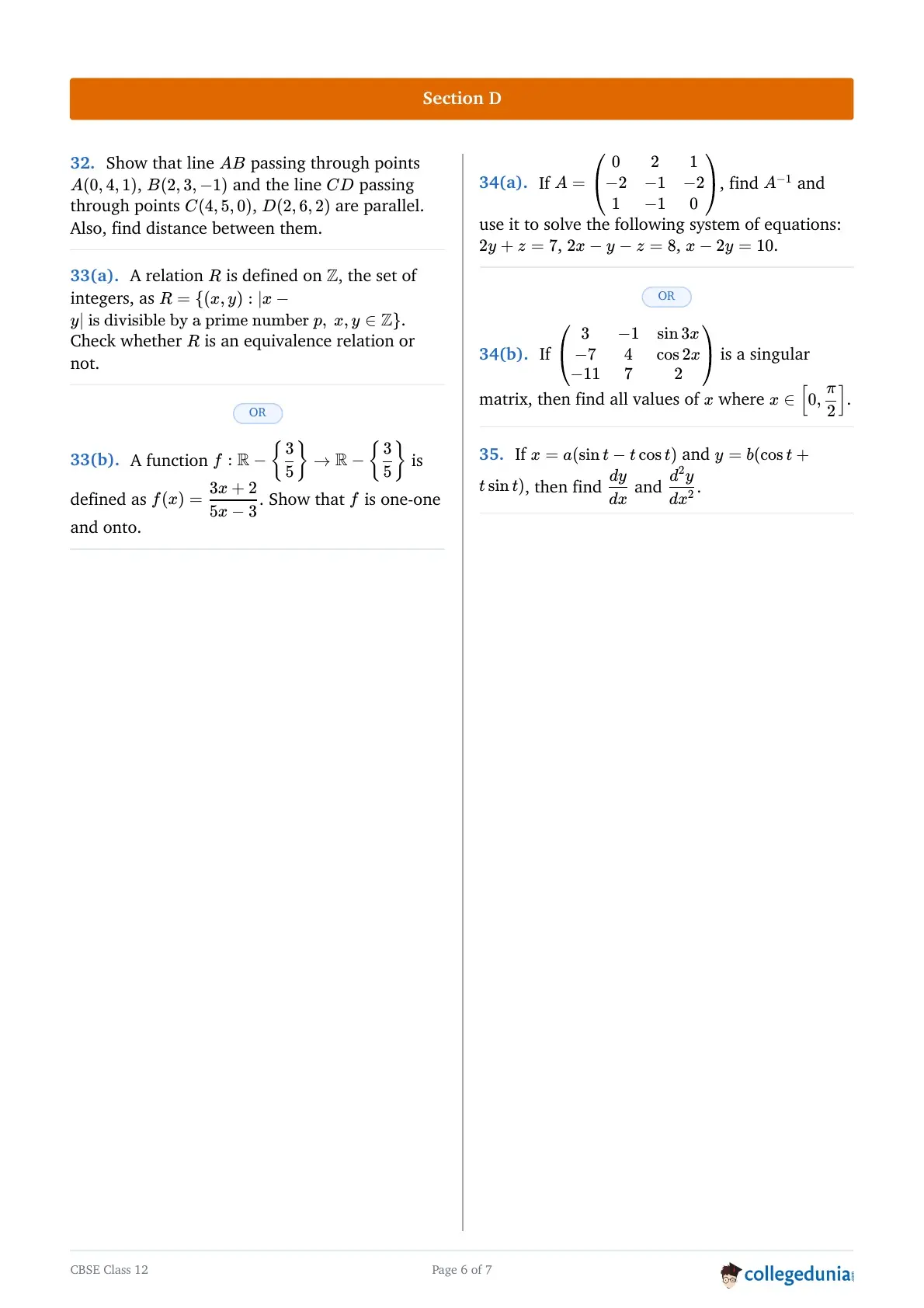
Show that line \( AB \) passing through points \( A(0, 4, 1), B(2, 3, -1) \) and the line \( CD \) passing through points \( C(4, 5, 0), D(2, 6, 2) \) are parallel. Also, find distance between them.
View Solution
Concept:
Direction Ratios (DRs): DRs of line through \( (x_1, y_1, z_1) \) and \( (x_2, y_2, z_2) \) are \( (x_2-x_1, y_2-y_1, z_2-z_1) \).
Parallel Lines: Two lines are parallel if their DRs are proportional.
Distance between parallel lines: \( d = \frac{|\vec{CP} \times \vec{d}|}{|\vec{d}|} \), where \( P \) is on line \( AB \), \( C \) is on line \( CD \), and \( \vec{d} \) is the direction vector.
Step 1: Determine the direction ratios of both lines
For line \( AB \): \( DRs = (2 - 0, 3 - 4, -1 - 1) = (2, -1, -2) \).
For line \( CD \): \( DRs = (2 - 4, 6 - 5, 2 - 0) = (-2, 1, 2) \).
Comparing the DRs: \[ \frac{2}{-2} = \frac{-1}{1} = \frac{-2}{2} = -1 \]
Since the DRs are proportional, the lines \( AB \) and \( CD \) are parallel.
Step 2: Set up vector quantities for distance calculation
Let point \( P = A(0, 4, 1) \) on line \( AB \).
Let point \( C = (4, 5, 0) \) on line \( CD \).
Vector \( \vec{CP} = (0 - 4)\hat{i} + (4 - 5)\hat{j} + (1 - 0)\hat{k} = -4\hat{i} - \hat{j} + \hat{k} \).
Direction vector of line \( CD \), \( \vec{b} = -2\hat{i} + \hat{j} + 2\hat{k} \).
Step 3: Calculate the distance
Cross product \( \vec{CP} \times \vec{b} \): \[ \vec{CP} \times \vec{b} = \begin{vmatrix} \hat{i} & \hat{j} & \hat{k} \\ -4 & -1 & 1 \\ -2 & 1 & 2 \end{vmatrix} = \hat{i}(-2 - 1) - \hat{j}(-8 + 2) + \hat{k}(-4 - 2) = -3\hat{i} + 6\hat{j} - 6\hat{k} \]
Magnitude \( |\vec{CP} \times \vec{b}| = \sqrt{(-3)^2 + 6^2 + (-6)^2} = \sqrt{9 + 36 + 36} = \sqrt{81} = 9 \).
Magnitude \( |\vec{b}| = \sqrt{(-2)^2 + 1^2 + 2^2} = \sqrt{4 + 1 + 4} = 3 \).
\[ Distance = \frac{|\vec{CP} \times \vec{b}|}{|\vec{b}|} = \frac{9}{3} = 3 units \] Quick Tip: Parallel lines have direction ratios \( a, b, c \) and \( ka, kb, kc \).
Distance can also be found using the projection method: \( \sqrt{|\vec{CP}|^2 - (proj_{\vec{b}}\vec{CP})^2} \).
A relation \(R\) is defined on \(Z\), the set of integers, as \[ R = \{(x,y) : |x-y| is divisible by a prime number 'p', x,y \in Z\}. \]
Check whether \(R\) is an equivalence relation or not.
View Solution
Concept:
Equivalence Relation: A relation is an equivalence relation if it is reflexive, symmetric, and transitive.
Divisibility: \( a \) is divisible by \( p \) if \( a = kp \) for some integer \( k \).
Step 1: Check for Reflexivity
For any \( x \in Z \), \( |x - x| = 0 \).
Since \( 0 = 0 \cdot p \), where \( 0 \) is an integer, \( 0 \) is divisible by \( p \).
Thus, \( (x, x) \in R \). \( R \) is reflexive.
Step 2: Check for Symmetry
Let \( (x, y) \in R \). Then \( |x - y| \) is divisible by \( p \).
Since \( |x - y| = |y - x| \), it follows that \( |y - x| \) is also divisible by \( p \).
Thus, \( (y, x) \in R \). \( R \) is symmetric.
Step 3: Check for Transitivity
Let \( (x, y) \in R \) and \( (y, z) \in R \).
Then \( |x - y| = k_1 p \) and \( |y - z| = k_2 p \) for integers \( k_1, k_2 \geq 0 \).
This implies \( x - y = \pm k_1 p \) and \( y - z = \pm k_2 p \).
Adding the equations: \( x - z = (x - y) + (y - z) = (\pm k_1 \pm k_2) p \).
Let \( K = \pm k_1 \pm k_2 \), which is an integer. Then \( x - z = Kp \).
Taking magnitude: \( |x - z| = |K| p \), which is divisible by \( p \).
Thus, \( (x, z) \in R \). \( R \) is transitive.
Since \( R \) is reflexive, symmetric, and transitive, it is an equivalence relation. Quick Tip: Modulo arithmetic rules: If \( a \equiv b \pmod{p} \) and \( b \equiv c \pmod{p} \), then \( a \equiv c \pmod{p} \).
0 is divisible by every non-zero integer.
A function \( f : R - \{3/5\} \to R - \{3/5\} \) is defined as \( f(x) = \frac{3x + 2}{5x - 3} \). Show that \( f \) is one-one and onto.
View Solution
Concept:
One-one (Injective): \( f(x_1) = f(x_2) \implies x_1 = x_2 \).
Onto (Surjective): For every \( y \) in the codomain, there exists an \( x \) in the domain such that \( f(x) = y \).
Step 1: Verify if the function is one-one
Let \( f(x_1) = f(x_2) \): \[ \frac{3x_1 + 2}{5x_1 - 3} = \frac{3x_2 + 2}{5x_2 - 3} \]
Cross-multiplying: \[ (3x_1 + 2)(5x_2 - 3) = (3x_2 + 2)(5x_1 - 3) \] \[ 15x_1x_2 - 9x_1 + 10x_2 - 6 = 15x_1x_2 - 9x_2 + 10x_1 - 6 \] \[ -9x_1 + 10x_2 = -9x_2 + 10x_1 \] \[ 19x_2 = 19x_1 \implies x_1 = x_2 \]
Thus, \( f \) is one-one.
Step 2: Verify if the function is onto
Let \( y = f(x) = \frac{3x + 2}{5x - 3} \). We need to express \( x \) in terms of \( y \): \[ y(5x - 3) = 3x + 2 \] \[ 5xy - 3y = 3x + 2 \] \[ 5xy - 3x = 3y + 2 \implies x(5y - 3) = 3y + 2 \] \[ x = \frac{3y + 2}{5y - 3} \]
Since the codomain is \( R - \{3/5\} \), \( y \neq 3/5 \), so \( 5y - 3 \neq 0 \).
For any \( y \in R - \{3/5\} \), \( x \) is a real number.
Also, if \( x = 3/5 \), then \( 3(3/5) + 2 = y(5(3/5) - 3) \implies 1.8 + 2 = y(0) \), which is impossible. So \( x \in R - \{3/5\} \).
Thus, every \( y \) has a pre-image, and the function is onto. Quick Tip: For rational functions \( \frac{ax+b}{cx+d} \), if \( ad - bc \neq 0 \), the function is always one-one.
The horizontal asymptote \( y = a/c \) is always excluded from the range of such functions.
If \( A = \begin{bmatrix} 0 & 2 & 1 \\ -2 & -1 & -2 \\ 1 & -1 & 0 \end{bmatrix} \), find \( A^{-1} \) and use it to solve the following system of equations :
\( -2y + z = 7, 2x - y - z = 8, x - 2y = 10 \)
View Solution
Concept:
Matrix Inverse: \( A^{-1} = \frac{1}{|A|} adj(A) \).
System Solution: \( X = A^{-1}B \).
Step 1: Calculate the determinant \( |A| \)
\[ |A| = 0(-1 - 2) - 2(0 - (-2)) + 1(2 - (-1)) \] \[ |A| = 0 - 2(2) + 1(3) = -4 + 3 = -1 \]
Since \( |A| \neq 0 \), \( A^{-1} \) exists.
Step 2: Find the adjoint of \( A \)
Cofactors:
\( A_{11}=-1, A_{12}=-2, A_{13}=3, A_{21}=-1, A_{22}=-1, A_{23}=2, A_{31}=-3, A_{32}=-2, A_{33}=4 \) \[ adj(A) = \begin{bmatrix} -1 & -2 & 3 \\ -1 & -1 & 2 \\ -3 & -2 & 4 \end{bmatrix}^T = \begin{bmatrix} -1 & -1 & -3 \\ -2 & -1 & -2 \\ 3 & 2 & 4 \end{bmatrix} \] \[ A^{-1} = \frac{1}{-1} \begin{bmatrix} -1 & -1 & -3 \\ -2 & -1 & -2 \\ 3 & 2 & 4 \end{bmatrix} = \begin{bmatrix} 1 & 1 & 3 \\ 2 & 1 & 2 \\ -3 & -2 & -4 \end{bmatrix} \]
Step 3: Solve the system
Note the system matrix \( C = \begin{bmatrix} 0 & -2 & 1 \\ 2 & -1 & -1 \\ 1 & -2 & 0 \end{bmatrix} \). This is \( A^T \).
Since \( (A^T)^{-1} = (A^{-1})^T \), we use the transpose of \( A^{-1} \). \[ \begin{bmatrix} x \\ y \\ z \end{bmatrix} = \begin{bmatrix} 1 & 2 & -3 \\ 1 & 1 & -2 \\ 3 & 2 & -4 \end{bmatrix} \begin{bmatrix} 7 \\ 8 \\ 10 \end{bmatrix} = \begin{bmatrix} 7 + 16 - 30 \\ 7 + 8 - 20 \\ 21 + 16 - 40 \end{bmatrix} = \begin{bmatrix} -7 \\ -5 \\ -3 \end{bmatrix} \]
Solution: \( x = -7, y = -5, z = -3 \). Quick Tip: Always check if the coefficients of the system match the matrix \( A \) or its transpose \( A^T \).
\( (A^T)^{-1} = (A^{-1})^T \).
If \( \begin{bmatrix} 3 & -1 & \sin 3x \\ -7 & 4 & \cos 2x \\ -11 & 7 & 2 \end{bmatrix} \) is a singular matrix, then find all values of \( x \) where \( x \in [0, \pi/2] \).
View Solution
Concept:
Singular Matrix: A matrix whose determinant is zero.
Trigonometric Identities: \( \sin 3x = 3\sin x - 4\sin^3 x, \cos 2x = 1 - 2\sin^2 x \).
Step 1: Expand the determinant and set it to zero
\[ 3(8 - 7\cos 2x) - (-1)(-14 + 11\cos 2x) + \sin 3x(-49 + 44) = 0 \] \[ 24 - 21\cos 2x - 14 + 11\cos 2x - 5\sin 3x = 0 \] \[ 10 - 10\cos 2x - 5\sin 3x = 0 \implies 2 - 2\cos 2x - \sin 3x = 0 \]
Step 2: Substitute identities and simplify
\[ 2 - 2(1 - 2\sin^2 x) - (3\sin x - 4\sin^3 x) = 0 \] \[ 2 - 2 + 4\sin^2 x - 3\sin x + 4\sin^3 x = 0 \] \[ 4\sin^3 x + 4\sin^2 x - 3\sin x = 0 \]
Step 3: Solve the equation
\[ \sin x (4\sin^2 x + 4\sin x - 3) = 0 \]
\( \sin x = 0 \implies x = 0 \in [0, \pi/2] \).
\( 4\sin^2 x + 4\sin x - 3 = 0 \implies (2\sin x - 1)(2\sin x + 3) = 0 \).
\( \sin x = 1/2 \implies x = \pi/6 \in [0, \pi/2] \).
\( \sin x = -3/2 \) (Impossible).
The values of \( x \) are \( 0 \) and \( \pi/6 \). Quick Tip: For singular matrices, \( |A| = 0 \).
When solving trigonometric equations, always filter solutions based on the given interval \( [0, \pi/2] \).
If \( x = a(\sin t - t \cos t) \) and \( y = b(\cos t + t \sin t) \), then find \( \frac{dy}{dx} \) and \( \frac{d^2y}{dx^2} \).
View Solution
Concept:
Parametric Differentiation: \( \frac{dy}{dx} = \frac{dy/dt}{dx/dt} \).
Second Order Parametric Differentiation: \( \frac{d^2y}{dx^2} = \frac{d}{dt} \left( \frac{dy}{dx} \right) \cdot \frac{dt}{dx} \).
Step 1: Find \( \frac{dx}{dt} \) and \( \frac{dy}{dt} \)
\[ \frac{dx}{dt} = a(\cos t - (\cos t - t \sin t)) = a t \sin t \]
\[ \frac{dy}{dt} = b(-\sin t + (\sin t + t \cos t)) = b t \cos t \]
Step 2: Calculate \( \frac{dy}{dx} \)
\[ \frac{dy}{dx} = \frac{b t \cos t}{a t \sin t} = \frac{b}{a} \cot t \]
Step 3: Find the second derivative
\[ \frac{d^2y}{dx^2} = \frac{d}{dt} \left( \frac{b}{a} \cot t \right) \frac{dt}{dx} \] \[ \frac{d^2y}{dx^2} = -\frac{b}{a} \csc^2 t \cdot \frac{1}{at \sin t} \] \[ \frac{d^2y}{dx^2} = -\frac{b}{a^2 t \sin^3 t} \] Quick Tip: Don't forget the \( \frac{dt}{dx} \) factor when finding the second derivative of parametric functions.
Product rule is essential when differentiating terms like \( t \cos t \) or \( t \sin t \).
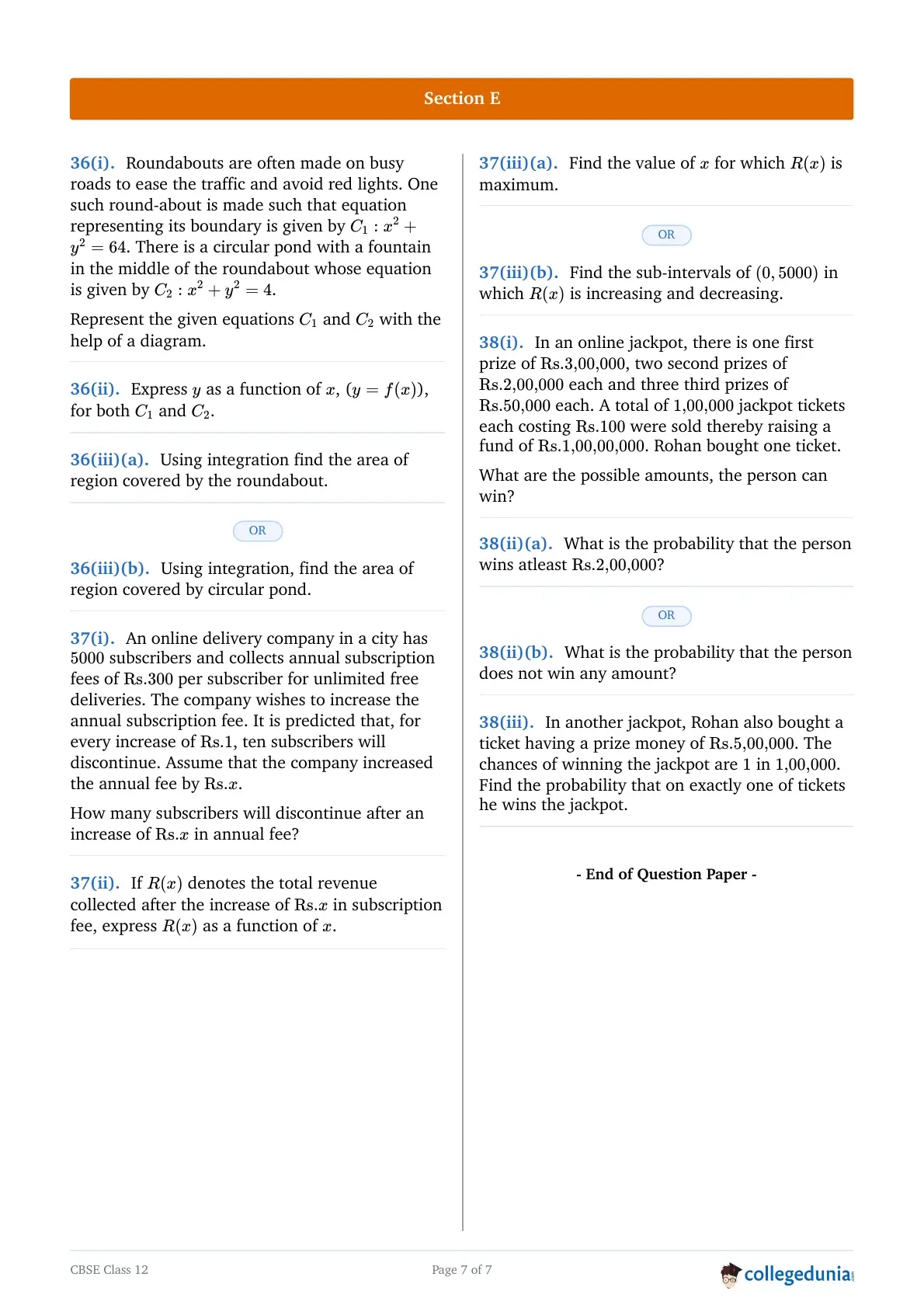
Roundabouts are often made on busy roads to ease the traffic and avoid red lights.
One such round-about is made such that the equation representing its boundary is given by \( C_1 : x^2 + y^2 = 64 \).
There is a circular pond with a fountain in the middle of the roundabout whose equation is given by \( C_2 : x^2 + y^2 = 4 \).
Based on the given information
Represent the given equations \( C_1 \) and \( C_2 \) with the help of a diagram.
View Solution
Concept:
A circle with its center at the origin \( (0, 0) \) and radius \( r \) is represented by the equation \( x^2 + y^2 = r^2 \).
Concentric circles are circles that share the same center but have different radii.
Step 1: Identify the center and radius for the boundary circle \( C_1 \)
The equation for \( C_1 \) is: \[ x^2 + y^2 = 64 \]
Comparing this with the standard form \( x^2 + y^2 = r^2 \): \[ r_1^2 = 64 \implies r_1 = 8 units \]
The center is at the origin \( (0, 0) \).
Step 2: Identify the center and radius for the pond circle \( C_2 \)
The equation for \( C_2 \) is: \[ x^2 + y^2 = 4 \]
Comparing this with the standard form: \[ r_2^2 = 4 \implies r_2 = 2 units \]
The center is also at the origin \( (0, 0) \).
Step 3: Draw the diagram showing concentric circles
Since both circles have the same center, they are concentric.
The pond \( C_2 \) is located inside the roundabout boundary \( C_1 \).
Quick Tip: For any circle \( x^2 + y^2 = a^2 \), the x-intercepts are \( (\pm a, 0) \) and the y-intercepts are \( (0, \pm a) \).
Concentric circles never intersect because their radii are different while their center is the same.
Express \( y \) as a function of \( x \), (\( y = f(x) \)), for both \( C_1 \) and \( C_2 \).
View Solution
Concept:
To express \( y \) as a function of \( x \), we isolate the \( y \) variable on one side of the equation.
A circle \( x^2 + y^2 = r^2 \) can be split into two functions: \( y = \sqrt{r^2 - x^2} \) (upper semicircle) and \( y = -\sqrt{r^2 - x^2} \) (lower semicircle).
Step 1: Derive the function for the boundary circle \( C_1 \)
The equation for \( C_1 \) is: \[ x^2 + y^2 = 64 \]
Subtract \( x^2 \) from both sides: \[ y^2 = 64 - x^2 \]
Taking the square root: \[ y = \pm \sqrt{64 - x^2} \]
Considering the upper part of the circle to represent it as a function: \[ f_1(x) = \sqrt{64 - x^2} \]
Step 2: Derive the function for the pond circle \( C_2 \)
The equation for \( C_2 \) is: \[ x^2 + y^2 = 4 \]
Subtract \( x^2 \) from both sides: \[ y^2 = 4 - x^2 \]
Taking the square root: \[ y = \pm \sqrt{4 - x^2} \]
Considering the upper part: \[ f_2(x) = \sqrt{4 - x^2} \] Quick Tip: Mathematically, a full circle is a relation and fails the vertical line test. We use the positive root to represent the upper boundary as a function.
The domain for \( C_1 \) is \( [-8, 8] \) and for \( C_2 \) is \( [-2, 2] \).
Using integration, find the area of the region covered by the roundabout.
View Solution
Concept:
The total area of a circle \( x^2 + y^2 = r^2 \) is four times the area in the first quadrant.
Area in the first quadrant = \( \int_{0}^{r} y \, dx \).
Standard Integral: \( \int \sqrt{a^2 - x^2} \, dx = \frac{x}{2}\sqrt{a^2 - x^2} + \frac{a^2}{2}\sin^{-1}\left(\frac{x}{a}\right) + C \).
Step 1: Set up the integral for the total area of circle \( C_1 \)
The radius is \( r = 8 \). The total area \( A_1 \) is given by: \[ A_1 = 4 \int_{0}^{8} \sqrt{64 - x^2} \, dx \]
Step 2: Apply the integration formula
Using the standard formula with \( a = 8 \): \[ A_1 = 4 \left[ \frac{x}{2}\sqrt{64 - x^2} + \frac{64}{2}\sin^{-1}\left(\frac{x}{8}\right) \right]_{0}^{8} \]
Step 3: Evaluate the definite integral with limits
Substituting the upper limit \( x = 8 \):
\[ \left( \frac{8}{2}\sqrt{64 - 64} + 32\sin^{-1}(1) \right) = 0 + 32 \cdot \frac{\pi}{2} = 16\pi \]
Substituting the lower limit \( x = 0 \):
\[ \left( \frac{0}{2}\sqrt{64 - 0} + 32\sin^{-1}(0) \right) = 0 + 0 = 0 \]
Step 4: Final multiplication
\[ A_1 = 4 \times (16\pi - 0) \] \[ A_1 = 64\pi sq. units \] Quick Tip: Always verify integration results for circles using the geometric formula \( \pi r^2 \).
The factor 4 accounts for symmetry across the x and y axes.
Using integration, find the area of the region covered by the circular pond.
View Solution
Concept:
The pond is bounded by \( C_2 : x^2 + y^2 = 4 \).
It is a circle with center at origin and radius \( r = 2 \).
Area = \( 4 \times \int_{0}^{r} \sqrt{r^2 - x^2} \, dx \).
Step 1: Set up the integral for circle \( C_2 \)
With radius \( r = 2 \): \[ A_2 = 4 \int_{0}^{2} \sqrt{4 - x^2} \, dx \]
Step 2: Apply the integration formula
Using the standard formula with \( a = 2 \): \[ A_2 = 4 \left[ \frac{x}{2}\sqrt{4 - x^2} + \frac{4}{2}\sin^{-1}\left(\frac{x}{2}\right) \right]_{0}^{2} \]
Step 3: Evaluate the definite integral
Substituting the upper limit \( x = 2 \): \[ \left( \frac{2}{2}\sqrt{4 - 4} + 2\sin^{-1}(1) \right) = 0 + 2 \cdot \frac{\pi}{2} = \pi \]
Substituting the lower limit \( x = 0 \): \[ \left( 0 + 2\sin^{-1}(0) \right) = 0 \]
Step 4: Final multiplication
\[ A_2 = 4 \times (\pi - 0) \] \[ A_2 = 4\pi sq. units \] Quick Tip: Integration is the standard tool for finding areas of regions with curved boundaries.
For a circle of radius \( r \), the integration result \( \int_{0}^{r} \sqrt{r^2 - x^2} \, dx \) always yields \( \frac{\pi r^2}{4} \).
An online delivery company in a city has 5000 subscribers and collects annual subscription fees of Rs 300 per subscriber for unlimited free deliveries.
The company wishes to increase the annual subscription fee. It is predicted that, for every increase of Rs 1, ten subscribers will discontinue.
Assume that the company increased the annual fee by Rs x.
Based on the given information
How many subscribers will discontinue after an increase of Rs x in annual fee ?
View Solution
Concept:
The rate of decrease in the number of subscribers is constant with respect to the increase in fee.
If \( k \) subscribers discontinue for every Rs 1 increase, then for an increase of Rs \( x \), \( k \cdot x \) subscribers will discontinue.
Step 1: Identify the rate of discontinuation
According to the problem, for every Rs 1 increase in the annual subscription fee, the number of subscribers that discontinue is 10.
\[ Rate of discontinuation = 10 subscribers / Rs 1 increase \]
Step 2: Calculate the total discontinued subscribers for Rs x increase
If the fee is increased by Rs \( x \), the total number of subscribers who will discontinue is given by the product of the rate and the amount of increase.
\[ Number of discontinued subscribers = 10 \times x = 10x \] Quick Tip: Always establish the relationship between the independent variable (fee increase) and the dependent variable (number of subscribers).
Linear relationships are of the form \( y = mx + c \). Here, the change in \( y \) is \( mx \).
If \( R(x) \) denotes the total revenue collected after the increase of Rs x in subscription fee, express \( R(x) \) as a function of x.
View Solution
Concept:
Total Revenue (\( R \)) = (Number of Subscribers) \(\times\) (Subscription Fee per subscriber).
New Fee = Original Fee + Increase (\( x \)).
New Number of Subscribers = Original Number - Discontinued Subscribers.
Step 1: Determine the new fee per subscriber
Original annual subscription fee = Rs 300.
Increase in fee = Rs \( x \). \[ New Fee = (300 + x) \]
Step 2: Determine the new number of subscribers
Original number of subscribers = 5000.
Number of subscribers who discontinue = \( 10x \). \[ Remaining Subscribers = (5000 - 10x) \]
Step 3: Formulate the revenue function \( R(x) \)
\[ R(x) = New Fee \times Remaining Subscribers \] \[ R(x) = (300 + x)(5000 - 10x) \] \[ R(x) = 1500000 - 3000x + 5000x - 10x^2 \] \[ R(x) = -10x^2 + 2000x + 1500000 \] Quick Tip: Revenue functions in such problems are usually quadratic.
Ensure units are consistent; here both the original fee and the increase are in Rupees.
Find the value of x for which \( R(x) \) is maximum.
View Solution
Concept:
To maximize a function, find its first derivative and set it to zero (\( R'(x) = 0 \)) to find critical points.
Use the second derivative test (\( R''(x) < 0 \)) to confirm a local maximum.
Step 1: Find the first derivative of \( R(x) \)
From the previous part: \[ R(x) = -10x^2 + 2000x + 1500000 \]
Differentiating with respect to \( x \): \[ R'(x) = \frac{d}{dx}(-10x^2 + 2000x + 1500000) \] \[ R'(x) = -20x + 2000 \]
Step 2: Solve for the critical point
Set \( R'(x) = 0 \) to find the value of \( x \): \[ -20x + 2000 = 0 \] \[ 20x = 2000 \] \[ x = \frac{2000}{20} = 100 \]
Step 3: Verify the maximum using the second derivative
Differentiating \( R'(x) \) again: \[ R''(x) = \frac{d}{dx}(-20x + 2000) = -20 \]
Since \( R''(100) = -20 \), which is less than 0, the function \( R(x) \) is maximized at \( x = 100 \). Quick Tip: For a quadratic function \( ax^2 + bx + c \), the maximum/minimum occurs at \( x = -b/(2a) \).
Here, \( x = -2000 / (2 \times -10) = 100 \).
Find the sub-intervals of (0, 5000) in which \( R(x) \) is increasing and decreasing.
View Solution
Concept:
A function is increasing on an interval if its first derivative is positive (\( R'(x) > 0 \)).
A function is decreasing on an interval if its first derivative is negative (\( R'(x) < 0 \)).
Step 1: Identify the first derivative and the boundary of the domain
We found \( R'(x) = -20x + 2000 \).
The total subscribers cannot be negative: \( 5000 - 10x \geq 0 \implies x \leq 500 \).
Thus, the practical domain for the increase \( x \) is \( [0, 500] \). The question specifies a broader range (0, 5000), but we analyze based on the derivative sign.
Step 2: Find the interval where \( R(x) \) is increasing
Set \( R'(x) > 0 \):
\[ -20x + 2000 > 0 \] \[ 2000 > 20x \implies x < 100 \]
So, \( R(x) \) is increasing in the interval \( (0, 100) \).
Step 3: Find the interval where \( R(x) \) is decreasing
Set \( R'(x) < 0 \):
\[ -20x + 2000 < 0 \] \[ 2000 < 20x \implies x > 100 \]
So, \( R(x) \) is decreasing in the interval \( (100, 5000) \). Note: realistically, it stops at \( x=500 \). Quick Tip: The turning point of the parabola marks the boundary between the increasing and decreasing intervals.
Since the parabola opens downwards (\( a = -10 \)), it increases before the peak and decreases after.
In an online jackpot, there is one first prize of Rs 3,00,000, two second prizes of Rs 2,00,000 each and three third prizes of Rs 50,000 each.
A total of 1,00,000 jackpot tickets each costing Rs 100 were sold there by raising a fund of Rs 1,00,00,000.
Rohan bought one ticket.
What are the possible amounts, the person can win ?
View Solution
Concept:
The possible outcomes for a single ticket holder correspond to the various prize tiers available or winning no prize at all.
Step 1: List the available prize amounts
From the problem description, the different prize amounts are:
First Prize: Rs 3,00,000
Second Prize: Rs 2,00,000
Third Prize: Rs 50,000
Step 2: Account for the possibility of not winning
Since there are only \( 1 + 2 + 3 = 6 \) winning tickets out of 1,00,000, it is possible for a person to not win any prize. In this case, the amount won is Rs 0.
Step 3: Combine all possible amounts
The set of possible winning amounts is:
\[ \{Rs 3,00,000, Rs 2,00,000, Rs 50,000, Rs 0\} \] Quick Tip: In discrete probability distributions, always include the zero outcome if the number of prizes is less than the total number of entries.
What is the probability that the person wins atleast Rs 2,00,000 ?
View Solution
Concept:
"At least Rs 2,00,000" means the person wins either a first prize (Rs 3,00,000) or a second prize (Rs 2,00,000).
Probability \( P(E) = \frac{Number of favorable outcomes}{Total number of outcomes} \).
Step 1: Identify the total number of outcomes
The total number of tickets sold is:
\[ N = 1,00,000 \]
Step 2: Identify the number of favorable outcomes
Number of first prize tickets = 1.
Number of second prize tickets = 2.
Total winning tickets for at least Rs 2,00,000: \[ n = 1 + 2 = 3 \]
Step 3: Calculate the probability
\[ P(at least Rs 2,00,000) = \frac{n}{N} \] \[ P = \frac{3}{1,00,000} \] \[ P = 0.00003 \] Quick Tip: When a question says "at least", sum the counts of all tiers meeting or exceeding that value.
Ensure you count all individual prizes (e.g., two second prizes count as 2 successful outcomes).
What is the probability that the person does not win any amount ?
View Solution
Concept:
The event "not winning any amount" is the complement of "winning any prize".
\( P(Not Win) = 1 - P(Win any prize) \).
Step 1: Calculate the total number of winning tickets
Number of 1st prizes = 1.
Number of 2nd prizes = 2.
Number of 3rd prizes = 3.
Total winning tickets: \[ Win = 1 + 2 + 3 = 6 \]
Step 2: Calculate the number of non-winning tickets
Total tickets = 1,00,000.
Non-winning tickets: \[ Non-Win = 1,00,000 - 6 = 99,994 \]
Step 3: Calculate the probability
\[ P(Not Win) = \frac{99,994}{1,00,000} \] \[ P = 0.99994 \]
Alternatively, using the complement: \[ P = 1 - \frac{6}{1,00,000} = 1 - 0.00006 = 0.99994 \] Quick Tip: Using the complement rule \( 1 - P(E) \) is often safer than counting large numbers of non-favorable outcomes.
In another jackpot, Rohan also bought a ticket having a prize money of Rs 5,00,000. The chances of winning this jackpot are 1 in 1,00,000.
Find the probability that on exactly one of tickets he wins the jackpot.
View Solution
Concept:
This involves two independent events, \( A \) (winning any prize in the first jackpot) and \( B \) (winning the second jackpot).
Probability of exactly one = \( P(A \cap B') + P(A' \cap B) \).
Since events are independent, \( P(A \cap B') = P(A) \times P(B') \).
Step 1: Find individual probabilities of winning
For Jackpot 1 (event \( A \)): Total winning tickets = 6. \[ P(A) = \frac{6}{1,00,000} \]
For Jackpot 2 (event \( B \)): \[ P(B) = \frac{1}{1,00,000} \]
Step 2: Find probabilities of not winning
\[ P(A') = 1 - \frac{6}{1,00,000} = \frac{99,994}{1,00,000} \] \[ P(B') = 1 - \frac{1}{1,00,000} = \frac{99,999}{1,00,000} \]
Step 3: Apply the formula for exactly one success
\[ P(Exactly one) = P(A)P(B') + P(A')P(B) \] \[ P = \left( \frac{6}{10^5} \times \frac{99,999}{10^5} \right) + \left( \frac{99,994}{10^5} \times \frac{1}{10^5} \right) \] \[ P = \frac{599,994 + 99,994}{10^{10}} = \frac{699,988}{10^{10}} \] \[ P \approx \frac{7}{10^5} = 0.00007 (approximately) \] Quick Tip: For very small probabilities, \( P(A)P(B') + P(A')P(B) \) is approximately \( P(A) + P(B) \). Always treat separate lotteries/jackpots as independent events unless specified otherwise.
CBSE Class 12 Mathematics Chapter-Wise Weightage
| S.No | Units | Marks |
|---|---|---|
| I | Relations and Functions | 08 |
| II | Algebra | 10 |
| III | Calculus | 35 |
| IV | Vectors and Three-Dimensional Geometry | 14 |
| V | Linear Programming | 05 |
| VI | Probability | 08 |
| Total (Theory) | 80 | |
| Internal Assessment | 20 |





Comments